


TL;DR:
- Eco labels in hotel textiles verify safety, organic fiber content, and supply chain ethics to meet guest and sustainability expectations. Hotels must verify product-specific certifications, incorporate end-of-life recycling clauses, and communicate credentials to enhance guest trust and brand reputation. Building supplier partnerships centered on durability, transparency, and circularity ensures genuine sustainability and competitive advantage.
Eco labels in hotel textiles are third-party certifications that verify chemical safety, organic fiber content, and ethical supply chain practices across every product a guest touches. The role of eco labels in hotel textiles extends well beyond compliance. Standards like OEKO-TEX Standard 100 and the Global Organic Textile Standard (GOTS) now directly shape procurement decisions, guest health outcomes, and a hotel’s credibility with sustainability-conscious travelers. With 93% of travelers expressing a preference for sustainable accommodation, eco-labeled textiles have moved from a niche preference to a baseline expectation in hospitality.
What are the main types of eco labels in hotel textiles?
Two certifications define the green certifications landscape for hotel textiles: OEKO-TEX Standard 100 and GOTS. They serve different purposes, and confusing them is one of the most common procurement mistakes hotel managers make.

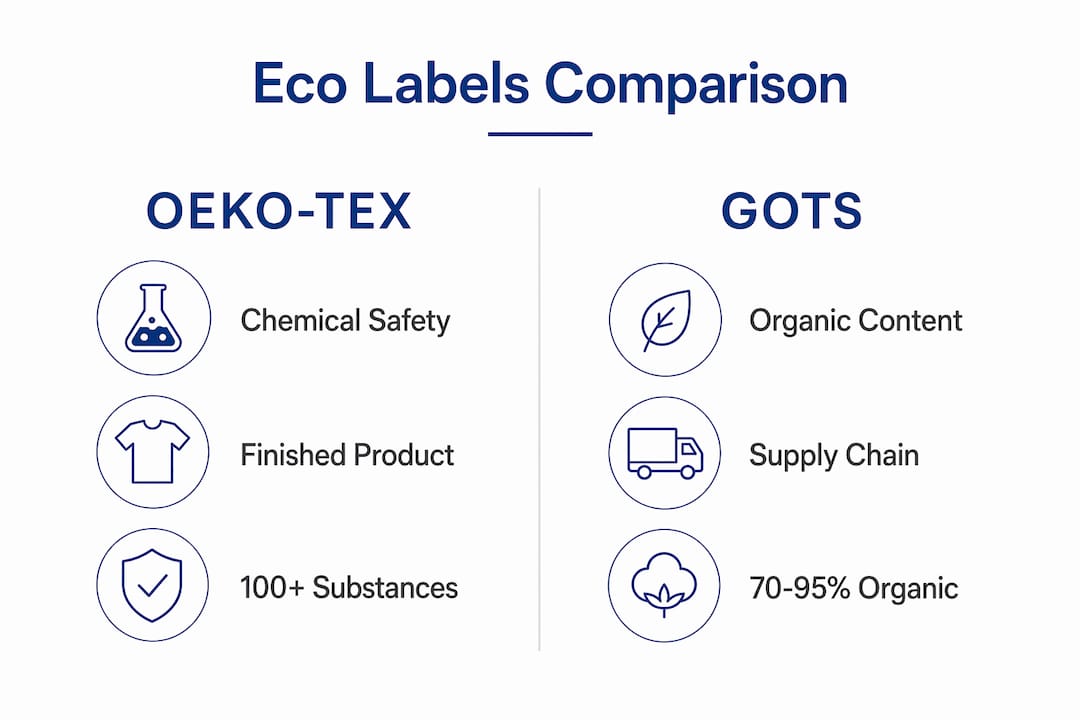
OEKO-TEX Standard 100 is a product safety label. It tests finished textiles for more than 100 harmful substances, including pesticides, heavy metals, and formaldehyde. A sheet or towel carrying this label guarantees that the finished item poses no chemical risk to guests. It says nothing, however, about how the cotton was grown or whether workers were paid fairly.
GOTS is a supply chain label. It requires a minimum of 70% organic fiber for a product to carry the label, and up to 95% organic fiber content for a product to be labeled “organic.” GOTS also mandates environmental processing standards and social compliance audits at every stage of production. That means the certification covers the farm, the spinning mill, the dyeing facility, and the finished goods manufacturer.
How the two labels compare in practice
| Criteria | OEKO-TEX Standard 100 | GOTS |
|---|---|---|
| What it certifies | Chemical safety of finished product | Organic fiber content and supply chain ethics |
| Minimum organic content | Not required | 70% (label) or 95% (organic) |
| Supply chain scope | Finished product only | Farm to finished goods |
| Social compliance | Not included | Required at every stage |
| Best used for | Guest safety assurance | Full sustainability claims |
The practical implication is clear. A hotel that wants to protect guests from chemical exposure needs OEKO-TEX. A hotel that wants to make credible sustainability claims about its eco-friendly hotel bedding needs GOTS. The strongest procurement position combines both, because distinguishing product safety from process sustainability prevents greenwashing and costly compliance gaps.
Pro Tip: Request product-level certificates, not brand-level claims. A supplier may hold a GOTS certificate for one product line while the rest of their catalog carries no certification at all.
Why do eco labels matter beyond compliance for hotels?
Eco labels deliver measurable business value across three areas: guest health, brand reputation, and competitive positioning. Each deserves a direct look.
Guest health is the most immediate benefit. Textiles treated with synthetic dyes, optical brighteners, or chemical softeners can cause skin irritation, especially for guests with sensitive skin or allergies. OEKO-TEX Standard 100 eliminates that risk. Clear communication of certification resonates directly with health-conscious guests and translates into positive reviews. A guest who notices an eco-label card on the pillow does not just feel reassured. They feel respected.
Brand reputation follows from transparency. Hotels that display eco credentials in room materials, on their website, and in booking platforms signal a genuine commitment rather than a marketing slogan. This matters because sustainability is now a factor in corporate travel programs. Companies with active ESG reporting requirements direct their employees toward hotels that can document environmental standards. Eco-labeled textiles feed directly into that documentation.
The competitive advantage is real and growing. Consider these specific benefits:
- Guest loyalty: Guests who trust a hotel’s environmental claims return more often and recommend the property more actively.
- Review scores: Visible sustainability efforts, including eco-label transparency, correlate with higher guest satisfaction scores.
- ESG reporting: Certified textiles provide documented evidence for sustainability disclosures required by investors and corporate clients.
- Hospitality certifications: Programs like Green Key and EarthCheck award points for certified textile procurement, supporting broader property-level accreditation.
“Eco labels are not just a purchasing filter. They are a communication tool. When a hotel can show guests exactly what standard its linens meet, that transparency becomes a loyalty driver that no marketing campaign can replicate.”
Textile sustainability in hospitality is no longer a differentiator for luxury properties alone. Mid-scale and budget hotels are adopting certified textiles because the cost of not doing so, in lost bookings and reputational risk, now outweighs the cost premium of certification.
How do circular economy models change eco labeling in hotels?
The importance of eco labels does not end at the point of purchase. The full lifecycle of a hotel textile, from raw fiber to industrial laundry to end-of-life disposal, determines whether a sustainability claim holds up under scrutiny.
Circular textile models are gaining traction in hospitality. Circular approaches incorporate at least 20% post-consumer raw material into hotel textiles, enabling sustainable sourcing without sacrificing the durability that hotel operations demand. That 20% benchmark signals a shift from linear purchasing to closed-loop supply chains where used textiles re-enter production rather than going to landfill.
Industrial laundering is where many sustainability claims break down. A certified organic cotton sheet that degrades after 80 wash cycles delivers less environmental value than a conventionally produced sheet that lasts 300 cycles. Eco-labeled textiles engineered for longevity maximize genuine environmental benefit because they reduce replacement frequency and the associated resource consumption. Hotel managers should request wash-cycle performance data alongside certification documents when evaluating suppliers.
Supplier contracts and data systems
The contract is where circular commitments become real. Hotel linen is often overlooked in ESG reporting, and without take-back and recycling clauses in supplier agreements, circular design remains a theoretical aspiration. A well-structured contract specifies what happens to textiles at end of life, who bears the cost of recycling, and how sustainability data gets reported.
RFID tagging and digital tracking systems add another layer of accountability. Hotels using RFID on linen inventory can track wash cycles per item, identify early-degrading products, and generate data for ESG reports. This shifts procurement from a one-time transaction to an ongoing performance measurement. The textile procurement guide for hospitality managers covers how to structure these supplier relationships for long-term operational consistency.
Pro Tip: When negotiating supplier contracts, include a clause requiring the supplier to accept returned textiles at end of life and provide documented recycling confirmation. Without this clause, your circular economy commitment stops at the loading dock.
What steps should hotel managers take when sourcing eco-labeled textiles?
Sourcing certified textiles requires more than checking a label on a product sheet. The verification process, the contract structure, and the guest communication strategy all determine whether the investment delivers real value.
-
Verify certificates at the product level. Always verify the current certificate in the official GOTS or OEKO-TEX database before signing a supply contract. A supplier’s general brand certification does not guarantee that a specific product line is certified. Request the certificate number and check it against the issuing body’s public registry.
-
Request complementary certifications. OEKO-TEX and GOTS address different risks. A hotel that sources only OEKO-TEX certified products protects guests from chemical exposure but cannot make organic or fair-labor claims. Sourcing products that carry both certifications provides a complete sustainability narrative.
-
Demand wash-cycle performance data. Durability under industrial washing conditions is a sustainability metric, not just an operational one. Ask suppliers for documented wash-cycle test results. A product rated for 300 industrial wash cycles at standard hotel temperatures delivers more environmental value than a certified product that degrades at 100 cycles.
-
Include take-back clauses in contracts. Linen procurement contracts must evolve from simple purchasing agreements to circular economy partnerships. Specify end-of-life responsibilities, recycling documentation requirements, and sustainability data reporting intervals in every supplier agreement.
-
Communicate certifications to guests. Place certification information in room folders, on your website, and in booking platform descriptions. Effectively communicating eco labels to guests builds trust and supports the hotel’s sustainability branding. A small card on the pillow explaining the OEKO-TEX certification takes 30 seconds to read and creates a lasting impression.
The importance of eco labels in hospitality procurement also extends to the sustainability programs offered by hospitality associations. Hotels pursuing Green Key or similar certifications gain points for documented certified textile sourcing, making the investment in eco-labeled products count twice.
Pro Tip: Build a certification tracker spreadsheet that logs each product’s certificate number, issuing body, expiry date, and wash-cycle rating. Review it at every contract renewal. Certificates expire, and an outdated certificate is as useful as no certificate.
Key Takeaways
Eco labels in hotel textiles deliver verified safety, supply chain accountability, and guest trust only when procurement, contract structure, and guest communication all align.
| Point | Details |
|---|---|
| OEKO-TEX vs. GOTS | OEKO-TEX certifies chemical safety; GOTS certifies organic content and supply chain ethics. Use both for complete coverage. |
| Durability is sustainability | Textiles engineered for 300+ industrial wash cycles deliver more environmental value than fragile certified products. |
| Contracts must include take-back | End-of-life recycling clauses make circular economy commitments real, not just aspirational. |
| Verify at the product level | Check certificate numbers in official databases before signing any supply contract. |
| Guest communication multiplies value | Displaying eco-label credentials in rooms and on booking platforms converts certification into loyalty and review scores. |
What I’ve learned about eco labels that most procurement guides skip
After years of observing how hotels approach textile sourcing, one pattern stands out. Hotels invest in certified products and then fail to extract any business value from that investment because they treat certification as a purchasing filter rather than a communication asset.
The second pattern is more damaging. Hotels accept brand-level sustainability claims from suppliers without verifying product-specific certificates. A supplier can hold a GOTS certificate for their premium line while their standard hotel range carries no certification at all. Verification must be shipment and product-specific, because general brand-level claims are insufficient and create real greenwashing risk.
The third pattern is the most forward-looking. The hotels that will lead on sustainability in the next five years are not the ones buying the most certified products. They are the ones building closed-loop supplier contracts that make suppliers responsible for textile end-of-life recycling. That shift, from purchasing to partnership, is where eco labeling in textiles becomes a genuine operational strategy rather than a marketing checkbox.
The future of textile sustainability in hospitality runs through durability data, take-back contracts, and transparent guest communication. Hotels that master all three will find that eco labels pay for themselves in loyalty, ESG compliance, and competitive positioning. Those that treat certification as a one-time purchase decision will keep paying the replacement cost, in both money and reputation.
— Xpert
Gjergjihtextil’s certified hotel textile solutions
Gjergjihtextil has supplied certified hotel textiles to international brands including Meliá, Marriott, and Sheraton for over 30 years. The company’s product range covers bed linens, towels, duvets, and pillows, all sourced and tested to meet the durability and safety standards that hotel operations require.

For hotel managers who need textiles that perform across hundreds of industrial wash cycles without losing certification compliance, Gjergjihtextil provides full procurement support, including documentation assistance and supplier advisory. The hotel textile catalog covers options across certification tiers, with guidance on matching the right product to your property’s sustainability reporting requirements. For broader sourcing strategy, the hotel textile selection guide covers cost, durability, and certification trade-offs in practical detail.
FAQ
What does OEKO-TEX Standard 100 certify in hotel textiles?
OEKO-TEX Standard 100 certifies that a finished textile product has been tested for more than 100 harmful substances, including pesticides and heavy metals, confirming it is safe for direct guest contact.
What is the difference between OEKO-TEX and GOTS for hotel procurement?
OEKO-TEX is a product safety label covering the finished item; GOTS is a supply chain label requiring at least 70% organic fiber content and social compliance audits at every production stage.
How do eco labels affect guest experience and hotel reviews?
Eco-labeled textiles reduce the risk of skin irritation from chemical residues, and clear communication of certification credentials correlates with higher guest satisfaction and positive reviews from health-conscious travelers.
Why does durability matter for eco-labeled hotel textiles?
A certified textile that degrades quickly under industrial laundering delivers less environmental value than a durable product. Hotels should request wash-cycle performance data to confirm that certified products maintain integrity across the full operational lifespan.
How should hotel managers verify supplier eco-label claims?
Verify the specific certificate number for each product line in the official GOTS or OEKO-TEX public database before signing any supply contract, since brand-level claims do not guarantee product-level certification.