

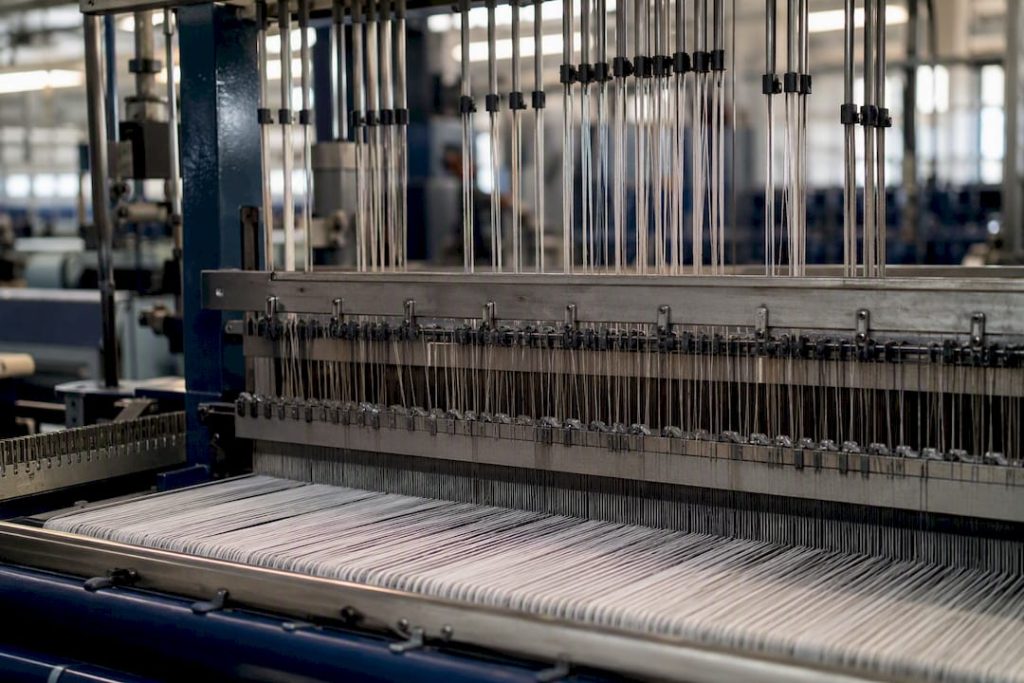
Dobby vs jacquard comes down to one mechanical fact: dobby looms lift warp threads in fixed groups, while jacquard looms control each warp end individually. That single distinction decides the pattern size, production speed, and price tag of everything the loom produces.
- Dobby is best for small, repeating geometric textures like piqué, dots, and stripes, produced fast and at lower cost.
- Jacquard is best for large or pictorial motifs, logos, and damask, where design depth matters more than run speed.
Pro Tip: Before requesting quotes, know your repeat size in centimeters. That number alone tells a mill whether you need dobby or jacquard. As WeaveTech notes, dobby suits high-speed, cost-efficient production of small repeats, while jacquard exists for pictorial or large-scale motifs that demand real design depth. The procurement implication follows directly: dobby costs less to buy, run, and maintain; jacquard costs more everywhere, but buys you pattern freedom dobby cannot touch.
Key Takeaways
The choice between dobby and jacquard depends on matching your pattern’s repeat size to the loom’s control granularity, not on which method sounds more advanced.
| Point | Details |
|---|---|
| Control method decides everything | Dobby lifts grouped warp threads via shafts; jacquard lifts individual ends via hooks or heads. |
| Capacity gap is the limiting factor | Dobby tops out near 28 shafts, while jacquard heads range from about 100 to 1,800 hooks. |
| Cost extends past the machine | Jacquard’s warp prep, sampling, and QA tolerances raise per-meter cost beyond machine price alone. |
| Hybrid setups solve mixed designs | Mills often run dobby for ground weave and jacquard for figured sections to balance speed and detail. |
| Match method to design roadmap first | Define your intended repeat size before requesting quotes to avoid overbuying jacquard capacity. |
Table of Contents
- What Is Dobby Weave and How Does It Work?
- How Does Jacquard Weaving Achieve Complex Patterns?
- Dobby vs Jacquard: Side-by-Side Production Trade-offs
- Where Each Weave Method Actually Shows Up
- What Questions Should You Ask Before Choosing a Weave?
- How Gjergji H Tekstil Applies This Choice for Hospitality Clients
- Why Procurement Teams Overthink This Decision
- Sources
What Is Dobby Weave and How Does It Work?
A dobby loom uses a mechanism called the dobby head to raise and lower harness frames, called shafts, in a programmed sequence. Each shaft controls a whole group of warp ends at once rather than a single thread, which is what caps the pattern size but also what keeps the machine fast and simple to run. Most dobby looms operate with 8 to 24 shafts, occasionally stretching to around 28 on more elaborate setups, according to iFactory’s comparison of pattern capability and cost.
That shaft count sets the design vocabulary: small geometrics, piqué, bird’s-eye, dots, and stripes, with repeats typically under 3 to 5 centimeters, as textile buying guides on dobby fabric confirm. You will not get a rose or a monogram out of a dobby loom. What you get instead is reliability at scale.
- Higher sustained running speed than jacquard for equivalent fabric weight
- Lower capital investment and simpler, cheaper maintenance
- Easier operator training since shaft programming is more forgiving than individual-hook control
- A hard ceiling: once your design exceeds the installed shaft count, dobby cannot deliver it, period
Dobby cloth is commonly woven from cotton or poly-cotton blends, which is exactly why it dominates shirting, sheeting, and hotel-grade table linen production worldwide.
How Does Jacquard Weaving Achieve Complex Patterns?
Jacquard looms replace grouped shafts with hooks, harness cords, or electronic heads that lift individual warp ends independently. That is the entire mechanical leap: instead of moving a block of threads together, the machine commands each thread on its own path. Head counts run from roughly 100 hooks on a compact unit up to 1,800 on an industrial jacquard, according to iFactory’s cost and pattern comparison, which effectively erases the repeat-size ceiling that limits dobby.
That capability opens the door to damask, brocade, large florals, pictorial scenes, and branded logos woven directly into the cloth, at a design scale dobby simply cannot approach.
- Individual-end control removes the shaft-based repeat limit almost entirely
- Setup and sampling take longer because each design requires its own punch-card or digital program
- Machine cost, warp preparation, and quality-assurance tolerances all run higher than dobby
- Maintenance demands more specialized technicians familiar with hook and harness-cord systems
The real cost story goes beyond the machine itself. Warp preparation, sampling runs, and tighter QA tolerances push per-meter cost up more than machine amortization alone would suggest, a point iFactory’s analysis makes explicit. If your buyer only quotes machine price, ask what sampling and QA add to the final number.
Dobby vs Jacquard: Side-by-Side Production Trade-offs
Put the two systems next to each other and the trade-off becomes a matter of arithmetic. Dobby’s shaft count, typically maxing near 28, controls warp threads in blocks. Jacquard’s hook count, running from about 100 to 1,800, controls each thread on its own. That gap in control granularity is the whole reason one system runs faster and cheaper while the other runs slower and pricier.
Speed and cost follow the same logic. A dobby loom producing a repeating stripe or piqué texture will out-produce a jacquard machine on the same fiber, because it is not recalculating a unique lift sequence for hundreds or thousands of individual ends every pick. Jacquard earns back that lost speed only when the design complexity justifies it, meaning a logo, a damask medallion, or a pictorial motif no dobby shaft arrangement could ever weave.
Maintenance mirrors the same pattern. Dobby heads are mechanically simpler and easier for a general textile technician to service. Jacquard harness cords and electronic heads need specialists who understand hook-level tension and lift timing, which raises both downtime risk and labor cost when something goes wrong.
A growing number of mills avoid the binary choice entirely. Running both systems side by side, using dobby for the ground weave and jacquard only for the figured sections, balances throughput against design ambition, a hybrid approach iFactory highlights as a practical middle path. If your order includes a simple base fabric with an accent pattern, ask your supplier whether mixed-shed production is available before assuming you need a full jacquard run.
Where Each Weave Method Actually Shows Up
- Dobby fabrics dominate shirting, table linens, and bed sheeting, where a subtle woven texture like piqué or bird’s-eye adds tactile quality without shouting for attention.
- Jacquard fabrics show up in upholstery, decorative bedding accents, and branded textiles for lobbies and event spaces, where the pattern itself is the selling point.
- Construction still outranks the loom name. Yarn quality, fabric weight in grams per square meter, and finishing treatment affect laundering durability, abrasion resistance, and snag risk more than whether the base weave is dobby or jacquard.
A jacquard tablecloth woven from low-grade yarn will pill faster than a well-constructed dobby piece, regardless of how impressive the pattern looks on day one. For hospitality buyers weighing visual impact against guest-facing durability, that construction detail belongs at the top of the textile visual impact conversation with any supplier.
What Questions Should You Ask Before Choosing a Weave?
Start with one decision rule: if your intended pattern repeat exceeds your mill’s installed harness capacity, you need jacquard, full stop. iFactory’s analysis treats this repeat-versus-capacity check as the single most reliable early signal that a design program has outgrown dobby, and auditing it up front avoids an expensive mid-project retrofit.
Bring these questions into any RFQ conversation:
- What is your maximum shaft count, or hook count if jacquard is on the table?
- What is typical sample turnaround time for a new design?
- What does cost-per-meter look like once sampling and QA tolerances are factored in, not just machine time?
- What maintenance schedule and technician availability supports this equipment long-term?
Pro Tip: Treat a supplier who recommends jacquard without walking you through a cost model and a sample trade-off as a red flag. Effective procurement means defining your design roadmap first, then matching the technology to it, not the reverse. Careful buyers also work through a structured procurement checklist before signing any bulk order.
How Gjergji H Tekstil Applies This Choice for Hospitality Clients
Gjergji H Tekstil has spent more than 30 years supplying hotels, restaurants, and event venues, which means the dobby-versus-jacquard call gets made constantly, not theoretically. Guest-room sheeting and restaurant table linens usually call for dobby: durable, fast to produce, and priced right for volume replacement cycles under industrial laundering. Branded event textiles, statement bedding accents, and lobby-facing décor lean toward jacquard, where the pattern itself supports the guest experience a property is trying to sell.
The right weave choice is never about which loom looks more impressive on paper. It is about matching pattern ambition to how the textile will actually be used, washed, and replaced across hundreds of guest cycles.
- Full supply-chain control from import through custom production keeps both weave options viable without inflated lead times
- Advisory support helps hotel and restaurant buyers avoid ordering jacquard complexity they do not actually need
Hospitality buyers working through a similar decision can review Gjergjihtextil’s hotel textile selection guidance for a closer look at balancing guest comfort against total cost, or check the event textile solutions checklist when a project calls for decorative jacquard pieces.
Why Procurement Teams Overthink This Decision
Most guides treat dobby versus jacquard as a design question first and a cost question second. That gets the order backward. The research consistently points the other way: repeat size versus installed harness capacity is the actual gating factor, and design preference only matters once that mechanical ceiling is understood.
The conventional advice, “pick jacquard for anything decorative,” oversells the technology. Plenty of decorative effects, piqué textures, subtle stripes, bird’s-eye patterns, sit comfortably within dobby’s range at a fraction of the cost and lead time. Jacquard earns its premium only when the motif genuinely exceeds what grouped-shaft control can produce.
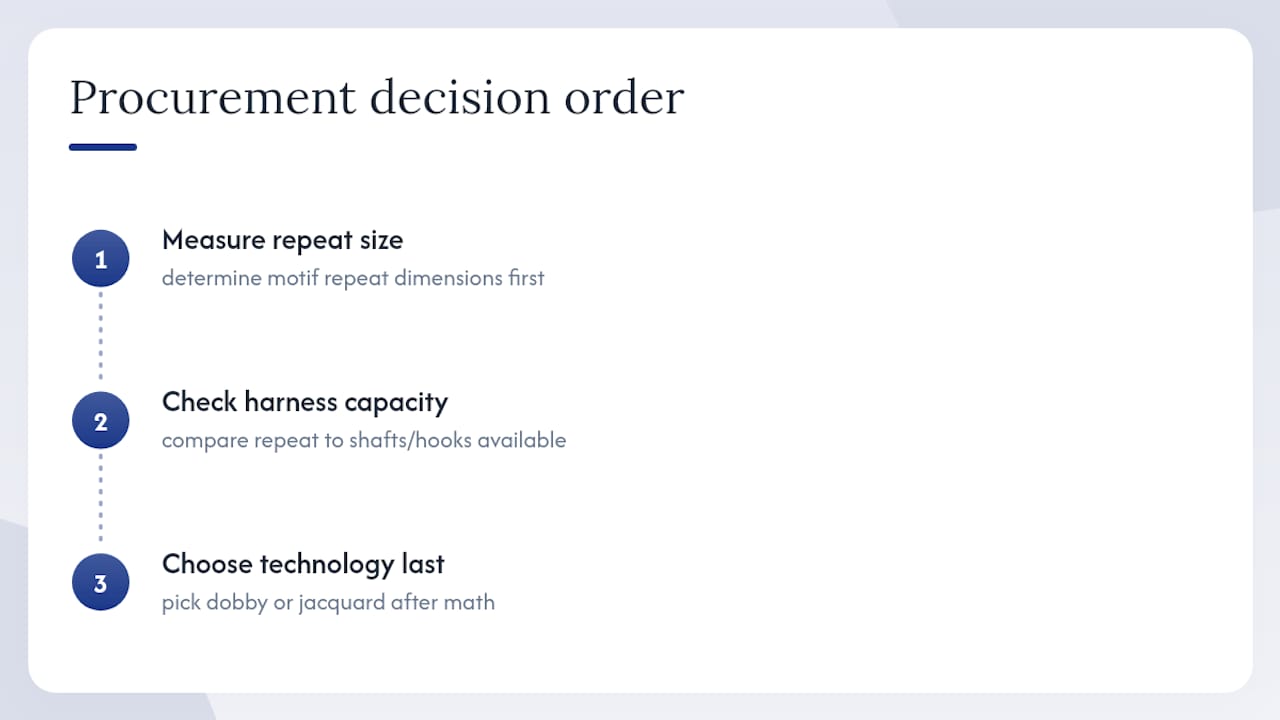
What buyers should prioritize first is not aesthetics but arithmetic: measure your repeat, check it against shaft or hook capacity, then let design conversations follow. Suppliers who skip that math and jump straight to selling jacquard capability are optimizing for their own margin, not your project’s actual requirements.
— Xpert