

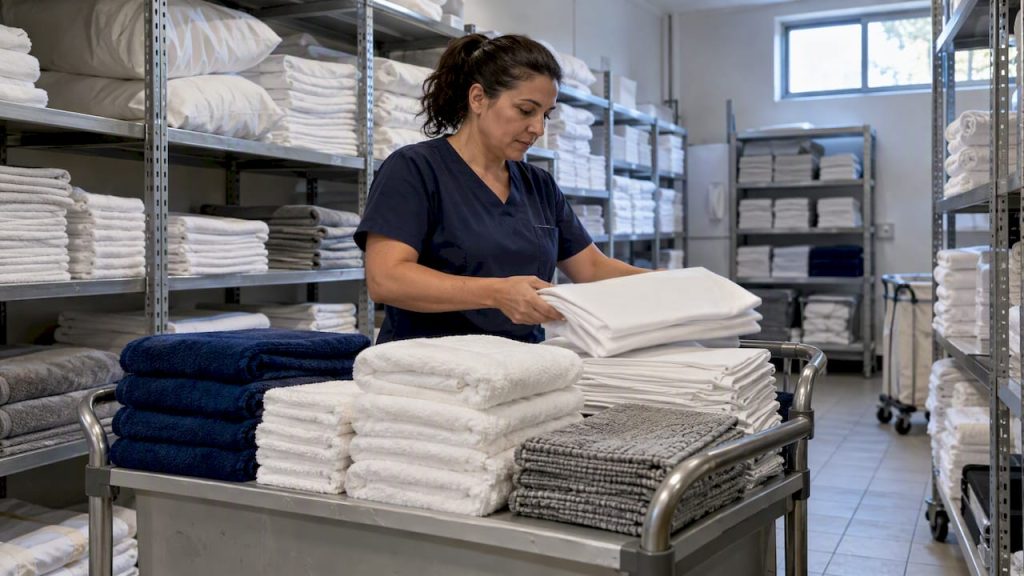
Use a 3-PAR baseline for properties with on-site laundry; plan 4 to 5 PAR for luxury properties or those using off-site laundry. Calculate each linen type using average daily usage multiplied by turnaround days, plus safety stock. A par level is simply the number of complete linen sets a property needs to run smoothly between laundry cycles, and getting that number right determines whether housekeeping runs on schedule or scrambles every morning.
TL;DR:
- Properties using off-site laundry should plan for at least 4 to 5 PAR to account for transit delays and vendor handoff risks.
- A typical 3 PAR level suffices for on-site laundry with turnaround times near 24 hours, but higher PARs are necessary during peak seasons or for luxury standards.
- Accurate linen counting, inventory tracking, and RFID tagging can significantly reduce waste, shrinkage, and rewash rates, improving par reliability.
- Supply chain control that manages import, production, and distribution reduces lead-time variance, which is crucial for maintaining consistent par levels.
- During shortages, quick action like reallocation or expedited ordering can resolve issues within 48 hours, especially when supply chains are tightly managed.
Table of Contents
- What 1-PAR means and how the formula works
- When 3 PAR works and when you need more
- Converting par into exact item counts
- Counting, storage, and the technology trimming par waste
- Adjusting par for seasons, events, and supply delays
- Why supply-chain reliability changes the par equation
- A 48-hour fix when par breaks down
- How we support reliable par planning
- FAQ
- Sources
What 1-PAR means and how the formula works
One PAR equals a single complete set of linens for every room, enough sheets, pillowcases, towels, and bath mats to make up each bed and bathroom once. From there, operators multiply by however many sets they need in circulation at any time.
The formula used across the industry is straightforward:
Par level = Average daily usage × laundry turnaround (in days) + safety stock

This math gives a number of sets, not pieces, which matters when converting to actual inventory counts later.
Par multiples describe how many complete sets a property stocks beyond the one currently on beds:
- 1 PAR covers only what is on the bed or in the bathroom right now, with zero buffer.
- 3 PAR is the industry-standard baseline: one set in the room, one in the laundry cycle, and one in storage.
- 4 to 5 PAR adds extra cushion for off-site laundry or luxury service levels, where transit time and guest expectations both run higher.
When 3 PAR works and when you need more
A 3-PAR policy fits properties with on-site laundry (OPL), stable occupancy, and a turnaround close to 24 hours, as outlined in this Food and Lodging Workflow efficiency guide. When sheets go from bed to wash to dry to shelf within a single day, one set in the room, one cycling through the laundry, and one in reserve is usually enough to prevent shortages.
Off-site laundry changes the math. Transit time between the property and the laundry provider adds a variable that in-house operations do not face, and that variable pushes many properties to add at least one additional PAR:
- On-site laundry supports 3 PAR when turnaround holds near 24 hours.
- Off-site laundry usually requires 4 PAR or more to cover transit delays and vendor handoff risk.
- Storage capacity and budget can cap how high a property can realistically go, regardless of what the formula suggests.
Service level matters too. A boutique property running tight occupancy can often hold at 3 PAR, while a resort offering twice-daily turndown or a luxury brand with strict presentation standards tends to run 4 to 5 PAR to absorb unpredictable demand without ever showing a bare shelf.
Pro Tip: Before raising your par multiple, check whether your turnaround time is the real problem. A faster laundry cycle often solves what looks like a par shortage.

Converting par into exact item counts
Once you have chosen a par multiple, the next step is turning that abstract number into a purchase order. The process is the same regardless of property size:
- Count items per room by linen type to build your 1-PAR baseline: typically two sheets, one duvet cover, two pillowcases, and two to four towels per room, depending on bed configuration and brand standard.
- Multiply 1-PAR by total room count to get your single-cycle total. A 150-room property needing two sheets per room needs 300 sheets for 1 PAR.
- Multiply that total by your chosen par multiple. At 3 PAR, the same property needs 900 sheets; at 4 PAR, 1,200 sheets, calculated purely from the 300-sheet base figure above.
- Add safety stock on top of the base calculation, concentrated on high-loss categories like pool towels and robes, which typically account for the bulk of annual shrinkage across hotel linen programs.
This same math applies to every linen category: towels, pillowcases, duvet covers, and bath mats each get their own 1-PAR baseline and their own multiple.
Counting, storage, and the technology trimming par waste
Par numbers only hold up if the counting behind them is accurate. Daily or shift-based counts, paired with signed handoff slips for any outsourced laundry pickup, give you a paper trail that catches short-ships before they become a pattern. The Xenia operations guide recommends vendor dock sign-off with a timestamp as a low-cost control that materially reduces disputes over missing inventory.
Storage practice matters as much as counting. Rotating stock so older linens cycle through first, rather than sitting at the back of a shelf, reduces uneven wear and keeps your replacement cycle predictable instead of reactive.
Track these KPIs monthly:
- Turnaround days, the time from soiled pickup to clean return.
- Par accuracy, how closely actual stock matches your target count.
- Shrinkage percentage, items lost to theft, staining, or miscounting.
- Rewash rate, how often items cycle through laundry without reaching guest-ready condition.
RFID item-level tagging has changed what is operationally possible here. A pilot deployment at Marriott properties reduced linen counting and housekeeping reporting time from roughly 90 minutes to about 10 minutes, with warehouse stocktake time cut substantially in the same reference model. The practical path is a phased rollout: tag your highest-loss categories, robes and banquet linen tend to justify the cost fastest, before expanding further.
Adjusting par for seasons, events, and supply delays
Static par levels break down the moment occupancy swings. Many operators run separate high-season and low-season par targets rather than one fixed number year-round, using rolling occupancy averages to set each.
Events need their own trigger checklist: extra ordering lead time, temporary overflow storage, and additional cart capacity booked in advance rather than scrambled together the morning of.
Supply-chain delays deserve the same proactive treatment. Industry guidance following recent supply disruptions points toward flexible temporary buffers rather than permanent par increases, since over-ordering during a shortage often leaves properties carrying excess inventory long after the disruption passes.
- Set separate high and low season pars using rolling occupancy data rather than a single fixed number.
- Build an event checklist covering ordering, temporary storage, and cart capacity.
- Add buffer days to lead time, not permanent par, when a vendor reports delays.
- Review par monthly, or immediately after any major event, to catch drift early.
Why supply-chain reliability changes the par equation
Par calculations assume a stable turnaround time, but that assumption only holds when your supplier delivers consistently. We built our operation around controlling every link in that chain: import, in-house production, and distribution, rather than depending on a patchwork of outside vendors with their own separate lead times. Over more than 30 years of supplying hotels and hospitality businesses, including work with international brands operating under names like Meliá, Marriott, and Sheraton, we have seen firsthand how lead-time variance, not bad math, is usually what breaks a par policy.
When a property controls its own import, production, and distribution chain, the lead-time variance that normally forces operators to pad their par levels largely disappears.
Full supply chain control helps reduce unpredictability that otherwise forces hotels to over-order as insurance against delay.
A 48-hour fix when par breaks down
When a shortage hits, speed matters more than precision. First, count every linen category by location, in-room, in laundry, in storage, to find exactly where the gap sits. Second, check for cross-department borrowing or short-term rental options to cover the next one to two turnover cycles. Third, if the shortfall traces back to a vendor delay, escalate to an expedited order immediately rather than waiting for the next scheduled shipment.
— Xpert
How we support reliable par planning
Par formulas only work as well as the supply behind them, and that is where Tekstile për Hotel & AirBnB comes in. We supply bulk hotel linens built for industrial wash cycles, with custom production available when a property needs specific dimensions, weights, or branding that off-the-shelf stock cannot match.

Our work covers:
- Bulk hotel textiles, sheets, towels, duvet covers, and bath mats sized for your room mix.
- Custom production, tailored to your property’s exact specifications rather than generic stock.
- Supply consistency, built on decades of import, production, and distribution experience serving hospitality clients at scale.
If your par numbers are not holding up under real occupancy, reach out through our hotel textile page to request a sample pack or talk through a par audit for your property.
FAQ
What is the 15/5 rule in hotels?
The 15/5 rule is a guest-service standard, not a linen metric. It tells staff to acknowledge guests from a close distance with eye contact and greet them verbally when nearer, and it has no direct connection to par stock calculations.
How do I calculate the par stock for hotel linens?
Multiply average daily usage by your laundry turnaround time in days, then add safety stock for high-loss items. Most on-site laundry properties land on a 3-PAR baseline, while off-site or luxury operations often need 4 to 5 PAR.
What is a good RevPAR for a hotel?
RevPAR, or revenue per available room, varies widely by market, property class, and season, so there is no single universal benchmark figure that applies across all hotels. It is unrelated to linen par stock, which measures inventory sets rather than revenue performance.
What linen is used in 5 star hotels?
Luxury properties typically specify higher thread-count cotton or cotton-blend sheets, plush towels, and duvet covers chosen for durability under frequent industrial washing as much as for guest-facing feel. These properties also tend to run higher par multiples, often 4 to 5 PAR, to maintain consistent presentation standards.
Sources
- Hotel Laundry Management: Par Stock + Checklist | Xenia
- Keeping your PAR levels up to par | Hotel Management
- Case Study – Marriott International 150,000-tag RAIN RFID linen deployment | RFID News