

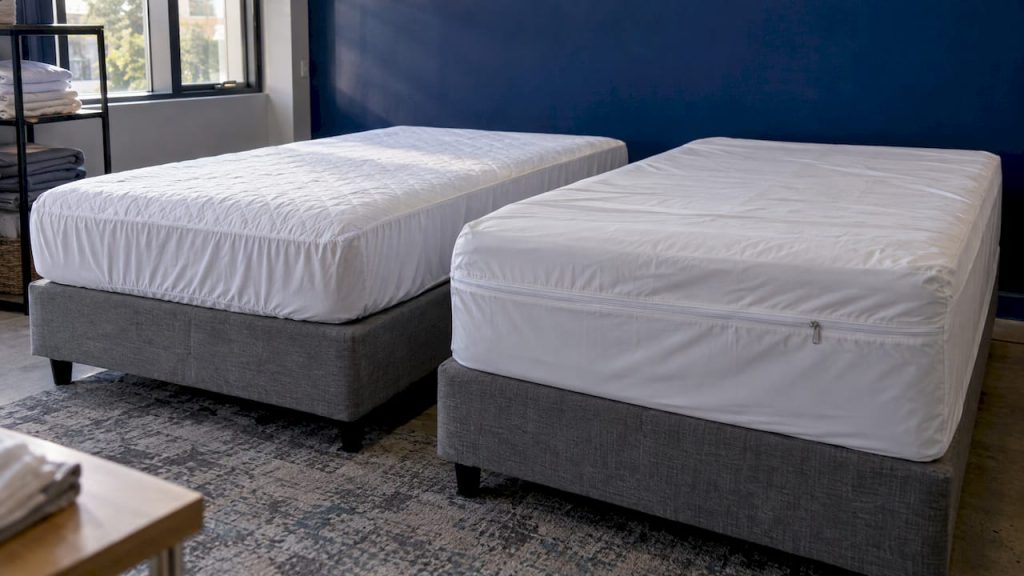
A mattress protector covers the top of the mattress like a fitted sheet and guards it against spills and stains. An encasement wraps all six sides and zips shut, which is why it is the one that matters for bed bugs and allergens inside the mattress. For most hotels the practical answer is not one or the other. It is a protector in every room, plus encasements where the risk justifies them.
This guide explains the difference in operational terms: what each product does, what it does not do, how it behaves under a hotel laundry schedule, and how to decide by room type, property and budget.
TL;DR
- A protector shields the top surface of the mattress. An encasement surrounds the whole mattress and closes with a zipper, so it also blocks bed bugs and allergens from entering or leaving.
- For bed bug protection, a protector alone does nothing. A six-sided encasement with a secure closure is required.
- A protector is removable and easy to wash between guests, so it suits routine spill and wear protection in every room.
- Many hotels layer both: the encasement as a permanent seal, the protector as the washable layer on top.
- A topper or mattress pad is not protection. It adds comfort or changes firmness.
Table of Contents
- The difference in one minute
- What a protector does well in a hotel room
- What an encasement adds
- Topper, pad, protector, encasement: four different products
- When a hotel should use both
- How to decide by property type
- Care and replacement routine
- Our perspective
- Specify protection for your rooms
- FAQ
- Sources
The difference in one minute
The two products are often sold under the same label, which is where the confusion starts. The difference is coverage and closure.
A protector sits on top of the mattress and is held in place with elastic corners, much like a fitted sheet. Sleep Foundation describes it as a relatively thin layer, with a breathable top over a waterproof coating, designed to keep spills, dirt, allergens and bacteria away from the mattress. It comes off easily for washing.
An encasement surrounds the mattress on all sides and typically zips closed. According to Sleep Foundation’s comparison, that full enclosure gives added protection against bed bugs and against allergens that can build up inside the mattress.
| Feature | Mattress protector | Mattress encasement |
|---|---|---|
| Coverage | Top surface, with skirt or elastic corners | All six sides |
| Closure | Fitted-sheet style | Zipper |
| Main job | Spills, stains, everyday wear | Sealing the mattress against bed bugs, moisture and allergens |
| Removal for washing | Quick, between guests | Usually stays on the mattress longer |
| Bed bug barrier | No | Yes, if well made and fully sealed |
| Typical place in a hotel | Every bed | Beds where sealing is a priority, or under a protector |
Both types come in waterproof and non-waterproof versions, and both can help extend mattress life and keep a manufacturer’s warranty valid, according to Sleep Foundation.
What a protector does well in a hotel room
In a hotel, the mattress is used almost every night by different guests. The protector is the layer that takes the daily load: spilled drinks, makeup, sweat, the occasional accident. Because it is removable, housekeeping can strip it and send it through the laundry with the rest of the linen.

The protector is also not a substitute for the fitted sheet. Alsco’s bedding guide makes the point that a protector is a barrier for the mattress and is not meant to be slept on directly, while the fitted sheet provides the comfortable surface. In practice the order on the bed is mattress, protector, fitted sheet. So the answer to the common question “do I need both a protector and a fitted sheet?” is yes: they do different jobs.
What to look for in a protector for hotel use:
- Wash cycles. The product will be laundered far more often than a home one. Ask for the washing temperature and the cycle count the product is designed for, and match it to your laundry’s program. Shrinkage (rrudhosje) and delamination of the waterproof layer are the two failures that show up first.
- Quiet surface. A protector that rustles or feels plasticky is noticed by guests. A breathable top fabric matters as much as the waterproof backing.
- Fit. Deep elastic skirts need to match your actual mattress depth, including any built-in pillow top.
- Fast drying. Thin, light constructions return to service sooner, which helps when rooms turn over daily.
Our own sourcing notes on this are in 3 mattress protector types hotels need.
What an encasement adds
An encasement does one thing a protector cannot: it closes the mattress off completely. That has three practical effects.
Bed bug barrier. Bed bugs enter a mattress from the sides and bottom, not only the top. MattressHelp notes that a protector does nothing for bed bug protection and that a six-sided zippered encasement with a secure closure is required.
Allergen containment. Dust and dander that have already built up inside a mattress stay sealed in, and new soil stays out.
Moisture barrier on all sides. A waterproof encasement protects against fluids reaching the foam or springs from any direction, which is relevant for mattresses that are moved, stacked or stored.

What makes an encasement effective against bed bugs
Not every zippered cover qualifies. The Alaska Department of Environmental Conservation lists the conditions: the cover must enclose the entire mattress and box spring, use bite-proof fabric, seal tightly without gaps or tears, and have small, close-set zipper teeth that close completely at the end-stop.
For a hotel buyer this becomes a short specification list:
- Covers the mattress and, where you use one, the box spring or base.
- Fabric with no holes or loose weave at seams.
- A zipper with fine teeth and a closed end-stop, ideally with a flap or cover over the zipper.
- Seams that are sealed or tightly stitched.
- A fabric that stays quiet and breathable, so the bed does not feel like it is wrapped in plastic.
An encasement that is torn should be repaired or replaced promptly, because a gap defeats its purpose. Add a visual check of zippers and seams to the room inspection routine whenever the mattress is rotated.
What an encasement does not do
An encasement is a preventive measure, not a pest treatment and not a cleaning method. SleepSanitation stresses that neither product replaces cleaning: they keep new soil from moving into the mattress. The same source cites a 2024 meta-analysis finding that partial bedroom control, such as encasements and hot-washing bedding on their own, is not recommended, while combined bedroom measures looked more promising. For a hotel this means encasements belong inside a wider routine of inspection, housekeeping and, when needed, professional pest control.
Topper, pad, protector, encasement: four different products
Guests and even buyers mix these up. The distinction is simple:
- Protector: keeps the mattress clean, according to Sleep Foundation’s care guidance.
- Encasement: seals all six sides.
- Pad: adds cushioning.
- Topper: adjusts firmness and support. It is much thicker than a protector and sits on top of the mattress, as Silentnight explains.
Pads and toppers are not meant to protect. If a room has a topper, the protector goes over it, so that the topper is also kept clean, then the fitted sheet goes over the protector.
When a hotel should use both
Using both is the common professional setup, and the logic is about washing. The encasement stays on the mattress as a long-term seal. The protector goes on top and is laundered regularly. MattressHelp makes the same recommendation: even with an encasement, a protector layered on top is still advised for routine spill and wear protection, as noted in its guide.
This two-layer approach makes sense in these situations:
- New mattress purchases. Seal the mattress from day one so it never accumulates hidden soil, and let the protector take the daily wear.
- High-turnover rooms. Family rooms, rooms near the pool or beach, and apartments rented by the night see more spills and more guest variety.
- Properties with a bed bug history or high risk exposure. Resorts with heavy international traffic, hostels and AirBnB-style units benefit from a permanent barrier that makes inspection simpler.
- Storage and rotation. Mattresses kept in reserve for seasonal opening, which is typical on the coast, stay clean when encased.
- Expensive mattresses. Where warranty terms require a cover, the protector and encasement together help keep the mattress within them. Check the manufacturer’s terms.
We cover the cost logic in two-layer mattress protection for hotels, including why replacing mattresses less often changes the budget more than the price of the covers.
How to decide by property type
| Property | Suggested setup | Reason |
|---|---|---|
| City business hotel | Protector on every bed, encasement on new or high-use mattresses | Constant turnover, frequent laundering |
| Seasonal coastal resort | Encasement plus protector | Mattresses stored in the off season, high guest numbers in summer |
| Boutique hotel with premium mattresses | Encasement plus protector | Protects a larger mattress investment |
| Guesthouse or AirBnB unit | Protector as a minimum, encasement where bed bug risk is a concern | Quick turnover, limited laundry capacity |
| Spa or wellness hotel | Waterproof protector, encasement on treatment-adjacent beds | Moisture and humidity exposure |
This is a guide, not a rule. The right setup depends on your room count, your laundry capacity and the age of your mattresses.
Care and replacement routine
A protector or encasement only works while it is intact. A simple routine keeps it that way:
- Wash protectors on the laundry’s standard cycle at the temperature the product is designed for. Avoid overloading the machine, which stresses the waterproof layer.
- Inspect at every change. Housekeeping checks for holes, delamination and loose elastic as part of stripping the bed.
- Check encasement zippers and seams whenever the mattress is rotated or moved.
- Keep spare sets. Rooms should never wait for a protector to dry. Plan for at least one extra set per bed in circulation.
- Track replacement by wash count, not by appearance, so retirement happens before the waterproof layer fails.
Keeping the bed clean is also a linen question. Sheets and duvet covers need regular washing; our note on duvet covers versus sheets explains how that interacts with the protector layer. Where humidity is a concern, as in coastal and mountain properties, see which lab tests to require for anti-mold textiles.
Our perspective
We have supplied hotels since 1994, and the most common mistake we see is treating the protector as a small accessory. It is a consumable that protects the largest asset in the room, the mattress. When it fails early, the cost shows up as a mattress replacement, not as a linen line.
Our view is simple. Every bed gets a protector chosen for the laundry it will actually go through. Where risk or mattress value justifies it, the bed also gets an encasement. The two layers do different jobs, and together they let the housekeeping team work faster, because the washable layer takes the daily load and the sealed layer stays untouched.
Because we import in volume and also run our own production, we can match a specification to a property: sizes, fabric weight, wash performance and quantity. That is more useful to a hotel manager than a catalog of generic covers, and it keeps the cost per bed per year low and predictable.
Xpert
Specify protection for your rooms
If you manage a hotel, guesthouse or short-stay property in Albania, Kosovo, Montenegro or North Macedonia, we can help you define the protector and encasement setup room by room, then supply it in the quantities your property needs. Our range covers bed linens, towels, bedding and protective layers, with custom production where a standard size does not fit.
See our hotel and AirBnB textiles page for the range, or read our hotel textile selection tips before you request an offer.

For a wider room refresh, guest room textile upgrades for Balkan hotels shows where the protective layer fits among the other textile decisions.
FAQ
Is a mattress encasement better than a protector?
It depends on the goal. An encasement offers a greater degree of protection against moisture, allergens and bed bugs, according to Sleep Foundation. A protector is easier to remove and wash between guests. Most hotels get the best result by combining them.
Do I need both a mattress protector and a fitted sheet?
Yes. The protector is a removable barrier for the mattress and is not meant to be slept on directly, while the fitted sheet is the comfortable sleeping surface, as Alsco explains. The protector goes on first, the sheet over it.
Does a mattress protector stop bed bugs?
No. Bed bugs enter from the sides and bottom, so bed bug protection needs a six-sided zippered encasement with a secure closure, per MattressHelp. Keep the encasement intact and combine it with regular room inspection.
Is a mattress topper the same as a protector?
No. A topper is thicker and adds support or changes firmness, while a protector is a thin removable layer that shields the mattress from stains, as Silentnight describes. If you use a topper, cover it with a protector.
Sources
- Mattress Protector vs. Mattress Encasement, Sleep Foundation
- Do You Need a Mattress Protector? Sleep Foundation
- How to Take Care of Your Mattress, Sleep Foundation
- Mattress Encasements for Bed Bugs, Alaska Department of Environmental Conservation
- Best Mattress Encasement for Bed Bugs 2026, MattressHelp
- Mattress Protectors vs Encasings, SleepSanitation
- How to Choose Bedding for Short-Term Rentals, Alsco
- A Guide to the Best Mattress Toppers, Silentnight