


TL;DR:
- Accurate textile forecasting in hospitality helps prevent guest complaints, reduce costs, and optimize inventory.
- It relies on unified data, rolling forecasts, monitoring supply risks, and close collaboration between procurement and housekeeping.
- Continuous evaluation and integration of market trends ensure supply resilience, cost savings, and guest satisfaction.
Running a hotel or restaurant without a reliable forecast of textile needs is like operating a kitchen without a prep list. Shortfalls in towels, bed linens, or tablecloths during peak season translate directly into guest complaints and emergency procurement at premium prices. Overstocking ties up capital and accelerates fabric degradation from unnecessary storage. Knowing how to forecast textile needs accurately is one of the highest-return operational skills a hospitality procurement professional can develop. This guide covers the data sources, workflow steps, and verification methods that actually move the needle.
Table of Contents
- Key takeaways
- How to forecast textile needs: the data foundation
- Step-by-step workflow for textile demand prediction
- Common mistakes in textile supply chain forecasting
- How to verify and refine your forecasting process
- What I have learned about forecasting in hospitality operations
- Source your textiles with confidence after forecasting
- FAQ
Key takeaways
| Point | Details |
|---|---|
| Start with unified data | Consolidate occupancy, historical consumption, and supplier lead times before selecting any forecasting model. |
| Use rolling forecasts | Update projections weekly or daily to capture short demand spikes instead of relying on static annual plans. |
| Monitor external supply risks | The 2026/27 cotton supply gap signals real price volatility that must factor into your procurement timeline. |
| Build feedback loops | Link forecasting outputs directly to procurement triggers so predictions translate into purchasing decisions. |
| Track accuracy with KPIs | Measure forecast accuracy percentage and holding costs weekly to catch model drift before it becomes costly. |
How to forecast textile needs: the data foundation
Before you apply any model or technology, you need the right inputs. Garbage in, garbage out remains the leading cause of failed AI initiatives in textile forecasting. For hospitality operations specifically, the minimum data set required looks like this:
- Historical consumption records: At minimum 24 months of actual textile usage by category (towels, bed linens, tablecloths, napkins, uniforms). Break this down by room type or service area, not just totals.
- Occupancy and reservation data: Occupancy rates are the single strongest predictor of linen consumption. Linking your PMS (Property Management System) output directly to your procurement records removes most of the guesswork.
- Seasonal trend data: Hotels in coastal or mountain destinations see demand swings of 60% or more between peak and off-peak periods. Restaurants tied to event calendars face similar volatility. Your forecast must model these curves, not average them out.
- Supplier lead times: If your primary linen supplier requires a 45-day lead time from order to delivery, your forecast horizon must extend at least that far. Most operations underestimate this.
- Raw material market conditions: The global cotton market faces a 5.7 million bale production gap in the 2026/27 crop year, with the stocks-to-use ratio dropping to 59%. That tightening affects pricing and availability for any property ordering cotton-rich fabrics.
Beyond internal data, broader factors shape textile demand in ways that purely operational numbers miss. Macro-environmental factors such as sustainability regulations, inflation, and shifting guest expectations all affect which textiles you buy and in what volume. Properties pursuing green certifications, for example, may need to shift sourcing toward organic or recycled-fiber products, which carry different supply lead times and price structures.
Pro Tip: Avoid the most common data silo problem in hospitality: procurement and housekeeping teams often track textile consumption in separate systems. Overcoming data silos through a unified platform or even a shared spreadsheet before your first forecast cycle will produce better results than any advanced algorithm running on fragmented data.
Technology helps significantly here. ERP platforms with textile modules can automate data aggregation. AI-driven forecasting tools go further by analyzing social media signals, e-commerce trends, and raw material availability alongside your internal records. The workflow for textile forecasting at the management level starts with data architecture, not software selection.
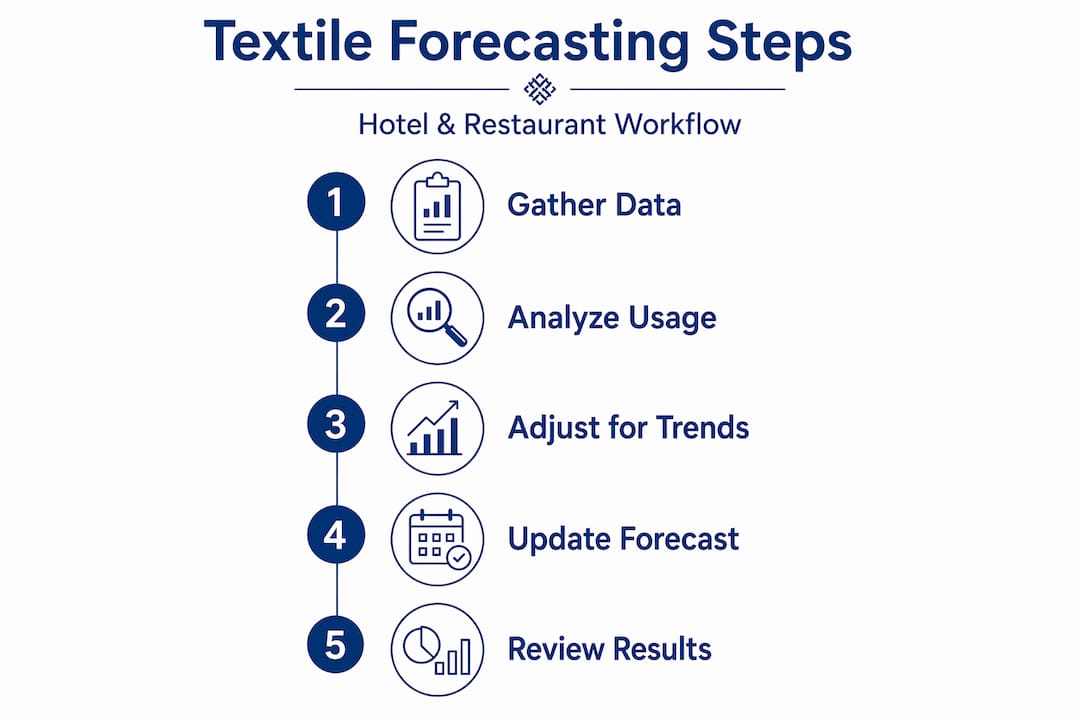
Step-by-step workflow for textile demand prediction
Once your data foundation is solid, you can move through a structured process. This is the workflow that procurement teams at high-performing hospitality operations actually use.
-
Define objectives tied to measurable outcomes. Vague goals produce vague forecasts. Clear objective setting aligned with waste reduction, cost control, or guest satisfaction targets is what differentiates a forecast that drives decisions from one that collects dust. A 400-room hotel might set a target of maintaining no more than 3.5 par stock on linens while sustaining a 99% availability rate. That number guides every downstream decision.
-
Collect and cleanse data using ETL processes. ETL stands for Extract, Transform, and Load. In practice, this means pulling consumption data from your laundry logs and PMS, standardizing units (some systems track by piece, others by weight or batch), and loading everything into a single forecasting environment. Skipping this step is the most common reason forecasts fail in their first cycle.
-
Select the right forecasting model for your context. Time series models work well when consumption is stable and history is long. Regression models add power when you want to factor in occupancy rates or event calendars as predictors. AI-enhanced forecasting goes further, analyzing social media and raw material availability to produce 85 to 95% accuracy. The right choice depends on your data quality and team capacity.
-
Implement rolling 12-week forecasting. Static annual plans break down in hospitality because the environment changes constantly. Modern forecasting models operate on rolling 12-week outlooks updated daily or weekly to capture demand spikes that last only 2 to 6 weeks. A group booking arriving in week 4 changes your linen requirements immediately. Your forecast needs to reflect that within days, not at the next monthly review.
-
Connect forecast outputs to procurement triggers. A forecast that lives in a spreadsheet and informs no purchasing decision has zero operational value. Forecasts must prompt specific actions, whether that means auto-generating purchase orders at a defined reorder point or alerting the procurement manager to a projected shortfall 30 days out.
Pro Tip: When first introducing a rolling forecast, run it in parallel with your existing ordering process for 6 to 8 weeks before fully committing. This gives you a calibration period to identify model errors without exposing the operation to supply risk.
Common mistakes in textile supply chain forecasting
Even well-resourced procurement teams fall into predictable traps. Knowing these failure modes in advance lets you avoid them.
-
Relying entirely on historical averages. A new event venue nearby, a renovation that changes room count, or a viral review that spikes occupancy in an off-peak month. None of these appear in last year’s data. Historical data tells you what happened. It does not tell you what is about to happen. Forecasting fabric inventory accurately requires layering current signals on top of historical baselines.
-
Ignoring raw material market volatility. Procurement teams focused on internal data often miss upstream supply risks until they appear as a price spike on an invoice. The cotton supply gap noted above is not a distant risk. It is already affecting procurement budgets for operations ordering in 2026. Building a quarterly review of raw material indexes into your forecasting process costs one hour and can save thousands.
-
Updating forecasts too infrequently. Monthly reviews are standard practice at many hotels. They are also insufficient for hospitality operations with dynamic occupancy patterns. Demand spikes in hospitality can appear and resolve within two weeks. A monthly forecast cadence misses them entirely.
-
Keeping forecasts separate from operations. This is the mistake that undermines all the others. When procurement and housekeeping operate without a shared view of textile stock levels and projected demand, data silos between teams produce duplicated orders, surprise shortfalls, and excess write-offs.
-
Underestimating replacement cycles. Hospitality textiles face industrial washing cycles that consumer-grade fabric is not built for. If your forecast assumes a 24-month replacement cycle but your laundry operation washes at high temperatures five days a week, actual useful life may be 14 months. This gap produces unexpected shortfalls that look like demand spikes but are actually asset deterioration.
How to verify and refine your forecasting process
Forecasting is not a one-time task. It requires ongoing calibration to stay accurate as your operation changes. The following framework gives you the structure to do that without adding significant overhead.
| KPI | What it measures | Target range |
|---|---|---|
| Forecast accuracy % | Variance between predicted and actual consumption | 85% or above |
| Par stock ratio | Current stock relative to operational minimum | 2.5 to 3.5x daily use |
| Holding cost per unit | Cost of carrying excess textile inventory | Minimize quarter over quarter |
| Replacement rate | Actual linen lifecycle vs. projected lifecycle | Within 10% of forecast |
| Stockout frequency | Number of shortfall events per quarter | Zero in core categories |
Velocity management means reviewing forecast performance in weeks 2 to 3 of any new forecast cycle, not at the end of it. If your projected towel consumption was 1,200 units and actual consumption in week 2 is already at 700, you can trigger a replenishment order in time to receive stock before the shortfall materializes. Waiting until week 8 to review leaves no time to respond.
Pro Tip: Assign a single person as the “forecast owner” for each textile category. Shared accountability in forecasting almost always means no accountability. One person tracking towel par levels and replacement rates will catch issues that a committee review misses every time.
ERP-optimized cut planning can reduce fabric waste by 5 to 8%, improving material utilization from 80 to 85% up to 88 to 92%. When you integrate this kind of operational data into your forecast refinement loop, the efficiency gains compound over time. Forecast accuracy improves. Procurement costs fall. And the guest experience stabilizes because the right textiles are always in stock.
Sustainability and supply chain resilience are becoming primary competitive factors in textile procurement. Including sustainability targets in your forecasting model, such as planned transitions to lower-impact fiber types, keeps procurement aligned with property-level certifications and guest expectations.
What I have learned about forecasting in hospitality operations
I have watched procurement teams spend significant time building detailed annual textile budgets, only to watch those budgets collapse by March when the first large group booking changes occupancy assumptions for the next six months. The problem is not that annual planning is wrong. The problem is treating it as the plan rather than a starting point.
What I have found actually works is the combination of a solid baseline plan with a weekly pulse check on the numbers that matter most: par stock levels, actual consumption against forecast, and any supply signals from your key vendors. That combination catches 90% of problems before they become guest-facing issues.
The shift from passive forecast to active operations tool is where most teams struggle. It requires getting procurement and housekeeping to look at the same data at the same time, which is more of an organizational challenge than a technical one. In my experience, starting with a weekly 20-minute sync between those two functions does more for forecast accuracy than any software purchase.
The future of textile forecasting in hospitality is AI-assisted and sustainability-weighted. Properties that optimize hospitality performance through better sourcing and forecasting will carry a real cost advantage over those that continue ordering reactively.
— Xpert
Source your textiles with confidence after forecasting

Once your forecasting process is producing reliable projections, the next question is whether your supply partners can actually meet those projections at the right quality and price point. Gjergjihtextil has supplied wholesale hotel textiles to properties including Marriott, Meliá, and Sheraton because the combination of volume importing, in-house production, and 30 years of hospitality supply experience produces a price-to-quality ratio that reactive purchasing cannot match. If you are managing a restaurant operation, Gjergjihtextil’s restaurant textile supply covers tablecloths, napkins, and runners built for heavy use and consistent presentation. For guidance on selecting the right specifications to match your forecast quantities, the hotel textile selection guide on their site covers durability grades, washing cycle resistance, and ordering quantities in practical terms.
FAQ
What data do I need to start forecasting textile needs?
You need at minimum 24 months of historical consumption records, current occupancy or reservation data, supplier lead times, and seasonal trend data. Unifying these inputs into a single system before selecting a forecasting model is the critical first step.
How often should hospitality teams update their textile forecasts?
Weekly updates are the standard for operations with dynamic occupancy. Rolling 12-week outlooks updated daily or weekly capture demand spikes that monthly reviews miss entirely.
What is the biggest mistake in textile demand forecasting?
The most common and costly mistake is keeping forecasts separate from procurement decisions. A forecast that does not trigger a purchasing action or reorder alert provides no operational value.
How does cotton market volatility affect textile forecasting?
With a projected 5.7 million bale production gap in 2026/27, cotton-rich textile categories carry real price and availability risk. Hospitality procurement teams should factor raw material indexes into their forecasting timeline and order windows.
Can small hotels benefit from structured textile forecasting?
Yes. Even properties with 30 to 50 rooms benefit from a basic par stock model linked to occupancy data. The process does not require AI tools to produce meaningful reductions in emergency purchasing and overstock write-offs.