

The fastest way to raise hotel standards is to combine prioritized SOPs, a data-backed QA cadence, targeted staff training, and guest-first technology — in that order. These four levers, applied systematically, produce measurable gains in guest satisfaction scores, complaint reduction, and revenue per available room faster than any single capital project.
Here is your same-day checklist to start immediately:
- Fix the three most common guest complaints logged in the last 90 days (check-in wait, room readiness, request fulfillment speed)
- Publish a one-page minimum viable SOP for front desk, housekeeping, and maintenance
- Add a daily pre-shift briefing for housekeeping with room-status targets
- Standardize linen specifications by department (GSM range, wash cycle tolerance, colorfastness grade)
- Set a defect-to-complaint ratio target of 3:1 as your QA baseline
- Assign a named owner to every open guest complaint and close the loop within 24 hours
- Pull your last 30 days of online reviews and tag each complaint by department
- Schedule your first monthly light-touch audit within the next two weeks
Prioritization by time-to-value:
- Immediate (same day, low cost): SOP quick cards, daily briefings, complaint tagging, linen spec review
- 30-day fixes (medium effort): Staff microtraining on service recovery, QA audit schedule, guest survey automation
- 90-day projects (higher investment, high return): Full PMS-to-housekeeping integration, mystery guest program, textile refresh aligned to spec
JD Power’s North America Hotel Guest Satisfaction Index recorded an industry-wide satisfaction gain of 13 points to 665 in its most recent study of 44,787 branded hotel guests, with notable lifts in room quality, F&B, and facility upkeep. That benchmark tells you where the floor is moving. The sections below tell you how to stay above it.
Key Takeaways
The most direct path to raising hotel standards is a layered system: codified SOPs, a 3:1 defect-to-complaint ratio target, a quarterly-monthly-continuous audit cadence, and textile specifications that hold up under industrial use.
| Point | Details |
|---|---|
| Start with SOPs for top complaints | Document check-in, room readiness, and request fulfillment first; assign a named owner to each. |
| Track defect-to-complaint ratio | Target 3:1 as your baseline; top performers reach 5:1 by catching issues before guests do. |
| Layer your audit cadence | Combine continuous digital monitoring, monthly light-touch checks, and quarterly deep dives to avoid audit fatigue. |
| Spec textiles for durability | Require specified GSM and wash cycle tolerances plus OEKO-TEX certification to reduce defects and replacement costs. |
| Gjergjihtextil for textile supply | Gjergjihtextil provides hotel-grade textiles with industrial-wash certification and specification advisory for B2B hotel procurement. |
Table of Contents
- Why raising hotel standards drives revenue and reputation
- 1. Build SOPs and brand standards that keep service consistent
- 2. Invest in staff training and a service culture that holds
- 3. Use guest experience levers that move satisfaction scores
- 4. Integrate your technology stack for measurable consistency
- 5. Set physical standards your guests can see and feel
- 6. Run a QA cadence that catches problems before guests do
- 7. Follow a 90-day roadmap with clear owners and budget guidance
- What actually works in practice: a field perspective
- Gjergjihtextil supports hotel-standard upgrades with specification-grade textiles
- Sources
Why raising hotel standards drives revenue and reputation
Improving standards is not a quality-for-quality’s-sake exercise. It maps directly to the metrics that determine whether your property can hold rate, earn repeat bookings, and defend its position on OTA rankings.
The KPIs worth tracking are specific. Net Promoter Score (NPS) captures loyalty intent; Guest Satisfaction Index (GSI) or Customer Satisfaction Index (CSI) measures overall experience quality; RevPAR (Revenue per Available Room) and ADR (Average Daily Rate) reflect whether quality improvements are translating to pricing power. Complaint rate per hundred occupied rooms tells you where your operation is leaking, and defect-to-complaint ratio tells you whether your QA system is catching problems before guests do.
On that last metric: hotel quality management research recommends a baseline defect-to-complaint ratio of 3:1, meaning your internal QA should surface at least three defects for every one that reaches a guest. Top-performing properties push that ratio to 5:1. A ratio below 3:1 means guests are finding problems your team is missing.
| KPI | Why It Matters | How to Measure | Example Target |
|---|---|---|---|
| NPS | Predicts repeat bookings and referrals | Post-stay survey | +40 or above |
| GSI / CSI | Tracks overall satisfaction by department | Branded survey or third-party tool | Majority positive |
| RevPAR | Ties quality to revenue performance | PMS report (ADR × occupancy) | Year-over-year growth |
| ADR | Reflects pricing power from perceived quality | PMS rate report | Segment benchmark |
| Complaint rate | Identifies operational failure points | Complaints per 100 occupied rooms | Below 2 per 100 |
| Defect-to-complaint ratio | Measures QA system effectiveness | Internal defect log vs. guest complaints | 3:1 minimum, 5:1 target |
| Request fulfillment time | Tracks service speed and reliability | Ticket system or manual log | Under 15 minutes |
Pro Tip: Set up a weekly review where your operations manager pulls the previous week’s negative reviews (from Google, TripAdvisor, and your post-stay survey) and tags each one by department and root cause. Feed those tags directly into your SOP update cycle and your next training session. This turns reactive reputation management into a structured improvement loop — and it costs nothing to start.
Online reviews are also a leading indicator of customer reviews’ role in hospitality reputation. A property that responds to and acts on negative feedback consistently outperforms one that monitors scores passively.
1. Build SOPs and brand standards that keep service consistent
Codified SOPs combined with visible ownership reduce errors and rework faster than any ad-hoc fix. The reason is simple: when a standard is written down and assigned to a named role, it gets executed consistently across shifts, not just when the department head is on property.
A well-built SOP contains seven elements: purpose (why this task matters to the guest), scope (which roles and shifts it applies to), step-by-step task sequence with timing standards, required tools and materials, safety checks, the KPI it feeds, and a named owner. Without the KPI link, SOPs become compliance theater rather than performance tools. Operational excellence research confirms that tying departmental SOPs to financial metrics like GOPPAR (Gross Operating Profit per Available Room) is what converts operational consistency into measurable revenue impact.
Must-have SOPs by department:
- Front desk: Check-in sequence (target: under 3 minutes), complaint escalation protocol, upsell script for room upgrades
- Housekeeping: Room turnover checklist (bed, HVAC, bathroom, minibar, scent, signage), linen replacement criteria, lost-and-found log
- Maintenance: Defect-logging procedure, response-time SLA by severity, preventive maintenance schedule
- F&B: Plating and temperature standards, table reset sequence, allergen communication protocol
- Laundry: Wash cycle parameters by textile type, inspection criteria post-wash, rejection and reorder trigger
- Engineering: Daily systems check (HVAC, water temperature, lighting), handover log between shifts
Start with the three operations that generate the most complaints: check-in, room readiness, and guest request fulfillment. Document a minimum viable SOP for each one first, then expand. A two-page SOP that gets followed beats a 20-page manual that sits in a binder.
For the check-in process specifically, the SOP should include pre-arrival data capture (arrival time, preferences, loyalty status), a defined greeting sequence, and a clear escalation path for complaints at the desk. That last element is the one most properties skip, and it shows in their scores.
Implementation tip: Use a digital checklist app (capable of photo verification, time-stamping, and shift handover logging) rather than paper. The audit trail it creates feeds directly into your QA cadence and makes defect-to-complaint ratio tracking automatic rather than manual.
2. Invest in staff training and a service culture that holds
Converting written standards into consistent behavior requires role-specific training and genuine empowerment. A staff member who knows the SOP but has no authority to resolve a guest complaint on the spot will still generate a negative review.
Onboarding essentials for every new hire (first 30 days):
- Service principles and brand standards overview (day 1)
- SOP quick cards for their specific role (days 1–3)
- Guest recovery steps: how to acknowledge, apologize, act, and follow up (week 1)
- Safety and emergency procedures (week 1)
- Textiles handling: wash cycle tolerances, inspection criteria, rejection protocol (week 2)
- PMS and communication tools walkthrough (week 2)
- Peer shadowing with a senior team member (days 3–10)
- Role-play scenario: handling a room complaint and a service delay (week 2)
- First formal check-in with department head on SOP adherence (day 30)
Cvent’s hotel management research identifies microlearning modules and peer-to-peer training as the most effective formats for hospitality staff, particularly for properties with high turnover. A 10-minute video refresher on service recovery, delivered via a mobile-friendly platform, outperforms a two-hour classroom session in retention and application.
Training cadence matters as much as content. Monthly microlearning refreshers, quarterly role-play sessions for service recovery, and real-time coaching tied to guest feedback create a continuous loop rather than a one-time event. Measure training effectiveness through post-training quiz scores, complaint rates by department, and NPS trends by shift.
Accountability structure (RACI-style):
- GM: Owns training budget, sets KPI targets, reviews monthly results
- Department head: Designs role-specific modules, delivers quarterly role-play, monitors daily adherence
- Shift lead: Runs daily pre-shift briefing, flags SOP deviations in real time, escalates unresolved issues
Retention is a training outcome, not just an HR metric. Schedule stability, cross-training across departments, and a visible recognition program (even a simple weekly shout-out in the pre-shift briefing) reduce turnover and the skill gaps that come with it.
Pro Tip: Use guest feedback to identify training gaps by department, not just by individual. If three different staff members in F&B generate complaints about temperature or timing in the same week, the issue is the SOP or the training, not the person. Address the system first.
3. Use guest experience levers that move satisfaction scores
Targeted personalization and reliable communications raise perceived value and loyalty more cost-effectively than large capital projects. A guest who receives a pre-arrival message confirming their room preference and a fast, frictionless check-in will rate their stay higher than a guest in a more expensive room who waited 15 minutes at the desk.
Map your guest journey across four stages and assign a measurable action to each:
- Pre-stay: Send a confirmation email within 24 hours of booking, include an upsell offer for room upgrades or early check-in, and capture arrival time and preferences (pillow type, floor preference, dietary notes for F&B).
- Arrival: Target a check-in time under 3 minutes. Have the room ready before the stated check-in time for repeat guests. A small, locally sourced welcome item costs under $3 and generates disproportionate goodwill.
- In-stay: Anticipatory service means acting on the data you already have. A guest who booked a late checkout last visit should be offered it proactively this time. A guest who called the desk about a noise issue should receive a follow-up call, not wait to complain at checkout.
- Post-stay: Send a survey within 2 hours of checkout. For guests who rate below 7/10, trigger a personal response from the department head within 24 hours. Recovery offers (a discount on the next stay, a complimentary upgrade) convert dissatisfied guests into repeat bookers at a higher rate than any acquisition campaign.
For a deeper framework on what guest experience actually means operationally, the distinction between expected service and memorable service is worth understanding before you allocate budget.
Service level agreements by channel:
| Channel | Expected Response Time | Owner |
|---|---|---|
| In-room phone | Under 3 rings | Front desk / operator |
| SMS / messaging app | Under 5 minutes | Designated front desk agent |
| Under 2 hours | Guest services manager | |
| In-person request | Immediate acknowledgment, fulfillment under 15 min | Shift lead |
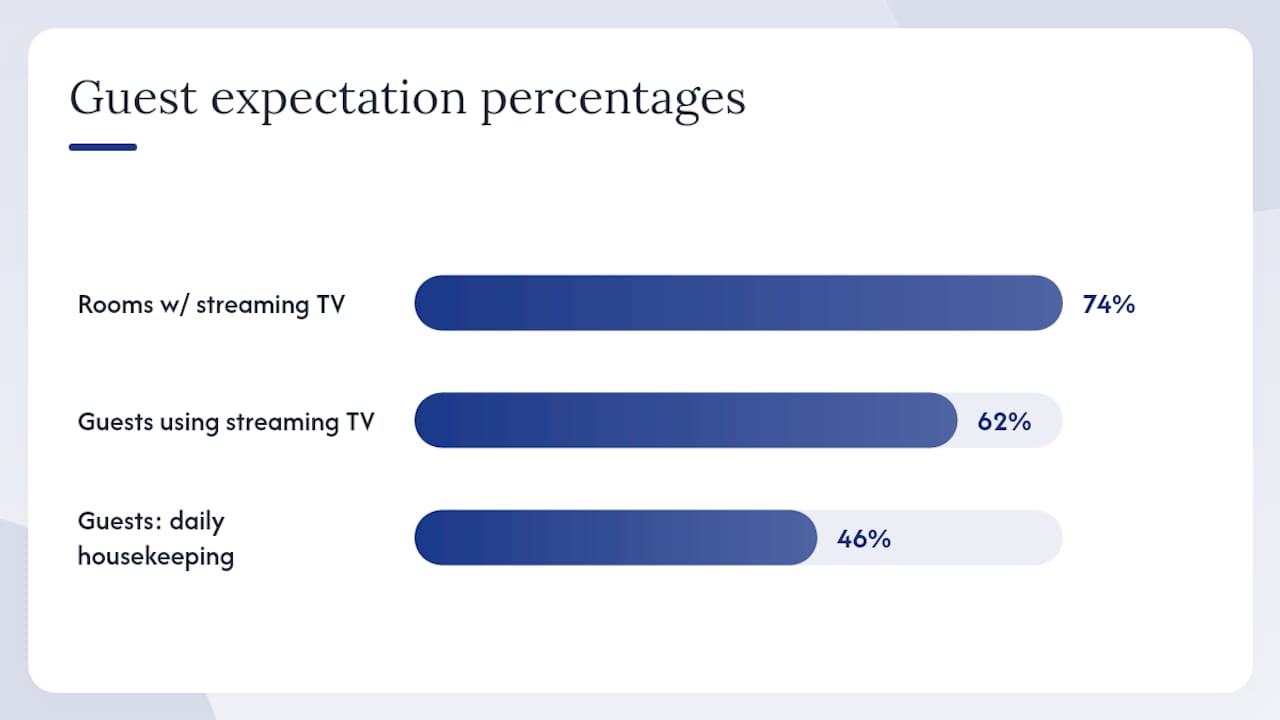
On amenities: JD Power’s satisfaction data shows that streaming-enabled smart TVs are now available in 74% of branded hotel rooms, with 62% of guests using them. Daily housekeeping is cited as a “need to have” by 46% of guests surveyed. These are no longer differentiators. Fast Wi-Fi, streaming-capable TVs, and filtered water are baseline expectations. Differentiators now sit at the sensory level: a locally curated turndown gift, a pillow menu, or a textile upgrade that guests notice and mention in reviews.
Personalization does not require a sophisticated CRM to start. A simple repeat-guest notes field in your PMS, reviewed during the pre-shift briefing, is enough to deliver the kind of anticipatory service that drives loyalty.
4. Integrate your technology stack for measurable consistency
The right system integrations free staff time for guest care and make quality measurable. A PMS that does not talk to housekeeping means room-ready delays. A maintenance system that is not connected to the defect log means repeat issues. These are not technology problems; they are operational problems that technology can solve when implemented correctly.
Integration checklist:
- PMS ↔ Housekeeping: Room status updates in real time; auto-alerts when a room is ready for inspection; occupancy data feeds cleaning priority queue
- Housekeeping ↔ Maintenance: Defect flags from room inspection route directly to maintenance tickets with priority level and target resolution time
- PMS ↔ CRM: Guest preference data (room type, floor, dietary, loyalty tier) syncs to pre-arrival briefing and in-stay service notes
- CRM ↔ Reputation aggregator: Post-stay survey triggers automatically; negative scores route to a prioritized response queue; review trends feed monthly KPI report
Automation use cases that deliver immediate operational value: auto-room-ready alerts that reduce check-in wait times, guest request routing that assigns tickets to the right department without a phone call, and post-stay survey automation that captures feedback before the guest’s experience fades. Mews’s operational best practices cite real-time housekeeping updates and embedded payment processing as two integrations that measurably reduce queue times and free front desk staff for higher-value interactions.
AI-assisted QA is also worth understanding. RapidEye Inspections’ QA research shows that AI can convert daily housekeeping photos into automated compliance checks, surfacing discrepancies in bed turns, amenity placement, and safety protocols without requiring a dedicated audit event. This shifts QA from periodic to continuous without adding headcount.
Pro Tip: Phase your technology rollout in 30-day increments. Train staff on one new system before introducing the next. Properties that deploy PMS, housekeeping, and CRM integrations simultaneously typically see a 60-day dip in compliance scores as staff revert to manual workarounds. Sequence the rollout, and measure adoption before adding complexity.
Risks to manage: data privacy compliance (ensure your PMS and CRM vendors meet applicable US data protection standards), and over-automation that removes human judgment from guest interactions. A chatbot that handles routine requests is an asset. A chatbot that handles a complaint about a broken air conditioner without escalating to a human is a liability.
5. Set physical standards your guests can see and feel
Consistent, hotel-grade materials and preventive maintenance reduce visible defects and guest complaints faster than most operational changes. A guest who notices a pilling duvet, a flickering light, or a bathroom fixture that drips will mention it in their review regardless of how good the service was.
Room inspection checklist at turnover:
- Bedding: no pilling, no staining, correct GSM for season, properly aligned and tensioned
- HVAC: set to standard arrival temperature, filter check weekly
- Lighting: all fixtures functional, bulb color temperature consistent across the room
- Minibar: fully stocked, no expired items, clean surfaces
- Bathroom fixtures: no drips, no limescale visible, grout clean, towels folded to spec
- Scent: neutral baseline (no cleaning product odor), optional signature scent if part of brand standard
- Signage and collateral: current, undamaged, correctly positioned
Linen performance attributes to require from your supplier:
| Attribute | Specification to Require | Why It Matters |
|---|---|---|
| GSM (grams per square meter) | Standard GSM range for sheets and towels | Determines weight, softness, and durability perception |
| Wash cycle tolerance | Minimum 150 industrial wash cycles before degradation | Reduces replacement frequency and total cost |
| Pilling resistance | Grade 4–5 on Martindale scale | Prevents visible surface degradation after repeated use |
| Colorfastness | Minimum colorfastness grade | Maintains appearance through repeated laundering |
| Certification | OEKO-TEX Standard 100 or equivalent | Confirms absence of harmful substances; supports brand trust |
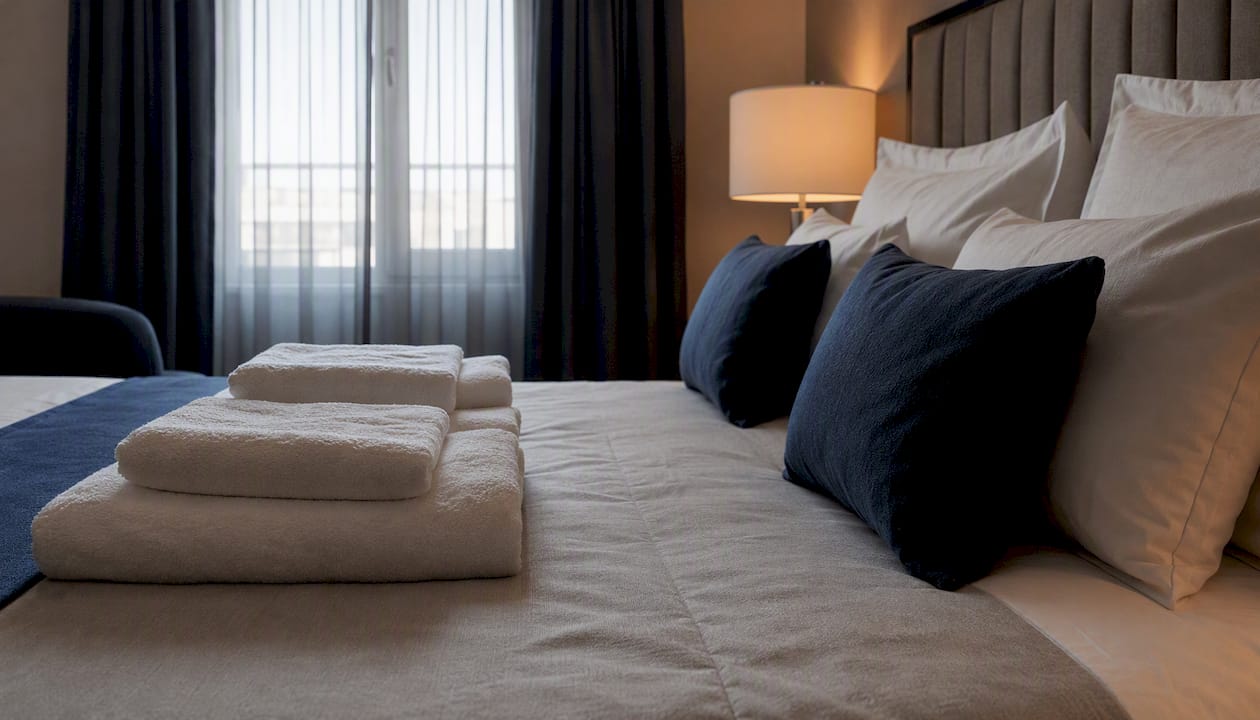
For a practical guide to textile upgrades in guest rooms and how specification choices affect guest perception, the detail on GSM ranges and wash tolerance is directly applicable to procurement decisions. Maximizing hotel textile durability also reduces the total cost of ownership, which matters when you are managing a 100-room property through multiple linen cycles per year.
The Michelin Key framework identifies consistent comfort and maintenance rituals as two of its five criteria for extraordinary service. That means the sensory experience of a room, including the weight of a towel and the smoothness of a sheet, is evaluated at the same level as service delivery. Spec your textiles accordingly.
Maintenance SLA by severity:
- Critical (safety risk, HVAC failure, flooding): response within 15 minutes, resolution within 2 hours
- High (broken fixture, no hot water, TV failure): response within 30 minutes, resolution within 4 hours
- Medium (cosmetic damage, minor plumbing, furniture scuff): logged and resolved within 24 hours
- Low (lightbulb, minor wear): scheduled in next preventive maintenance cycle
F&B presentation standards follow the same logic. A table reset SOP that specifies linen alignment, cutlery placement, and glassware polish standard takes 10 minutes to write and eliminates the most common F&B complaints. Temperature standards (hot dishes served above 140°F, cold dishes below 40°F) should be logged, not assumed.
6. Run a QA cadence that catches problems before guests do
The right audit cadence prevents audit fatigue while catching issues early. A property that runs a full audit every week burns out its team and produces diminishing returns. One that audits quarterly misses the defects that accumulate between cycles. The answer is a layered system.
| Cadence | Type | Owner | Frequency | Sample Size | Action Triggered |
|---|---|---|---|---|---|
| Continuous | Digital monitoring (photo-verified, review tracking) | Housekeeping supervisor / tech system | Daily | All rooms in rotation | Immediate defect ticket if threshold exceeded |
| Monthly | Light-touch internal audit | Department head | Monthly | 20–30% of rooms | SOP update, targeted retraining |
| Quarterly | Deep-dive audit | GM + department heads | Quarterly | 100% of rooms + all departments | Corrective action plan with 30-day closure target |
| Mystery guest | Unannounced third-party evaluation | External vendor | 2–4 times per year | Full guest journey | Strategic review, training redesign if needed |
Hotel quality management research recommends exactly this layered cadence: quarterly deep dives, monthly light-touch checks, and continuous digital monitoring. Mystery guests are used strategically, not as a substitute for the internal system. Les Roches hospitality QA guidance reinforces the value of regular inspection schedules tied directly to training programs, so audit findings feed the next training cycle rather than sitting in a report.
The root-cause loop works like this: audit identifies a defect, the defect is logged with department, root cause, and severity, a corrective action is assigned with a named owner and a closure date, and the fix is verified at the next audit cycle. When the ratio drops below 3:1, your QA system is underperforming.
Scoring thresholds give teams a clear signal.
Pro Tip: Treat maintenance as a ritual, not a checklist. Have housekeeping staff walk barefoot on carpets during inspection to detect snags and uneven wear that visual checks miss. Have engineering test faucet temperatures during shift handover rather than waiting for a guest complaint. These tactile checks surface defects that no digital system will catch — and they build a quality-first culture that checklists alone cannot create.
7. Follow a 90-day roadmap with clear owners and budget guidance
A focused 90-day sprint with three priority initiatives keeps momentum and shows measurable ROI before budget cycles close. Trying to fix everything at once produces partial implementations across all areas and measurable improvement in none.
| Phase | Tasks | Owner | Budget Range | Success Metric |
|---|---|---|---|---|
| Days 1–30 | Publish SOPs for top 3 complaint areas; launch daily pre-shift briefings; set up complaint tagging system; schedule first monthly audit | GM + department heads | Low cost | Complaint rate down 15%; audit scheduled |
| One-month period | Deploy microtraining modules for service recovery; integrate PMS-to-housekeeping alerts; run first mystery guest evaluation; standardize linen specs | Department heads + IT | Medium cost | NPS up 5 points; room-ready time reduced |
| Two-month period | Complete textile refresh for highest-traffic rooms; launch post-stay survey automation; run quarterly deep-dive audit; review defect-to-complaint ratio | GM + procurement | Higher investment cost | Defect-to-complaint ratio at 3:1; GSI improvement |
Budget guidance by initiative type:
- SOP rollout and documentation: Low cost, primarily staff time. A department head spending 4 hours per SOP produces a 6-month operational asset.
- Staff microtraining: $50–$150 per staff member for a structured module library; peer-to-peer shadowing costs nothing beyond scheduling.
- Textile refresh (high-traffic rooms): Cost varies by property size and current spec. Upgrading to a 400 GSM sheet with a 150-cycle wash tolerance typically reduces annual replacement costs by 20–30% compared to lower-spec alternatives.
- Tech integrations (PMS-housekeeping-CRM): $3,000–$15,000 depending on existing infrastructure and vendor. ROI is measurable within 60 days through reduced check-in wait times and complaint resolution speed.
Governance rhythm:
- Daily: pre-shift briefing (10 minutes, shift lead)
- Weekly: ops review (30 minutes, department heads + GM)
- Monthly: KPI review (NPS, complaint rate, defect ratio, RevPAR)
- Quarterly: deep-dive audit + corrective action review
Change management is where most 90-day plans fail. Frontline staff need to understand why standards are changing, not just what is changing. A 5-minute explanation of how a new linen spec reduces their workload (fewer re-inspections, fewer guest complaints to handle) generates more buy-in than a memo from management. Involve shift leads in SOP drafting. Their operational knowledge improves the document, and their ownership of it improves compliance.
What actually works in practice: a field perspective
The most common mistake in hotel standard improvement programs is treating the SOP document as the finish line. It is not. The finish line is the moment a housekeeper catches a pilling duvet before a guest does, or a front desk agent resolves a complaint without escalating it, because they have both the knowledge and the authority to act.
In practice, the fastest gains come from two places: fixing the physical product and fixing the handover. A property that upgrades its linen specification from a 200 GSM sheet with a 50-cycle wash tolerance to a 350 GSM sheet rated for 150 cycles will see a measurable drop in room-inspection defects within the first laundry cycle. The reason is not just durability; it is that higher-spec textiles hold their appearance longer, which means fewer re-inspections, fewer guest complaints about bedding, and fewer emergency replacements that disrupt housekeeping schedules.
The handover problem is subtler. When the morning housekeeping shift does not communicate defects to the afternoon shift, the same issue gets reported by a guest that evening. A simple shift handover log, whether digital or paper, eliminates this. The technology is irrelevant; the discipline is everything.
One practical warning: do not implement brand standards as an identical checklist across different guest segments. A business traveler and a leisure family have different definitions of “clean,” “comfortable,” and “responsive.” Your SOP for a business-floor room should weight desk lighting, fast Wi-Fi confirmation, and a quiet HVAC over the decorative elements that matter more in a leisure suite. Segment your standards, not just your rates.
The other failure mode is deploying technology without training. A PMS-to-housekeeping integration that staff route around because they do not trust it produces worse data than a manual log. Train before you go live, and measure adoption before you measure outcomes.
Gjergjihtextil supports hotel-standard upgrades with specification-grade textiles
Upgrading your physical standards is faster when your textile supplier understands hotel operations, not just thread counts. Gjergjihtextil provides hotel-grade linens, towels, bedding, and uniforms built for industrial wash cycles, with specification advisory that ties directly to the defect-to-complaint ratios and maintenance SLAs described in this article.
The practical difference: Gjergjihtextil’s B2B supply model means you receive textiles specified for your property’s actual wash cycle volume and room count, not a retail product repackaged for hospitality. Durability under repeated industrial laundering, OEKO-TEX-aligned certification, and colorfastness grades that hold through 150+ wash cycles are the baseline, not an upgrade tier. For hotels managing 30 or more rooms, that specification consistency reduces annual textile replacement costs and eliminates the defect spikes that come with under-spec’d materials.
For procurement managers working through a hotel textile selection process, Gjergjihtextil offers sample reviews and specification consultations for properties looking to align their textile investment with operational KPIs. Contact the team directly to request a spec review or sample set for your property’s highest-traffic room categories.
Sources
These sources back the frameworks, benchmarks, and specifications in this article. Each one has a specific operational use for hotel managers.
- Hotel quality management: building a system your auditors and your gm both trust
- Hotel Operational Excellence in Practice: The SOPs, KPIs and Playbooks That Scale
- Hotel Management Tips to Elevate Guest Experience
- Tips for quality assurance and standards in hospitality