

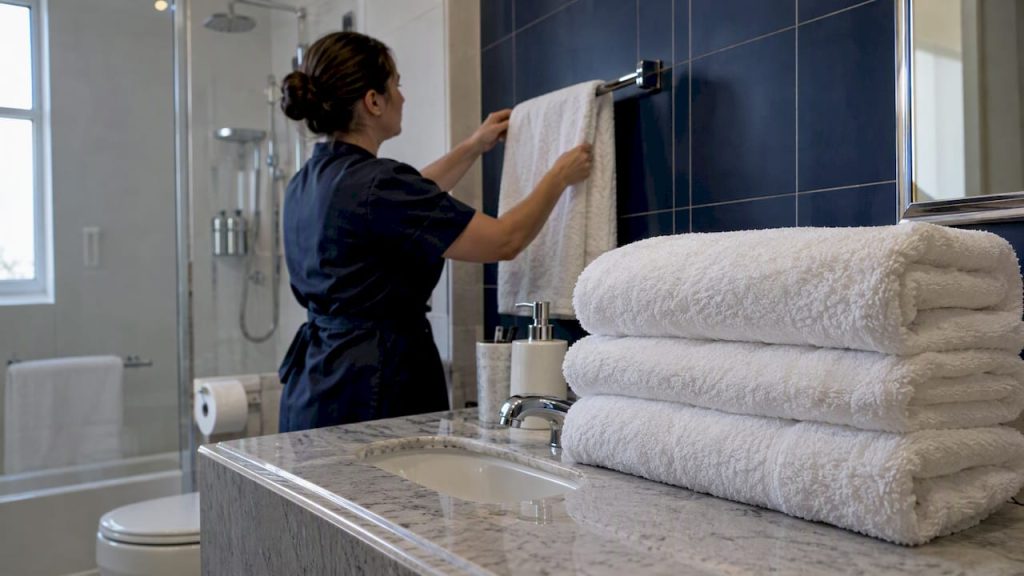
Zero-twist towels deliver the softest out-of-the-box feel of any cotton terry construction because their pile yarns skip the tight twist that stiffens loops, but that softness only holds up over time if the GSM, pile height, and finishing are right. Before ordering, check the GSM, ask for wash-test or laundering data, and confirm any certification claims. We have supplied hospitality textiles for more than 30 years, including 300-wash durability testing on hospitality towel lines.
TL;DR:
- Guest rooms suit 400 to 500 GSM for comfort and manageable drying; spa towels can reach 500 to 650 GSM when plushness outweighs turnaround speed.
- Request loop extraction and tensile data after multiple commercial wash cycles; 300 washes is one supplier’s internal benchmark, not an industry standard.
- Treat zero twist as a construction detail, not a full specification: confirm fiber content, pile height, yarn count, finishing, and the exact certification scope.
- Ring spun yarn generally retains tensile strength and appearance better than open end yarn, but costs more; verify the yarn type before ordering.
- High turn properties should favor denser, lower GSM or twisted towels unless their laundry program controls temperature, detergent, and cycle settings to protect loose loops.
Table of Contents
- What zero-twist means for towel construction
- How zero-twist affects softness, absorbency, drying, and durability
- A practical checklist: what to compare when buying zero-twist towels
- Hospitality-grade specs and procurement notes from Gjergji H Tekstil
- Overview of typical zero twist towel applications in hospitality settings
- Advantages of zero twist towels specifically for hotels and restaurants
- Cost analysis: pricing ranges and total cost of ownership for zero twist towels
- Recommended laundering and care guidelines customized for commercial hospitality use
- When we pick zero-twist: practical procurement judgment
- FAQ
- Sources
What zero-twist means for towel construction
A twisted pile yarn is spun with turns per inch that lock the cotton fibers together, giving the loop structure and some rigidity. A zero-twist, or twistless, pile yarn skips that step: the fibers run parallel with little to no twist, so the loops stay looser and the surface feels plusher against skin. That difference is structural, not cosmetic. A peer-reviewed comparison of yarn structure variables found that twistless pile towels showed greater absorptive capacity and lower flexural rigidity than twisted pile towels in controlled testing, which is the measurable basis for the “softer hand” marketing language you see on product pages.
Softness and stiffness, though, are never determined by twist alone. Pile height, weft density, and weft yarn count interact with the twist level to shape the final feel and performance. A tall, loose pile on a twistless yarn feels different from a short, dense one, and a heavier weft density can offset some of the softness gain by adding structure back into the fabric. The same study that measured absorptive capacity and flexural rigidity also varied pile height and weft density alongside yarn type, because isolating twist alone does not explain real-world towel behavior.
This is where labeling gets loose. “Zero-twist” has become a selling point on product listings, but the term is not standardized or independently verified the way a certification mark would be. Two towels both marketed as zero-twist can differ meaningfully in how they perform once GSM, pile height, and yarn count vary.
Before you take a label at face value, check:
- Fiber content, since 100% cotton behaves differently from cotton-polyester blends even at the same twist level
- GSM and pile height, since these determine water capacity and drying speed more than twist alone
- Whether any wash-test or lab data backs the softness or durability claim, rather than relying on marketing copy
Zero-twist construction is a real, physically distinct category. It just is not a complete spec on its own, and treating it as one is the most common buying mistake we see among first-time hospitality procurement teams.
How zero-twist affects softness, absorbency, drying, and durability
The appeal of zero-twist towels is real: looser pile yarns trap more surface area for moisture contact, and a peer-reviewed comparison found twistless pile towels had greater absorptive capacity and longer absorbency time than twisted pile towels. Separate research on cotton terry fabric found that moisture absorption depends on fabric weight, thickness, and pile-yarn twist together, not twist in isolation, measured through absorption rate, absorption time, and vertical wicking.
A 2020 yarn-structure study found that heavier, thicker towels absorb more water and show higher water-vapor permeability, with GSM and yarn parameters together driving comfort outcomes. That means a 600 GSM zero-twist towel will generally hold more water than a 400 GSM one, but it also takes longer to dry and adds more weight to a laundry load, a real operating cost for any property running its own wash cycles.
The trade-offs worth weighing before you buy:
- Plush feel versus dry time: a taller, looser pile feels luxurious in hand but retains more water, extending dryer cycles.
- Heavier GSM versus laundry throughput: more absorbent towels mean fewer towels per dryer load, which matters at hotel volume.
- Initial softness versus post-wash performance: a towel can feel excellent new and lose structure after repeated commercial laundering if the construction was not built for it.
Durability is the piece that marketing language tends to skip. An experimental study on 100% cotton terry fabrics wove nine different constructions, ran them through five washing cycles, and measured air permeability, resistance to pile-loop extraction, bursting strength, tensile and tear strength, and abrasion resistance using standard ISO and EN test methods. The same research found that weft yarn count, weft density, and the number of wash cycles a towel has already been through all materially change those numbers, which is why a single new-towel sample tells you very little about year-two performance.
Two tests matter most for buyers evaluating durability claims:
- Pile-loop extraction resistance, which measures how well the loops stay anchored instead of pulling free during use and washing.
- Tensile and bursting strength, which measures how the base fabric holds up under the mechanical stress of industrial extraction and pressing.
Ring-spun yarns generally outperform open-end yarns on tensile strength and long-term appearance in terry construction, so it is worth asking a supplier directly which spinning method they use rather than assuming all cotton yarn behaves the same under repeated laundering.
A practical checklist: what to compare when buying zero-twist towels
Comparing zero-twist towels by feel alone is unreliable once you are buying for repeat commercial use. Work through the specs in this order.
- Check GSM first. Towels in the 400 to 500 GSM range suit everyday home or guest-room use, balancing softness with reasonable dry time. Properties running higher-end spa or resort programs often look at 500 to 700 GSM for a heavier, plusher feel, accepting the longer dry cycle that comes with it. For more detail on how GSM interacts with laundry cost at the heavier end, see our notes on 400 to 500 GSM hotel robe materials, which apply the same logic to bath textiles.
- Ask about pile height and yarn count. A taller pile on a zero-twist yarn increases softness and absorbency but is more vulnerable to loop pull if the base fabric is not dense enough to anchor it.
- Confirm ring-spun versus open-end yarn. Ring-spun costs more but holds tensile strength and appearance better through repeated commercial washing.
- Ask what finishing or chemical treatments were applied. Some softening finishes fade after a handful of wash cycles, which can make a towel feel softer in the showroom than it will in month three of service.
- Request the OEKO-TEX certificate number and scope, not just the logo. OEKO-TEX Standard 100 is a product-testing and certification system tied to specific articles and components, so a certificate covering one towel line does not automatically cover every size, color, or trim a supplier sells. We break this down further in our guide to what OEKO-TEX certification means for hotel textile buyers.
- Ask for post-wash test data, not just new-towel specs. A supplier who can show pile-loop extraction and tensile results after multiple wash cycles is giving you a real durability picture.
- Check size and hem construction. Hems that are double-stitched or reinforced hold up better under repeated industrial laundering and pressing than a single fold.
Pro Tip: Ask any supplier for a sample that has already been through at least five commercial wash cycles, not a fresh-off-the-line piece, so you can feel what guests will actually experience by month two.
Sample spec targets by use case: everyday home bath towels typically run 400 to 500 GSM with a medium pile height; hotel guest towels for standard rooms often target the same range for a balance of guest comfort and laundry turnaround; spa and pool towels benefit from heavier GSM, in the 500 to 650 range, since guests expect a plusher, more absorbent feel and faster turnover is less critical than in guest rooms.
Hospitality-grade specs and procurement notes from Gjergji H Tekstil
Hotel procurement runs on different math than a retail purchase. A towel that feels great to one guest once has to survive repeated industrial wash cycles and still feel acceptable to the next guest. That is why we test our towel lines through extensive wash cycles before setting a product’s recommended service life, rather than relying on new-towel feel alone.

The metrics that matter in that testing line up with what independent terry fabric research measures: resistance to pile-loop extraction, remaining water ratio after extraction, and bursting or tensile strength, all of which change measurably with repeated laundering cycles according to controlled experimental testing. A towel that scores well on all three after extensive washes is a towel that will still look and perform acceptably in a guest room two or three years into a laundry rotation, which is the real question a hotel operator needs answered, not how the towel feels in a showroom.
Sizing and GSM pairing should follow how a towel will actually be used and laundered:
- Standard guest bath towels typically run in the 400 to 500 GSM range at a size around 70 by 140 centimeters, balancing guest comfort with reasonable dry times on commercial equipment, a pairing we detail in our hotel towel spec guide for procurement.
- Spa and wellness towels often run heavier, since guests expect a plush feel and turnaround speed matters less than in a guest room.
- High-turn economy properties sometimes do better with a slightly lower GSM and denser weave to cut dry time and laundry cost per cycle, even at some expense to initial plushness.
| Spec factor | What to check | Why it matters for hotels |
|---|---|---|
| GSM | 400 to 500 for guest rooms, 500 to 650 for spa use | Balances guest comfort against dryer cycle time |
| Pile-loop extraction resistance | Post-wash lab results, not new-towel claims | Predicts how towels hold appearance after repeated laundering |
| Yarn type | Ring-spun vs open-end, stated by supplier | Ring-spun generally holds tensile strength longer |
| Certification scope | Exact OEKO-TEX certificate number and product scope | Confirms the claim applies to the specific line you are buying |
Supply-chain control reduces the variability that makes multi-property procurement difficult. When import, design, and production are coordinated, a hotel group reordering the same spec next year gets consistent yarn count, finishing, and pile height, rather than a close approximation from a different mill. For a full procurement reference, our hotel towel quality checklist walks through the questions worth asking any supplier before a bulk order.
Overview of typical zero twist towel applications in hospitality settings
Zero-twist towels show up across several points of a hospitality operation, not just in guest bathrooms. Guest room bath towels and hand towels are the most common application, where the plush first impression matters for guest satisfaction scores. Spa and wellness areas use heavier zero-twist towels for treatment rooms and pool decks, where absorbency and a luxury feel matter more than fast turnaround. Bathrobes in premium rooms often use a related zero-twist terry construction for the same soft-hand reasons as towels.
Restaurants with attached washrooms or staff facilities sometimes specify the same construction for hand towels, trading a bit of durability for guest-facing softness in high-visibility areas. Event venues and banquet operations use zero-twist towels more selectively, usually reserved for VIP amenities rather than general-use stock, since the heavier laundering load from event volume favors sturdier constructions in back-of-house areas.
The common thread across all these settings is that zero-twist construction gets reserved for guest-facing, comfort-driven touchpoints, while higher-turnover or heavy-duty applications lean on denser, twisted-yarn alternatives built for volume over plushness.
Advantages of zero twist towels specifically for hotels and restaurants
Guest satisfaction scores respond to tactile details more than most operators expect, and towel feel is one of the few amenities a guest touches directly multiple times during a stay. Zero-twist construction gives hotels a measurable edge here: the lower flexural rigidity and higher absorptive capacity shown in peer-reviewed testing translate into a towel that feels noticeably softer and dries skin faster during actual use.
For restaurants, the advantage shows up less in guest-facing towels and more in staff and washroom applications, where a soft hand towel reinforces the same attention to detail that shows up on the table linens. Properties running spa or wellness programs get a second benefit: the higher absorptive capacity documented in terry fabric research means fewer towels needed per treatment, which can offset some of the added laundry weight from heavier GSM.
The advantage is conditional, though. It depends on a laundering program built to preserve the construction, since the same looseness that creates softness also makes zero-twist pile more vulnerable to loop extraction under aggressive industrial washing without the right detergent and cycle settings.
Cost analysis: pricing ranges and total cost of ownership for zero twist towels
Total cost of ownership for commercial towels extends well past the per-unit purchase price. A heavier zero-twist towel costs more upfront per unit than a lighter twisted-pile alternative, largely because it uses more cotton and often a pricier ring-spun yarn. That upfront cost compounds through the laundry cycle: heavier, more absorbent towels take longer to dry and add weight to each load, both of which affect utility and labor cost per wash cycle.
Durability shifts the math the other direction. A towel engineered to hold its pile-loop structure and tensile strength through hundreds of wash cycles, the kind of performance we test for across 300 washes on our own lines, spreads its purchase cost over a longer service life, which lowers the real cost per guest-night even if the sticker price is higher than a budget alternative.
The practical takeaway for procurement: evaluate price per expected wash cycle, not price per towel. A supplier who can show post-wash durability data lets you run that calculation with real numbers instead of guessing at replacement frequency. Our guide to maximizing hotel textile durability and cutting costs walks through that calculation in more detail for mixed hotel linen programs.
Recommended laundering and care guidelines customized for commercial hospitality use
Commercial laundering is the single biggest factor in how long a zero-twist towel keeps its feel and structure, more than the initial construction spec. Wash temperatures and detergent chemistry that are too aggressive accelerate pile-loop extraction, the exact failure mode that independent terry fabric testing tracks across repeated wash cycles.
A few guidelines worth building into a hospitality laundry program:
- Avoid chlorine bleach on zero-twist cotton towels where possible, since harsh bleaching cycles weaken fiber structure faster than oxygen-based alternatives.
- Keep wash temperatures within the range the mill recommends for the specific GSM and finish, since over-hot cycles can degrade finishing treatments faster than the cotton itself.
- Separate heavier spa or pool towels from lighter guest towels in the wash cycle, since mixed loads with uneven absorbency can extend dry times across the whole load.
- Rotate stock systematically so every towel in a property’s inventory accumulates wash cycles at roughly the same rate, making it easier to predict replacement timing.
Industrial laundries and in-house hotel laundry operations benefit from asking their textile supplier for explicit care instructions tied to the specific construction they bought, rather than applying a generic cotton towel care routine across different GSM and finish combinations.
When we pick zero-twist: practical procurement judgment
Zero-twist earns its place in premium guest rooms, spa programs, and resort amenities where the plush first touch genuinely affects how a stay gets remembered. We recommend it with more caution for very high-turn economy properties, where laundry volume and aggressive wash cycles put more stress on pile-loop structure than the construction may be built to handle without a carefully managed laundering regime.
The deciding factor is rarely the marketing language on a product listing. It is whether the laundry program, water temperature, detergent chemistry, and cycle count match what the construction was engineered to withstand. A towel with excellent zero-twist softness, run through the wrong wash cycle for years, will disappoint a property faster than a slightly firmer construction run correctly. That is the judgment call we make with procurement teams every time a spec conversation starts with “soft” instead of “how will this get washed.”
— Xpert
FAQ
What does zero twist mean for towels?
Zero-twist, or twistless, means the pile yarns are spun with little to no twist, leaving the cotton fibers looser than in a standard twisted pile yarn. That looseness is what gives zero-twist towels their notably softer feel and greater absorptive capacity compared with twisted pile construction.
Is zero twist cotton good?
Zero-twist cotton performs well for softness and moisture absorption, supported by peer-reviewed comparisons showing higher absorptive capacity and lower flexural rigidity than twisted pile cotton. Durability depends on additional factors like GSM, pile height, and yarn count, so a well-constructed zero-twist towel with the right finishing and laundering care performs reliably over time.
Where can I find 100% zero twist cotton towels?
Zero-twist cotton towels are available through hospitality textile suppliers, specialty bath retailers, and wholesale importers who can confirm fiber content, GSM, and yarn construction directly. For bulk or commercial purchasing, working with a supplier who can provide wash-tested durability data, such as our hotel and Airbnb textile offerings, gives you more certainty than a retail listing alone.
What type of towels do 5 star hotels use?
High-end hotels typically specify towels in the 500 to 650 GSM range with dense, well-anchored pile construction, often using zero-twist or low-twist yarns for guest-facing softness. The exact spec varies by property and laundering program, but durability testing, such as resistance to pile-loop extraction after repeated wash cycles, matters as much as the initial feel when selecting a commercial-grade towel.
How many wash cycles should a quality hotel towel survive?
There is no single industry-wide number, since durability depends on GSM, yarn type, and laundering chemistry, but 300 wash cycles is a benchmark we use internally when testing our own hotel towel lines. Procurement teams should ask any supplier for their own post-wash test data rather than assuming a universal standard applies.
Sources
We built our approach around the full chain that determines whether a zero-twist towel performs past its first few wash cycles: wholesale import, manufacturing, and custom production. That control lets us match GSM, pile height, and yarn type to the laundering regime a property actually runs, rather than selling a generic spec and hoping it holds up.
If you are sourcing towels for guest rooms, a spa program, or a restaurant washroom, our coordination of linens for short-term rentals is a key operational consideration to ensure consistent guest satisfaction along with the GSM and construction ranges discussed here, backed by the wash-testing we run internally before recommending a spec. We also put together a hotel towel quality checklist procurement teams can use to vet any supplier, including us, before committing to a bulk order. Reach out for sample towels, post-wash test data, or a direct conversation about matching a construction to your laundry program.
- Effect of yarn structure variables on comfort for cotton towels (peer-reviewed comparative study)
- Study of moisture absorption characteristics of cotton terry towel fabrics
- OEKO‑TEX STANDARD 100 — FAQs (official documentation)
- An Experimental Study on Selected Performance Properties of 100% Cotton Terry Fabrics