

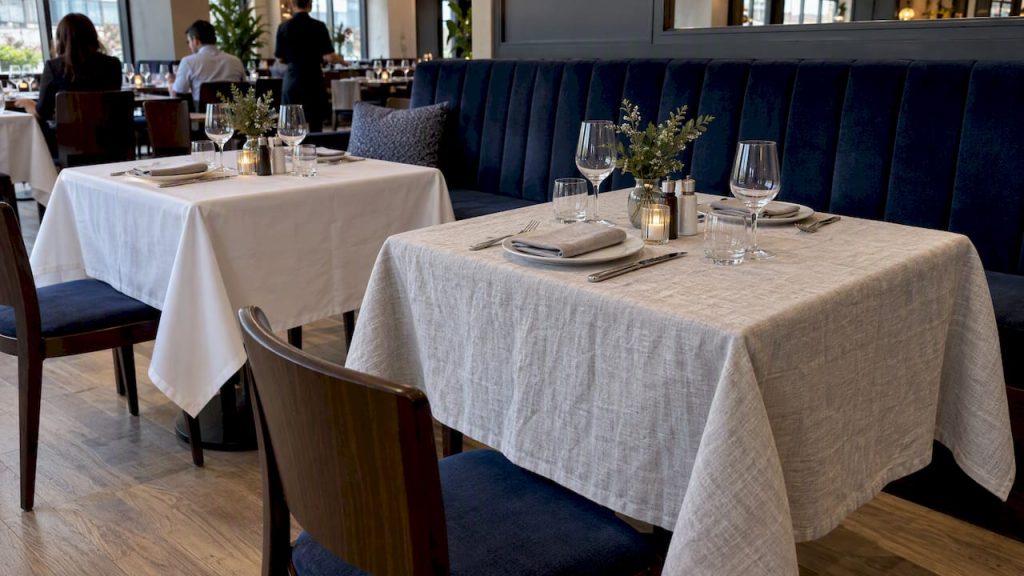
For most hotels and restaurants, the answer depends on what the cloth has to do. Linen gives you the stronger fiber, a visible natural texture and a relaxed drape, but it creases and costs more. Cotton gives you a smoother, more polished table that is easier to keep crisp, and it is the usual choice for high-turnover service. Neither is “better” in the abstract. The right choice follows your concept, your laundry cycle and how often a cloth is replaced.
This guide is written for hotel managers, restaurant owners and event venue operators in Albania and the wider Balkans who buy tablecloths and napkins in volume. It compares the two fibers on appearance, durability, care and cost, then shows where polyester blends fit, and ends with a checklist you can use before you place a bulk order.
TL;DR
- Linen is made from flax and is one of the strongest natural fibers, with a textured surface and a relaxed drape. It suits formal dining, boutique hotels and special events.
- Cotton looks smoother and more uniform, and is easier to keep crisp. It suits daily restaurant service, breakfast rooms and banquets that need a clean, classic look.
- Durability depends as much on weave, weight and wash temperature as on the fiber. Ask for these specifications in writing before ordering.
- For napkins in heavy service, a cotton-polyester blend often lasts longer and stains less, while 100% cotton absorbs better.
- Match the fabric to the room: linen where texture is part of the brand, cotton where consistency is, a blend where volume is.
Table of Contents
- How linen and cotton differ on the table
- Durability under repeated laundering
- Care and laundering: what your laundry team needs to know
- Where each fabric belongs
- Napkins: cotton or polyester?
- Our view: what we tell hotel and restaurant buyers
- Specifications to check before you order
- Supply for hotels and restaurants in Albania and the region
- FAQ
- Sources
How linen and cotton differ on the table
Both fibers are natural and breathable, but they look and behave differently once the cloth is on the table and a guest sits down.
Appearance. Cotton tablecloths generally have a smooth, polished look, the kind you see in fine-dining rooms. Linen has a more relaxed drape and a distinct, visible woven texture, because flax threads are thicker than cotton threads (Wirecutter). That texture is the main reason people choose linen, and the main reason others avoid it.
Feel. Cotton usually feels softer when new. Linen can feel crisper at first and, as a natural fiber, develops a softer hand over time with washing. If your guests handle the cloth directly, for example at a buffet or a communal table, softness matters more than it does on a table covered by plates and runners.
Creasing. Linen wrinkles easily and has limited elasticity. The Utah State University extension reference lists this alongside its strengths: linen is absorbent, quick-drying and washable, and it does not have pilling or lint problems (Utah State University). In a rustic or Mediterranean setting, creasing reads as character. In a formal dining room with white cloths and polished glassware, it reads as a mistake unless the cloth is pressed.
Moisture. Cotton is highly absorbent. Linen absorbs up to about 20% of its weight in moisture and dries fast (Silvester Fabric). For a terrace table in an Albanian summer, quick drying after a wipe-down or a laundry cycle is a real operational advantage.
Quick comparison
| Criterion | Linen | Cotton |
|---|---|---|
| Source fiber | Flax | Cotton plant |
| Surface | Visible natural texture | Smooth, uniform |
| Drape | Relaxed | Crisper, more structured |
| Creasing | Creases easily | Generally less prone to creasing |
| Fiber strength | Among the strongest natural fibers | Strong, abrasion-resistant |
| Drying | Dries fast | Absorbs more, dries slower |
| Typical fit | Formal, boutique, special occasions | Daily service, banquets, breakfast |
| Purchase price | Usually higher | Usually lower |
The creasing point comes with a caveat. Depending on weave and thickness, cotton tablecloths range from lightweight to heavy-duty, so a thin cotton can crease as badly as a mid-weight linen. Judge the sample, not the fiber name.
Durability under repeated laundering
This is the question that matters most for a hotel, because a tablecloth is not a one-off purchase. It is a number of washes you are buying.
What the fibers can take
A textile reference guide describes linen as highly durable, with two to three times the strength of cotton, while cotton is strong and abrasion-resistant but not very resilient (Maxwell Fabrics reference guide). On fiber strength alone, linen wins.

But fiber strength is not service life. Linen is stiff and has poor elasticity, so it tends to wear first along folds and edges, where the same creases are pressed again and again. Cotton is more forgiving of folding and mangle ironing. In practice, a tightly woven, heavier cotton can outlast a loose, light linen.
What the tests say about cotton in industrial washing
There is useful academic evidence on cotton in hotel conditions, although it concerns sheets rather than tablecloths. A 2022 study from the Federal University of Technology of Paraná in Brazil found that 100% cotton, 300-thread satin hotel sheets showed satisfactory durability after 200 industrial washes (UTFPR). It does not prove the same for a tablecloth, but it shows that quality cotton, well woven and properly laundered, is not a short-life product.
We would not give a single “number of washes” for linen or cotton tablecloths, because service life moves with weave, weight, finishing, detergent, water temperature and how stains are treated. Anyone who quotes you one figure for a fiber without those variables is simplifying.
The three things that decide service life
- Weight and weave. A heavier, tighter weave resists snagging and thinning. Ask for the weight in grams per square meter and the weave type for every cloth, not only the fiber percentage.
- Wash temperature and chemistry. Hot cycles remove grease and wine, but excessive heat and harsh chemistry shorten fiber life. We cover this trade-off in our guide to industrial wash temperatures for hotel linen.
- Handling. Cloths left stained for days, overloaded in machines or dragged over rough surfaces fail early, whatever the fiber.
For a broader view of what makes hotel fabrics last, see key traits of durable hotel fabrics and how to maximize hotel textile durability and cut costs.
Care and laundering: what your laundry team needs to know
Care is where the two fibers differ most in daily work, and where a wrong assumption costs you cloths.
General routine. Pretreat stains and wash table linens promptly. Most can be washed in cold or warm water on a permanent-press cycle and dried on medium-high heat or a permanent-press setting, while delicate or vintage items should be air-dried (The Spruce). Commercial fabrics are usually finished for hotter cycles, so always follow the label of the specific product.
Temperature and shrinkage. One Swedish linen and cotton manufacturer recommends washing its fabrics at 60°C, says they can withstand 85 to 90°C if necessary, and notes that its tablecloths shrink about 5% in width and 7% in length, with tumble drying and dry cleaning not recommended (Insjöns Väveri). That is one manufacturer’s guidance, not a universal rule, but it shows why you should ask for shrinkage figures before you order cloths to fit specific table sizes. A cloth cut to fit that shrinks 7% in length will look short after the first wash.
Linen specifics. Use a gentle detergent, avoid overloading the machine, remove the cloth promptly after washing, reshape it before drying and iron according to the label if you want a pressed finish (Linen Fashion). The point about removing it promptly matters in a busy laundry: a linen cloth left damp in a heap creases deeply and is far harder to press.

Cotton specifics. Cotton handles routine cycles and pressing well, which is why it is so common in restaurants with in-house or outsourced industrial laundry. Its weakness is its absorbency: wine and oil soak in, so stains should be treated before the wash, not after.
Cost per use, not cost per cloth
Linen usually costs more to buy. Whether it costs more to own depends on how many services it survives and how much pressing time it needs. A practical way to compare is to divide the purchase price by the realistic number of services, then add the labor of ironing. A cheap cotton cloth that is replaced twice as often can cost more per use than a better one, and a linen cloth that needs hand pressing before every service can cost more in labor than it saves.
Where each fabric belongs
Choose linen when
- texture is part of your identity, for example a boutique hotel, a farm-to-table restaurant or a seaside venue with a relaxed but premium feel;
- the cloth is used for special occasions and formal dinners where natural texture is wanted, which is how linen is generally positioned (Silvester Fabric);
- you have a laundry process that handles gentle washing and prompt removal;
- you accept visible creasing as part of the look, or you have staff time to press.
Choose cotton when
- you need a smooth, uniform surface across dozens of tables;
- cloths go through frequent laundering and you want predictable results;
- you set tables for breakfast, banquets and conferences where the look should be clean and consistent;
- budget per table matters, as cotton and cotton-linen blends are generally the everyday option.
Consider a cotton-linen blend
A blend sits between the two: more texture than plain cotton, fewer creases than pure linen, and a more moderate price. It is a sensible compromise for a hotel with both a formal restaurant and a casual terrace that wants one visual language.
Napkins: cotton or polyester?
Napkins are handled more, stained more and washed more than tablecloths, so the fiber choice shifts.
Cotton napkins absorb well, feel good against the hand and mouth, and look right in upscale and mid-range restaurants. Their downsides are creasing, some shrinkage and a tendency to hold stains if they are not pretreated.
Polyester and cotton-polyester napkins resist wrinkles and stains better and are long-lasting, but they are less absorbent and feel less natural. Polyester suits high-volume service where ease of maintenance matters more than hand feel. Trade guidance from linen suppliers is consistent on this point, and a common recommendation is a blend with a weight around 140 to 180 GSM for sit-down restaurants.
A useful rule: if the napkin is meant to do a job (wipe fingers, absorb a spill), pick cotton or a blend with a high cotton share. If it is mainly a visual element or sits in a very high-turnover operation, a blend or polyester is defensible. Light colors show stains most, which is a reason blends are popular in cafés and breakfast service.
For the detail on how these fibers behave in hospitality, read polyester-cotton in hospitality: what buyers need to know and polyester versus spun polyester.
Our view: what we tell hotel and restaurant buyers
We have supplied hospitality businesses since 1994, and we import, design and produce textiles ourselves. That means we see the same pattern in purchasing again and again: buyers compare the fiber name and the unit price, and they skip the specification that drives the real cost.
Our advice is practical.
- Decide the role of each table first. A tablecloth for a signature dining room and one for a breakfast buffet should not be the same product, and often should not be the same fiber.
- Buy by specification, not by label. Ask for weight, weave, finishing, shrinkage and the recommended wash conditions, and compare these across suppliers.
- Test before you commit. Wash a sample through your own laundry, or your laundry partner’s, several times. See how it creases, shrinks and handles stains before you order for the whole property.
- Plan the par level. Having enough sets in rotation reduces wear per cloth, because no single cloth is washed every day.
- Do not choose on price alone. Because we import large volumes, we can offer a favorable price-to-quality balance, but a lower unit price on a cloth that fails sooner is not a saving.
In our experience, linen is the right answer for fewer venues than people expect, and the right answer very well for those it fits. Cotton and blends do most of the daily work in the Balkan hospitality trade.
— Xpert
Specifications to check before you order
Use this list when you request quotes for tablecloths and napkins. Whatever the supplier, the answers should be in writing.
- Fiber composition, as a percentage: 100% linen, 100% cotton, or a named blend ratio.
- Weight (GSM) and weave: plain, damask, twill or other. Heavier is not always better, but a very light cloth wears and creases faster.
- Size and shrinkage allowance. Ask how much the cloth shrinks in width and length after washing, then order sizes with the correct drop for your tables after shrinkage.
- Recommended wash temperature and chemistry, compared with your laundry’s actual process.
- Colorfastness, especially for dark or bold colors that will be washed hot.
- Finishing and hems. Hem quality is where a cloth often fails first. Check stitching density and corners.
- Consistency across batches. A reorder in a year should match the first order in shade and weight.
- Customization options. Sizes, logos, edge finishes and colors for different areas of the property.
- Supply continuity. Can the supplier restock the same product when your stock wears out?
For premium restaurant linen specifically, see what premium restaurant linen means for buyers, and for the full table, restaurant table setup textiles. If you are also choosing for dining spaces more broadly, expert tips for selecting textiles for hotel and dining spaces is a good next step.
Supply for hotels and restaurants in Albania and the region
If you run a hotel, restaurant or event venue in Albania, Kosovo, Montenegro or North Macedonia, we can supply tablecloths, napkins, runners and related textiles in volume, either imported or produced in our own workshop, with customization to your sizes and colors. Our restaurant textiles page shows the range, and if your tables are for weddings and banquets, see our event textiles. We work through bulk orders and long-term supply agreements, so contact us with your table counts and service style, and we will propose fabrics and sizes to fit.
FAQ
Is linen or cotton better for restaurant tablecloths?
It depends on the concept and the laundry. Linen is stronger as a fiber and gives a natural, textured look, but it creases and usually costs more. Cotton is smoother, easier to keep crisp and generally the more practical choice for daily service.
Which lasts longer, linen or cotton?
Linen fiber is stronger, reported at two to three times the strength of cotton. Real service life, however, also depends on weave, weight, wash temperature and handling. A heavy, tightly woven cotton can outlast a light linen in industrial laundering.
Are cotton or polyester napkins better for a busy restaurant?
Cotton absorbs better and feels more natural, which suits upscale and mid-range service. Polyester and cotton-polyester blends resist stains and creases better and usually last longer, so they suit high-volume operations. Many venues use a blend for daily service and cotton for premium tables.
How should I wash linen and cotton tablecloths?
Pretreat stains, wash promptly and follow the care label of the specific product. Many table linens go in cold or warm water on a permanent-press cycle, while some manufacturers recommend 60°C. Avoid overloading the machine and take linen out promptly to reduce creasing.
Do tablecloths shrink?
Many do, especially natural fibers. One manufacturer reports about 5% shrinkage in width and 7% in length for its linen and cotton tablecloths. Ask your supplier for shrinkage figures and order sizes with that allowance.
Sources
- The 2 Best Tablecloths of 2026, Wirecutter
- Tablecloth Fabric & Care Guide, Silvester Fabric
- From Fiber to Fabric: Linen, Utah State University
- Textile Reference Guide, Maxwell Fabrics
- Study on industrial washing of hotel sheets, UTFPR
- How to Wash Tablecloths and Linens, The Spruce
- Care advice, Insjöns Väveri
- Linen Tablecloth: How to Choose, Compare & Care