

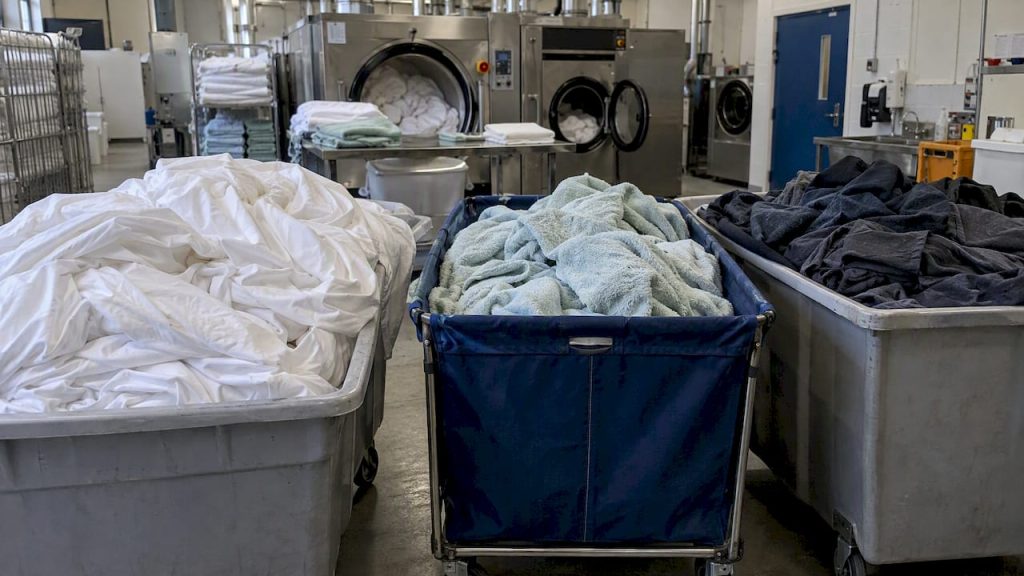
Color separation in a hotel laundry means sorting linen into whites, pastels, brights and darks before it reaches the washer, then keeping those streams apart through washing, drying and storage. Done well, it prevents dye from bleeding onto white sheets and towels, and it keeps the rewash rate down. This guide explains how to set up that sorting, which wash settings protect color, how to treat new linen, and what to do when a load goes wrong. It is written for hotel managers, housekeeping heads and restaurant owners in Albania, Kosovo, Montenegro and North Macedonia.
TL;DR
- Sort into four color groups: whites, pastels and medium colors, brights, and darks. Wash each group on its own.
- Wash new, strongly colored linen separately for its first washes, because unstable dye is released early.
- Separate by fiber, soil level and item type as well as color. Towels, sheets, table linen and uniforms need different cycles.
- Check table linen for paper napkins before loading. One red napkin can turn a white load pink.
- If dye transfers, do not dry the load. Rewash it right away.
Table of Contents
- Why dye moves from one item to another
- The four color groups that work
- Sorting beyond color: fiber, soil and item type
- New and strongly colored linen: the first washes
- Wash settings that protect color
- Making the system work on a busy floor
- What to do when color bleeds onto other laundry
- Our perspective: color problems are usually procurement problems
- Textiles chosen for your laundry, not against it
- A simple color separation plan to adopt
- FAQ
- Sources
Why dye moves from one item to another
Dye transfer happens in two ways. Iowa State University Extension distinguishes bleeding from crocking: bleeding is dye leaching into water or solvent, while crocking is dye rubbing off through friction. Crocking may cause permanent discoloration, and bleeding can be hard to remove once it has settled into another fabric.
For a laundry manager, this has two consequences. First, sorting by color addresses the water side of the problem. Second, load size, mechanical action and drying also matter, because friction moves dye as well. A perfectly sorted load that is overfilled and tumbled hard can still lose color to its neighbors.
The cost is rarely the single damaged sheet. It is the rewash, the extra chemicals and water, the delay to room turnover and, when the damage is permanent, the early replacement of linen that should have lasted much longer. That is why color separation belongs in your written laundry procedure and not in the habits of individual staff members.
The four color groups that work
The American Cleaning Institute (ACI) advises sorting by color, fabric type and washing instructions, and matching each load to similar detergent, cycle and temperature needs. Its color guidance is simple: whites alone, pastels and medium colors together, brights by themselves, and darks by themselves. Fluorescent colors should be washed separately or tested first.
In a hotel, that translates into bins and rules like these:
| Stream | What goes in | Handling rule |
|---|---|---|
| Whites | White sheets, pillowcases, duvet covers, white bath and pool towels, white napkins | Washed alone. Never mixed with anything tinted, even pale tints |
| Pastels and medium colors | Cream, light grey, beige, soft blue or green linen, light uniforms | Washed together, but only after a first-wash test if the item is new |
| Brights | Red, orange, strong teal, colored table runners, event linen | Washed alone. Fluorescent items are tested first |
| Darks | Navy, black, charcoal, burgundy, dark uniforms and towels | Washed alone, at a lower temperature than whites |
ACI also notes that white and lightly colored synthetics need particular protection from dark-dye transfer. That matters in Albanian hotels that use polyester blends in curtains, uniforms and table linen, since synthetics can pick up dye that cotton would shed more easily.
If your property is mostly white linen, as many hotels are, the practical risk sits in the exceptions: a colored runner, a dark spa towel, a staff uniform, a decorative cushion cover. Those items should have their own bin from the first day, not be added when the first accident happens.
Sorting beyond color: fiber, soil and item type
Color is only one axis. The ASEAN industrial laundry training material treats color sorting as part of a wider production-control system. Fiber, soil, item type and contamination are sorted together so that each stream receives a suitable wash formula.
In practice, a sorting table for a mid-sized hotel looks like this:
- Towels apart from sheets. The ASEAN guide says towels run on a different cycle from sheets, and white towels should be washed separately from colored towels.
- Heavily soiled apart from lightly soiled. Kitchen cloths, bar towels and heavily soiled linen need stronger cycles that would be unnecessarily harsh on guest-room linen.
- Lint producers apart from lint collectors. ACI warns that new towels, flannels, chenille and fuzzy items release lint, and should be washed apart from fabrics such as corduroy and permanent-press garments that attract it.
- Spa and salon textiles as their own stream. The ASEAN guide flags colored spa or salon towels as a high-risk stream, since massage oil or hair dye may be present and the towels fade over time.
- Table linen after inspection. The same guide stresses checking for food scraps, cutlery and paper napkins before washing.
This is why a hotel with a restaurant, a spa and an event hall cannot run a single laundry flow. Each department generates a different kind of soil and a different color profile, and each should arrive at the laundry already separated, ideally in marked bags or carts.
New and strongly colored linen: the first washes
New colored items are the most common cause of surprise bleeding. Unstable surface dye that has not yet been washed out tends to release in the first few cycles. The widely repeated rule is to wash deep colors, such as dark red or indigo, alone for their first washes, and to turn garments inside out to reduce surface abrasion.
For a hotel, build this into receiving:
- Tag every new colored delivery with the date it arrived and a “wash alone” marker.
- Run the first wash with a small test load and check the rinse water and a white cloth for tint.
- Keep dark linen out of the whites stream permanently, even after the first washes have gone cleanly.
- Record the result, so that a repeat bleeding problem can be traced back to a supplier lot.
The better fix is upstream. Color fastness is a property you can specify and test before you buy, and it decides how well a towel or a tablecloth behaves in an industrial machine. Our guide to color fastness in hotel linens explains what procurement should ask for, and the playbook on fade failures across 20 to 30 cycles connects purchasing decisions to laundry results.
Wash settings that protect color
Sorting only works if the wash itself does not undo it. ACI’s product fact sheet says to read garment and product labels, use cold water for fine fabrics and sensitive colors, warm for moderately soiled clothes, and hot for durable whites, badly soiled, permanent-press and colorfast items. It also says not to overload the machine.
Translated for a hotel laundry:
- Whites: the hottest temperature the fabric and label allow, because that is where stains and body oils are removed.
- Darks and strong colors: a lower temperature, which reduces dye release and fading.
- Delicate or unknown items: cold, with a test first.
- Every load: filled to the machine’s rated capacity, not beyond it. Overloading raises friction and leaves dye with nowhere to go but onto the next fabric.
Temperature is also a cost and lifespan decision. Washing everything at one high setting is simple, but it shortens linen life, especially for colors. We cover that trade-off in detail in industrial wash temperatures and linen replacement.
Making the system work on a busy floor
A sorting chart on the wall does not run a laundry. People do, usually under time pressure, at the end of a shift or during a checkout rush. A few controls make the difference.
Sort at the source
Housekeepers should drop linen into color-coded bags or carts at the room or at the restaurant. Sorting a pile of mixed laundry in the laundry room costs time and invites mistakes. Where the property is small, two bags per trolley, whites and everything else, remove most of the risk.

Inspect before loading
Table linen deserves a particular check. The ASEAN guide notes that a single overlooked red paper napkin can turn a white load pink and force an expensive rewash. Make pocket checks and a shake-out the last step before any load goes in. The same goes for staff uniforms, where tissues, pens and dye-bearing items travel in pockets.
Write down the formula
Each stream should have a named formula: cycle, temperature, chemistry and load weight. Operators then follow a printed card, not memory. Weighing loads and keeping a production log also help you spot patterns, such as bleeding that keeps appearing in one machine or on one shift.
Track color across the supply chain
Larger operations that produce or finish textiles increasingly record color data from batch to batch. If you want to see how that thinking works at industrial scale, this overview of textile color traceability shows how dye lots and quality records can be followed from production onward. For a hotel, the equivalent is simple: keep the supplier, lot and delivery date of each colored item so a problem can be traced.
If your goal is a leaner overall routine, our hotel laundry best practices list and the guide to a textile maintenance workflow for Albanian hotels cover the surrounding process.
What to do when color bleeds onto other laundry
Mistakes happen even in good systems. The first rule from ACI’s laundering problems guide is not to dry the affected items. Heat sets dye. Rewash promptly with detergent and a fabric-safe bleach, at the hottest temperature the fabric can safely take. Severe damage may be permanent, so speed matters.
For dye transfer on white fabrics, the ACI stain removal guide recommends a packaged color remover followed by laundering. If dye remains, chlorine bleach can be used only where the fabric is safe for it, and non-colorfast fabrics can be soaked in oxygen bleach before laundering. Always check the care label first, and test on a hidden seam. Do not use chlorine bleach on items whose label forbids it.
A short incident routine helps staff react correctly:
- Stop the cycle or pull the load as soon as the tint is noticed.
- Keep the load wet. Do not send it to the dryer.
- Identify the source item and remove it.
- Rewash the affected items with the correct remover or bleach for the fabric.
- Log the cause and the item, so the sorting rule can be corrected.
Our perspective: color problems are usually procurement problems
We have supplied hotels, restaurants and event venues since 1994, and we see the same pattern. Laundry teams are blamed for bleeding and fading that began at the purchase order. When a colored towel or runner is chosen for how it looks in a showroom and not for how it behaves after fifty industrial washes, the laundry inherits a problem that no sorting chart can solve.

Our advice is to treat color as a three-part decision. First, choose dyes and fabrics with the washing regime in mind. Second, limit the number of strong colors in a property to what the laundry can actually keep separate. A hotel that runs white linen in rooms and one dark tone for spa and pool towels is far easier to manage than one with six accent colors. Third, keep every colored item in a defined stream from receiving to storage.
Because we import, design and produce in-house, we can adjust specifications for a client, from fabric weight to color choice, so the linen suits the laundry that will look after it. A laundry that keeps the service “on rails” is rarely the one with the most complex rules. It is the one with the fewest exceptions.
— Xpert
Textiles chosen for your laundry, not against it
If you are replacing or expanding linen and want it to match how you wash, our team can advise on fabrics, colors and quantities for hotel and Airbnb textiles, restaurant table linen and work uniforms. Wholesale supply, custom production and long-term contracts are our business, so contact us with your room count, your laundry setup and the colors you plan to use. We will be glad to propose a range that keeps sorting simple. See our professional textile services for the full list.
A simple color separation plan to adopt
If you do nothing else, put these steps in your procedure this month:
- Define your four color streams and label the bins in the working language of your staff, with a picture of a typical item for each.
- Add separate bins for spa towels, kitchen cloths and uniforms.
- Create a receiving rule for new colored items: tag, test wash, record.
- Print one wash card per stream with temperature, load weight and chemistry.
- Add a pocket check for table linen and uniforms.
- Write the incident routine above and place it by the machines.
- Review rewash causes monthly and adjust the rules, or the purchasing specification, accordingly.
For hotels planning a wider linen review, our housekeeping efficiency textiles guide and the article on maximizing hotel textile durability help connect laundry practice to cost per use.
FAQ
Do I really need to separate laundry by color in a hotel?
Yes, in any hotel that has both white and colored items. Dye can leach in the wash water and rub off through friction, and the damage on white linen can be permanent. If your whole stock is white and everything is washed the same way, separation matters less, but spa, pool, restaurant and staff textiles usually bring color back in.
Can I wash different colors together if the water is cold?
Cold water lowers the risk but does not remove it, and it also cleans less effectively on soiled hotel linen. Group pastels and medium colors together if they are colorfast and tested, and keep whites, brights and darks in their own loads. Fluorescent items should be washed apart or tested first.
How many washes before a new colored towel is safe to mix?
There is no universal number. Guidance generally says to wash strongly colored new items alone for the first few washes. In a hotel, keep dark towels in their own stream permanently, and mix new pastels only after a test wash shows a clean rinse and no tint on a white cloth.
What should I do if a white load turns pink?
Do not put it in the dryer. Rewash it promptly with detergent and a fabric-safe bleach at the hottest temperature the fabric allows, or use a packaged color remover on white items. Check care labels first, and log what caused the transfer so the sorting step can be fixed.
Sources
- American Cleaning Institute: Laundry Basics
- American Cleaning Institute: Laundry product fact sheet
- American Cleaning Institute: Laundering Problems and Solutions
- American Cleaning Institute: Stain Removal Guide
- Iowa State University Extension: Preventing Color Transfer by Bleeding or Crocking
- ASEAN: Maintain and Operate an Industrial Laundry
- Textile color traceability