

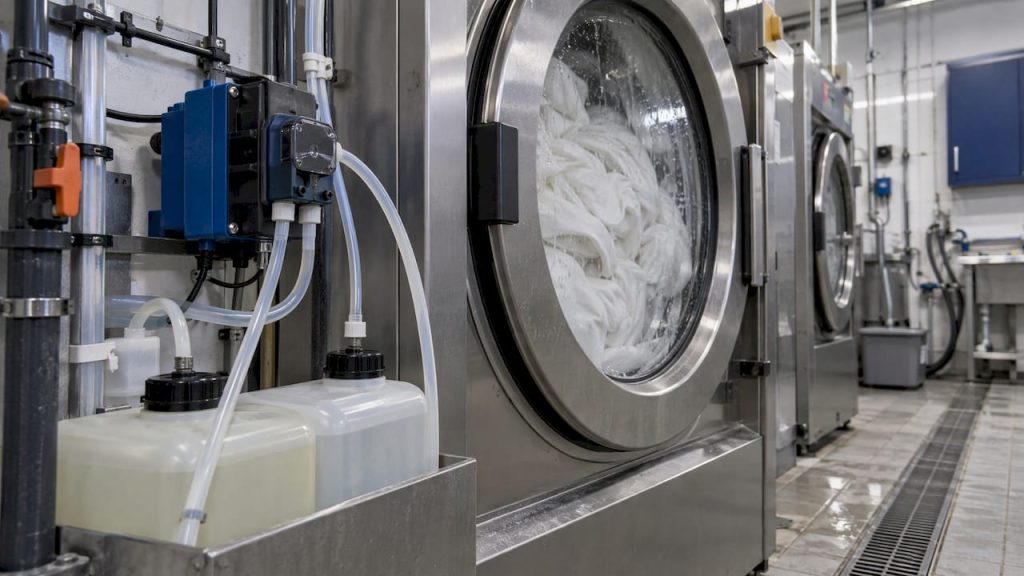
Hydrogen peroxide does bleach linens, but it is an oxygen bleach: gentler than chlorine, best at keeping white linens white, and only safe on items whose care label allows it. A white sheet is not automatically bleach-safe. Check the label, test an inside seam, dose by dry weight, and keep the wash temperature in the range the chemistry needs.
This guide is written for hotel managers, housekeeping heads and laundry supervisors in Albania and the wider region who buy or wash bed linen, towels and table linen in volume.
TL;DR
- Hydrogen peroxide is an oxidizing bleach. It is milder than chlorine and works best at maintaining whiteness, not restoring badly yellowed linen.
- White color does not prove a fabric is bleach-safe. Fiber content, finishes and trims decide, so read the care label and test a hidden seam first.
- Peroxide works best hot (80°C or above) and at high pH, and it should be dosed by the dry weight of the load, not by eye.
- Bleach does not replace a good wash. It removes the stains that remain after proper detergent action.
- Buying linens specified for industrial washing at the start saves more than any bleaching routine later.
Table of Contents
- Does hydrogen peroxide bleach linen?
- Read the care label before anything else
- Which linens suit peroxide and which do not
- Temperature, pH and dosing in the wash
- Stains and timing
- Peroxide or chlorine?
- Choosing bleach-friendly linens
- Linens built for your wash program
- FAQ
- Sources
Does hydrogen peroxide bleach linen?
Yes. Hydrogen peroxide is an oxidizing bleach that reacts with vegetable dyes, turning them from colored to colorless. That is why it lifts the yellow-brown tint that builds up on cotton and linen. The international care-labelling standard treats this as part of a wider category: bleaching is an aqueous process using oxidizing agents, either chlorine or oxygen-based, to improve soil removal and whiteness.
Two points matter for a hotel laundry.
First, the effect is strongest on natural fibers. Cotton and linen are cellulose, and the same oxidizing action that lightens them can also weaken the fibers. The risk is not a reason to avoid peroxide. It is a reason to control it: excessive damage can be avoided if concentration and stage times are correct.
Second, whiteness is not only about the bleach. An academic study of flax fabric found that pretreatment affected residual chromophore content, and fabric color correlated with bleachability. In plain terms, how a fabric was prepared and what color it starts with change how well it whitens. Two white sheets from different sources can respond differently to the same wash.
Is the effect permanent?
Bleaching removes color from stains and dyes through a chemical reaction, so you do not wash it back out. If a dyed fabric loses color under peroxide, that loss stays. Whitening of a stain or of yellowing is likewise a change in the fabric’s appearance. What can return is yellowing itself, because it can result from accumulated perspiration, detergent and limescale residues. If the cause is still in the wash, the color comes back.
Read the care label before anything else
Bleach-friendly sheets are identified by their label, not by their shade. Care symbols follow a fixed order: washing, bleaching, drying, ironing and professional textile care. The second symbol is the one that matters here.
| Bleaching symbol | Meaning for your laundry |
|---|---|
| Plain triangle | Bleaching allowed |
| Triangle with two diagonal lines | Oxygen (non-chlorine) bleach only |
| Crossed-out triangle | No bleaching agents |
The symbol distinguishes permitted chlorine bleach, oxygen bleach or no bleaching, and a crossed-out triangle means no bleaching agents unless the manufacturer gives a more specific instruction. Remember that the label shows the most severe treatment that can be used without damaging the article. It is a ceiling, not a recommendation to wash at that limit every time.
One regional note. Care symbols are voluntary in many regions unless national law requires them, and when they are used they must follow the standardized GINETEX/ISO rules. In practice, linen that reaches Albanian hotels may arrive with full labels, partial labels or none. When the label is missing, ask your supplier for the written care specification before the first wash, and keep it on file for housekeeping.
The swab test for unlabeled items
When a white item has no usable label, the American Cleaning Institute recommends a simple test: dip a cotton swab in a bleach and water mix, touch an inside seam, and check whether the fabric color holds. If it remains, the item should be safe. Do this on a hidden area, and note the result in the linen register so staff do not repeat the test on every delivery.

Which linens suit peroxide and which do not
White color alone does not guarantee safety. The ACI points out that suitability can depend on fiber content, including wool, silk, mohair and spandex, flame-retardant finishes and certain trims. Even a white item should have its label read first.
For a hotel, that translates into a short sorting rule:
- Plain white cotton and cotton-rich percale or sateen sheets: usually the best candidates for oxygen bleach, when the label permits.
- White towels and bathrobes: suitable when labelled for bleaching. Check for colored borders, stripes or woven logos, which can bleed or fade.
- Table linen: white damask and cotton napkins are common candidates. Stained napkins from red wine or coffee respond well to oxygen bleach in the main wash.
- Items with flame-retardant finishes, elastic or stretch content, or decorative trims: do not bleach until you have the manufacturer’s instruction.
- Colored or dark linen: keep away from bleach unless the label explicitly allows it. Color fastness is a separate question, covered in our guide to color fastness in hotel linens.
Hydrogen peroxide can also serve as a targeted pre-treatment on delicate whites that are compatible with oxygen bleach. The advice from laundry specialists is to test on a hidden area first. Never skip this on a new batch, even from a supplier you know.
Temperature, pH and dosing in the wash
Peroxide is chemistry that depends on conditions. It works best at or above 80°C and pH 11. Another laundry-industry source notes that it is usually designed to work around 65°C. The difference reflects product formulation: some systems use activators that lower the working temperature. Follow your chemical supplier’s data sheet for the product you actually buy.
A dosing example from a technical bulletin
One Australian technical bulletin for 50% hydrogen peroxide suggests 80 mL per 100 kg of dry linen, roughly 35 mL per 45 kg, added to the main detergent wash. For a stock dilution, the same document gives 1.5 liters of concentrate to 50 liters of water, with 2 liters of that solution applied per 45 kg of dry linen.
Use these as an illustration of how dosing is expressed, not as your own recipe. Your machines, water hardness, detergent and peroxide concentration will differ. Ask the chemical supplier for the rate on your product, and weigh loads dry. Concentrated peroxide needs the handling steps in its safety data sheet, including gloves, eye protection and dosing through an automatic system where possible.
Do not use bleach to cover a weak wash
Bleaching agents decolorize stains that remain after a good wash process and are not a substitute for adequate detergency. The same principle appears in the laundry-chemistry literature: bleaching agents must not be used to compensate for poor washing performance. If linen comes out grey, check these before raising the bleach dose:
- Detergent dose against water hardness.
- Load size, because overloaded drums do not rinse.
- Wash temperature and cycle time.
- Rinse count, since residues cause yellowing.
- Sorting, so heavily soiled items do not share a load with fine whites.
We cover the temperature side in more depth in industrial wash temperatures and linen replacement rates, and the wider routine in a hotel laundry best practices list.
Stains and timing
Peroxide is often chosen for protein stains, and one consumer guide notes that it works well on protein stains such as blood is not what that page says, so we rely instead on the laundry-chemistry point that matters for hotels: timing. Hydrogen peroxide and peracetic acid may cause blood to set onto fabric if present too early in the wash cycle. Add the bleach after the pre-wash and main detergent action, not at the start.

Temperature affects stains the same way. UK guidance on linen management notes that higher temperatures increase the risk of fixing stains, and suggests a pre-wash, normally at 30°C or 40°C, and checking linen for stains before drying. Once a stain goes through the dryer or ironer, it is far harder to remove.
For small, spot treatments at the laundry bench, a 3% hydrogen peroxide solution is commonly mixed with dishwashing liquid and left for 20 to 30 minutes at room temperature. Pat or soak rather than scrub. Flax fibers are susceptible to damage from high-friction scrubbing, which can snap yarns and cause pilling. Always test the spot on a hidden area, and rinse well afterward.
For makeup and cosmetic marks, which are a daily issue in guest rooms, see our notes on cosmetic stain removal and rewash rates.
Before treating any stain, the Detergo guidance is a useful checklist: identify where the stain came from, confirm the treatment will not damage the fibers, check color resistance on colored items, and look for special finishes the treatment could affect.
Peroxide or chlorine?
Both are bleaches, with different strengths. The ACI explains that sodium hypochlorite bleaches are more powerful and disinfect, clean and whiten, while oxygen bleaches are gentler and work best for maintaining whiteness, not restoring it.
| Question | Oxygen (peroxide) bleach | Chlorine bleach |
|---|---|---|
| Strength | Gentler | More powerful |
| Best use | Keeping whites white | Cleaning, whitening and disinfecting |
| Fabric load | Lower | Higher, label must allow it |
| Typical need | Routine whites, delicate whites | Heavy discoloration, disinfection |
Hygiene is a separate question from whitening. UK guidance says used linen must be washed at the highest temperature its care label allows, or with an alternative low-temperature chemical disinfection process. For Albanian hotels, the practical step is to define a written disinfection routine with your laundry or chemical supplier, and to check that the linen you buy can survive it.
One caution applies if you use chlorine anywhere near care products: it can react with chlorhexidine to cause brown stains. If your hotel has a spa or clinic-style treatments, keep those textiles on a separate routine.
If your laundry runs chlorine regularly, specify linens for it. Our guide to chlorine-resistant textile rules for hotel specifiers explains what to ask for.
Perspective
After more than thirty years supplying hotels, we see the same pattern. Bleaching problems rarely start in the laundry. They start at purchase, when a linen is chosen for how it looks on the shelf and nobody asks how it will be washed.
A hotel that runs hot industrial cycles, peroxide or chlorine, needs fabric, thread, trims and dyes that were made for that routine. This is why we import, specify and, where needed, produce in-house: we control the construction, so we can match the textile to the wash program instead of asking the laundry to compromise.
Our advice to managers is simple. Write down your wash program, give it to your supplier, and ask for a care specification that confirms bleaching tolerance in writing. Then keep a small sample of each delivered batch for testing. It takes an hour and prevents a season of grey sheets.
The best bleaching routine is the one you rarely need, because the linen was right from the first wash.
Xpert
Choosing bleach-friendly linens
When you are ordering, these questions matter more than the shade of white:
- Does the care label allow oxygen bleach, chlorine bleach or both?
- What wash temperature and number of cycles is the fabric specified for?
- Are trims, borders and stitching thread compatible with bleach?
- Is there a flame-retardant or other finish that restricts bleaching?
- Can the supplier provide a written care specification and a sample for testing?
The same logic applies across categories. For guest rooms, see our notes on hotel textile selection and maximizing textile durability. For fade problems after repeated washes, our procurement to laundry playbook shows where the failures usually begin.
Linens built for your wash program
Gjergji H Tekstil imports, manufactures and distributes professional textiles for hotels, restaurants, event venues and laundries across Albania and the region, from bed linen and towels to table linen, spa textiles and uniforms. If you want white linens specified for your laundry’s temperatures and chemistry, send us your wash program and we will advise on suitable options.

See our range of textiles for hotels and Airbnb properties, or contact us through the Gjergji H Tekstil website to discuss a supply agreement.
FAQ
Can I use hydrogen peroxide on all white sheets?
No. White color does not guarantee that a fabric is bleach-safe, because fiber content, finishes and trims also decide. Read the care label first, and if it is missing, run the swab test on an inside seam. If the color holds, the item should be safe.
Is hydrogen peroxide bleaching permanent?
The color change in a stain or dye is chemical, so it does not reverse. Yellowing can come back if its cause, such as detergent, perspiration or limescale residue, stays in the wash. Fix the wash and the whiteness lasts.
What is the difference between oxygen bleach and chlorine bleach?
Chlorine bleach is more powerful and also disinfects. Oxygen bleach, which includes hydrogen peroxide, is gentler and best for maintaining whiteness. Choose according to what the care label allows.
Which fabrics should not be treated with peroxide?
Avoid wool, silk, mohair and spandex, items with flame-retardant finishes, and certain trims, unless the manufacturer says otherwise. A crossed-out triangle on the label means no bleaching agents.
Sources
- ISO 3758:2012 textile care labelling
- Looking after fabrics, WASHCO
- How to Use Bleach, American Cleaning Institute
- Bleaching Care Symbols Explained, AMANN
- Surface properties and residual chromophore content of flax fabric
- Whiten Yellowed Laundry: Percarbonate, Bleach, Tips
- GINETEX technical booklet
- Role of different bleaches in fabric care operation, Solenis
- Hydrogen Peroxide 50 technical bulletin
- Guidance for the Safe Management of Linen
- Red wine stain removal guide
- Washing blood out of sheets guide
- Risks of damages in stain removal and washing, Detergo