

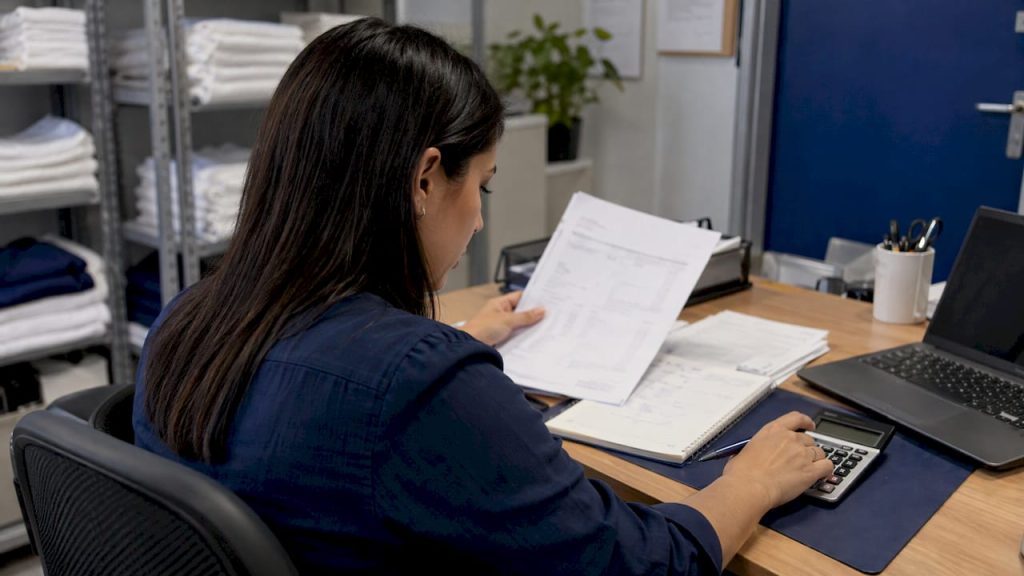
Textile cost per occupied room is your annual linen and laundry spend divided by the number of rooms actually sold in the same period. Count laundry (in-house or outsourced) and the yearly write-off of sheets, towels and bathrobes, then divide by occupied room nights. Track it the same way every month. This guide shows what to include, a worked example for a seasonal Albanian hotel, and the levers that bring the number down.
TL;DR
- Formula: (laundry cost + amortized linen replacement + any linen rental) ÷ occupied rooms, for identical dates.
- In the USALI chart of accounts, linen and laundry is its own line under rooms expenses, so keep it apart from housekeeping supplies and amenities.
- Banquet and restaurant linen belongs in a separate calculation, or your room figure will be distorted.
- In a seasonal market like Albania, a low-occupancy month raises the figure even when nothing changed in how you run linen. Compare like with like.
- The fastest reductions come from par levels sized to your real laundry turnaround and from textiles that last more wash cycles.
Table of Contents
- What cost per occupied room means for textiles
- What to include in the calculation
- A worked example for a seasonal Albanian hotel
- Why the Albanian season changes the math
- Par stock: the biggest hidden driver
- In-house or outsourced laundry
- Where replacement cost hides
- How to monitor CPOR month by month
- Perspective: why we look at cost per wash, not cost per piece
- Supplying hotel textiles that fit your cost target
- FAQ
- Sources
What cost per occupied room means for textiles
Cost per occupied room (CPOR) is a rooms-department metric. A common definition is total departmental operating costs divided by rooms sold over the same dates. Frye, writing in LODGING, describes laundry cost per occupied room as labor, laundry chemicals and utilities added together and divided by rooms occupied in that period. The same article puts variable costs per occupied room anywhere from $12 at a budget property to more than $75 at a world-class hotel, which shows how much the answer depends on what a hotel counts and what level of service it sells.
The textile version narrows this to one question: what does it cost you, per guest room sold, to keep clean, presentable linen on every bed and clean towels in every bathroom?
This is useful because textile costs behave in two ways. Laundry is variable: it rises and falls with the number of rooms sold. Linen replacement is semi-fixed: you buy stock for the rooms you have, and it wears out through washing and handling. A good CPOR calculation puts both into one figure that you can compare across months, seasons and years.
What to include in the calculation
In the USALI uniform chart of accounts, Account 5003 is Linen and Laundry, listed under Rooms Expenses next to housekeeping supplies and guest room amenities. That gives you a sensible boundary: the textile figure covers linen and laundry, and the other lines stay separate.
Inside that boundary, include:
- Laundry cost. For outsourced laundry, the invoice amount. For in-house laundry, French hospitality guidance lists equipment depreciation and maintenance, water and electricity, detergent products and staff costs.
- Annual linen amortization. The purchase value of sheets, duvet covers, pillowcases, towels and bathrobes, spread over their realistic working life. The same French guidance says to include the yearly linen amortization provided by accounting when the hotel owns its linen and sends it out.
- Rental fees, if you lease linen instead of owning it.
- Replacement of lost or damaged items that fall outside normal wear, such as stained or missing towels.
Leave out:
- Restaurant tablecloths, napkins and banquet linen. One industry benchmarking article notes that banquet linen can represent around 30% of the laundry bill in full-service resorts, so mixing it into the room figure hides what your rooms really cost.
- Staff uniforms, unless your accounting places them in the same line. Pick one rule and keep it.
- Amenities and cleaning chemicals used for room cleaning rather than laundry.
Write your definition down. A consistent definition used every month tells you more than a sophisticated formula that changes quietly from one report to the next.
A worked example for a seasonal Albanian hotel
The numbers below are illustrative, not benchmarks. Replace them with your own.
Take a 50-room coastal hotel that is open 150 days.
| Item | Figure |
|---|---|
| Rooms available | 50 |
| Days open | 150 |
| Average occupancy | 65% |
| Occupied room nights | 50 × 150 × 0.65 = 4,875 |
| Outsourced laundry invoices for the season | €9,750 |
| Linen and towel stock (3 par) | €15,600 |
| Working life used for amortization | 2 seasons |
| Annual linen amortization | €7,800 |
| Total textile cost | €17,550 |
| Textile cost per occupied room | €3.60 |
Now see what happens when occupancy drops to 50% with exactly the same stock and the same laundry rate per kilogram. Occupied room nights fall to 3,750. Laundry invoices fall roughly with volume, to about €7,500, but the €7,800 amortization stays put. The total becomes €15,300, and CPOR rises to €4.08. Nothing about your linen management got worse, yet the metric moved by 13%. This is why you separate the variable part (laundry) from the fixed part (amortization) and read both before drawing conclusions.
Why the Albanian season changes the math
Albanian hotels do not sell rooms evenly. INSTAT reported that hotel-room occupancy reached 39.5% in June 2025, while non-resident visitors in coastal areas rose 42.4% against June 2024. Overall demand is also climbing: Albanian accommodation establishments recorded 9.67 million overnight stays in 2025, nearly 30% more than the previous year, with 91% of non-resident overnight stays in hotels and similar structures.
For your textile budget this has three consequences:
- Peak months carry the stock. You buy enough par for the busiest weeks, so in shoulder months the same stock is spread over fewer sold rooms.
- Cash flow is uneven. The Albanian accounting firm Albania Ekonomist describes the sector’s rhythm as four to six months of intensive turnover followed by six months of fixed costs and minimal revenue. Laundry services are one of the many suppliers that must be reconciled against invoices throughout.
- Annual CPOR hides the story. Calculate it monthly and for the season. A full-year figure blends high-occupancy months with near-empty ones.
If you stay open year-round, also compare each month with the same month last year rather than with the month before.
Par stock: the biggest hidden driver
Par level is the number of full linen sets you need so that every bed is always made while the rest is in the wash, in storage or on its way back. A common planning formula is daily linen requirement multiplied by laundry turnaround days, plus safety stock. Many hotels start with a rule of thumb of three sets per room, but the right figure depends on turnaround time, occupancy patterns, loss rates and seasonal swings.
Par matters for CPOR because every extra set you hold adds to the amortization line without selling a single room. Too little par has its own cost: rushed laundry, rewashing, unmade rooms and guest complaints. For a deeper look at sizing, see our guide to hotel linen par levels for operations managers.
A practical way to check your par:
- Count the sets in circulation: on beds, in the laundry cycle, on shelves.
- Note your real turnaround from dirty to back on the shelf, in days.
- Compare with your busiest day’s occupied rooms, plus a small buffer.
- If sets sit unused even at peak, you are overstocked. If you run out on peak days, you are understocked.
In-house or outsourced laundry
The calculation changes depending on who washes your linen.
Outsourced. Usually the simplest: the invoice divided by rooms sold, plus linen amortization. Prices per kilogram, collection schedules and loss or damage clauses all feed into the number.
In-house. You need more lines: machine depreciation, maintenance, steam or electricity, water, detergent, staff hours. A German hotel trade article frames the choice as leasing linen, which avoids upfront purchases and charges for what is used, versus in-house laundry, which needs labor, energy and upkeep. In Albania, if you run a small laundry room on seasonal staff, remember to include the hours of the people who fold, iron and carry, not only the machine cost.
Whichever route you take, the CPOR formula is the same. Only the inputs differ. To compare the two routes fairly, run both through the same worksheet for a full month. For practical routines that reduce washing cost, see our hotel laundry best practices list.
Where replacement cost hides
Labor is usually the biggest cost in laundry, and linen replacement often ranks right behind it. A Solenis white paper on linen use says replacement can account for about a third of total laundry operating costs. The same paper argues that extending average linen life by 30% reduces replacement volumes and brings savings quickly.
That is the logic behind buying by cost per wash cycle instead of unit price. A set that costs less today but needs replacing after one season is more expensive per occupied room than a sturdier set that survives two or three. Specify what matters: fabric weight, thread construction, finishing, and resistance to industrial washing and abrasion. If you are drafting specifications for procurement, the durability specs for procurement teams show how a buyer can put measurable requirements on paper. For linen, our own guides on maximizing textile durability and the total cost of ownership for textiles walk through the same idea.
To see when your stock actually needs replacing, track how many wash cycles each category has been through and the reasons for retirement: wear, stains, loss or style change. Our hotel linen replacement cycle guide for Albania covers typical cycles and what to log.

How to monitor CPOR month by month
Labor, laundry and guest supplies are variable expenses that should move in proportion to rooms occupied. So your monthly check is simple: if occupied rooms rise 20% and laundry cost rises 35%, something is off.
Build a one-page monthly sheet with these rows:
- Rooms sold
- Laundry cost (invoice or in-house total)
- Linen amortization for the month (annual figure ÷ 12, or ÷ months open)
- Items retired and replaced, with reason
- Textile cost per occupied room
- Kilograms washed per occupied room, if your laundry reports weights
That last row is the most telling. Kilograms per occupied room reveals whether you are washing more than you need, for example from changing towels on a rigid schedule regardless of guest choice, or overloading beds with extra layers. Our hotel textile usage analysis guide shows how to structure that review.
Then act on the largest lever first:
- Reduce rewashes. Stain pretreatment and sorting at the room level cut the number of items going through twice.
- Right-size par. Remove dead stock and rebalance by floor or building.
- Choose textiles for the wash. Heavy bathrobes and towels dry slowly and cost more to launder, so weight should match purpose. See our note on bathrobe materials that cut laundry costs.
- Store properly. Damp or crowded storage shortens life. A procurement checklist for textile storage helps.
- Standardize the fabric range. Fewer sizes and colors mean easier replacement and a smaller safety stock.
Perspective: why we look at cost per wash, not cost per piece
We have supplied hospitality businesses since 1994, and the conversation about textile budgets almost always starts with the price of one sheet or one towel. We think that is the wrong starting point.
A hotel does not consume textiles in pieces. It consumes them in wash cycles. A towel that meets hotel-grade standards and holds its shape, absorbency and color through many industrial washes costs less per occupied room than one that looks cheaper on the invoice but is retired early. Our approach is built around that logic: we import in volume, manufacture and customize in-house, and keep control of the chain from sourcing to delivery, so we can match a specification to how a particular hotel really washes and uses its linen.
For Albanian and regional hotels, we also see how seasonality magnifies the issue. When occupancy swings from busy to quiet within a few months, the stock you bought has to perform at both ends. That is why we advise clients to size par levels from real turnaround time, to specify weights and finishes for the intended use, and to plan replacement in cycles rather than in emergencies.
The best textile budget is one you can predict. That is what we aim to help our clients achieve.
Xpert
Supplying hotel textiles that fit your cost target
If you are reviewing your linen specification after running the numbers, we can help. Gjergji H Tekstil imports, manufactures and supplies bed linens, towels, bedding, curtains and custom textile solutions for hotels and guesthouses across Albania and the region. Our hotel and Airbnb textile range is built for guest comfort and durability under industrial washing, and we can work to your par levels and replacement plan.

For restaurant and banquet linen, which you should track separately, see our pages on restaurant textiles and event textiles. To discuss a supply agreement, start from our professional textile services page.
FAQ
How do you calculate textile cost per occupied room?
Add your laundry cost and the amortized yearly cost of sheets, towels and bathrobes, plus any rental fees. Divide the total by the number of rooms sold in exactly the same period. Use the same definition every month so the trend is reliable.
Should banquet and restaurant linen be included?
No, not in the room figure. Banquet linen can make up a large share of the laundry bill in full-service properties, so benchmark room linen and food and beverage covers separately. Otherwise your room CPOR will look higher than it is.
Why does my textile CPOR rise in the low season?
Linen amortization is largely fixed, while rooms sold fall. The same stock is spread over fewer occupied rooms, so the figure rises even with unchanged habits. Compare each month with the same month in the previous year, and watch kilograms washed per occupied room.
What is the quickest way to lower it?
Start with par levels and wash cycles. Remove stock that never leaves the shelf, cut rewashes, and buy textiles by how many washes they last rather than by unit price. A longer working life reduces the replacement line directly.
Is there a single benchmark I should aim for?
No. Variable costs per occupied room vary widely with property class, as the LODGING range from $12 to over $75 shows. Use your own history as the main benchmark and improve against it.
Sources
- What Are Your True Variable Costs Per Occupied Room? (LODGING)
- USALI Uniform Chart of Accounts, short version
- Fiche pratique: calculer le coût du blanchissage (L’Hôtellerie Restauration)
- Benchmarking Linen Cost Per Room, Cover, and Bed
- INSTAT: Accommodation establishments, June 2025
- Rreth 9.6 milionë netë qëndrime në 2025 (Scan TV)
- Kontabilitet për Hotele dhe Turizëm në Shqipëri (Albania Ekonomist)
- Hotel Laundry Management: Par Stock and Checklist
- Ist das Wäsche waschen im eigenen Hotel rentabel? (hotelier.de)
- Beyond the Stay (Solenis)
- Rooms Department Operations: Controllable and Profitable
- Hotel rug durability specs for procurement teams