

TL;DR:
- Hospitality front-of-house textiles must meet strict safety, durability, and appearance standards to protect guests and preserve brand image. Selecting fabrics with proper flame retardancy, high abrasion resistance, and compatible cleaning codes ensures longevity and compliance, avoiding costly replacements. Building detailed textile specifications and verifying supplier compliance help create durable, compliant uniforms and seating fabrics that reinforce brand reputation.
Front-of-house textile standard is defined as the set of fabric performance specifications, safety compliance requirements, and appearance criteria applied to all textiles visible to guests in a hospitality environment. This covers upholstery in lobbies and dining rooms, table linens, curtains, and the uniforms worn by hosts, servers, bartenders, and front desk staff. These standards exist at the intersection of brand image, guest safety, and operational durability. Getting them right means fewer early replacements, consistent brand presentation, and full compliance with fire safety codes such as CAL TB 117-2013, NFPA 260, and BS 7176. Getting them wrong costs you money, reputation, and in some cases, regulatory standing.
What are the key performance criteria for front-of-house textiles?
Four variables govern every front-of-house textile decision: flame compliance, abrasion resistance, cleanability, and aesthetics. Failure in any one of these leads to premature fabric replacement within 1–2 years. That is not a minor inconvenience. It is a direct hit to your procurement budget and your brand consistency.
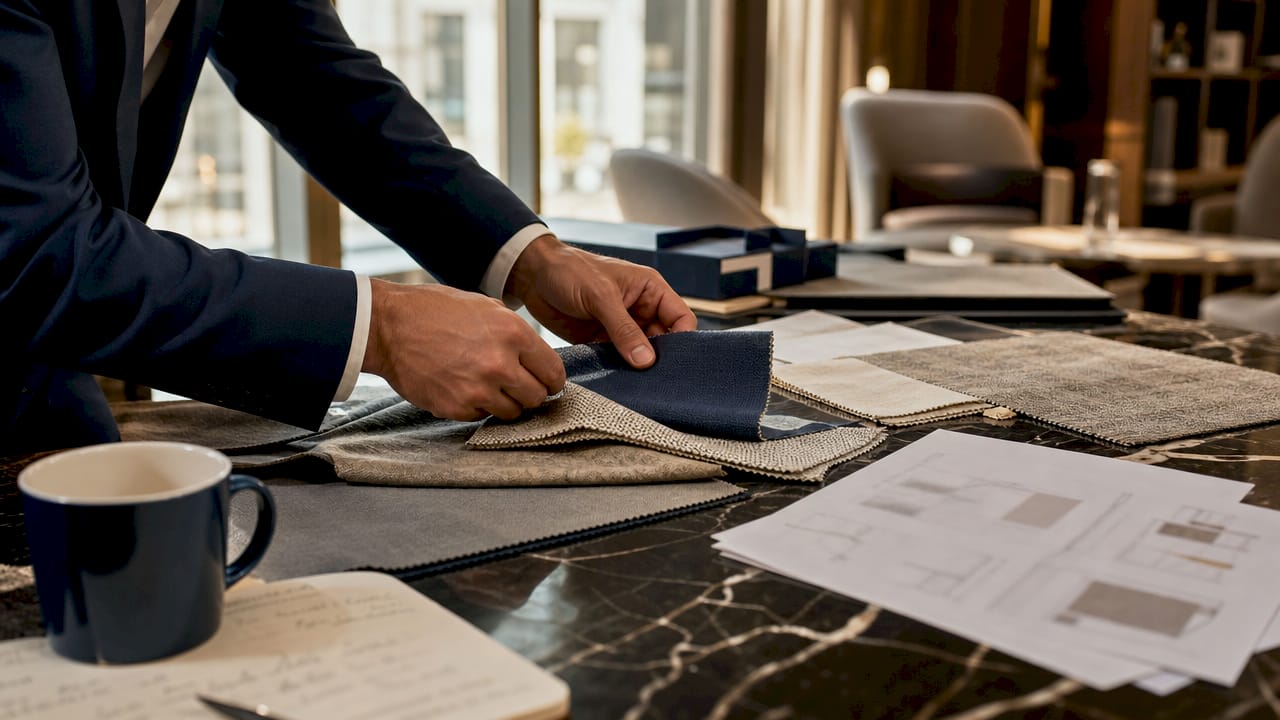
Flame retardancy is the non-negotiable baseline. Most major hotel chains mandate CAL TB 117-2013 and NFPA 260 Class I for upholstered furniture. UK and EU properties typically require BS 7176 Medium Hazard certification, which references BS 5852 Crib 5. These are not optional upgrades. They are minimum legal thresholds in most jurisdictions.
Abrasion resistance determines how long a fabric survives in a high-traffic environment. High-traffic FOH upholstery requires 60,000–100,000+ Martindale double rubs to endure intensive daily use. The Martindale test simulates circular friction on fabric; the higher the cycle count, the longer the fabric lasts before showing wear. A lobby chair rated at 30,000 Martindale cycles will look tired within a year of heavy use.
Cleanability is where many managers underestimate the risk. Incompatible cleaning codes with hotel housekeeping protocols cause fabric failure even when abrasion ratings are high. Alkaline cleaners, which are standard in most commercial housekeeping programs, degrade topical flame-retardant treatments. This means a fabric can pass its initial compliance test and then fail that same test after six months of routine cleaning.
Lightfastness rounds out the performance criteria. Lightfastness Class 4 is the minimum for interior FOH fabrics, with Classes 5–6 recommended for textiles placed near windows or under direct lighting. Faded upholstery and curtains signal neglect to guests before a single word is spoken.
Pro Tip: Always request a fabric’s cleaning code alongside its technical data sheet. A fabric rated W (water-based cleaning only) will not survive commercial housekeeping with solvent-based products, regardless of its Martindale count.
How do front-of-house textile standards differ from back-of-house requirements?
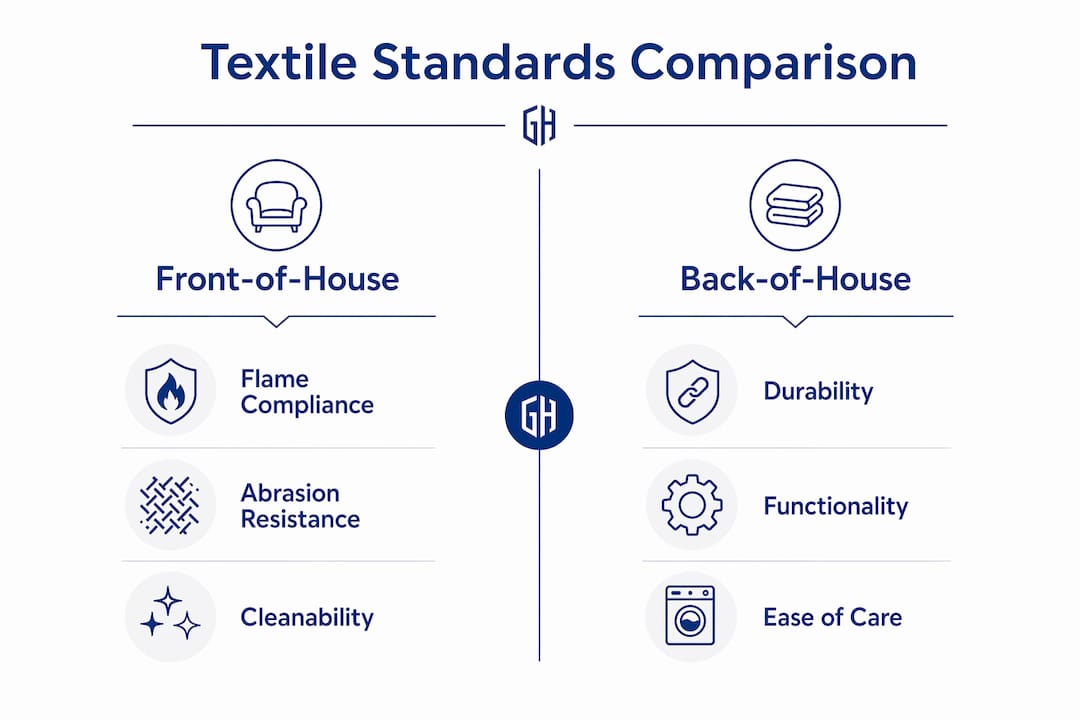
FOH and BOH textiles serve fundamentally different operational roles. FOH textiles act as brand ambassadors, prioritizing sharp appearance, colorfastness, and guest-facing presentation. BOH textiles prioritize heat management, extreme durability, and protective performance. Mixing the two creates real problems, both for safety compliance and brand signaling.
| Criteria | Front-of-House | Back-of-House |
|---|---|---|
| Primary purpose | Guest-facing presentation | Protective performance |
| Flame standard | CAL TB 117-2013, NFPA 260, BS 7176 | NFPA 701 (kitchen/curtain fabrics) |
| Abrasion focus | Martindale 60,000–100,000+ | High tensile strength, tear resistance |
| Appearance | Colorfastness, wrinkle resistance, drape | Functional; appearance secondary |
| Typical garments | Blazers, dress shirts, aprons, table linens | Chef coats, kitchen aprons, utility wear |
A server’s poly-viscose blazer is designed to look sharp under dining room lighting and survive repeated industrial laundering. A chef coat is designed to resist heat, grease, and physical stress. Putting a chef coat on a front desk agent signals operational confusion to guests. Putting a FOH blazer in a kitchen creates a safety risk because it may not meet NFPA 701 standards for kitchen environments.
Pro Tip: Label your textile inventory clearly by zone. A simple tagging system prevents BOH garments from migrating into FOH rotations during busy periods, which is more common than most managers realize.
What practical guidelines should hospitality managers follow when selecting front-of-house textiles?
Prioritize your selection criteria in this order: flame compliance first, abrasion resistance second, cleanability third, and aesthetics fourth. Reversing this order is the most common and most expensive mistake in FOH textile procurement. A beautiful fabric that fails a flame test or disintegrates after 20 wash cycles costs far more than a durable, compliant fabric that simply looks professional.
Follow these steps when evaluating any FOH textile:
- Confirm flame certification. Request the actual test certificate, not just a vendor claim. Verify it matches the standard required by your jurisdiction and property type.
- Check the Martindale or Wyzenbeek rating. For seating in lobbies, restaurants, and bars, target a minimum of 60,000 Martindale cycles. For lower-traffic areas, 30,000–50,000 may be acceptable.
- Verify cleaning code compatibility. Match the fabric’s cleaning code (W, S, WS, or X) against your housekeeping chemical program before purchasing.
- Assess lightfastness for placement. Any fabric near a window or under strong ambient lighting needs a lightfastness rating of Class 5 or higher.
- Evaluate fabric blend for the specific role. Poly-viscose blends at 65/35 are the standard for front desk and concierge uniforms, offering wrinkle resistance, formal drape, and easy maintenance. Poly-cotton 65/35 blends work well for server uniforms because they withstand industrial wash cycles at 60°C while providing breathability during long shifts.
- Specify embroidery over printed logos. Embroidery on FOH uniforms withstands hundreds of commercial laundry cycles without cracking. Screen printing and heat transfers begin fading as early as month 4, forcing early uniform replacement.
- Maintain dye lot consistency. Order enough fabric from a single dye lot to cover your full FOH area. Mixing dye lots creates visible color variation that guests notice, even if you do not.
Lifecycle cost matters as much as unit price. A fabric that costs 20% more per meter but lasts three times as long delivers better value. Build this calculation into every procurement decision. For a structured approach to sourcing, a hospitality procurement guide can help you formalize these criteria before you go to market.
Pro Tip: Request fabric samples and run them through your own housekeeping chemical protocol for at least four wash cycles before committing to a bulk order. Lab test results reflect controlled conditions. Your laundry room is not a lab.
Which fabrics are most suitable for FOH uniforms and seating?
The right fabric depends on the role, the traffic level, and the brand positioning of the property. Fine dining requires different specifications than a high-volume hotel lobby bar.
For FOH uniforms, the most reliable options are:
- Poly-viscose 65/35: The standard for front desk, concierge, and management roles. Recommended GSM range is 180–240 for suiting fabrics, which provides durability without sacrificing drape.
- Poly-cotton 65/35: Best for servers and hosts who need breathability during long shifts. Handles industrial laundering at 60°C without significant shrinkage or color loss.
- Wool-polyester blend 55/45 at 280 GSM: The choice for high-grade FOH blazers in upscale properties. Offers natural temperature regulation and effective crease resistance, with stain-resistant coatings available for extended shift performance.
For FOH upholstery and seating, the specifications shift significantly:
- Lobby and restaurant seating requires 50,000–100,000 double rubs and flame retardant certification.
- Inherently flame-retardant fabrics are preferred over topically treated alternatives because they maintain compliance under repeated industrial cleaning.
- Synthetic blends dominate for stain and soil resistance in high-traffic areas.
| FOH Role | Recommended Fabric | Key Specification |
|---|---|---|
| Front desk / concierge | Poly-viscose 65/35 | 180–240 GSM, wrinkle resistant |
| Server / host | Poly-cotton 65/35 | Industrial wash at 60°C, breathable |
| Management blazer | Wool-polyester 55/45 | 280 GSM, stain-resistant coating |
| Lobby seating | Synthetic blend, IFR | 60,000–100,000+ Martindale cycles |
| Restaurant seating | Synthetic or woven blend | Flame certified, cleanability code W or WS |
| Fine dining table linens | Cotton or cotton-poly | Colorfastness, wrinkle recovery, formal drape |
Inherently flame-retardant fabrics carry a clear advantage over topical treatments. Alkaline cleaners degrade topical treatments, causing loss of compliance and visible fabric dulling over time. IFR fabrics resist this degradation because the flame resistance is built into the fiber, not applied to the surface.
Key Takeaways
Front-of-house textile standards require flame compliance, abrasion resistance, cleanability, and aesthetic consistency to protect both guest safety and brand integrity.
| Point | Details |
|---|---|
| Flame compliance is non-negotiable | Verify CAL TB 117-2013, NFPA 260, or BS 7176 certification before purchasing any FOH fabric. |
| Abrasion ratings determine lifespan | Target 60,000–100,000+ Martindale cycles for high-traffic seating to avoid early replacement. |
| Cleaning compatibility prevents failure | Match fabric cleaning codes to your housekeeping chemicals before committing to bulk orders. |
| IFR fabrics outperform topical treatments | Inherently flame-retardant fabrics maintain compliance and appearance under industrial laundering. |
| Embroidery protects uniform investment | Embroidered logos survive hundreds of commercial wash cycles; screen prints fade by month 4. |
What I have learned from watching FOH textile programs succeed and fail
The most consistent mistake I see hospitality managers make is letting the purchasing decision start with aesthetics. A fabric swatch looks perfect in a showroom. It photographs well. The color matches the brand palette exactly. Then it goes into service and starts failing within eight months. The flame certificate was for a different treatment that the housekeeping team unknowingly stripped out. The Martindale rating was adequate for light residential use, not a hotel lobby with 300 daily check-ins.
The second mistake is treating FOH and BOH textiles as interchangeable during busy periods. A kitchen apron that migrates to a server’s station is not just an appearance problem. It may not meet the flame standards required for FOH environments, and it signals to guests that operational controls are loose. That perception is hard to recover from.
What works is building a textile specification document before you go to market. List the compliance standards required by your jurisdiction, the minimum abrasion ratings by area, the cleaning codes compatible with your housekeeping program, and the GSM ranges appropriate for each uniform role. Then evaluate suppliers against that document, not against fabric swatches alone. Gjergjihtextil has supplied properties like Meliá, Marriott, and Sheraton using exactly this kind of structured approach. The result is textile programs that hold up operationally and visually across full contract cycles.
One more thing: invest in embroidery for your branded uniforms. The cost difference over screen printing is real but modest. The durability difference is not modest. A logo that survives 200 wash cycles versus one that fades by month 4 is the difference between a uniform program that reinforces your brand and one that quietly undermines it.
— Xpert
Gjergjihtextil’s wholesale FOH textile solutions for hospitality
Gjergjihtextil supplies wholesale hotel textiles that meet the performance standards covered in this guide, including flame-certified upholstery fabrics, industrial-grade uniform blends, and table linens built for high-volume service environments. The company has supplied major international brands including Meliá, Marriott, and Sheraton, which means the quality benchmarks are validated at the highest level of hospitality operations. Gjergjihtextil offers expert consultation on fabric selection, compliance verification, and dye lot consistency, so your FOH textile program holds up across full contract cycles. For practical guidance on selecting the right textiles for your property’s specific needs, the team is available for direct B2B consultation.
FAQ
What is a front-of-house textile standard?
A front-of-house textile standard is the set of fabric performance specifications, safety certifications, and appearance requirements applied to all guest-facing textiles in a hospitality property, including upholstery, uniforms, and table linens.
What flame retardancy standard applies to FOH upholstery?
Most hotel chains require CAL TB 117-2013 and NFPA 260 Class I for upholstered furniture. UK and EU properties typically require BS 7176 Medium Hazard certification referencing BS 5852 Crib 5.
How many Martindale cycles does FOH seating fabric need?
High-traffic front-of-house seating requires 60,000–100,000+ Martindale double rubs. Lower-traffic areas may accept 30,000–50,000 cycles, but lobby and restaurant seating should always target the higher range.
Why are inherently flame-retardant fabrics better than topically treated ones?
Inherently flame-retardant fabrics maintain compliance and appearance under repeated industrial laundering because the flame resistance is built into the fiber. Topical treatments degrade when exposed to alkaline commercial cleaners, causing loss of both compliance and fabric appearance.
What fabric blend works best for FOH server uniforms?
Poly-cotton 65/35 blends are the standard for server and host uniforms. They withstand industrial laundering at 60°C, provide breathability during long shifts, and maintain a professional appearance through consistent commercial wash cycles.