


TL;DR:
- A Certificate of Origin certifies where a textile product was made, directly affecting tariff rates at customs. It is essential for compliance, as mistakes can lead to duties, delays, or rejection. Properly verifying and supporting COO documentation helps importers avoid costly legal and financial risks.
A Certificate of Origin (COO) is the official document certifying the country where a textile product was manufactured or substantially transformed, and it directly determines the tariff rate applied at customs. Every textile importer working with suppliers in Italy, China, India, or Pakistan needs to understand what is COO in textile importing before a single shipment clears port. Without a valid COO, your goods face full duty charges, shipment detention, or outright rejection. The COO is not optional paperwork. It is the financial and legal foundation of every compliant textile import.
How does the COO affect textile import regulations and customs procedures?
The COO sits at the center of customs clearance for textile and apparel shipments. U.S. Customs and Border Protection uses it to verify product origin, apply the correct tariff schedule, and determine whether a shipment qualifies for preferential duty treatment under free trade agreements (FTAs). Textile and apparel tariff rates in the U.S. can exceed 30%. A valid preferential COO can reduce that rate to near zero under agreements like USMCA or CAFTA.
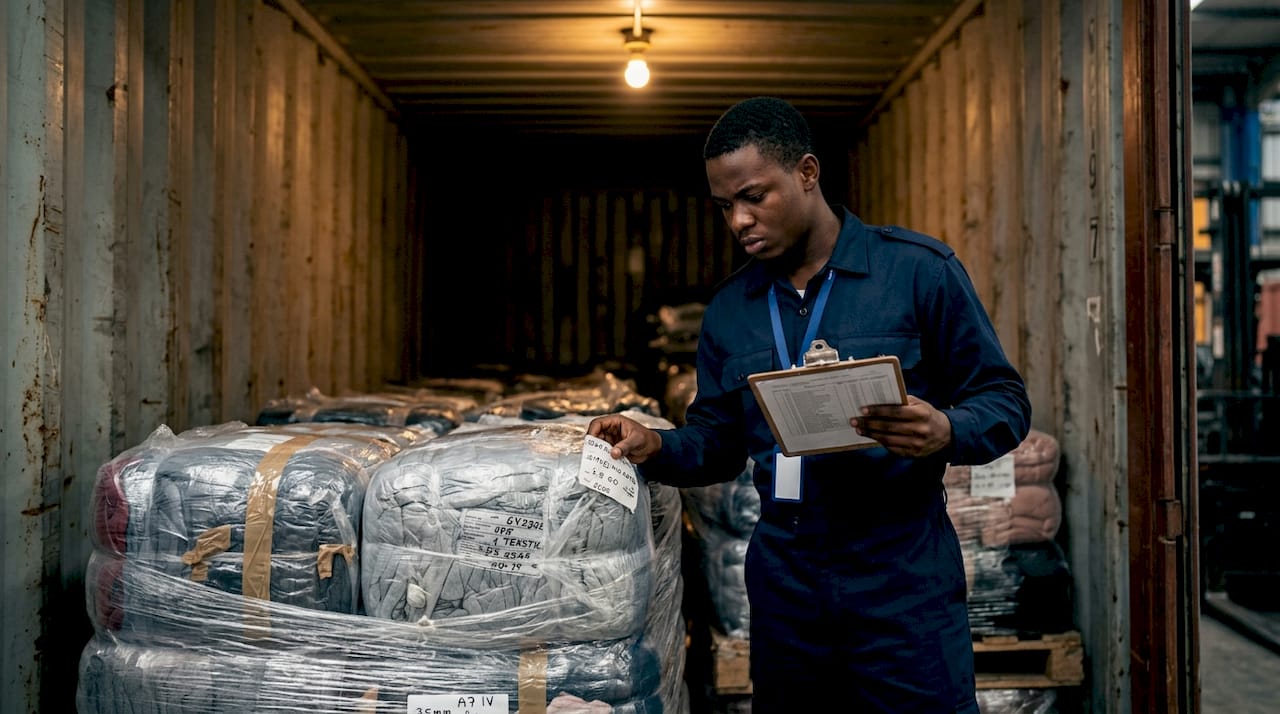
The Federal Trade Commission adds another layer. FTC rules under 16 CFR Part 303 require permanent, legible, sewn-in labels showing fiber content, country of origin, and manufacturer information. These labels must align exactly with the COO declaration. A mismatch between the two triggers detention at the port of entry.
Beyond tariffs and labeling, some textile categories require additional documentation. Textile visas and export licenses issued by the exporting country’s government accompany the COO for quota-controlled goods. Importers who skip this step face delays that can run weeks, not days.
Common compliance failures in this area include:
- Submitting a COO that lists a different country than the product label
- Using a non-preferential COO when a preferential one was available, and paying excess duties
- Failing to update COO declarations after a supplier changes their production location
- Relying on a COO issued after shipment rather than before or at the time of export
Pro Tip: Request a draft COO from your supplier before the shipment leaves the factory. Reviewing it against your commercial invoice and product labels at that stage costs nothing. Fixing a mismatch after the goods arrive at port can cost thousands.
What are the types of COO and the rules of origin for textiles?
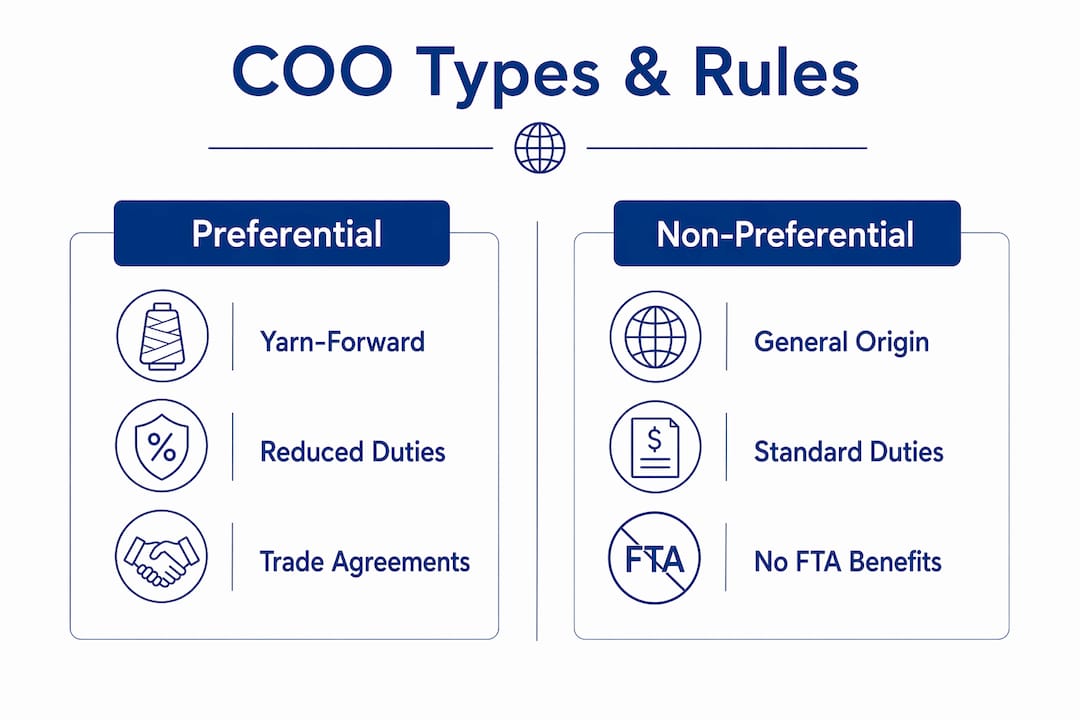
Two categories of COO exist in international textile trade. A Preferential COO certifies that goods qualify for reduced or zero duties under a specific FTA. A Non-Preferential COO simply confirms the country of origin for general customs purposes without unlocking any duty reduction. Choosing the wrong type means paying full tariff rates even when a lower rate was available.
Rules of origin define which country gets credit for producing the textile. Three main criteria apply:
| COO Type | Rule of Origin | Common Application |
|---|---|---|
| Preferential | Yarn-Forward | USMCA, CAFTA: yarn must be spun in the FTA region |
| Preferential | Fabric-Forward | Some bilateral FTAs: fabric must be woven in the FTA region |
| Preferential | Regional Value Content | Requires a minimum percentage of value added within the FTA zone |
| Non-Preferential | Substantial Transformation | General customs: product must be meaningfully changed in the declared country |
| Non-Preferential | Wholly Obtained | Raw materials and production entirely within one country |
The yarn-forward rule is the most demanding standard in U.S. textile trade agreements. Minor assembly in a different country does not confer origin. Sewing buttons, attaching labels, or folding and packaging a garment in a second country does not make that country the origin. Failure to apply this correctly triggers retroactive high tariffs.
Multi-country supply chains create the most confusion. A fabric woven in China, cut in Vietnam, and assembled in Bangladesh involves three countries. Under yarn-forward rules, none of those countries may qualify as the FTA origin unless the yarn itself was spun within the FTA zone. Trade agreements define thresholds and tariff shift rules that exporters must satisfy before applying through local chambers of commerce.
Pro Tip: Map your full supply chain before applying for a COO. Identify where the yarn was spun, where the fabric was woven, and where final assembly occurred. That map is your origin evidence. Without it, your COO application is a guess.
How to obtain and verify a COO for textile imports
Obtaining a COO follows a defined process, and skipping any step creates risk at customs.
-
Gather documentation. Collect commercial invoices, fiber content declarations, production process records, and manufacturing location details. Accurate commercial invoices and manufacturing details reduce clearance delays and penalties. Your invoice must list fiber content percentages, country of manufacture, and the exporter’s legal name.
-
Apply through the authorized issuing body. In most exporting countries, the local Chamber of Commerce issues COOs. Some countries use government trade ministries or authorized private agencies. The application requires the documentation gathered in step one, plus a completed declaration form.
-
Align the COO with your product labels. The country of origin on the COO must match the country of origin on the permanent sewn-in label. A mismatch between COO and textile labels leads to seizure or shipment delays under customs mislabeling regulations. Check both documents side by side before the shipment departs.
-
Engage a customs broker for pre-verification. A licensed customs broker reviews the draft COO, commercial invoice, and product samples before shipment. Pre-verification by customs brokers reduces errors and prevents costly delays or rejection at the port of entry. Third-party inspection agencies like Cotecna or Bureau Veritas offer this service for high-volume importers.
-
Retain all supporting records. U.S. Customs requires importers to keep entry records for five years. Store the COO, invoice, bill of lading, and production records together. Customs audits cross-reference all of these documents simultaneously.
For hospitality importers sourcing bed linens, towels, or uniforms from multiple countries, this process applies to every shipment from every origin. Gjergjihtextil manages this documentation chain across suppliers in Italy, China, India, and Pakistan, which is one reason hotels like Marriott and Sheraton rely on established importers rather than sourcing direct. You can review textile import compliance requirements specific to hospitality operations for a more detailed checklist.
Pro Tip: Due diligence on your supplier’s labor practices is now part of COO verification. The Uyghur Forced Labor Prevention Act (UFLPA) creates a rebuttable presumption that goods from certain regions are made with forced labor. A COO alone does not clear that bar. You need certified supply chain documentation to prove otherwise.
What common challenges do textile importers face with COO compliance?
The most costly misconception in textile importing is treating the COO as routine paperwork. Improper COO documentation can trigger costly audits and legal fees due to origin misclassification or illicit transshipment suspicion. Customs auditors cross-reference the COO against bills of lading, manufacturing logs, and shipping routes. Any inconsistency opens the door to a full investigation.
Proving substantial transformation is the hardest part of COO compliance for multi-country supply chains. The concept is legally nuanced. Sewing a garment together in one country when the fabric came from another does not automatically make the assembly country the origin. Yarn-forward and fabric-forward rules determine COO validity under FTAs, and minor operations like packaging or labeling do not qualify as substantial transformation.
Human rights compliance has become a direct part of COO verification. Authorities now demand certified proof that goods were not produced in sanctioned regions or with forced labor. A COO from a Chamber of Commerce does not satisfy this requirement on its own. Importers need documented supply chain transparency, including labor condition records, to support their COO declarations.
The top five COO mistakes textile importers make:
- Accepting a COO without verifying it against the commercial invoice and product labels
- Applying for a non-preferential COO when the shipment qualifies for preferential treatment
- Assuming minor assembly in a third country changes the product’s origin
- Failing to update COO declarations when a supplier shifts production to a new facility
- Ignoring forced labor compliance requirements that now accompany origin verification
Key takeaways
A valid COO is the single most important document in textile importing because it controls tariff rates, customs clearance, and trade agreement eligibility simultaneously.
| Point | Details |
|---|---|
| COO defines tariff exposure | U.S. textile tariffs can exceed 30%; a preferential COO reduces that rate under FTAs like USMCA. |
| Two COO types exist | Preferential COOs unlock duty reductions; non-preferential COOs confirm origin without rate benefits. |
| Yarn-forward rules are strict | Minor assembly does not confer origin; yarn must be spun in the FTA zone to qualify. |
| Label and COO must match | Any mismatch between the sewn-in label and the COO triggers port detention or seizure. |
| Forced labor compliance is now required | A COO alone no longer satisfies U.S. customs; documented supply chain transparency is mandatory. |
The COO is a financial instrument, not a formality
After working closely with textile supply chains across multiple sourcing countries, the pattern I see most often is this: importers invest heavily in product quality and supplier relationships, then treat the COO as an afterthought. That order of priorities is backwards.
The COO is where the financial outcome of your import is decided. Get it wrong and you pay full tariff rates on goods that qualified for zero. Get it wrong on a large shipment and you are looking at tens of thousands of dollars in avoidable duties, plus legal fees if customs opens an audit. I have seen shipments detained for weeks because a label said “Made in Bangladesh” and the COO said “India.” Both documents were technically correct for different stages of production. Neither one was aligned with the other, and the importer paid for that gap.
The regulatory environment is also tightening. The UFLPA has changed what “origin verification” means in practice. Customs officers are no longer satisfied with a Chamber of Commerce stamp. They want manufacturing records, labor condition certifications, and supply chain maps. Importers who built those systems early are clearing goods without friction. Those who did not are facing holds and requests for evidence that take months to compile.
My advice is direct: treat your COO process as part of your sourcing decision, not as a post-shipment task. Vet your suppliers’ documentation capacity before you place an order. If a supplier cannot produce a clean, verifiable COO with supporting records, that is a risk signal about their entire operation. The COO tells you more about a supplier’s reliability than their product catalog does.
— Xpert
Gjergjihtextil’s approach to textile sourcing and compliance
Gjergjihtextil has operated as a wholesale textile importer and distributor since 1994, sourcing from Italy, China, India, and Pakistan for hospitality clients across Albania and the region. That sourcing volume creates the documentation infrastructure that individual importers often lack.

For hotels, resorts, and restaurant operators who need bed linens, towels, uniforms, and table textiles that arrive with clean documentation and verified origin, Gjergjihtextil manages the full supply chain from import to delivery. Clients like Meliá, Marriott, and Sheraton have relied on that consistency. If you are sourcing wholesale hotel textiles and need a partner who handles compliance as part of the service, Gjergjihtextil is built for that role. Contact the team directly to discuss your procurement needs and volume requirements.
FAQ
What does COO stand for in textile importing?
COO stands for Certificate of Origin. It is the official document that certifies the country where a textile product was manufactured or substantially transformed, and it determines the applicable tariff rate at customs.
What is the difference between a preferential and non-preferential COO?
A preferential COO certifies that goods qualify for reduced or zero duties under a specific free trade agreement like USMCA or CAFTA. A non-preferential COO confirms origin for general customs purposes without unlocking any duty reduction.
What is the yarn-forward rule and why does it matter?
The yarn-forward rule requires that yarn be spun within the FTA region for a textile product to qualify for preferential duty treatment. Minor operations like assembly, packaging, or labeling in a different country do not change the product’s origin under this rule.
How do I obtain a COO for a textile shipment?
Apply through the Chamber of Commerce or authorized trade agency in the exporting country, supported by commercial invoices, fiber content declarations, and production records. Pre-verify the COO against your product labels before the shipment departs to avoid mismatches at customs.
Can a COO be rejected at U.S. customs?
Yes. U.S. Customs and Border Protection rejects COOs that contain mismatched information, show signs of transshipment fraud, or lack supporting documentation for forced labor compliance under the UFLPA. A rejected COO results in shipment detention, full tariff charges, or seizure.