

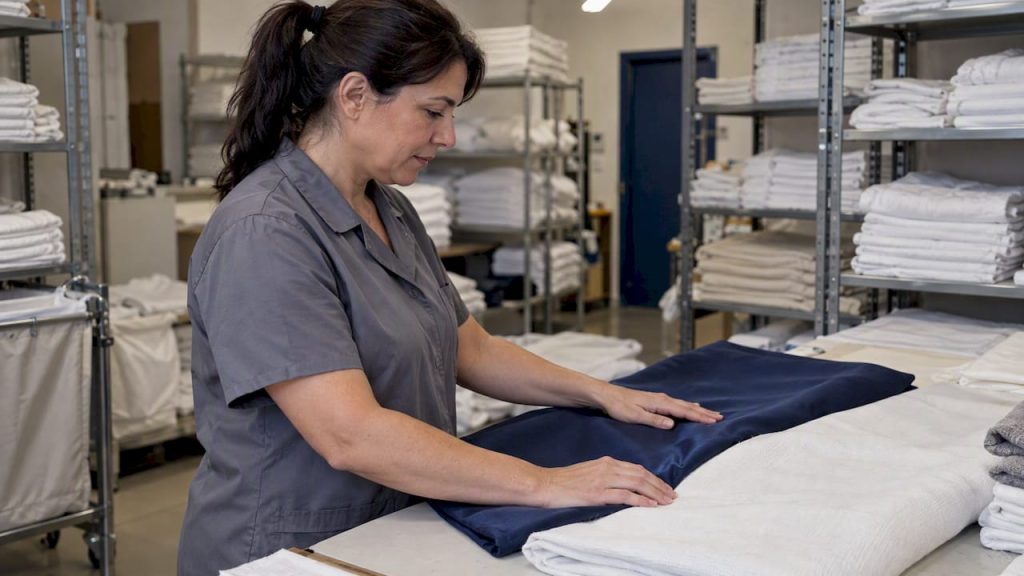
Both are polyester chemically; the difference is construction. Regular polyester can be made as continuous filament, which is smoother and less prone to pilling. Spun polyester is cut staple fiber twisted into yarn, which feels softer, looks more matte and behaves more like cotton. You choose between the two by weighing look and feel against strength.
TL;DR:
- Filament measures 55–70 cN/tex in tensile strength, compared with 30–45 cN/tex for spun, making it preferable for straps, linings, and load bearing gear.
- For polos, bedding, and table linens, spun offers a matte, softer hand; choose filament for smoother surfaces and more uniform color.
- Ask suppliers for abrasion and pilling results after repeated wash cycles, since new fabric samples may not predict wear in industrial laundering.
- Before ordering at scale, run a spun fabric through your usual laundry cycle and compare it with a reference sample for early pilling.
- When softness and seam strength both matter, consider a blend or yarn built around a stronger core, and ask the supplier to confirm construction in writing.
Table of Contents
- How filament and spun polyester are made
- What each one looks and feels like
- How they perform: strength, pilling, breathability and color
- Which one to choose for apparel, linens and upholstery
- Care, durability and industrial washing
- Why we spec for guest touch first and test before we commit
- How we support hospitality buyers who need spun or filament polyester
- FAQ
- Sources
How filament and spun polyester are made
Both start as the same polymer, PET, melted and pushed through fine holes. Filament yarn stays as continuous, unbroken strands. Spun polyester takes that same continuous tow and cuts it into short staple fibers, typically 38–51 mm long, which are then carded and twisted into yarn the way cotton is. That choice is made at fiber formation, so a spun yarn cannot simply be turned back into filament.
The physics follow from the construction. A filament yarn has no loose ends along its length, so its surface is smooth and every strand shares the load. A spun yarn has thousands of fiber ends poking out of the twist. Those ends create the surface fuzz, and they are also the starting point for pilling, because short fibers work loose under friction and tangle into small balls.
Twist matters as well. Tighter twist can help lock staple fibers in place and add strength, but it may also make the yarn firmer. Filament yarns can offer high strength without that trade-off, making them useful in technical applications. Filament yarns also account for a major share of polyester production, and their orientation and heat setting differ by end use.

What each one looks and feels like
Hand and appearance are usually the first thing a guest or a uniform wearer notices, so set expectations early. Spun polyester has a matte, slightly fuzzy surface and a warmer, drier hand. It drapes softly and reads as cotton-like even when no cotton is present. Filament polyester is smoother, can carry a visible sheen, and feels cooler and slightly slippery against the skin.
Use these cues in the field:
- Touch: a dry, soft, cotton-like feel points to spun; a cool, slick feel points to filament.
- Light: a glossy shimmer when you tilt the fabric suggests filament; a flat, even matte suggests spun.
- Close look: under a magnifier, tiny fiber ends along the yarn mean spun; smooth continuous strands mean filament.
- Yarn test: unravel a thread. Spun breaks into short fibers when you tease it apart, while filament stays as long continuous strands.
When in doubt, ask the supplier to state the yarn construction in writing rather than relying on the fiber content line.
How they perform: strength, pilling, breathability and color
Construction drives most measurable differences. One technical overview of the two yarn types puts filament tensile strength at 55–70 cN/tex for FDY, against 30–45 cN/tex for spun. Filament can pill less because it has fewer loose ends to migrate to the surface, while spun often shows more surface fuzz.
Filament yarns measure 55–70 cN/tex in tensile strength versus 30–45 cN/tex for spun, according to GLYarn, so filament carries more load per unit of yarn weight.
The remaining differences are smaller but still practical:
- Moisture and warmth: spun polyester has slightly higher moisture regain, 0.4–0.8% in the same overview, and its fuzzy surface traps a little air, so it feels warmer and less clammy than slick filament.
- Breathability: polyester absorbs little water either way, but the open, fibrous surface of spun fabric gives it a more comfortable feel against the skin.
- Color: filament usually dyes more uniformly. Spun can look slightly heathered because staple fibers take up dye less evenly.
- Repeated washing: abrasion and pilling are the metrics to ask for. Request results after many wash cycles, not just on new fabric.
Which one to choose for apparel, linens and upholstery
Match the construction to the job, not to the label. Use these decision rules during specification:
- Polo shirts and uniform polos: choose spun when a cotton-like hand and matte look matter more than peak strength.
- Table linens and bedding: choose spun for a soft, matte surface that reads as natural cloth on the table or in the bed.
- Linings, straps and outdoor gear: choose filament, where smoothness and strength per thread count most.
- High-stress technical uses: choose filament, because continuous strands carry load without shedding fibers.
- Mixed needs: if you want softness and seam strength together, consider a blend or a core-spun yarn rather than forcing one pure construction to do both.
For procurement staff, one rule covers most cases: if guests touch it, lean spun; if it carries load or must stay smooth, lean filament. For table settings specifically, our wholesale napkins range shows how these choices play out in a working restaurant.
Care, durability and industrial washing
Polyester of either construction handles hot industrial cycles better than cotton does, since it neither shrinks as much nor weakens as quickly in the wash. Filament constructions can resist mechanical action well because they have fewer loose fiber ends to abrade. Spun fabrics tolerate it well but show wear first as pilling and fuzz on high-friction areas.
Blends tell the same story on strength. In one study of woven fabrics, raising the polyester share lifted areal density from 184 to 199 g/m² and tensile strength up to 19 times higher in the weft direction than 100% cotton. For hotels and restaurants, the study suggests that polyester blends may improve fabric durability under laundering.
Practical habits for the laundry team:
- Wash similar fabrics together so abrasive items do not rub against softer spun pieces.
- Turn uniforms and fitted items inside out to protect the face of the fabric.
- Avoid overloading machines, since crowded drums raise friction and pilling.
- Dry at moderate temperature and remove items promptly to limit surface wear.
Pro Tip: Run one test batch of a new spun fabric through your usual cycle before a full rollout, and compare it with a reference sample to catch pilling early.
For deeper fixes, see our guide on stopping fabric pilling and our notes on durable hotel fabrics.
Why we spec for guest touch first and test before we commit
Most buyers over-index on strength figures and under-weigh what a guest actually feels at 11 p.m. when they pull up a duvet cover. Our view is that touch points may benefit from a softer, matte construction, while load-bearing parts may call for stronger yarn. Color consistency matters as much as either, because a mismatched batch is visible across a whole room set. Blends and core-spun yarns are worth a look when you need softness and seam strength together. Whatever you pick, ask suppliers for industrial-wash data and test swatches before a large order, because paper specifications may not predict how a fabric will look after repeated washing.
— Xpert
How we support hospitality buyers who need spun or filament polyester
We control our own supply chain, from import to custom production, and we focus on hospitality, so we can match the yarn construction to the job rather than to a catalog. We can provide advisory support before you commit to volume. Start with our hotel and AirBnB textiles, or browse our professional textile services. Contact us to request swatches and tell us what your guests, staff and laundry team need.

FAQ
Is spun polyester better than polyester?
Neither is better in every case. Spun polyester can feel softer and more cotton-like, while filament polyester is generally smoother. Pick the construction that matches the job, whether that is guest comfort or load-bearing strength.
What is spun polyester?
Spun polyester is made by cutting continuous polyester filament into short staple fibers, typically 38–51 mm, then carding and twisting them into yarn. The chemistry is the same PET as regular polyester. Only the construction differs.
Is spun fabric good for summer?
Spun polyester may feel drier and softer against the skin than slick filament, which some people may find more comfortable in warm weather. Its slightly higher moisture regain also helps. Fabric weight and weave still matter more than the yarn type alone.
Does polyester vs spun polyester change how often fabric pills?
Yes. Filament has few loose fiber ends, so it pills less. Spun has more fiber ends at the surface, which can make it more prone to pilling under friction, so wash-cycle testing can be useful.
Sources
- Old
- Effect of cotton‐polyester composite yarn on the physico‐mechanical and comfort properties of woven fabric