

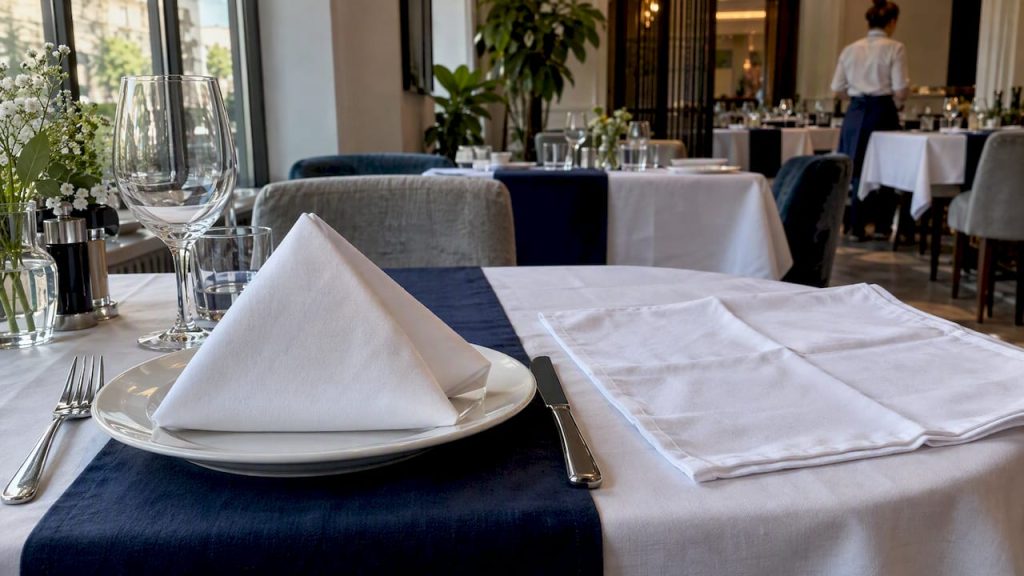
For a restaurant or hotel dining room, the right cloth napkin is usually between 45 and 56 cm (18 to 22 inches) square. Dinner service takes the top of that range, lunch and café service takes a smaller napkin, and cocktail and bar service takes a small paper or cloth napkin of about 25 cm. Below you will find each size in inches and centimeters, what it is used for, and how to match it to your venue and your laundry.
TL;DR
- Dinner and fine dining (cloth): 20 x 20 in (about 50 x 50 cm) is the standard. 18 to 22 in covers most formal and semi-formal service.
- Lunch, brunch and casual (cloth): 16 to 18 in (about 40 to 45 cm) covers the lap without too much fabric to wash and fold.
- Bar and cocktail: around 10 in (25 cm). Paper suppliers commonly sell 25, 33 and 40 cm sizes.
- Match the napkin to the venue: an oversized napkin in a fast casual room is wasted cost, and a tiny one in a fine dining room reads as a service failure.
- Buy for the laundry: choose fabric that holds its dimensions after hundreds of industrial washes, and order every size from one production run.
Table of Contents
- The sizes at a glance
- How to choose by type of venue
- Napkin size and the rest of the table
- Fabric matters as much as size
- How many napkins do you need?
- White or colored napkins
- Our view: standardize, then test
- From specification to order
- A short checklist before you order
- FAQ
- Sources
The sizes at a glance
Napkin sizes are usually quoted flat and unfolded. Inches dominate English-language catalogs, while Albanian and Balkan buyers think in centimeters, so both are shown here. Differences of 1 to 2 cm between suppliers are normal, and hemming and washing change the finished size a little.
| Use | Size (flat) | Approx. cm | Typical venue |
|---|---|---|---|
| Cocktail, beverage | 10 x 10 in | 25 x 25 | Bars, lounges, canapé service |
| Luncheon, casual | 16 x 16 in | 40 x 40 | Cafés, brunch, daytime restaurants |
| Everyday restaurant | 18 x 18 in | 45 x 45 | Casual and mid-range dining |
| Dinner | 20 x 20 in | 50 x 50 | Hotel restaurants, fine dining |
| Banquet, formal | 22 x 22 in | 56 x 56 | Weddings, galas, multi-course menus |
The dinner figure is well documented. One restaurant-supply reference puts the standard dinner napkin at 20 by 20 inches, with 18 to 22 inches appropriate for formal and semi-formal dining. Etiquette guidance says the same thing from the guest’s side: the formality of the event sets the napkin’s size and shape, and a formal multi-course meal calls for the large napkin.
How to choose by type of venue
Size is an operational decision before it is a style decision. It affects how much fabric you buy, how much you launder, how fast staff can fold, and what the guest thinks when sitting down.
Fine dining and hotel restaurants
Use 20 x 20 in (50 x 50 cm), or 22 x 22 in for banquets and tasting menus. A napkin this size can be folded into a clean shape on the plate or placed on the lap with enough overhang to protect clothing. In a hotel, the dinner napkin sits in the same visual family as the tablecloth and the bed and bath linen, so keep the fabric weight and white shade consistent across all of them.
Casual restaurants and cafés
A 16 to 18 in napkin (40 to 45 cm) works well. It covers the lap, folds fast, and uses less fabric per wash load. If you serve both lunch and dinner, many restaurants keep one 18 in napkin for the whole day rather than stocking two sizes and mixing them up in the laundry.
Bars, terraces and breakfast buffets
Small napkins of around 25 cm suit drinks and bites. Paper is common here because the napkin is used once and thrown away. A Bulgarian paper producer, for example, lists three standard sizes of 25, 33 and 40 cm, which is a useful guide to how the paper trade divides the range. For breakfast buffets in Albanian hotels, a 33 cm paper napkin next to a cloth napkin at the table is a common and practical pairing.

Paper or cloth by segment
The choice of material follows the segment too. One HoReCa napkin guide says fast food uses 1-ply dispenser napkins, cafés use 2-ply, and fine dining uses 3-ply or fabric. That matches what we see: cloth carries the premium impression, while paper carries speed and low cost.
Napkin size and the rest of the table
A napkin has to fit the place setting, not just the guest. A placemat or set for main dishes needs room for plate, cutlery and glasses, and one study of restaurant textiles gives 30 x 40 cm as the minimum size of such a set. If the napkin is folded on top of the plate, a 20 in napkin folded in quarters is about 25 cm wide and fits a standard dinner plate without hanging over the edge. If it sits to the left of the fork, you can use a smaller fold.
Tablecloth size follows from the table, and we have a separate tablecloth size chart for hospitality buyers. For layout ideas, our practical guide to restaurant table setup textiles shows how napkin, runner and cloth work together. If you want to see how tableware and table styling are handled by another hospitality team, handmade ceramic tableware and table styling from a Rome restaurant is a good visual reference for color and texture next to a white napkin.
Fabric matters as much as size
Two napkins with the same label size can behave very differently after six months of service. When you specify a hotel napkin, check these points:
- Fiber. Cotton feels best and absorbs well. Cotton-polyester blends usually survive more wash cycles and wrinkle less, which saves ironing time. Pure linen looks premium but needs more care.
- Shrinkage. Hospitality textiles are made for industrial laundering, so ask for a stated shrinkage figure. As a working rule, we look for shrinkage under 5% so that a 50 cm napkin does not end up visibly smaller than the new ones.
- Color fastness. For colored napkins, ask for a color fastness grade of 3 or higher on the ISO scale, and wash a sample before you order in volume.
- Safety. Napkins touch food and lips. Ask for a fabric composition declaration and OEKO-TEX certification.
- Hems and weave. A stitched hem on all four sides and a tight weave resist fraying and snagging from industrial folding machines.
A 20 in napkin cut from fabric that shrinks 8% in the first month is effectively an 18.4 in napkin. Buy one size larger if your supplier cannot state the shrinkage, or ask for a pre-washed sample. Our guide to what makes restaurant linen premium covers weave and weight in more detail.
How many napkins do you need?
A working par level is the number of napkins you need in circulation, not just on the tables. A common approach is to multiply the seats you fill per service by the number of services per day, then add a laundry cycle buffer so you are never short while a batch is in the wash.
Example: a hotel restaurant with 60 seats, two turns at dinner and one breakfast service. That is up to 180 napkins in use per day. With one full set drying or in transit and another on the shelf, a par of three sets (540 napkins) is a sensible starting point, adjusted after a month of real data. Banquet and event napkins are counted separately, because a wedding for 200 guests uses the whole stock at once.
Napkins also get stained and retired earlier than tablecloths. Plan to replace a share of stock every season and keep a few spare dozens from the same production run. Mixed batches can show slightly different whites and sizes side by side, and guests notice.

White or colored napkins
White remains the default for hotels and fine dining. It looks clean, matches any tableware, and shows stains immediately, so staff know when a napkin must be pulled. White cotton can also be washed hot with strong detergent and sanitized without worrying about fading.
Colored napkins are a good choice when your brand or concept calls for them: a beach club in Vlora, a wine terrace, a rustic taverna. They hide minor stains, but they fade over time and do not take aggressive laundering as well. If you use color, run a wash test on samples first, and keep a white set for formal events.
The same logic for towels
Readers often ask why hotels use white towels. The reasons are the same as for napkins: white looks clean, suits any bathroom, can be bleached and sanitized, and shows wear. Colored towels are possible, but they need color-safe laundering and are harder to replace in matching shades. For bath and spa sizing, see our 10 point hotel towel spec, which starts from the 70 x 140 cm standard.
Our view: standardize, then test
We have supplied hospitality businesses since 1994, and the most common napkin problem we see is not the wrong size on paper. It is inconsistency: three sizes in the same dining room, because stock was bought in different seasons from different sources. The guest sees it, and the laundry feels it, because folding machines and manual folds are set for one size.
Our advice is plain. Pick one dinner size and one casual size at most, and write the finished dimensions and shrinkage tolerance into your purchase specification. Order a sample set, wash it as your laundry does, then measure it again. Only then place the volume order. Because we import in large volumes and also produce in-house, we can match a specification, a size or a custom hem to your venue, and we can repeat the same run when you reorder.
For most hotel restaurants in Albania, Kosovo, Montenegro and North Macedonia, our starting recommendation is a white 20 x 20 in (50 x 50 cm) dinner napkin and an 18 x 18 in (45 x 45 cm) everyday napkin, in a fabric that holds up to your wash program. Adjust that from there for your concept.
— Xpert
From specification to order
If you run a restaurant, hotel or event venue and need napkins in a defined size, fabric and quantity, our team can propose options from stock or produce them to your size. You can see the range on our wholesale napkins page, review our offer for restaurant textiles, or send us your specification through the Gjergji H Tekstil website. We sell in bulk to hospitality businesses, not to individual consumers. To keep ongoing costs down, our guide on how to maximize hotel textile durability and cut costs is a useful next read.
A short checklist before you order
- Decide the napkin size for each service: breakfast, lunch, dinner, banquet, bar.
- Write the finished size in centimeters and inches, with a tolerance of about 1 to 2 cm.
- Ask for fiber composition, shrinkage, color fastness and OEKO-TEX information.
- Wash and measure a sample before the volume order.
- Calculate par levels, including the laundry cycle.
- Order spare stock from the same production run.
- Check that the folds you plan to use work with the chosen size.
FAQ
What size are restaurant napkins?
Most cloth napkins in restaurants are 18 to 20 inches square (45 to 50 cm). Casual and daytime venues often use 16 to 18 inches, and formal dinner service uses 20 to 22 inches. Bars use much smaller napkins of about 10 inches (25 cm).
What is the standard dinner napkin size?
The usual dinner napkin is 20 x 20 inches, or about 50 x 50 cm, and sizes from 18 to 22 inches are considered appropriate for formal and semi-formal dining. Choose the larger end for banquets and multi-course menus. Keep one size across the room so the table looks uniform.
What are typical cloth napkin dimensions for a hotel?
For hotel restaurants we suggest a 20 x 20 in (50 x 50 cm) napkin for dinner and 18 x 18 in (45 x 45 cm) for breakfast and lunch. Ask the supplier for the finished size after washing, since shrinkage can reduce it. A stated tolerance of 1 to 2 cm is realistic.
Why do hotels use white towels, and should I use colored ones?
White looks clean, suits every room, can be sanitized with hot, strong laundering, and shows stains and wear so staff can retire items on time. Colored towels can work for a distinct brand or spa concept, but they need gentler washing and fade sooner. Test a sample in your own laundry first.
Is paper or cloth better for a restaurant?
It depends on the segment. Paper suits fast service, bars and buffets, while cloth suits fine dining and hotel restaurants where the guest expects a premium table. Many hotels use both: cloth at the table and small paper napkins at the bar or breakfast buffet.
Sources
- What Size Is a Dinner Napkin? Chef’s Resource
- The Expert’s Guide to Napkin Use and Etiquette
- Alfy Paper: napkin sizes
- Gastronomic Napkins: Complete HoReCa Guide
- Textile Products for Restaurant Business