

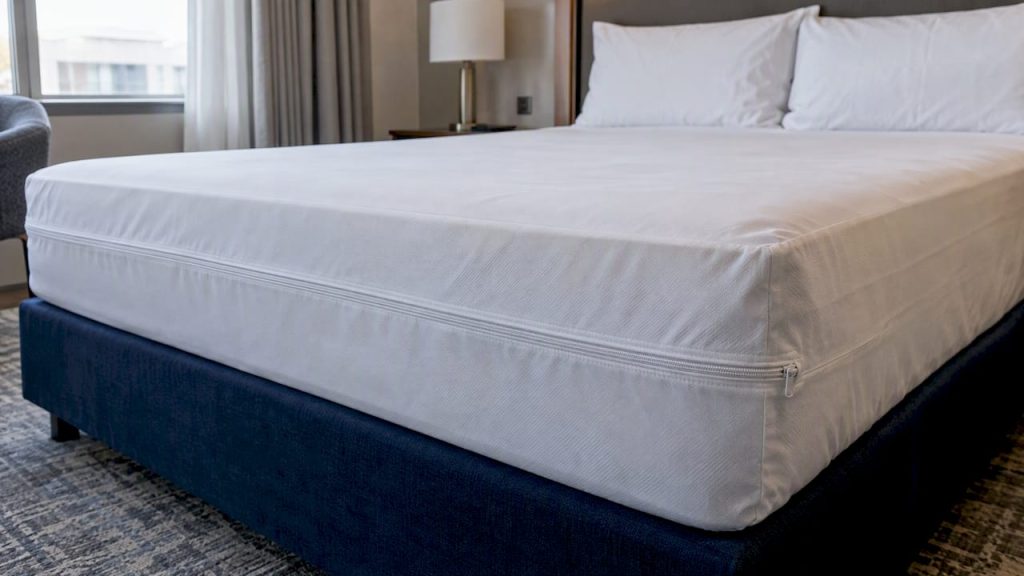
A correctly sized encasement with tested zippers and sealed seams blocks bed bugs from entering or escaping a mattress, but only when the product has documented lab testing behind it. The fabric matters less than the zipper, since that is where most products fail. Before buying, measure the mattress and read the testing summary, not just the marketing claim.
TL;DR:
- Request a lab report naming the laboratory, tested fabric and zipper, bed bug life stages, exposure times, and sample sizes; a bare claim proves little.
- Measure mattress length, width, and depth, then match the encasement to home laundering or industrial hotel washing and check for a guarded micro zipper.
- Vacuum first, seal the zipper guard flat, and inspect seams monthly or weekly during suspected infestation; follow wash limits and avoid high heat drying.
- Replace it when the zipper gaps, fabric tears, or seams fray, because any failure can reopen a path into or out of the mattress.
- Leave a suspected infestation sealed and undisturbed for an extended period; opening it early can release surviving bugs before they starve.
Table of Contents
- How mattress encasements block bed bugs and what that accomplishes
- Materials, construction, and lab testing: the checklist that proves “bed bug proof”
- Practical buying checklist: choose the right encasement
- Install, inspect, and maintain your encasement step-by-step
- How long protection lasts and when to replace an encasement
- Procurement perspective: what hospitality buyers should prioritize
- An adjacent option for bulk buyers: hotel mattress protection sourced at scale
- FAQ
- Sources
How mattress encasements block bed bugs and what that accomplishes
An encasement works by closing off every hiding place a bed bug could use: the fabric covers the mattress surface, the seams are sealed shut, and the zipper closes the one remaining gap. When all three hold, bugs already inside cannot escape to feed, and bugs outside cannot get in to nest. That is the whole mechanism, and it only works when none of the three parts fail.

Encasements get used in two different situations. For containment, we trap an existing infestation inside a mattress and starve it out over time. For prevention, we stop a clean mattress from ever becoming a host. The same product does both jobs, but buyers should know which one they need before they shop.
A well-built encasement typically includes a tightly woven or laminated membrane, a zipper guard that covers the closure, and seams reinforced or sealed against puncture. According to academic research on bed bug biology, encasements reduce harborage and help contain or prevent mattress infestations when used as part of a broader control approach.
A good encasement should prevent:
- Bugs already in the mattress from reaching a host to feed
- New bugs from nesting in seams, tufts, or mattress edges
- Egg-laying sites from forming on the mattress surface
- Moisture or stains from degrading the mattress underneath
Materials, construction, and lab testing: the checklist that proves “bed bug proof”
Not every fabric that looks sealed actually blocks a bed bug. Tightly woven polyester, polyurethane laminate, and vinyl are the three materials most often used, and each works differently. Woven polyester relies on thread count tight enough that a bug’s flattened body cannot squeeze through. Polyurethane laminate adds a thin waterproof layer bonded to the fabric, which blocks penetration outright rather than relying on weave density. Vinyl does the same job but tends to feel stiffer and less breathable, which matters for hotel guests sleeping on it nightly.
The zipper is the part that fails most often, not the fabric. A micro-zipper with fine teeth closes more tightly than a standard zipper, and a separate zipper guard, a fabric flap that covers the track, adds a second barrier at the one seam that opens and closes repeatedly. When a product fails a lab test, the zipper is usually the reason.
A credible lab report is specific, not vague. A one-line claim of “bed bug proof” with no supporting document means little; a real report names the testing lab, states whether fabric and zipper were tested separately, lists the bed bug life stages used (eggs, nymphs, adults), and gives exposure times and sample sizes.
Before buying, it helps to:
- Ask the seller directly which laboratory ran the test and request the report
- Check whether the fabric and the zipper were tested as separate components
- Confirm the report states exposure duration and life stages tested
- Look for recognized material certifications alongside the pest-control claim
Independent product testing, including reviews that evaluate construction and zipper security, consistently points to zipper design as the detail that separates reliable encasements from ones that only look reliable on a label.
Practical buying checklist: choose the right encasement
Buying the right encasement is a matter of working through a short sequence rather than picking whatever appears first in search results.
- Measure the mattress length, width, and depth, since an undersized encasement will not seal and an oversized one bunches at the seams.
- Decide whether you need hotel-grade durability for repeated industrial washing or a lighter home-use product for occasional laundering.
- Check the zipper design for a micro-zipper closure and a separate zipper guard or locking sleeve.
- Request the lab test documentation and ask which certification names appear on it before paying.
- Decide whether you also need pillow encasements, box spring covers, or bed frame protection, since bugs can nest in any of these.
- Compare retail suppliers against hospitality-focused suppliers if you are buying in volume, since minimum order sizes and fabric grades differ.
Pro Tip: Ask for a physical sample before committing to a bulk order. A swatch lets you check seam stitching and zipper feel in hand, which a product photo never shows.
For hotel and short-term rental operators, protection decisions rarely stop at the mattress. A layered approach to mattress protection that pairs an encasement with a washable topper tends to extend the life of both.
Install, inspect, and maintain your encasement step-by-step
Getting the barrier right starts at installation and continues with a maintenance routine.
- Vacuum the bare mattress thoroughly, paying attention to seams and tufted areas, before fitting anything over it.
- Fit the encasement over the mattress corners first, then work the fabric flat along each side to remove slack.
- Close the zipper fully and confirm the zipper guard lies flat over the track with no gap.
- Run a hand along every seam and the zipper line to check for tears, holes, or an incomplete seal.
- Inspect the encasement monthly, or weekly if you suspect an active infestation, checking the same seams and zipper each time.
- Wash according to the manufacturer’s temperature limit, since polyurethane-laminated fabric can crack under high heat, and air-dry or use a low dryer setting rather than high heat.
- If you suspect bugs are trapped inside, leave the encasement sealed and undisturbed, since removing it early lets any surviving bugs escape before they starve.
How long protection lasts and when to replace an encasement
Most encasements hold up for one to several years, depending on material and how often they are laundered. A polyurethane-laminated encasement in a home bedroom, washed occasionally, tends to last longer than the same product under hotel-grade industrial laundering cycles, where heat and frequency wear down seams faster.
Watch for the signs that mean a replacement is due:
- A zipper that snags, gaps, or no longer closes flush
- Visible tears or thinning fabric, especially near corners and seams
- Seam stitching that has pulled loose or frayed
- A musty smell or visible staining that suggests moisture has penetrated
Washing at the manufacturer’s specified temperature and avoiding high-heat drying extends the working life of the barrier. Once a seam or zipper fails, the encasement no longer does its job, even if the fabric itself still looks intact.
Procurement perspective: what hospitality buyers should prioritize
After more than 30 years sourcing and producing textiles for hotels, we have found that two habits separate reliable mattress protection programs from ones that fail under real-world use. First, insist on seeing the actual test report before signing a bulk order, not just a label that says “bed bug proof.” Second, request a physical sample and inspect the zipper and seams yourself before committing to volume. Procurement teams that skip either step tend to discover the weak point only after the product is already in use across dozens of rooms.
— Xpert
An adjacent option for bulk buyers: hotel mattress protection sourced at scale
For hospitality managers sourcing mattress protection across many rooms, we handle the procurement side directly: bulk supply, custom specifications, and advisory on which materials and testing documentation to request before you commit to an order.

If you manage guest room textiles and want to review samples or documentation before ordering, our hotel and short-term rental textile line is the place to start. We also work with teams managing guest check-in and operations software like EuroCheckin who need their room textile sourcing to keep pace with turnover schedules. Reach out through our main site to request a sample or ask about custom specifications for your property.
FAQ
Do bed bug encasements really work?
Yes, encasements work when the fabric, seams, and zipper are all intact and the product has documented lab testing behind the claim. Research on bed bug biology supports encasements as an effective part of containing or preventing mattress infestations, not as a standalone guarantee.
Can bed bugs bite through encasements?
A bed bug cannot bite through an intact, properly sealed encasement, since the barrier keeps the bug from reaching skin through the mattress. If a bite occurs through a mattress protected by an encasement, it usually means a tear, a seam gap, or a zipper failure has opened a path.
What material can bed bugs not get through?
Tightly woven polyester, polyurethane laminate, and vinyl are the main materials used because their weave density or laminated layer is fine enough to block a bed bug’s body. The zipper closure matters as much as the fabric, since a loose or standard zipper is the most common failure point even on a well-made fabric.
How long can bed bugs survive in a mattress encasement?
Bed bugs trapped inside a sealed encasement cannot reach a host to feed, and they will eventually starve, though survival time varies by life stage and conditions. Leaving the encasement sealed and undisturbed for an extended period, rather than removing it early, gives the containment method time to work.