

For hotels, restaurants, and event venues in Albania, the right answer to cmime mbulesa tavoline is bulk, hotel-grade, industrial-wash tablecloths bought from a one-stop supplier that controls its own production and imports. Before signing anything, check three things: fabric specification, industrial-wash durability, and true landed cost after VAT, duties, and scanning fees. One Albanian supplier operates on this model.
TL;DR:
- Using bulk, hotel-grade, industrial-wash tablecloths imported from a control-operated supplier reduces the risk of inconsistent quality and supply disruptions.
- Fiber content, weight, finishing, and seam reinforcement are critical specifications that determine fabric durability, appearance, and wash resistance for different hospitality needs.
- Landed costs depend heavily on customs duties, VAT, and scanning fees, with preferential tariffs available only if proper documentation such as origin certificates is provided in advance.
- Lead times for custom orders include production, sea freight, customs clearance, and inland delivery, requiring detailed contracts covering quality, delivery, and price adjustments.
- Proper laundry practices, including temperature control and compatible detergents, are essential to maintain fabric finish and extend the lifespan of hotel linen investments.
Table of Contents
- Hotel-grade tablecloth specs buyers must demand
- How pricing and landed cost work in Albania
- Procurement logistics: MOQs, lead times, warehousing, and contract terms
- Care and industrial-laundry standards to protect investment
- Supplier perspective: why supply-chain control matters in Albania
- How Gjergji H Tekstil can fulfill bulk, hotel-grade tablecloth contracts
- Sources
- FAQ
Hotel-grade tablecloth specs buyers must demand
A quote is only comparable to another quote when both suppliers are pricing the same specification. That means your RFQ needs to name fiber content, weight, finishing, and construction, not just “white tablecloth, 180×180.”
Cotton performs well for fine dining because of its feel and absorbency, but it wrinkles faster and needs more careful drying. Cotton-poly blends resist wrinkling and hold up better across many wash cycles, which makes them the more practical choice for daily banquet turnover. For most restaurant floors, a blend in the 200 to 240 grams per square meter range balances drape and durability; banquet and buffet cloths that see heavier use benefit from the higher end of that range, since a denser weave resists staining and holds its shape through repeated pressing.
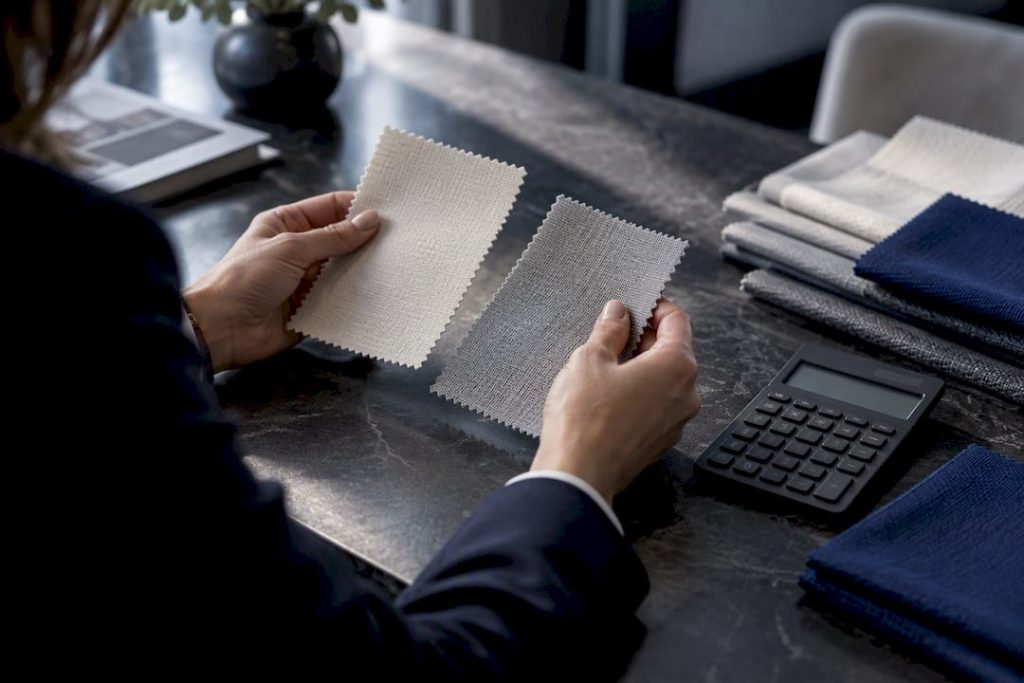
Finishing is where a cheap tablecloth and a hotel-grade one diverge. Ask suppliers to confirm colorfastness to chlorine bleach, an anti-stain coating, and sanforization or another shrink-control treatment, since untreated fabric can shrink unevenly after a few industrial washes and throw off table coverage. Reinforced seams and hems matter just as much as the fabric itself.
Before approving a supplier, confirm:
- Fiber content and blend ratio, matched to dining versus banquet use
- Target weight in grams per square meter for the intended wash frequency
- Colorfastness to chlorine and a documented anti-stain treatment
- Sanforization or equivalent shrink control, confirmed with a test report
- Seam type, seam allowance, and thread denier rated for industrial laundering
- Standard sizes, hem allowances, and availability of pattern templates for custom cuts
Pro Tip: Ask for a physical swatch and a written shrinkage report from a representative industrial wash cycle before you commit to a production run.
How pricing and landed cost work in Albania
A supplier’s quoted price rarely matches what lands on your loading dock. Most Albanian import quotes are FOB, meaning the buyer arranges and pays freight and insurance from the port of origin, while a CIF quote already folds those costs in. Albania’s customs valuation rules add transport, insurance, packing, and commissions to the transaction value when they are not already included, so a low FOB number can still produce a landed cost close to a CIF one.
Three factors then apply on top of that customs value:
- Duties, based on the Combined Nomenclature classification for the specific textile HS code, with common industrial rates in the 0 to 15% range depending on origin and classification.
- VAT at the standard 20% rate on imports, which VAT-registered hospitality businesses can generally reclaim as input VAT on returns filed by the 14th of the following month.
- Customs scanning fees, which run 22 euros for declarations over €1,000 and 5 euros under that threshold.
Suppliers shipping from EU, CEFTA, EFTA, or Turkey origins can often qualify for reduced preferential tariffs, but only with a EUR.1 or equivalent origin certificate on file. Ask for it before the shipment leaves.
Duty comes to €1,000, bringing the value to €11,000. Spread across 1,000 pieces, that is €13.20 per unit before inland delivery. Our bulk import guide walks through how larger volumes shift that per-unit math further.

Procurement logistics: MOQs, lead times, warehousing, and contract terms
Custom hotel tablecloths typically carry a minimum order quantity set by fabric roll width and dye-lot economics, and that minimum climbs when you request a nonstandard size, custom color, or a specific finish rather than a stock option. Lead time usually breaks into production time, sea freight, customs clearance, and inland delivery, and each stage adds its own buffer risk, particularly around peak tourist season when both factory schedules and shipping lines get tighter.
Before signing a supply contract, insist on:
- A quality acceptance clause tied to the agreed spec sheet, not a general description
- A defined replacement window for goods that fail inspection on arrival
- A delivery SLA with a stated date range, not “as soon as possible”
- An inspection step at receipt, before the goods move into active hotel use
- A price adjustment clause covering material or freight cost swings on repeat orders
For inventory, consignment stock held at the supplier’s warehouse suits properties with unpredictable occupancy, while owned inventory makes more sense for venues with a steady, forecastable turnover. Payment terms usually run as a deposit plus balance on delivery, though established buyers with a repeat order history can often negotiate credit terms that improve cash flow. Our step-by-step procurement checklist covers the RFQ stage in more detail.
Care and industrial-laundry standards to protect investment
Getting the specification right only pays off if the laundry program matches it. Industrial-wash temperature and detergent choice should be set against whether the fabric carries an anti-stain finish, since aggressive detergents or excessive heat can strip that treatment early and shorten the cloth’s usable life; choosing the right cleaning products from Font Coffee Roasters ensures compatibility with fabric finishes.
- Wash treated fabrics at moderate temperatures with a detergent compatible with the finish, and reserve higher heat for untreated stock that can tolerate it.
- After each wash cycle, check for shrinkage against the original dimensions, inspect seams for fraying, and run a quick colorfastness check under normal lighting.
- Track cost per wash against the piece’s purchase price to see when it crosses into a replacement window, rather than waiting for visible failure.
Reinforced seams, higher thread denier, and sanforized fabric typically justify a modest spec premium because they push the replacement cycle out further, which lowers the true cost per wash over the item’s life. Our linen replacement cycle guide has more detail on budgeting that cycle.
Pro Tip: Log wash counts by batch, not by purchase date, since two identical tablecloths bought the same week can wear at different rates depending on which laundry rotation they land in.
Supplier perspective: why supply-chain control matters in Albania

A supplier who only trades finished goods can promise a spec sheet but not consistency across shipments. A supplier operating in Albania for many years and serving major hospitality groups demonstrates experience in handling repeat, large-volume orders.
Controlling import, in-house production, and local warehousing under one roof reduces the number of handoffs where a shipment can slip or a spec can drift between the sample and the delivered batch. For a hotel signing a multi-year supply contract, that continuity is worth more than a marginally lower quote from a trader with no production of its own.
— Xpert
How Gjergji H Tekstil can fulfill bulk, hotel-grade tablecloth contracts
Running your own import license, chasing multiple factories, and managing warehousing separately from your linen supplier adds cost and risk that a one-stop contract avoids. One supplier imports from multiple countries, produces in-house, and warehouses locally, which can keep your restaurant textile program under one accountable contract instead of several loosely connected vendors.
What that looks like in practice:
- In-house production alongside import routes across several source markets
- Custom sizing, color, and finishing built into the production run
- Local warehousing to smooth out lead times between orders
- Long-term supply contracts structured around your property’s order cycle
Start with a spec-based RFQ that states fabric weight, required finishes, sample approval terms, minimum order quantity, and a delivery schedule. Visit the Tekstile për Restorante page to open that conversation, or check the Tekstile për Hotel & AirBnB line if your property needs linens beyond the dining room.
Sources
For landed-cost calculations and paperwork, consult the Albanian Tax Authority’s VAT guidance and the Customs Combined Nomenclature. Confirm your HS code and secure EUR.1 origin documents before shipment to lock in any preferential tariff.
FAQ
What fabric weight is best for hotel restaurant tablecloths?
A cotton-poly blend in the 200 to 240 grams per square meter range suits most restaurant and banquet use, since it resists wrinkling and holds up across repeated industrial washes. Heavier daily-use banquet cloths generally do better at the higher end of that range.
How much VAT applies to imported hotel tablecloths in Albania?
Albania applies a standard 20% VAT to imported goods, and VAT-registered hospitality businesses can generally reclaim that amount as input VAT on their monthly return. Returns are due by the 14th of the following month.
What are customs scanning fees for textile imports?
Albanian customs charges a scanning fee of 22 euros on declarations valued over €1,000, and 5 euros on declarations under that threshold. This fee applies in addition to duties and VAT.
How can I reduce customs duty on imported tablecloths?
Duty reduction depends on the goods’ origin and correct documentation. If the shipment originates in the EU, CEFTA, EFTA, or Turkey, a EUR.1 origin certificate can qualify it for a preferential tariff rate instead of the standard rate.
What minimum order quantity should I expect for custom hotel tablecloths?
Minimum order quantities vary by supplier and rise with customization such as nonstandard sizes, custom colors, or special finishes. Ask for the MOQ tied to your exact specification rather than a generic stock figure, since the two can differ significantly.