

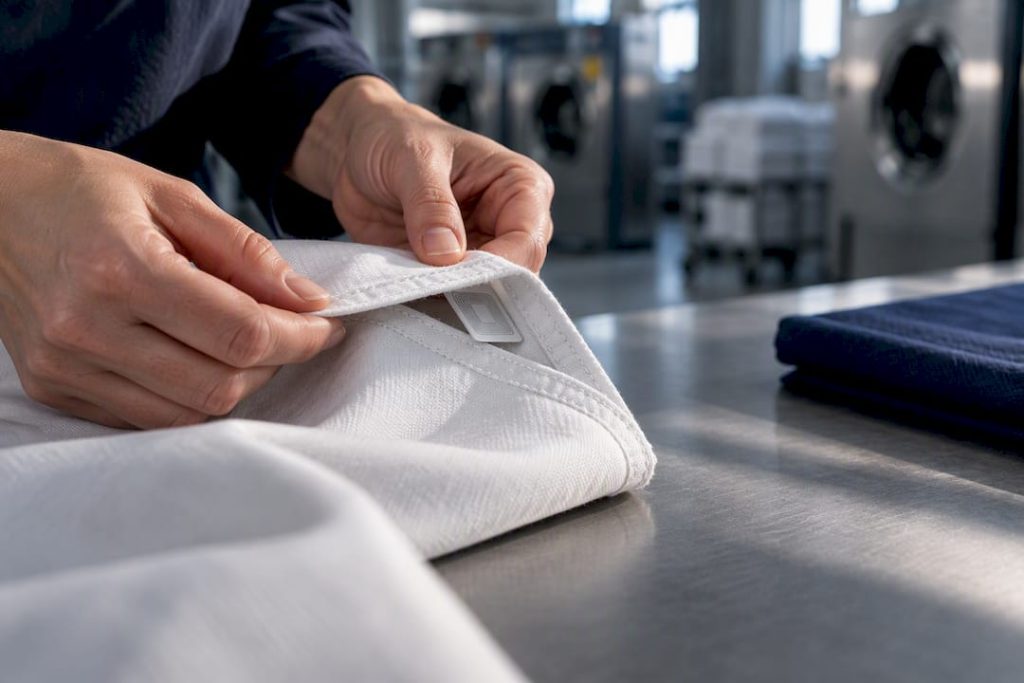
For industrial hotel and laundry operations, washable UHF RFID tags installed by heat-seal or sewn-in hem give the strongest balance of durability and operational efficiency for etiketim tekstilesh lavanderi. Flat linens like sheets and towels do well with heat-seal or hem placement, while uniforms benefit from pouch or sew-in tags that allow easy replacement. Procurement should require a minimum of 200 commercial wash cycles in any supplier specification. The next step is a controlled pilot on a single textile category before committing to a full rollout.
TL;DR:
- Washable UHF RFID tags must withstand at least 200 wash cycles to match the typical lifespan of hotel linens and towels.
- RFID is ideal for high-volume textiles like sheets and towels due to its ability to read in bulk, reducing counting time significantly.
- Placement in reinforced hems or corners, using heat-seal or sew-in methods, ensures reliable reads through multiple wash cycles.
- Pilots should cover at least one textile category with several hundred units and include a minimum of 50 wash cycles to validate durability and performance.
- Bulk order options with pre-installed tags at manufacturing simplify installation, ensure consistency, and reduce labor costs during large rollouts.
Table of Contents
- Why durable labeling matters for hotel and laundry operations
- RFID vs. barcodes: choosing the right tracking method
- Durable tag types and how to choose the right one
- Installation and placement best practices for reliable reads
- How to pilot and scale a tagging program
- Maintenance and quality assurance for tagged textiles
- How Gjergji H Tekstil supports source-tagging and specification work
- Compliance with textile labeling standards in hospitality and laundry operations
- Cost analysis and return on investment for RFID labeling
- Lessons from procurement practice on tagging rollouts
- Bulk supply with source-tagging built in
- Technical guides and case studies referenced
- Sources
- FAQ
Why durable labeling matters for hotel and laundry operations
Textiles disappear. Between guest rooms, laundry carts, and third-party laundry partners, hotels and industrial laundries routinely lose track of linens, towels, and uniforms, and reconciling those losses by hand is slow and unreliable. Item-level identification changes that equation by giving every piece a traceable identity from the moment it enters circulation.
With reliable tagging in place, procurement teams get a clearer picture of what actually happens to their textiles:
- Losses become visible early, before they turn into a large reorder.
- Replacement decisions are based on real wear data instead of guesswork.
- Billing between hotels and outsourced laundries reflects actual item counts, not estimates.
- Housekeeping and laundry staff spend less time on manual counts and more time on throughput.
The metrics that matter to procurement are straightforward: shrinkage rate, hours spent counting by hand, and the average life cycle of each textile category. Tracking these consistently turns linen management from a recurring cost center into a controllable budget line. For a closer look at how textile choices affect lifecycle economics, see how to maximize hotel textile durability and cut costs.
RFID vs. barcodes: choosing the right tracking method
RFID and barcode systems solve the same problem in different ways, and the right choice depends on volume and workflow speed. RFID tags can be read in bulk, without line of sight, which means an entire stack of towels or a full laundry cart can be scanned in seconds rather than item by item.
Barcodes still have a place, particularly for lower-value items where the cost of an RFID tag is hard to justify:
- RFID supports bulk reads and stacked scanning, cutting count times dramatically for high-volume categories like sheets and towels.
- Barcodes require direct line of sight and manual handling, which slows counts but keeps upfront costs low.
- Barcodes remain a reasonable fit for low-turnover or low-value items where tracking precision matters less.
- Many operations run a hybrid model: barcodes for basic stock items, RFID for high-turnover or high-value textiles that need tighter accountability.
Industrial laundries handling thousands of items per shift see the clearest return from RFID, since the labor savings on counting scale directly with volume.
Durable tag types and how to choose the right one
Not all washable tags perform the same way, and the differences matter once you are ordering thousands of units. Washable UHF textile tags built for laundry use, such as the Xerafy TEX TRAK series, come in thin heat-seal or sew-in formats designed specifically to survive commercial wash cycles.
More than 200 commercial wash cycles is the durability benchmark documented for washable UHF RFID tags built for textile inventory, and it is the figure procurement teams should require in any supplier contract. That threshold roughly matches the working life of a hotel-grade sheet or towel, which means a properly specified tag should outlast the textile it is attached to.
A few practical distinctions help narrow the choice:
- Thin heat-seal or sew-in UHF formats, such as TEX 70×15 or TEX 50×12, suit sheets, towels, and other flat linens where discretion and read reliability both matter.
- Silicone-encapsulated tags, including formats like TEX 55×12 Silicone, work well for comfort-sensitive garments and offer strong resistance to moisture and chemical exposure.
- Rigid, hard-shell tags can last longer in raw cycle counts but add bulk that may irritate guests or staff wearing the tagged item.
- Fabric-carrier tags cost roughly $0.15 to $0.45 per unit and are generally the better fit for hotel linens because they are discreet and align with normal replacement cycles.
The lifecycle math favors higher-cost, longer-life tags whenever the textile itself has a multi-year service life, since replacing a failed tag mid-cycle costs more in labor than the price difference between tag grades.
Installation and placement best practices for reliable reads
Where and how a tag is attached determines whether it survives the laundry process or fails after a handful of cycles. Standard placement for sheets and towels puts the tag in a hem or corner, away from fold lines and center areas where repeated folding and ironing stress the material.
- Choose a reinforced hem section rather than open fabric, since hems provide structural support for the tag and reduce movement during washing.
- For heat-seal installation, keep temperature, time, and pressure tightly controlled to bond the tag without damaging the chip or the surrounding fabric.
- For sew-on or sew-in placement, use industrial polyester or nylon thread and position stitches at least 2 millimeters away from the chip and antenna area to avoid puncturing the electronics.
- Position the tag at a safe distance from the hem fold to reduce stress during repeated laundering.
- After installation, run a read test on every batch and follow it with a visual inspection for loose stitching or heat-seal separation.
Pro Tip: Run a read test immediately after installation and again after the first wash cycle: a tag that fails early almost always points to a placement or attachment error, not a defective chip.
Sew-in hem placement during manufacture tends to produce the most consistent results, since it removes the variability that comes with field retrofitting by different laundry staff.

How to pilot and scale a tagging program
A pilot program gives procurement the data needed to justify a larger investment, and it should be treated as a real test, not a formality. Structure it in stages so each decision is backed by evidence.
- Pick one textile category, such as bath towels or bed sheets, and select a sample size large enough to produce meaningful read-rate data, typically several hundred units.
- Decide how many wash cycles the pilot needs to validate durability claims, commonly in the 50 to 100 cycle range as an interim checkpoint before the full 200-cycle benchmark.
- Choose your read points: handheld readers work well for spot checks and smaller batches, while fixed or cabinet readers suit high-volume trolley scanning in a central laundry.
- Confirm what inventory or laundry management software the tags need to integrate with before ordering hardware, since read data is only useful if it flows into a usable count.
- Set clear success criteria in advance: minimum read accuracy, tag survival rate after the target number of washes, and measurable time savings per batch compared to manual counting.
- Build a short training plan for housekeeping and laundry staff, covering scanning procedure, tag handling, and what to do when a tag fails a read.
For guidance on sizing the pilot against real turnover patterns, usage analysis for hotel textile inventory offers a useful starting point.
Maintenance and quality assurance for tagged textiles
A tagging program needs ongoing checks, not just a one-time installation. Periodic read-sampling catches problems before they become a full inventory gap.
- Sample a portion of each batch on a regular schedule, checking read accuracy against expected counts rather than waiting for a full audit.
- Treat a failed post-wash read as a replacement trigger, along with any visible stitch damage or heat-seal separation found during inspection.
- Log every tag failure in your inventory software so patterns emerge, whether they point to a bad batch, a placement issue, or a specific wash program that is too aggressive.
- Keep a spare-tag buffer on hand so replacements happen during normal laundry turnaround instead of pulling items out of rotation.
Consistent QA also feeds back into supplier negotiations, since a documented failure rate gives procurement leverage when renewing a tag contract. Rotation planning tools like textile rotation workflows for hotels and restaurants pair naturally with this kind of ongoing check.
How Gjergji H Tekstil supports source-tagging and specification work
Gjergji H Tekstil has operated in the hospitality textile supply chain for many years, supplying hotels, restaurants, and industrial laundries with linens, towels, uniforms, and custom textile solutions, reflecting the scale and consistency the company builds into its production process.
Because Gjergji H Tekstil controls import, design, production, and distribution in-house, source-tagging during manufacture is a natural extension of that supply chain. Attaching tags at the production stage, rather than retrofitting them on-site, produces consistent placement across every unit and removes a layer of labor from the receiving hotel or laundry. For operations planning a large rollout, working with a manufacturer that can build specification packages, covering placement, stitch requirements, and tag type, into the production run simplifies the entire procurement process.
Compliance with textile labeling standards in hospitality and laundry operations
Textile tracking in commercial laundry settings is not governed by a single universal law, but industry technical guidance shapes how responsible operations design their systems. The TR 72 guideline for RFID laundry systems covers frequency selection, article association, inventory software requirements, and count accuracy, giving operators a technical reference point when specifying a new system.
Beyond RFID-specific guidance, hospitality textiles are also subject to general fiber content and care labeling rules that vary by market, and procurement teams should confirm the requirements that apply in their own country before finalizing a supplier contract. Tagging systems used for inventory and tracking purposes are separate from consumer-facing care labels, and the two should not be confused when writing a specification document: a tracking tag identifies and counts an item, while a care label communicates washing instructions.
Working with a supplier familiar with both the technical side of RFID integration and the practical realities of commercial laundry chemistry, including detergent exposure and extractor pressure, reduces the risk of specifying a tag that fails in real conditions even though it passed a generic lab test. Requesting a vendor test report based on your laundry’s actual wash program, rather than relying only on a general cycle-count claim, is a reasonable step before signing a bulk order.
Cost analysis and return on investment for RFID labeling
The upfront cost of an RFID tagging program comes from three places: the tags themselves, the reader hardware, and the software integration needed to make the read data useful. Fabric-carrier tags run roughly $0.15 to $0.45 per unit, and that per-tag cost needs to be weighed against the labor hours saved on manual counting.

The return shows up primarily in three areas: faster inventory counts, reduced shrinkage, and more accurate billing between hotels and outsourced laundries. A commercial laundry case study using washable tags paired with automated reader software showed that trolley-level scanning with automatic delivery-note generation cut manual reconciliation steps significantly compared to hand counting.
For a hotel or laundry evaluating the investment, the calculation typically comes down to volume: operations processing thousands of items per week recover tag and hardware costs faster than smaller operations, since the labor savings on counting scale with throughput. Rigid, longer-life tags can also shift the economics in high-turnover settings, since a tag that survives 300 or more cycles spreads its cost across more wash-and-wear rotations. Before committing to a large order, running the pilot outlined earlier gives procurement real numbers on time saved per batch, which is the figure that ultimately determines payback period.
Lessons from procurement practice on tagging rollouts
The biggest mistake operations make is scaling a tagging program before it has been proven. Validating one textile category for at least 50 to 100 wash cycles before expanding gives you real failure data instead of a vendor’s marketing claim, and that data is what protects the budget when a rollout hits its first snag.
Standardizing placement across every SKU, so a towel tag always sits in the same corner regardless of size or supplier, keeps scanning and handling simple for staff who are not thinking about RFID all day. Budget for a steady replacement cadence and real vendor training from day one, because a program that works perfectly in the pilot and falls apart during scale-up almost always traces back to skipped training, not bad tags.
— Xpert
Bulk supply with source-tagging built in
Ordering hotel-grade linens and uniforms with tags already installed at the point of manufacture removes a step that most operations underestimate: the labor cost of retrofitting tags on-site, batch by batch, with inconsistent placement from one staff member to the next.

Bulk hotel textiles, restaurant linens, and uniforms can be supplied with the option to build tagging specifications into the production run itself, so every sheet, towel, or uniform arrives ready for your tracking system with consistent placement from the first wash.
- Bulk hotel and AirBnB textiles built to industrial laundry standards.
- Custom production runs with specification packages covering placement and stitch requirements.
- Uniform and workwear lines designed for repeated commercial washing.
If your team is planning a pilot or a full rollout, request a specification sheet or a bulk quote through Tekstile për Hotel & AirBnB and get source-tagged textiles built around your laundry’s actual process from the start.
Technical guides and case studies referenced
This guide draws on the Xerafy technical guide to RFID textile tagging, the TEX TRAK product series, the LinTRAK datasheet, the TR 72 technical guideline, and a commercial laundry case study on RFID rollout results.
Sources
- The Xerafy Guide to RFID Tagging for Textile Inventory
- LinTRAK® C10-MRI
- Guidelines for RFID systems for laundry and linen management (TR 72)
- Royal Jersey Laundry Enhances Linen Inventory Management for London’s Prestigious 5-Star Hotels With HID Acuity and LinTRAK RFID Tag Solution
FAQ
What is the standard durability benchmark for laundry RFID tags?
Washable UHF RFID tags built for commercial laundry use are commonly specified to survive more than 200 wash cycles. Procurement teams should request this figure as a minimum in supplier contracts and verify it with a vendor test report based on their own wash program.
Should hotels choose RFID or barcode tags for linen tracking?
RFID suits high-volume, high-turnover textiles like sheets and towels because it allows bulk reads without direct line of sight. Barcodes remain a reasonable, lower-cost option for smaller inventories or low-value items where scanning speed matters less.
Where should tags be placed on hotel linens for the best results?
Tags should be placed in a reinforced hem or corner, away from fold lines and center areas that take the most stress during washing and ironing. This placement, combined with heat-seal or sew-in hem attachment, gives the most consistent read reliability over the textile’s life.
How large should a pilot program be before scaling up?
A pilot typically covers one textile category with a sample large enough to produce reliable read-rate data, often several hundred units, tested through at least 50 to 100 wash cycles as an interim checkpoint. Success criteria should include read accuracy, tag survival rate, and measurable time savings per batch before expanding.
Does Gjergji H Tekstil supply textiles with tags already installed?
Tagging specifications, including placement and stitch requirements, can be built into custom production runs for bulk hotel and hospitality textiles. Reach out through the Tekstile për Hotel & AirBnB page to request a specification sheet for your operation.