

TL;DR:
- Albania’s textile sector’s competitiveness depends on logistics, energy reliability, governance, and technology, not just factory counts.
- Structural disadvantages, like logistics delays and power outages, have led to declining exports and investment shifts toward regions near Durrës port.
Albania’s textile sector attracts considerable attention from investors and policymakers looking at European nearshoring options. But explaining textile infrastructure in Albania requires more than counting factories or tallying registered firms. The real analytical work involves examining logistics geometry, energy reliability, industrial park governance, and workforce technical capacity. These are the operational variables that translate directly into unit costs, competitiveness, and long-term viability. This article breaks down each layer systematically, using the Korçë versus Tirana/Durrës corridor as a live case study that exposes the gap between industrial capacity on paper and production infrastructure readiness.
Table of Contents
- Key Takeaways
- Geographical distribution of production zones
- Energy reliability and its real cost impact
- Industrial park governance and sequencing challenges
- Technology gaps and workforce readiness
- Framework for assessing infrastructure competitiveness
- My perspective on what the data actually means
- How Gjergjihtextil navigates Albania’s supply chain realities
- FAQ
Key Takeaways
| Point | Details |
|---|---|
| Geography drives unit costs | Logistics distance from Korçë to Port of Durrës adds €0.45–€0.60 per garment unit, compounding competitive disadvantage. |
| Energy reliability is unequal | Only 31% of Korçë textile SMEs have reliable three-phase electricity, raising operational costs by 12–15% through generator use. |
| Governance sequencing matters | Durana Tech Park’s incentive-before-infrastructure model illustrates how industrial parks can delay actual production capacity. |
| Technology gaps compound problems | Korçë machinery averages 14.7 years in use versus 8.3 years in Tirana, limiting compliance and output quality. |
| Readiness beats registration | Analysts must distinguish between firms registered on paper and facilities with genuine production infrastructure readiness. |
Geographical distribution of production zones
The Albania textile supply chain does not operate uniformly across the country. Two distinct zones have emerged, and their structural differences explain much of the sector’s uneven performance. The Tirana and Durrës corridor has attracted the majority of greenfield investment, capturing €18.4 million in textile investment in 2024 alone, compared to just €2.1 million directed toward Korçë during the same period. That is not a marginal gap. It reflects a structural preference by investors who understand that proximity to the Port of Durrës is a genuine operational asset.
Korçë, historically one of the most recognizable names in the textile industry in Albania, is facing measurable contraction. Export revenue has declined from €58 million in 2019 to approximately €47–52 million by 2024. Employment has dropped from roughly 5,100 workers to an estimated 3,800–4,200 over the same period. These are not cyclical fluctuations. They reflect a compounding structural disadvantage rooted in geography.
Why logistics geometry matters more than most people realize
The road transit from Korçë to the Port of Durrës adds 4 to 5 hours compared to producers operating in the Tirana/Durrës corridor. According to World Bank logistics data cited by KiTalent, this translates into an additional €0.45 to €0.60 per garment unit in logistics cost. That figure sounds small until you apply it at production volumes of 200,000 to 500,000 units per season, which is standard for OEM contracts. At that scale, the cost differential becomes the difference between winning and losing a contract.
Consider what this means in practice. A buyer sourcing from both Korçë and a Tirana-area facility at equal quality will gravitate toward the facility with better port access, all else equal. The terrain between Korçë and Durrës adds complexity beyond time. Mountain routes introduce seasonal risk, truck capacity constraints, and higher fuel costs that further erode margins for subcontractors already operating on tight spreads.
| Location | Distance to Port of Durrës | Additional logistics cost per unit | Greenfield investment (2024) |
|---|---|---|---|
| Tirana/Durrës corridor | Minimal (within 30 km) | Baseline | €18.4 million |
| Korçë | 4–5 hours additional transit | €0.45–€0.60 per garment | €2.1 million |
- Investment concentration follows port proximity, not labor cost alone
- Terrain and transit time create compounding cost disadvantages at OEM production volumes
- Korçë’s declining export figures reflect logistics penalties accumulating over years, not a single event
Pro Tip: When evaluating a textile manufacturing site in Albania, calculate total landed cost to the buyer’s port of final destination, not just factory-gate cost. A 10% labor cost saving can evaporate entirely once logistics penalties are added.
Energy reliability and its real cost impact
The impact of textiles on the Albanian economy depends heavily on whether production facilities can operate consistently. In Korçë, this is a concrete problem. Only 31% of textile SMEs in the region have access to reliable three-phase electricity, which is the standard power supply required to run industrial sewing lines, finishing equipment, and automated cutting systems without interruption.
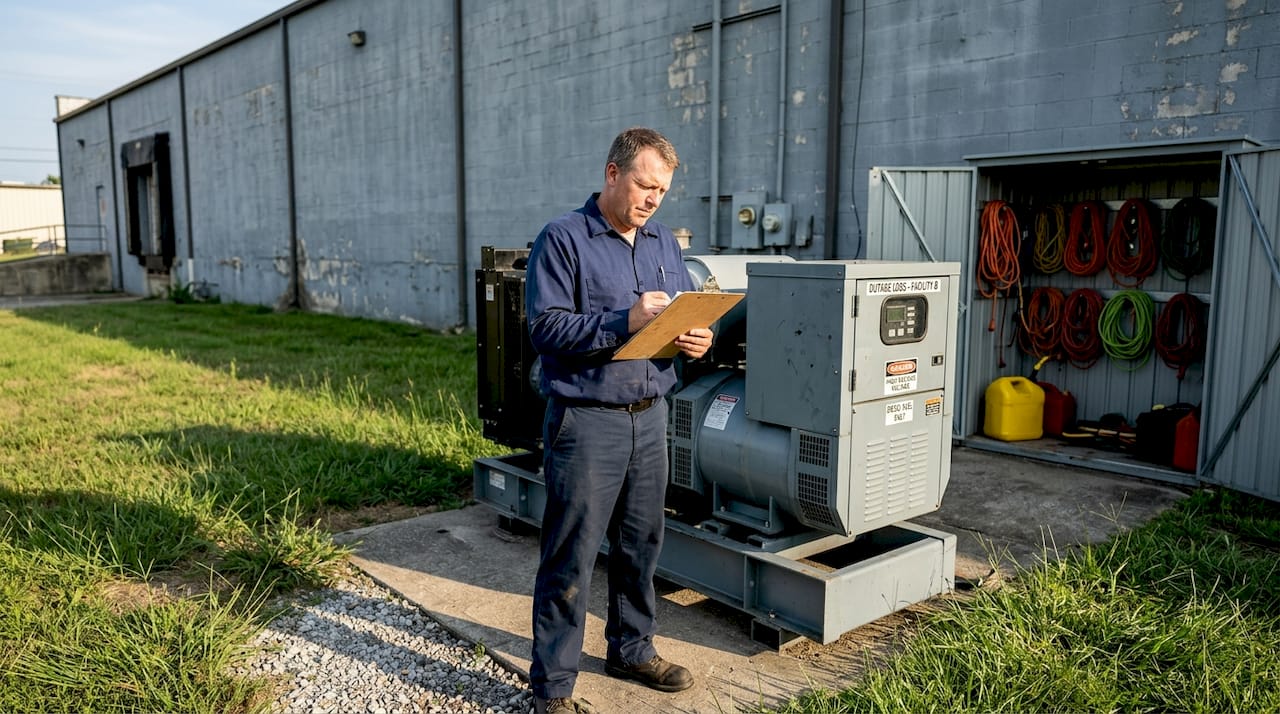
The outage data is equally striking. Korçë textile producers face an average of 127 unplanned power outage hours per year, compared to 34 hours in Tirana. When a sewing line goes down unexpectedly, the cost is not just the downtime itself. It includes the rework of garments in process, the disruption to order scheduling, and the reputational risk with buyers who track on-time delivery rates closely.
How diesel dependency affects the cost structure
To compensate, roughly 23% of Korçë textile firms invest in diesel generator systems. These backups add 12 to 15% to unit production costs according to the AIDA Regional Investment Climate Survey data reviewed by KiTalent. For a factory operating on an OEM margin of 8 to 12%, that addition is not manageable without raising prices or absorbing losses.
- Unreliable three-phase electricity affects cutting, sewing, pressing, and finishing simultaneously
- Unplanned outages at 127 annual hours in Korçë versus 34 in Tirana represent a 3.7x reliability gap
- Generator fuel costs are passed into unit costs, reducing Albania’s price competitiveness in nearshoring conversations
- Energy reliability is increasingly evaluated by EU buyers conducting factory assessments before awarding contracts
Pro Tip: Policymakers assessing regional textile competitiveness should treat industrial electricity reliability as a primary infrastructure metric, not a secondary utility concern. Investment attraction decisions hinge on it.
This dimension is often underweighted in discussions of Albanian textile infrastructure explained for investor audiences. The instinct is to highlight labor cost advantages and geographic proximity to EU markets. Both are real. But if the factory cannot run a full shift without a generator, the cost model breaks down before the first order is shipped.
Industrial park governance and sequencing challenges
The Durana Tech Park case offers a precise illustration of a broader governance pattern in Albanian textile manufacturing processes. The park received government approval and contract finalization in 2024. By February 2025, it entered a “virtual phase” in which fiscal and regulatory incentives became available to registered tenants, but the physical infrastructure, meaning roads, utilities, and buildings, had not yet been constructed.
For a textile or manufacturing tenant, this creates a specific problem. The incentive package is real on paper. The ability to produce is not. A company that registers to take advantage of tax relief but cannot operate because there is no electricity connection, no road access, and no warehouse space has gained nothing of operational value.
“Governance sequencing in industrial parks can create a gap between economic incentives and actual hard infrastructure, delaying production capacity and influencing investor decisions.” Durana Park governance analysis
The broader lesson for analysts and policymakers is structured as follows:
- Incentive availability without hard infrastructure creates a misleading picture of manufacturing capacity.
- Tenants who commit based on incentive terms may face 12 to 24 months of production delay waiting for physical buildout.
- Investor confidence erodes when infrastructure delivery does not follow the announced timeline.
- The gap between registered capacity and operational capacity becomes a credibility problem for industrial zone governance overall.
This sequencing issue is not unique to Albania, but it carries particular weight in the textile sector where buyers award contracts on 6 to 12 month cycles and cannot wait for infrastructure to materialize.
Technology gaps and workforce readiness
The challenges in the Albanian textile sector extend beyond logistics and energy. Machinery age and technology adoption rates directly affect the ability to meet modern production standards, including those increasingly demanded by EU buyers.
Korçë textile machinery averages 14.7 years in use compared to 8.3 years in Tirana. Only 12% of Korçë SMEs use ERP systems for production management, and just four firms in the region operate CAD/CAM equipment. These numbers matter for a straightforward reason: modern EU buyers expect digital traceability, production documentation, and the ability to meet sustainability compliance requirements.
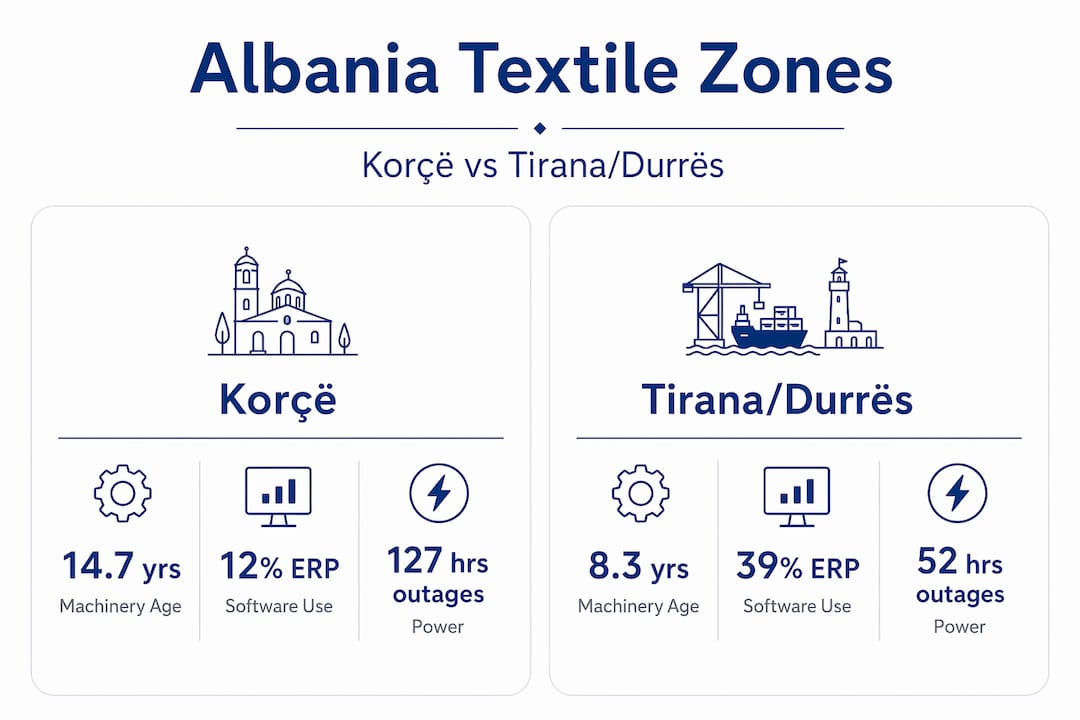
| Technology metric | Korçë | Tirana/Durrës corridor |
|---|---|---|
| Average machinery age | 14.7 years | 8.3 years |
| ERP system adoption | 12% of SMEs | Significantly higher |
| CAD/CAM usage | 4 firms | More widespread |
The workforce picture compounds the technology gap. Vocational training in Korçë focuses on traditional hand sewing, not technical textiles, automated machinery operation, or production data management. The median age of sewers in the region falls between 48 and 52 years, and the incoming cohort from vocational centers does not have the skills to operate modern equipment even when that equipment is eventually installed.
Adding urgency to this situation is the EU’s Digital Product Passport requirement, which will require full supply chain traceability data from textile producers by 2027. This includes material origins, production stage documentation, sustainability metrics, and recyclability information. Producers without ERP systems and basic digital infrastructure will face direct market access barriers, regardless of how competitive their labor costs are.
The connection between infrastructure and technology adoption runs in both directions. Reliable electricity supports the operation of digital equipment. Modern machinery requires stable power to function consistently. A facility that cannot guarantee power continuity cannot realistically operate automated cutting or pressing systems, which reinforces why energy reliability and technology adoption must be treated as linked variables, not separate concerns.
Framework for assessing infrastructure competitiveness
Professionals and policymakers working on Albanian textile infrastructure need a framework that separates industrial capacity on paper from genuine production infrastructure readiness. Registered firms, approved parks, and announced investments tell you what could exist. Logistics route geometry, electricity reliability statistics, machinery age, and workforce skill profiles tell you what actually works today.
A practical assessment framework covers four core dimensions. First, logistics performance: calculate actual transit time and unit logistics cost to the buyer’s destination port, not just distance to the nearest highway. Second, energy reliability: measure three-phase electricity access rates and annual unplanned outage hours for the specific production zone. Third, governance sequencing: verify whether incentives and hard infrastructure are being delivered in aligned timelines. Fourth, workforce and technology alignment: assess machinery age, digital system adoption, and vocational training outputs against the specific production standards required by target buyers.
Pro Tip: When advising clients on sourcing from Albania, request facility-level energy reliability data and outage logs as part of due diligence. Factory owners who cannot produce this data likely have not measured it, which is itself a risk indicator.
| Assessment dimension | Key metric | Risk indicator |
|---|---|---|
| Logistics | Unit cost to buyer’s port | Above €0.60/unit premium vs. corridor facilities |
| Energy | Annual unplanned outage hours | Above 80 hours per year |
| Governance | Incentive-to-buildout lag | More than 12 months |
| Workforce/technology | Machinery age and ERP adoption | Average machinery over 12 years, ERP below 20% |
For more context on how Albania’s textile supply chain structure affects hospitality sourcing decisions, the industry news section at Gjergjihtextil provides ongoing analysis connecting infrastructure developments to procurement realities.
My perspective on what the data actually means
I’ve spent considerable time analyzing the gap between how Albania’s textile sector gets described in investment promotion materials and what the operational data actually shows. The disconnect is consistent and instructive.
The standard pitch emphasizes low labor costs, EU proximity, and a growing factory count. All of that is true. What gets omitted is that Albania’s nearshoring advantage depends entirely on logistics and energy reliability, not factory presence alone. You can have 500 registered firms in a region and still have an infrastructure problem if 70% of them are running on generators and sending trucks through mountain roads to reach a port.
What I find most concerning is the governance sequencing issue. The Durana Park pattern, where incentives go live before a road or a power line is built, creates the appearance of progress without the substance. Investors who come in based on that picture face operational delays they did not price into their decisions. That damages credibility at exactly the moment Albania needs to build it.
The workforce piece is the slowest-moving problem. Logistics infrastructure can be improved with capital and political will within a few years. Reorienting vocational training pipelines toward technical textiles and digital production management takes a decade. Policymakers who are not starting that process now are locking in a skill gap that will persist well into the 2030s.
My read is that Albania has genuine structural advantages in textiles. The path to realizing them runs through grid upgrades in production regions, honest sequencing of industrial park delivery, and a vocational curriculum overhaul that matches what modern buyers actually require. Counting factories without addressing those fundamentals produces good headlines and poor outcomes.
— Xpert
How Gjergjihtextil navigates Albania’s supply chain realities

Understanding the structural gaps in Albania’s textile production zones helps explain why supply chain control matters so much in the hospitality sector. Gjergjihtextil has operated as a fully integrated textile sourcer and distributor since 1994, building supply relationships across Italy, China, India, and Pakistan precisely because domestic production infrastructure has never been uniformly reliable.
For hotels and hospitality operators sourcing bed linens, towels, tablecloths, and uniforms at scale, the operational lesson from Albania’s infrastructure data is clear. Dependence on a single domestic production zone introduces the same risks that affect manufacturers in underserved regions: unpredictable delivery, variable quality, and cost exposure from energy and logistics inefficiencies. Gjergjihtextil’s wholesale hotel textile offer gives hospitality buyers a consistent, quality-controlled alternative that sidesteps these variables entirely. You can also explore hotel textile selection guidance to align procurement with both guest comfort and operational efficiency.
FAQ
What does textile infrastructure in Albania actually include?
Textile infrastructure in Albania covers logistics access to production ports, energy reliability for manufacturing equipment, industrial park governance, workforce technical capability, and technology adoption rates. Counting factories alone does not capture operational readiness.
Why is Korçë losing ground to Tirana and Durrës in textile production?
Korçë faces a 4 to 5 hour logistics penalty to Port of Durrës, adding €0.45 to €0.60 per garment unit in costs, alongside significantly higher electricity outage rates and older machinery. These compounding disadvantages have driven greenfield investment heavily toward the Tirana/Durrës corridor.
What is the Digital Product Passport requirement for textile producers?
The EU’s Digital Product Passport requires textile manufacturers to provide full supply chain traceability data by 2027, including material origins, production stages, and sustainability metrics. Producers without digital tracking systems risk losing EU market access.
How does governance sequencing affect textile manufacturing in Albania?
When industrial parks like Durana Tech Park make incentives available before physical infrastructure is built, tenants cannot actually produce. This creates a gap between announced capacity and operational reality that increases investment risk and delays production timelines.
What metrics should policymakers use to assess textile zone competitiveness?
The most reliable metrics are unit logistics cost to buyer destination, annual unplanned electricity outage hours, machinery average age, ERP system adoption rates, and the time lag between incentive availability and hard infrastructure delivery in industrial zones.