

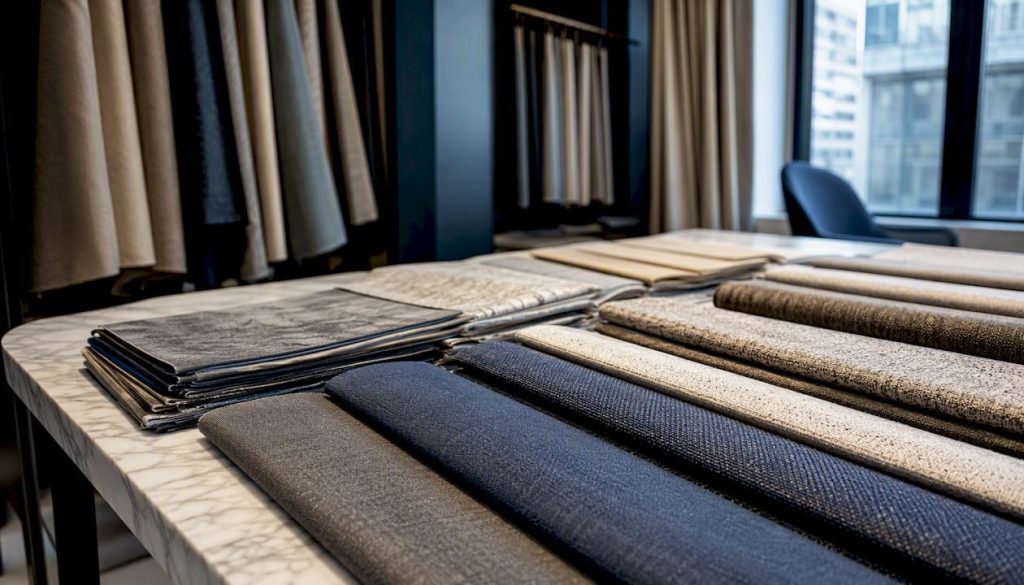
Specify contract-grade, inherently fire-retardant, solution-dyed fabrics with area-matched abrasion thresholds and independent lab certificates before any bulk purchase order is issued. That single decision protects your property from premature replacement, housekeeping chemistry failures, and compliance gaps. Before finalizing any supply contract, collect these four documents from every supplier:
- Independent FR test report (NFPA 701 for curtains, CAL TB 117-2013 for upholstered furniture) dated within 24 months
- Abrasion test report stating Wyzenbeek double rubs or Martindale cycles by area
- Colorfastness certificates (lightfastness ISO 105-B02, wash, and crocking grades)
- Cleaning code declaration (W, S, WS, or X) with compatible detergent pH range
RFP opener to copy: “All fabric submissions must be accompanied by current independent laboratory test reports (issued within 24 months) for flame retardancy, abrasion resistance, and colorfastness, plus dye-lot continuity confirmation and care instructions from the production batch to be supplied.”
Use this textile procurement manager’s guide as a companion document when building your RFP package.
Key Takeaways
Specify inherent FR, solution-dyed, contract-grade fabrics with area-matched abrasion thresholds and independent lab certificates as the non-negotiable baseline for every hotel textile procurement.
| Point | Details |
|---|---|
| FR certificates are mandatory | Request independent lab reports (NFPA 701, CAL TB 117-2013) dated within 24 months before any bulk order. |
| Match abrasion thresholds to area | Lobby seating requires 60,000–100,000 Martindale; guestroom seating minimum 40,000. |
| Cleaning code must match housekeeping chemistry | Verify W or WS code against your exact detergent SDS; topical FR can fail at pH 8–11. |
| Dye-lot continuity protects phased projects | Secure a written dye-lot continuity clause and retain physical cuttings from the first delivery. |
| Gjergjihtextil for Albanian procurement | Offers in-house supply chain control, independent testing coordination, and dye-lot guarantees for bulk hotel contracts. |
Table of Contents
- What does a hotel fabric specification guide cover by area?
- How do abrasion, pilling, and dimensional stability affect your procurement decisions?
- What cleaning protocols protect fabric lifespan in commercial hotel use?
- Which fire retardancy certificates must you demand before ordering?
- Which fabric types work best across different hotel areas?
- How do you calculate total cost of ownership for hotel textiles?
- What should you expect from a professional Albanian hospitality textile supplier?
- The procurement mistakes that cost hotels the most
- Gjergjihtextil: a direct supply route for Albanian hotel procurement
- Sources
What does a hotel fabric specification guide cover by area?
Every area in a hotel operates under different wear, cleaning, and compliance pressures. Applying a single abrasion threshold across lobby seating and guestroom curtains wastes budget in one direction and creates premature failure in the other. Map intensity first, then assign minimums.
For premium properties or projects with 8–10 year refurbishment cycles, adding 20,000–30,000 rubs above the minimums is a defensible procurement decision. Lobby seating in a resort with year-round occupancy should realistically target 100,000 Martindale cycles, not 60,000.
RFP snippet for guestroom seating: “Fabric must achieve a minimum 40,000 Martindale cycles per EN ISO 12947, accompanied by an independent lab report. Cleaning code W or WS required. FR certificate to CAL TB 117-2013 mandatory.”
For F&B areas, specify bleach and solvent resistance explicitly. Solution-dyed acrylics and polyurethane-coated fabrics are the practical choice for booth seating that gets wiped down with commercial disinfectants between every cover. See the restaurant textiles category for contract-grade F&B options.
How do abrasion, pilling, and dimensional stability affect your procurement decisions?
Abrasion resistance is the most cited metric in hospitality procurement, but it is not the only one that determines whether a fabric survives a commercial environment.
Wyzenbeek vs. Martindale: Wyzenbeek (ASTM D4157) moves a cotton duck or wire mesh back and forth across the fabric; Martindale (EN ISO 12947) uses a figure-eight motion. The two tests are not directly interchangeable, but a rough working equivalence used in contract procurement is: 50,000 Wyzenbeek double rubs for standard seating, 100,000+ for severe contract use. Martindale is the dominant standard in European and Balkan procurement; Wyzenbeek is more common in North American specifications. When a supplier quotes only one, ask for both or confirm which standard their lab used.
Per ISO 105-B02 lightfastness testing and Martindale (EN ISO 12947), these are the metrics to specify on every technical data sheet (TDS):
- Pilling resistance: Grade 4 minimum (ISO 12945-2). Grade 3 is marginal for guestroom use; anything lower fails within months on upholstered seating.
- Seam slippage: Minimum 6mm resistance under 200N load (EN ISO 13936). Weak seams fail at cushion edges before the face fabric shows wear.
- Dimensional stability: Maximum 2% shrinkage after washing (ISO 6330). Exceeding this causes fitted covers to pucker and distort after the first commercial laundry cycle.
- Crocking: Grade 4 dry, Grade 3 wet minimum (AATCC 8 or ISO 105-X12). Lower grades transfer dye to guest clothing and bedding.
A fabric that passes abrasion but fails crocking at Grade 2 will generate guest complaints within weeks of installation.
What cleaning protocols protect fabric lifespan in commercial hotel use?
Cleaning codes define the method a fabric can tolerate, not the specific chemistry. That distinction matters operationally. Cleaning codes W, S, and WS indicate suitable cleaning methods but do not guarantee resistance to specific commercial chemicals; always verify compatibility with your housekeeping vendor’s SDS documentation.

Pro Tip: Request the supplier’s SDS alongside the TDS. Many commercial detergents operate at pH 8–11, which can strip topical finishes within a few wash cycles. Run a 10-cycle wash test on sample yardage using your exact housekeeping chemistry before approving bulk delivery.
A sample wash specification to include in supplier documentation: wash at 60°C maximum, neutral-to-mildly-alkaline detergent (pH 7–9), no optical brighteners for dark colorways, tumble dry at low heat, and no chlorine bleach unless the supplier’s TDS explicitly permits it.
Which fire retardancy certificates must you demand before ordering?
Fire compliance is non-negotiable, and the certificate type must match the application. Procurement must collect independent test reports for flame retardancy before finalizing bulk supply contracts, and in some jurisdictions, PFAS-free certification is also required. The relevant standards for hotel procurement are:
- NFPA 701 (USA standard, widely referenced internationally): applies to curtains, drapes, and window treatments
- CAL TB 117-2013 (California, broadly adopted): applies to upholstered furniture filling and fabric composites
- ASTM E84: surface burning characteristics for wall and ceiling materials
- BS 5867: curtains and drapes (UK/EU-influenced markets)
- BS 7176 / BS 5852: upholstered seating (composite test, fabric plus foam)
For Albanian hotel projects, NFPA 701 and CAL TB 117-2013 are the most commonly referenced international standards. Confirm with your local fire authority whether Albanian building regulations require additional national certifications.
Certificate checklist — what every FR report must include:
- Issuing laboratory name (SGS, Intertek, UL, or Bureau Veritas are widely accepted)
- Test date within the last 24 months
- Fabric sample ID matching the production batch
- For composite tests (BS 7176): the specific foam type used in the test must be named
That last point is critical. BS 7176 is a composite test of fabric plus foam; a certificate that names only the fabric is invalid if the installed foam differs from the foam tested. Reject any FR certificate that does not document the full assembly.
Pro Tip: Inherent FR (IFR) fabrics — where the flame resistance is built into the fiber, not applied as a topical finish — maintain compliance through repeated commercial wash cycles. Topical FR finishes can degrade after as few as 10–15 commercial washes. For any application with frequent laundering, specify IFR and ask the supplier to confirm FR permanence in writing.
Which fabric types work best across different hotel areas?
Fiber choice determines how a fabric performs under real operational conditions, not just how it looks in a sample book. Each family has a clear operational profile.
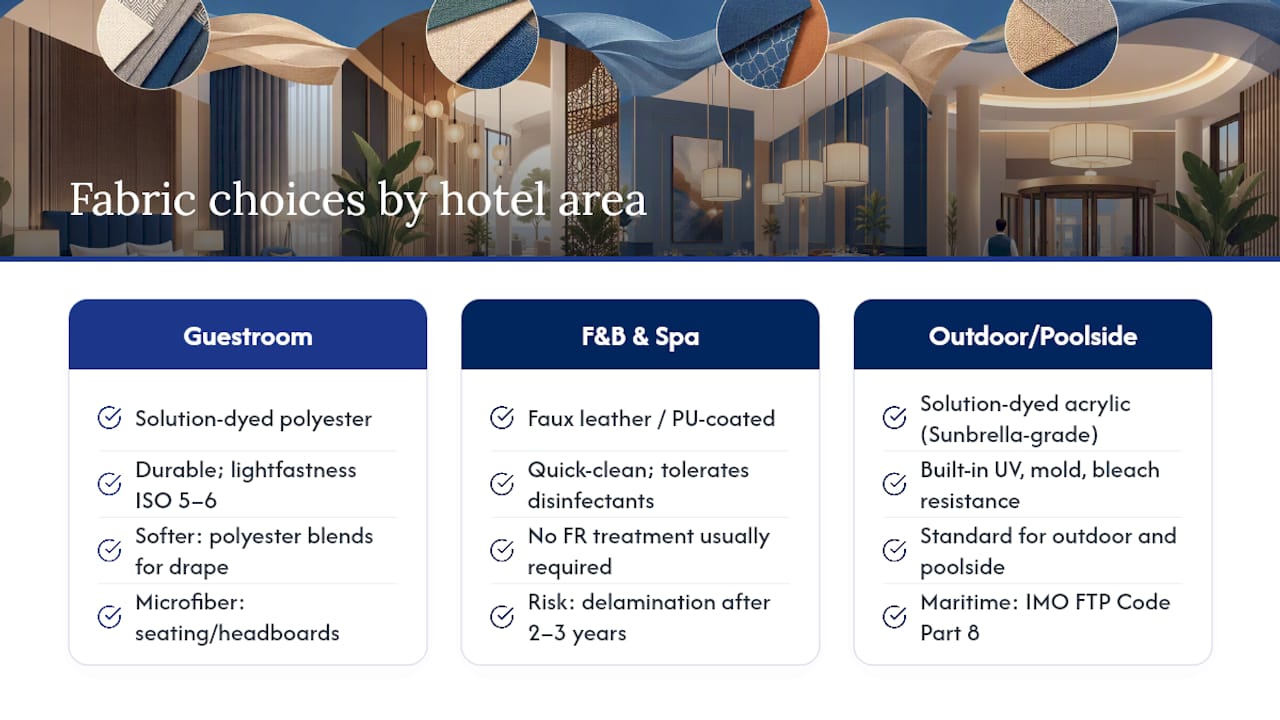
Solution-dyed polyester is the workhorse of contract hospitality. Dye is added to the polymer before extrusion, so color is locked into the fiber rather than sitting on the surface. Lightfastness grades of 5–6 on ISO 105-B02 are achievable, and the fabric resists fading under direct sunlight in lobby and poolside applications. It also tolerates WS cleaning codes and mild bleach solutions. The trade-off is hand feel: solution-dyed polyester can feel synthetic compared to natural blends, which matters in premium guestroom applications.
Polyester blends (polyester/cotton, polyester/viscose) offer a softer hand and better drape for curtains and bedding, but colorfastness depends on the dyeing method. Piece-dyed blends fade faster than solution-dyed equivalents under UV exposure. For curtains in sun-facing rooms, specify solution-dyed or insist on a lightfastness grade of 5 minimum.
Microfiber performs well in guestroom seating and headboards. Its tight weave resists liquid penetration and achieves high abrasion grades, but it can pill at Grade 3 if the construction weight is too low. Specify minimum 300 gsm for upholstery applications.
Faux leather and PU-coated fabrics are the practical choice for F&B booth seating and spa reception areas. They clean quickly, tolerate disinfectants, and require no FR treatment in most jurisdictions because the base substrate is inherently non-combustible. The weakness is delamination: low-quality PU coatings separate from the backing after 2–3 years of heavy use. Request a delamination test result alongside the abrasion report. See long-lasting textile examples for hospitality interiors for contract-grade options.
Modacrylic is used where inherent FR is mandatory and wool-like aesthetics are required, particularly in curtains and decorative throws. It is more expensive than polyester but eliminates the topical FR compliance risk entirely.
For outdoor and poolside areas, solution-dyed acrylic (such as Sunbrella-grade constructions) is the standard. UV resistance, mold resistance, and bleach tolerance are all built into the fiber. Maritime and cruise interiors require IMO FTP Code Part 8 compliance, a stricter standard than land-based hotel specifications.
How do you calculate total cost of ownership for hotel textiles?
Purchase price is the least reliable indicator of value in contract textile procurement. A fabric at twice the unit cost that lasts three times as long and requires half the replacement labor is the cheaper option over a 7-year refurbishment cycle.
TCO drivers to quantify before issuing a PO:
- Unit purchase price per meter or per item
- Laundering cost per cycle (water, energy, detergent, labor)
- Replacement frequency based on projected abrasion cycles and wash cycles
- Installation labor for re-upholstery or re-hanging
- Disposal or recycling cost at end of life
A simplified TCO example: a guestroom chair fabric at $18/meter with a 40,000 Martindale rating and a 5-year replacement cycle costs less over 10 years than a $12/meter fabric rated at 25,000 Martindale that requires replacement every 3 years, once installation labor is included.
Warranty and sample approval clause checklist for bulk contracts:
- Minimum 3-year warranty on abrasion performance and colorfastness for contract-grade upholstery
- Dye-lot continuity guarantee: supplier retains matched stock for phased delivery across the project timeline
- Sample approval: buyer receives and approves a cutting from the specific production dye lot before bulk shipment
- Lead time commitment in writing (typically 8–14 weeks for custom or imported contract fabrics in Albania)
- MOQ stated per colorway, not per order, to avoid forced substitutions mid-project
Dye-lot continuity is a frequent failure point in multi-year hotel installs. Retain physical cuttings from the first delivery and compare them against every subsequent shipment. A color mismatch across rooms in a phased refurbishment is irreparable without a full re-order.
What should you expect from a professional Albanian hospitality textile supplier?
A credentialed supplier operating at contract scale in Albania should be able to provide the following without delay:
- Current independent lab reports from SGS, Intertek, UL, or Bureau Veritas (not older than 24 months)
- Technical data sheets (TDS) and safety data sheets (SDS) for every product
- FR certificates specific to the application (curtains vs. upholstery vs. bedding)
- Sample yardage from the exact dye lot to be ordered, not a generic showroom cutting
- Written warranty on abrasion and colorfastness performance
- Confirmed lead times and MOQ per colorway for phased projects
For Albanian and Balkan hotel projects, typical lead times for imported contract fabrics run 8–12 weeks from order confirmation. Custom manufacturing or in-house production can reduce this for standard constructions. MOQ expectations vary by supplier and origin; a supplier with direct import relationships from Italy, India, or Pakistan can often negotiate lower MOQs than a local distributor working through intermediaries.
Gjergjihtextil has supplied contract textiles to international hotel brands including Meliá, Marriott, and Sheraton, operating with in-house supply chain control from import through distribution. For Albanian procurement teams, this means coordinated independent testing, dye-lot guarantees, and bulk pricing without the lead-time penalties of multi-tier sourcing. Verify any supplier’s claims by requesting their most recent independent lab reports and a reference contact from a comparable hotel project.
The hotel textiles wholesale page lists the full range of contract-grade products available for bulk procurement, including bedding, towels, curtains, and upholstery fabrics.
The procurement mistakes that cost hotels the most
The most expensive errors in hotel textile procurement are not specification errors. They are process errors: choosing by sample-book aesthetics, skipping the chemical compatibility check, and accepting a supplier’s marketing claims in place of independent lab data.
Choosing a statement fabric because it photographs well in a mood board, then discovering it carries a cleaning code S in a property where housekeeping uses water-based disinfectants, is a predictable failure. So is accepting a generic “FR certified” claim without requesting the actual certificate, only to find the topical finish washes out after the first commercial laundry cycle.
Six procurement traps and their fixes:
- Choosing by look, not spec — always request the TDS before the sample book
- Ignoring housekeeping chemistry — match cleaning code to your exact detergent SDS, not a generic pH assumption
- Accepting topical FR as equivalent to inherent FR — specify IFR for any laundered application
- No dye-lot clause in the contract — add continuity language before signing, not after the first delivery
- Single-supplier sample approval — test samples against your own housekeeping products on-site before bulk approval
- Skipping the composite FR check — for upholstered furniture, confirm the certificate names the foam used in the test
Stage approvals in two steps: a lab-based review of the supplier’s test reports, followed by an on-site mock-up where housekeeping runs their standard cleaning protocol on the approved sample for 30 days. What survives that test is what belongs in your rooms.
Gjergjihtextil: a direct supply route for Albanian hotel procurement
For procurement teams in Albania and the Balkans, the practical challenge is not knowing what to specify. It is finding a supplier who can deliver contract-grade textiles with the documentation, dye-lot control, and lead-time reliability that a multi-room hotel project requires.
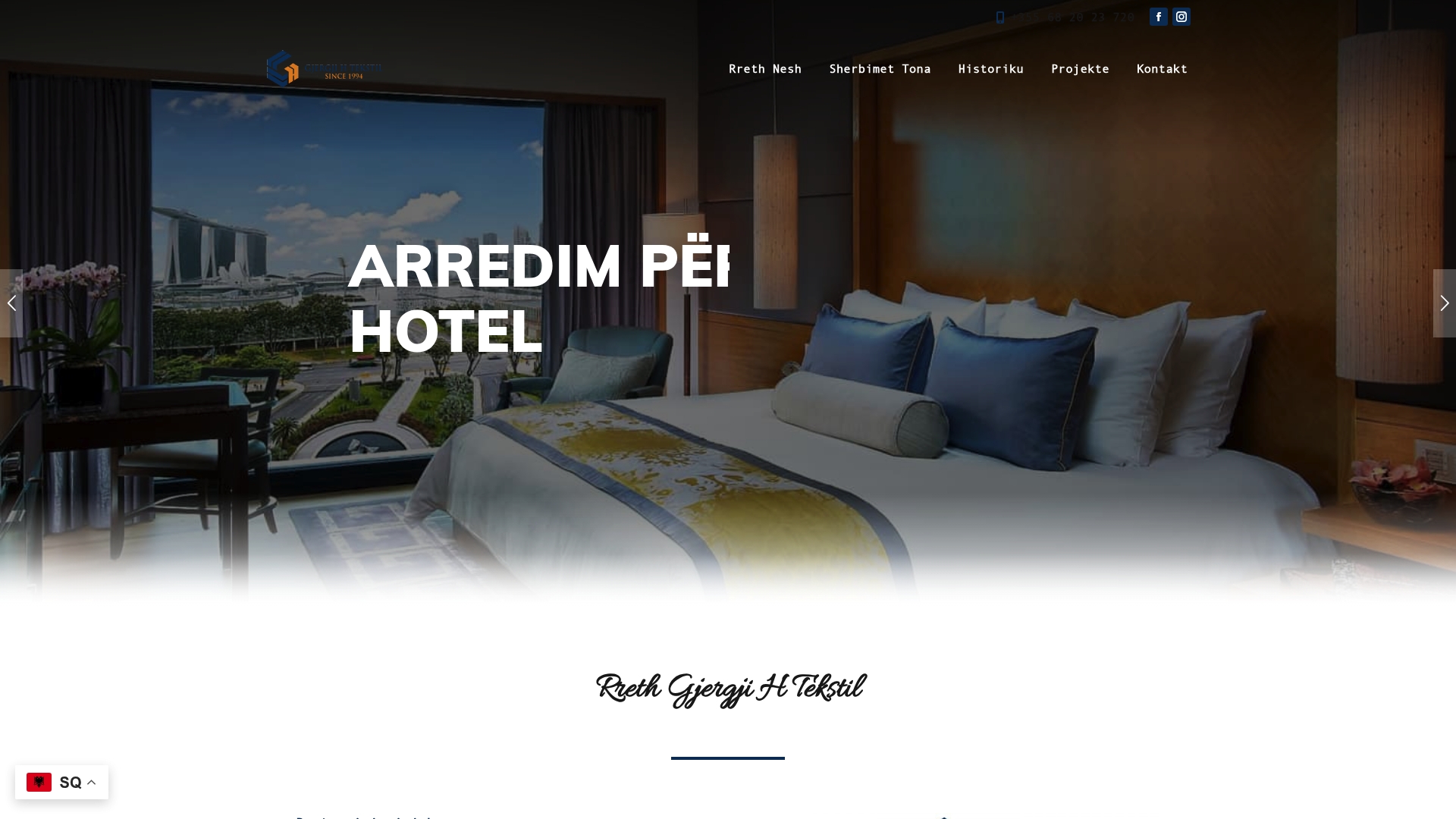
Gjergjihtextil operates as a fully integrated supply chain partner: in-house manufacturing, direct import from Italy, India, China, and Pakistan, and distribution across the region. The concrete advantage for hotel buyers is a shorter, controlled supply chain that reduces the documentation gaps common in multi-tier sourcing. Every bulk contract includes sample cuttings from the production dye lot, TDS and SDS for each product, coordination of independent lab testing through accredited labs, and written lead-time commitments per colorway. For phased refurbishment projects, dye-lot stock reservation is available by agreement.
Request a sample pack and independent test reports directly through the hotel textiles wholesale page, or review hotel textile selection tips for guided procurement support.
Sources
The following standards and testing bodies are the ones to name explicitly on your TDS, RFP, and certificate requests:
- Hospitality fabric specification procurement checklist
- How to Specify Fabric for Hotel and Hospitality Projects: A Complete Guide for Interior Designers
- Hospitality Fabric Requirements: What Hotels, Restaurants, and Cruise Lines Actually Demand
- ISO standard reference (example listing)
Accepted independent testing laboratories for hospitality procurement: SGS, Intertek, UL, and Bureau Veritas. Certificates from these labs are recognized across international hotel brand supply chains and Albanian regulatory review.
For a local compliance checklist aligned with Albanian hotel requirements, the hotel textile compliance checklist covers the document set procurement teams need to assemble before a project goes to tender. For broader context on how hospitality design trends are influencing fabric selection priorities, that resource covers the guest-experience angle alongside operational requirements.