

TL;DR:
- A hotel uniform policy in Albania is a formal set of standards governing attire, grooming, and identification for staff members. It ensures consistent presentation, highlights brand identity, and provides a clear enforcement framework for managers.
A hotel uniform policy is defined as a formal set of standards governing what staff wear, how they present themselves, and how their attire reflects the property’s brand. In Albania, understanding what is hotel uniform policy Albania requires means recognizing that these standards are not optional guidelines. Albanian hotel service standards mandate that uniforms be clean, properly fitted, and consistent with each staff role. For hotel managers and HR professionals, a well-written policy is the foundation of consistent guest experience and staff accountability.
What is hotel uniform policy in Albania?
A hotel uniform policy in Albania is a documented set of rules that defines attire, grooming, and identification requirements for every staff role. The policy covers fabric standards, color coordination, department-specific garments, and personal presentation. Albanian hospitality dress standards categorize uniforms by department and require staff at 5-star properties to meet strict presentation benchmarks, including proficiency in up to 3 foreign languages. That language requirement signals how deeply presentation standards are embedded in Albanian hotel operations at the upper tier.
The policy serves three practical functions. First, it creates a visual identity guests can recognize and trust. Second, it removes ambiguity for staff about what is acceptable. Third, it gives HR professionals a clear enforcement framework when standards slip. Without a written policy, managers rely on informal expectations that vary by shift and supervisor, which produces inconsistency.
What are the standard uniform requirements for different hotel roles in Albania?
Hotel staff dress codes are built around three priorities: professional appearance, staff comfort, and brand identity. Each department has distinct physical demands, so uniform requirements differ accordingly.
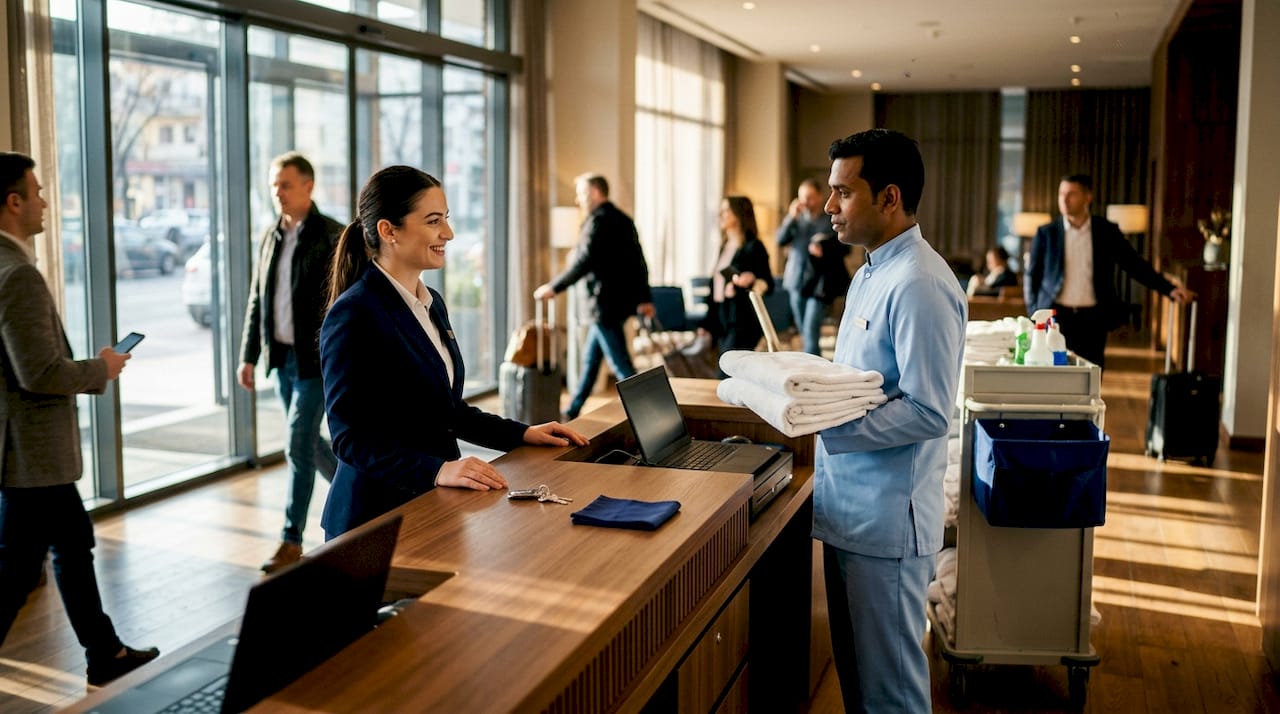
Front desk and concierge staff represent the property’s first impression. Front desk uniforms should include blazers, dress shirts, and tailored trousers or skirts in the hotel’s brand colors. Fabrics should be wrinkle-resistant and easy-care to maintain a crisp appearance across long shifts. Polished footwear and a visible name badge complete the look.
Housekeeping staff face a different set of demands. Housekeeping uniforms prioritize comfort and function, with moisture-wicking shirts and stretch-waist slacks that allow ease of movement. Matching colors across the team create a professional appearance while clearly distinguishing the department from front-of-house staff.
| Department | Core Garments | Key Fabric Properties | Accessories |
|---|---|---|---|
| Front desk | Blazer, dress shirt, tailored trousers or skirt | Wrinkle-resistant, easy-care | Name badge, polished footwear |
| Housekeeping | Polo shirt, stretch-waist slacks | Moisture-wicking, durable | Apron, comfortable closed-toe shoes |
| Food and beverage | Waistcoat, dress shirt, smart trousers | Stain-resistant, easy-wash | Name badge, non-slip footwear |
| Maintenance | Work shirt, cargo trousers | Heavy-duty, abrasion-resistant | Safety footwear, high-visibility vest |
| Security | Formal shirt, dark trousers | Durable, structured | Identification badge, belt |
Food and beverage staff need stain-resistant fabrics that survive repeated industrial washing cycles. Maintenance and security roles call for heavy-duty materials with safety-compliant footwear. Hospitality dress codes confirm that reception staff wear branded shirts, waistcoats, and polished footwear, while housekeeping wears practical polos and trousers. Matching colors across departments reinforces a coordinated, professional environment throughout the property.
Pro Tip: Source wrinkle-resistant and moisture-wicking fabrics from a supplier with hotel-grade specifications. Off-the-shelf retail fabrics rarely survive the industrial washing cycles that hotel laundry operations demand.
How do grooming and identification policies complement uniform standards in Albanian hotels?
Grooming standards are the second layer of any effective Albania hotel dress standard. A staff member wearing a perfect uniform but with unkempt hair or chipped nails undermines the policy’s purpose. Albanian hotel grooming requirements include neatly styled hair, clean-shaven or well-trimmed facial hair, short and clean fingernails, and name badges that display the staff member’s position. Catering staff are specifically required to avoid nail polish, which reflects both hygiene standards and food safety expectations.
A clear grooming policy should address the following:
- Hair: Kept clean, styled, and away from the face. Long hair tied back for food service and housekeeping roles.
- Facial hair: Clean-shaven or neatly trimmed. Stubble that appears mid-shift reflects poor preparation.
- Fingernails: Short, clean, and unpolished for food-handling roles. Clear polish is acceptable for front-of-house staff where the policy permits.
- Jewelry: Minimal and discreet. Dangling earrings and large rings create safety risks in housekeeping and kitchen environments.
- Fragrance: Light and neutral. Strong perfume or cologne affects guests with sensitivities and can conflict with food aromas in dining areas.
- Name badges: Worn at chest height, clearly visible, and showing the staff member’s name and role.
Identification badges serve a function beyond branding. They allow guests to address staff by name, which research in hospitality management consistently links to higher satisfaction scores. They also support internal accountability. When a guest reports a positive or negative interaction, a visible name badge makes follow-up straightforward for management.
Pro Tip: Build grooming standards into the onboarding checklist, not just the policy document. A new hire who reads the policy once and signs it is less prepared than one who receives a grooming briefing with visual examples on their first day.
Enforcement is the most common failure point. Assign grooming checks to shift supervisors as a daily pre-shift task, not a reactive response to complaints. Consistency in enforcement prevents the perception that standards are applied selectively.
What are the legal and cultural considerations impacting hotel uniform policies in Albania?
Albanian labor and tax law shapes how uniform policies are structured and communicated to staff. Getting this wrong creates both legal exposure and employee relations problems.
-
Uniform provision and tax status. Branded work-related uniforms in Albania are generally not considered taxable compensation when they are clearly necessary for the job. High-value or personal items, such as luxury accessories provided alongside a uniform, may be treated as taxable benefits. HR professionals should document the business necessity of each uniform component to support this classification.
-
Ownership and return policy. Albanian labor law requires that employment terms be clearly documented. If the hotel owns the uniforms and expects their return upon termination, this must be stated in the employment contract or a separate uniform agreement. Failure to document this creates disputes at offboarding.
-
Cultural modesty expectations. Albania has a diverse cultural and religious population. Uniform policies should account for staff who observe religious dress requirements, such as head coverings. A policy that accommodates these needs within the hotel’s visual standards avoids discrimination claims and retains qualified staff.
-
Seasonal and climate adjustments. Albanian summers are hot, particularly in coastal resort areas. A rigid year-round uniform that does not account for heat creates discomfort and affects staff performance. Policies should specify approved summer variants, such as short-sleeve shirts or lighter fabrics, that maintain brand standards while addressing climate realities.
-
Language of the policy document. The policy must be written in Albanian to be enforceable. An English-only document is not legally sufficient for Albanian employees and creates ambiguity in disputes.
How to implement and maintain an effective hotel uniform policy in Albanian hospitality businesses?
An effective uniform policy implementation follows a defined workflow from drafting through daily enforcement. Skipping steps in this process is the primary reason policies fail within the first year.
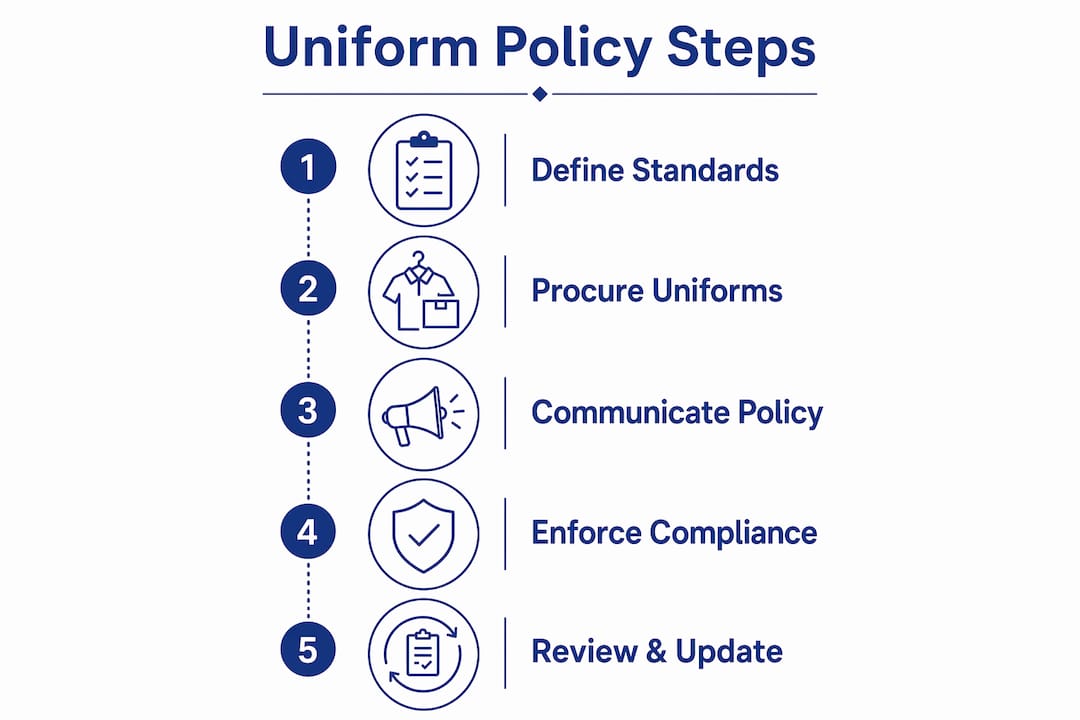
The implementation process breaks into five stages:
- Draft the policy document. Define uniform requirements by department, grooming standards, identification badge rules, care instructions, and consequences for non-compliance. Write in Albanian. Have it reviewed by a local labor law advisor before distribution.
- Communicate with staff. Hold a briefing session for each department when the policy launches. Distribute written copies and collect signed acknowledgments. Visual guides showing correct and incorrect presentation are more effective than text descriptions alone.
- Procure uniforms through a coordinated process. Textile procurement for Albanian hotels works best when managed centrally. Measure all staff before ordering, build a 15–20% buffer stock for replacements, and specify fabric standards in the purchase order. Reactive procurement after uniforms wear out leads to inconsistent replacements.
- Establish a care and replacement workflow. Define who is responsible for laundering uniforms, how often replacements are issued, and what condition triggers a replacement. A textile maintenance workflow that is documented and assigned prevents uniforms from degrading below standard unnoticed.
- Monitor and enforce consistently. Assign pre-shift uniform checks to supervisors. Log non-compliance incidents. Review the policy annually and update it when brand standards, staff roles, or Albanian labor regulations change.
A comparison of policy management approaches shows a clear performance gap. Properties that centralize procurement, assign enforcement to supervisors, and review the policy annually maintain consistent standards. Properties that manage uniforms reactively, without documented workflows, experience visible inconsistency within 6–12 months of a policy launch.
Pro Tip: Photograph the correct uniform for each role and include those images in the policy document. A picture removes interpretation gaps that written descriptions always leave open.
Key Takeaways
A hotel uniform policy in Albania requires documented standards for attire, grooming, and identification, enforced consistently by supervisors and reviewed annually to stay current with brand and legal requirements.
| Point | Details |
|---|---|
| Define standards by department | Each role needs specific garment types, fabric standards, and accessory requirements. |
| Grooming is part of the policy | Hair, facial hair, nails, and badges must be addressed alongside attire. |
| Legal compliance matters | Document uniform ownership and tax classification to avoid labor disputes. |
| Procurement needs a workflow | Centralized buying with buffer stock prevents inconsistent replacements. |
| Enforcement requires structure | Assign pre-shift checks to supervisors and log non-compliance incidents. |
What I’ve learned about uniform policies that most guides skip
Most hotel uniform policy guides focus on what to include in the document. The harder problem is what happens after you distribute it.
The most common failure I see is a policy that was written once, signed by staff, and then never revisited. Uniforms wear out. Brand colors get updated. New roles are added. The policy stays frozen while operations evolve around it. Within two years, the document no longer reflects reality, and enforcement becomes impossible because the standard itself is unclear.
The second failure is treating grooming standards as a sensitivity issue rather than an operational one. Managers avoid enforcing grooming rules because they worry about staff reactions. The result is inconsistent application, which creates more resentment than consistent enforcement would. Staff notice when rules apply to some people and not others. That inconsistency damages morale more than the standard itself ever would.
Albanian hotels face a specific challenge that international guides do not address. The cultural and religious diversity of the workforce means a single rigid standard will create friction. The solution is not to lower standards. The solution is to build flexibility into the policy from the start, with approved variations that maintain the visual identity while accommodating individual needs. Hotels that do this retain better staff and face fewer disputes.
The final point is procurement. A policy is only as good as the uniforms it describes. If you write a standard for wrinkle-resistant blazers and then buy cheap polyester because it was available, the policy fails at the source. Fabric quality is not a detail. It is the physical expression of everything the policy is trying to achieve.
— Xpert
Gjergjihtextil’s uniform and textile solutions for Albanian hotels
Albanian hotels that want to enforce consistent uniform standards need a supplier who understands hotel-grade specifications, not just fabric weights.
Gjergjihtextil has supplied hotels including Meliá, Marriott, and Sheraton with textiles built for hospitality environments. The company offers custom production, department-specific fabric selection, and volume procurement that keeps per-unit costs competitive. For HR professionals managing uniform rollouts across multiple departments, Gjergjihtextil provides advisory support on fabric choices that meet both brand standards and Albanian operational conditions. Explore the full range of hotel textile solutions to source uniforms and workwear that hold up under daily use and industrial laundering.
FAQ
What is a hotel uniform policy?
A hotel uniform policy is a formal document that defines attire, grooming, and identification standards for each staff role. It gives managers a clear enforcement framework and ensures consistent guest-facing presentation across all departments.
What do Albanian hotel uniform guidelines require?
Albanian hotel service standards require uniforms to be clean, properly fitted, and role-specific. Staff at 5-star properties must also meet strict grooming and presentation benchmarks.
Are hotel uniforms taxable in Albania?
Branded uniforms clearly necessary for the job are generally not considered taxable compensation in Albania. High-value or personal items provided alongside a uniform may be treated as taxable benefits.
How often should a hotel uniform policy be reviewed?
A hotel uniform policy should be reviewed at least once per year. Updates are needed when brand standards change, new roles are added, or Albanian labor regulations are revised.
What fabrics work best for hotel staff uniforms?
Wrinkle-resistant and moisture-wicking fabrics perform best in hotel environments. They maintain a professional appearance across long shifts and survive repeated industrial washing cycles without degrading.