

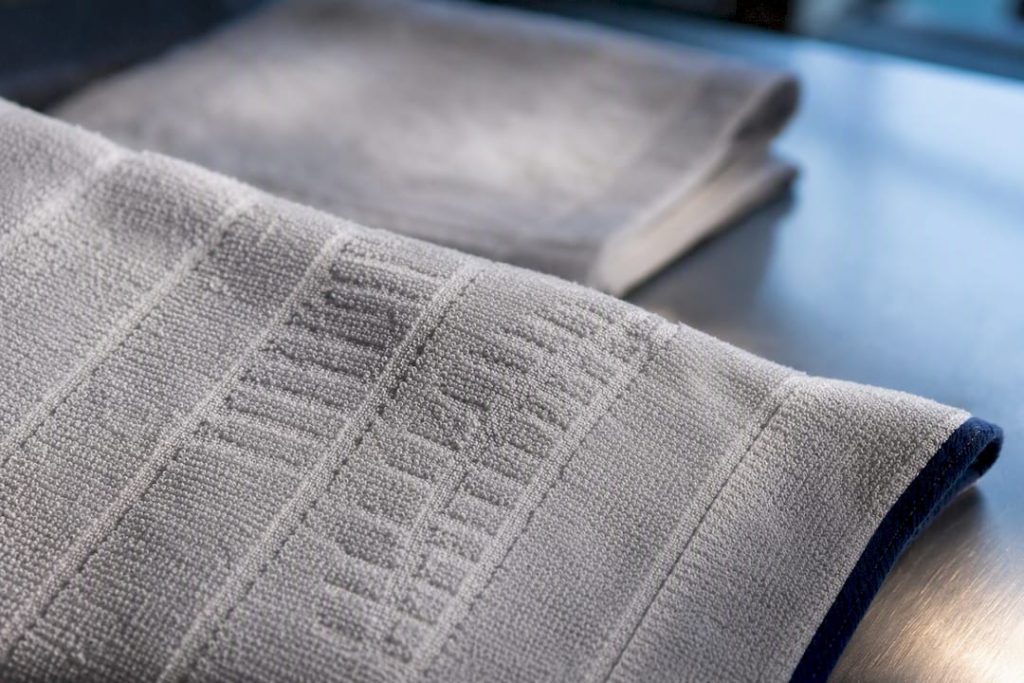
For heavy-use hotel towels, a jacquard-woven logo paired with combed ring-spun cotton at a mid-to-heavy weight outperforms embroidery in commercial laundry conditions. It costs more upfront, but you replace fewer towels over the life of the contract because the logo is built into the fabric, not stitched onto it. Before you order a single case, request a physical sample and a commercial wash-test report from any supplier under consideration.
TL;DR:
- Request physical wash-tested samples and detailed performance reports before ordering to ensure durability and colorfastness under commercial laundry conditions.
- Specify fiber type, construction details, and performance expectations in your RFQ to avoid inconsistent product quality and supply delays.
- Jacquard weaving provides superior longevity for logos compared to embroidery or printing, especially for towels subjected to frequent industrial washing.
- Choose towel weight and construction based on balancing guest perception, laundry costs, and durability, typically favoring middle to heavier GSM options for commercial use.
- Neglecting to evaluate the combined product and logo specifications during procurement often leads to premature logo fading and towel failure within a few years.
Table of Contents
- What Should Procurement Specify When Ordering Logo Towels?
- Embroidery, Printing, or Jacquard: Which Logo Method Actually Holds Up?
- Which Towel Specifications Belong on Your Order Form?
- How Do You Move From Sample to Full Production Order?
- How Should Housekeeping Launder Branded Towels to Protect the Logo?
- Why Gjergji H Tekstil’s Supply Chain Experience Matters Here
- The Procurement Mistake Almost Every Hotel Buyer Makes
- Ready to Request a Sample or Start an RFQ?
- Sources
What Should Procurement Specify When Ordering Logo Towels?
An RFQ that only asks for “white towels with our logo” invites vague quotes and inconsistent product. Specificity in the request document is what separates a towel program that lasts three years from one that needs reordering after eight months.
Start with fiber and construction. Ask specifically for combed ring-spun cotton, note the pile type (terry loop, velour, or a combination border), and require reinforced headers, since that seam is usually the first place a commercial-grade towel fails. Then move to functional performance: absorbency expectations, shrinkage tolerance after repeated hot washes, and dimensional specs with a stated tolerance range, such as plus or minus half an inch on length and width.
Certifications matter more than they used to. If your property markets itself on sustainability or serves guests sensitive to chemical finishing, ask whether the textile carries an OEKO-TEX certification, and request documentation of any industrial-wash performance guarantee the supplier is willing to put in writing.
Your RFQ should also nail down commercial terms before price negotiations even start:
- Sample policy: is a physical sample free, and how many wash cycles will the supplier run before shipping it?
- Minimum order quantity per size, color, and logo placement
- Lead time from proof approval to delivery, including any seasonal slowdowns
- Dye-lot handling procedures for reorders, so shade drift doesn’t show up in a repeat shipment
- Packaging and labeling requirements, especially if towels ship directly to multiple properties
A wholesale textile supplier that can answer all of these without hedging is one worth taking seriously.
Pro Tip: Put your RFQ questions in a numbered list and ask suppliers to answer them in the same order. It takes ten extra minutes on their end, and it makes comparing three or four quotes side by side dramatically faster.
Embroidery, Printing, or Jacquard: Which Logo Method Actually Holds Up?
Each method produces a different visual result and a different lifespan, and the difference matters more than most first-time buyers expect.
Embroidery stitches thread directly onto the towel surface, giving a raised, textured logo that reads as premium on a folded display towel. Printing applies pigment or dye onto the fiber and works well for complex, multicolor logos at a lower cost, but it tends to fade faster under repeated hot-water extraction. Jacquard weaves the logo into the towel structure itself during production, integrating it into the fabric rather than adding it afterward; this method offers superior durability across industrial wash cycles.
That structural difference explains the durability gap. VTITowels notes that jacquard typically offers far greater resilience across wash cycles than surface embroidery, because there’s no thread or ink layer sitting on top of the fiber to abrade or peel. Suppliers running dedicated jacquard looms, like those described by Roux Professional, position the technique specifically for hospitality clients who need the logo to survive hundreds of industrial cycles.
Towel weight and weave also shape how a logo reads. A heavier, denser weave holds embroidery stitching more securely and gives jacquard patterns crisper definition, while a lighter towel can make either method look thin or washed out after a season of use.
Here’s how the three methods map onto hotel segments:
- Economy properties: printed or basic embroidered logos, prioritizing cost per unit over multi-year durability
- Midscale hotels: embroidery on bath towels, jacquard on pool and spa towels that see more frequent laundering
- Upscale and resort properties: jacquard as the default, since guests notice texture and the towel represents a longer-term brand investment
- Spa and wellness facilities: tonal jacquard, which keeps the branding subtle against the fabric’s own softness
Which Towel Specifications Belong on Your Order Form?
Weight, expressed in grams per square meter (GSM), is the first number suppliers will ask about, and it drives both guest perception and laundry cost. Lighter towels dry faster and cost less to launder at scale but feel thinner in hand and show wear sooner. Heavier towels feel luxurious and last longer under commercial washing, at the cost of longer dry times and higher per-unit price. Most hotel buyers land in a middle range for bath towels and go heavier for bathrobe-adjacent or spa products, but the right number depends on your laundry cycle frequency and guest expectations, so ask your supplier for weight options rather than assuming a single figure fits every property type.
Pile and header construction decide how long that weight holds up. A double-loop pile resists matting and shrinkage better than a single loop, and reinforced headers prevent the seam from fraying at the point where towels get pulled off racks and stuffed into laundry bags hundreds of times a month.
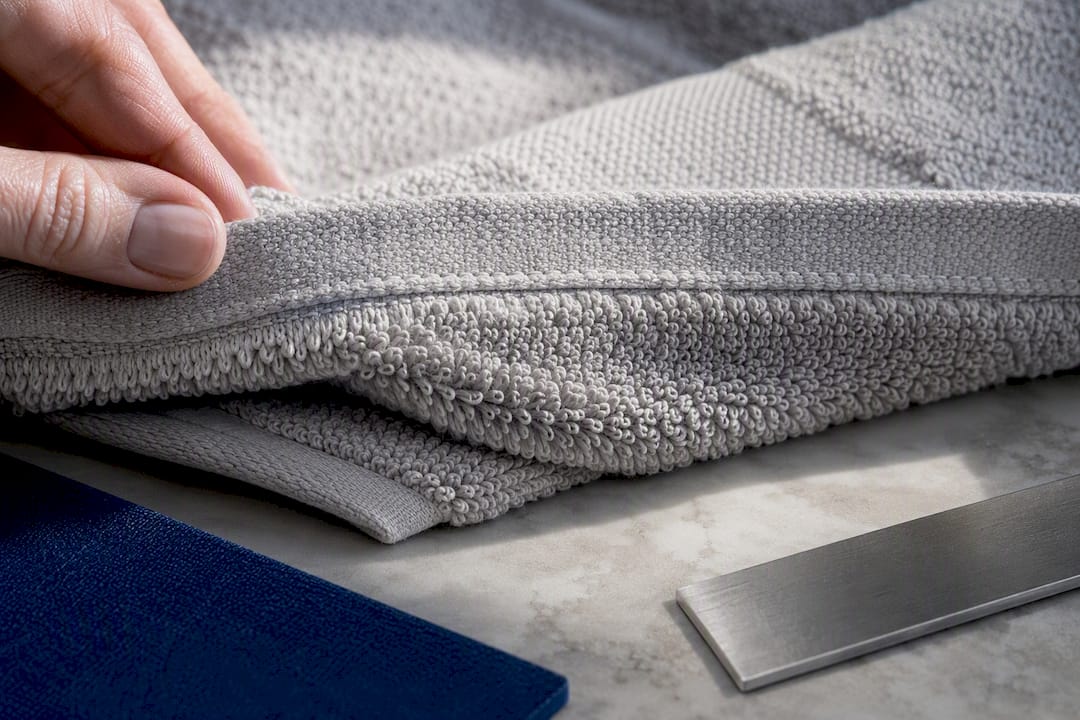
Sizing consistency matters more than most buyers expect. Standardize your bath towel, hand towel, and washcloth dimensions across all room types so your laundry team isn’t sorting mismatched batches, and confirm the supplier’s stated dimensions reflect post-wash, not pre-wash, measurements.
On finish and color:
- Dyeing method (piece-dyed versus yarn-dyed) affects colorfastness and how the logo yarn matches the base fabric
- Softening finishes trade a small amount of absorbency for a more premium hand-feel
- Tonal logos (same color family as the towel) read as understated luxury; high-contrast logos read as bold branding and work well for budget or lifestyle-brand properties
How Do You Move From Sample to Full Production Order?
The path from first inquiry to a delivered pallet of branded towels follows a predictable sequence, and skipping steps is where most procurement mistakes happen.
- Request samples. Ask for a wash-tested physical sample, not just a photo. AllStarLogo describes a standard workflow: submit artwork, review a digital proof, then receive a physical sample before committing to a production run.
- Test the sample yourself. Run it through your own laundry cycle several times and check for shrinkage, colorfastness, and logo retention, not just how it looks fresh out of the box.
- Approve artwork formally. Provide vector files (AI or EPS) with Pantone color codes specified, and expect at least one revision round before final proof sign-off.
- Confirm cost drivers. MOQ, dye-lot size, and packing choices (bulk versus individually wrapped) all move the per-unit price, sometimes significantly.
- Negotiate bundling. Ordering towels alongside bathrobes or bath mats from the same production run often lowers the blended unit cost.
Pro Tip: Ask your supplier for a yarn-dyed swatch of both the base towel color and the logo thread before signing off on a jacquard order. Pantone matching on paper doesn’t always translate to fabric, and catching a mismatch at the swatch stage is far cheaper than catching it in a 2,000-unit shipment.
How Should Housekeeping Launder Branded Towels to Protect the Logo?
Wash temperature and chemical choice matter as much as the towel’s original construction. Excessive bleach or overly aggressive extraction cycles degrade both cotton fiber and woven logo yarn faster than moderate, well-managed cycles. Segregate branded towels by property section or room tier so wear patterns stay predictable, and rotate stock so no single batch absorbs a disproportionate share of laundry cycles.
The logo method you chose also dictates what housekeeping and your supplier contract should track. Jacquard needs less special handling than embroidery, which can snag on Velcro or rough surfaces during transport. Ask suppliers to document durability guidance in the contract itself, and use early wash-test data to forecast when a batch will need replacing.
- Track initial weight, post-wash weight, and dimensional change after a defined number of cycles
- Photograph logo condition periodically to build a visual record, not just a written one
- Feed that data into your total-cost-of-ownership math instead of budgeting on purchase price alone
Why Gjergji H Tekstil’s Supply Chain Experience Matters Here
A supplier with a fully controlled supply chain operates from import through design, production, and distribution rather than reselling someone else’s inventory. That structure matters because it removes the middleman delays and quality gaps that come with intermediated sourcing, echoing the point that in-house weaving capability gives better control over color matching and wash performance than resellers can offer.
Textile programs supplied to recognized hotel brands set a practical floor for what “hotel-grade” means in commercial laundering. What that experience translates into for a smaller property or a first-time buyer:
- Sample and wash-test support before you commit to a production run
- Design proofing so your logo translates correctly onto woven or embroidered product
- Bulk production capacity without sacrificing responsiveness on smaller reorders
The Procurement Mistake Almost Every Hotel Buyer Makes
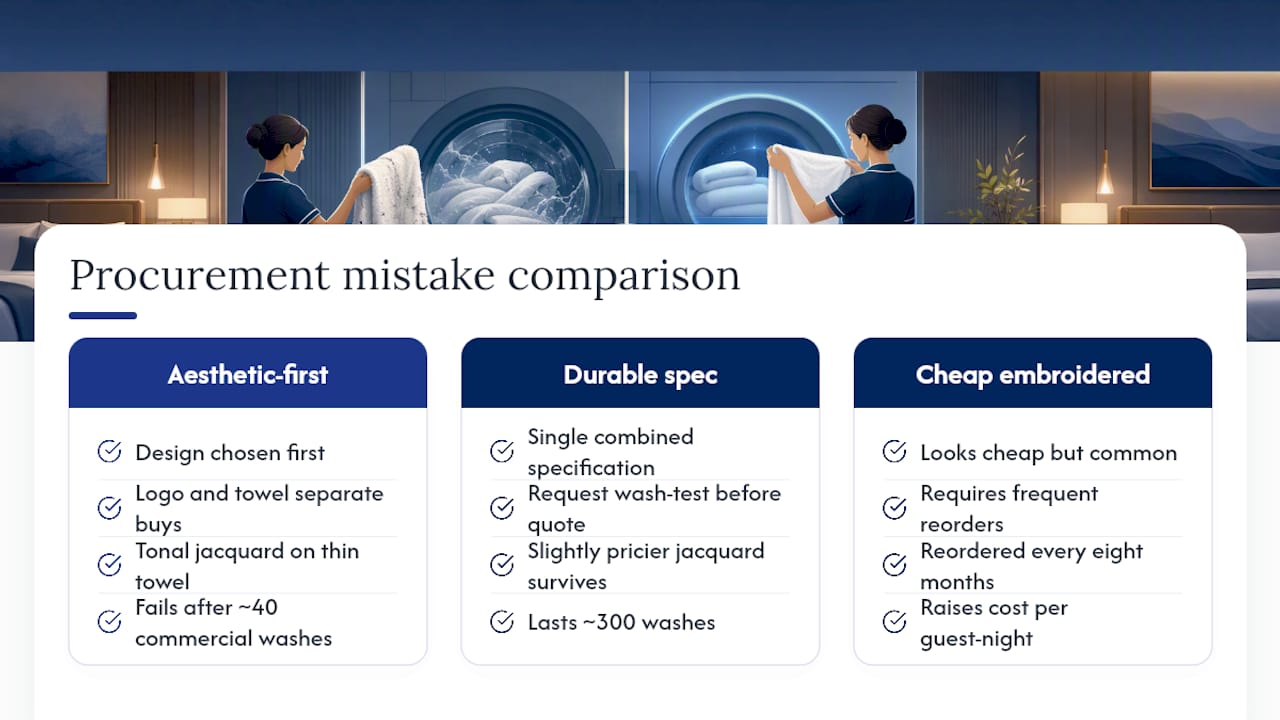
Most towel procurement fails for a boring reason: buyers evaluate the logo and the towel as separate purchases. They pick a pretty design first, then hunt for a towel to put it on, when the real decision is a single combined spec. A tonal jacquard logo on a thin, single-loop towel looks fine in a photo and falls apart, literally, after forty commercial washes.
The conventional advice out there leans heavily on aesthetics, but understanding what guest experience means reveals why tactile elements like towels impact perceived quality. Compare fonts, compare thread colors, pick what “looks premium” in a catalog photo. That advice skips the part that actually determines your cost per guest-night: how the logo technique interacts with your laundry’s chemistry and cycle count. A supply chain built around consistency rather than one-off orders is what prevents the shade drift and mismatched reorders that quietly erode a hotel’s brand presentation over two or three years.
If you take one thing from this guide, make it this: request the wash-test before you request the quote. Price comparisons without durability data are comparing the wrong thing entirely. A slightly more expensive jacquard towel that survives 300 washes beats a cheap embroidered one you’re reordering every eight months, every time the math gets run honestly.
— Xpert
Ready to Request a Sample or Start an RFQ?
Some suppliers skip the reseller layer that adds cost and delay to hotel towel orders. When production runs through an integrated import, design, and manufacturing chain rather than a broker network, procurement teams can get direct answers on lead time, dye-lot consistency, and wash performance instead of relayed guesses.
Getting a real answer starts with sending the right information. Share your target GSM range, preferred logo method, room count, and current laundry cycle frequency, and you’ll get a quote that reflects your actual operating conditions rather than a generic catalog price. Visit the hotel textile selection guide to review weight and sizing options before you request samples, or browse design inspiration for hotel textiles if you’re still deciding between tonal and high-contrast branding. With more than 30 years supplying hotels, restaurants, and resorts across the region, Gjergjihtextil can move from sample request to production order without the back-and-forth that slows down most first-time custom towel programs. Send over your specs and get a wash-tested sample in hand before you commit to a full run.
Sources
- Personalized Towels for Hotels & Resorts: 2026 Buying Guide
- Hotel Collection – De La Fabrica
- Custom towels for promotion, hotels & wellness | Roux Professional