

TL;DR:
- Specialized textile warehouses protect fabric quality and reduce waste through climate control and structured processes.
- Modern warehouses with WMS improve order accuracy, reduce costs, and enable real-time inventory visibility.
- Local Balkan warehouses offer faster delivery, lower lead times, and better supply reliability for hospitality firms.
Hospitality managers often focus on guest experience, staff training, and food quality, yet one operational pillar quietly determines whether rooms are ready on time and tables look sharp every service: the textile supply chain. Most hotel and restaurant operators assume any warehouse can store linens and uniforms without consequence, but the reality is sharply different. Specialized textile warehouses protect fabric integrity, maintain inventory accuracy, and reduce costly waste in ways that general storage facilities simply cannot match. This guide explains what a textile warehouse is, how its core processes work, which model fits your operation, and how technology is reshaping supply reliability for hospitality businesses across Albania and the broader Balkan region.
Table of Contents
- What is a textile warehouse?
- Key processes in textile warehouse management
- Types of textile warehouses: Which fits your hospitality needs?
- Advances in textile warehouse technology
- Our take: What most Albanian hospitality managers miss about textile warehousing
- Next steps: Find your ideal textile warehouse partner
- Frequently asked questions
Key Takeaways
| Point | Details |
|---|---|
| Specialized textile warehousing | Textile warehouses protect, organize, and preserve textile quality for hospitality operations. |
| Efficient inventory management | Advanced systems like WMS cut stock waste, boost order accuracy, and speed up shipments. |
| Warehouse type matters | Choose between production and distribution warehouses based on your supply and fulfillment needs. |
| Local sourcing advantage | Using a local Balkan textile warehouse can shorten lead times and reduce operational risks. |
What is a textile warehouse?
Now that the importance of reliable textile supply is clear, let’s define exactly what a textile warehouse is and what sets it apart from ordinary storage.
A textile warehouse is fundamentally different from a standard general-purpose facility. According to apparel warehousing principles, a textile warehouse is a specialized storage facility for textiles, fabrics, garments, trims, and accessories, often climate-controlled with hanging racks, modular shelving, and high-density storage to handle large assortments of sensitive materials. That last word, sensitive, is the key distinction. Fabrics respond to temperature swings, humidity, and improper stacking in ways that generic goods do not.
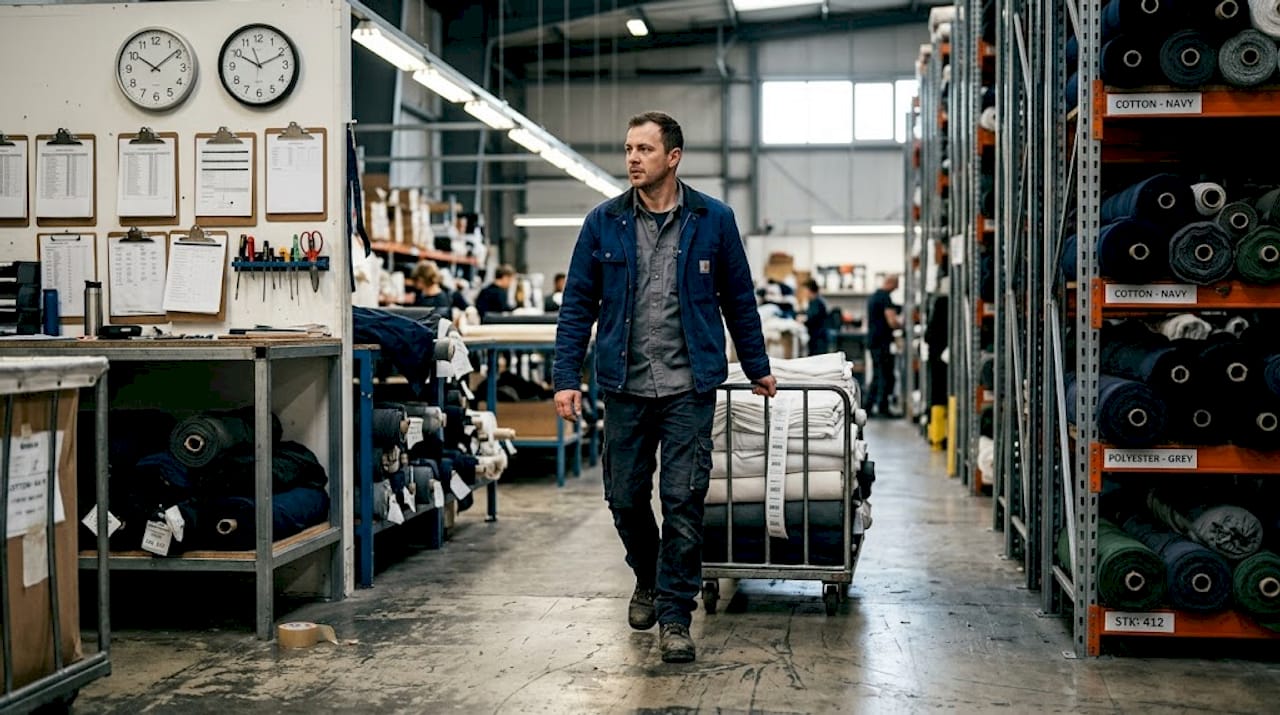
What does the physical layout actually look like? Well-designed textile warehouses use a combination of hanging rail systems for garments and curtains, flat modular shelving for folded linens and towels, and bulk racking for high-volume stock. Climate control maintains consistent humidity levels, typically between 45% and 65%, to prevent mildew growth, fiber brittleness, and color fading. Lighting is managed to avoid UV degradation on white linens, which is a detail most general warehouses never consider.
The types of items typically held in a hospitality-focused textile warehouse include:
- Bed linens: flat sheets, fitted sheets, pillowcases, duvet covers
- Bath textiles: towels, bath mats, robes, face cloths
- Table textiles: tablecloths, napkins, runners, overlays
- Room accessories: curtains, blackout liners, decorative cushion covers
- Staff uniforms: kitchen whites, service uniforms, housekeeping wear
The operational benefit for hotels and restaurants is direct. When textiles are stored correctly, you lose fewer items to damage, replacements are easier to track, and your housekeeping team spends less time sorting mismatched or deteriorated stock. Understanding Balkan textile logistics shows how proximity and proper storage infrastructure compound these benefits further.
| Feature | Textile warehouse | General warehouse |
|---|---|---|
| Climate control | Yes, humidity and temp regulated | Rarely standard |
| Storage system | Hanging racks, modular shelving | Standard pallet racking |
| Inventory sensitivity | Fabric-grade handling | Generic handling |
| Loss prevention | High, purpose-built | Moderate |
| Hospitality suitability | Optimized | Limited |
“The difference between a textile warehouse and a general one is not just equipment. It is the entire operating logic built around protecting material integrity across thousands of SKUs.”
Key processes in textile warehouse management
Understanding the core functions of textile warehouses is essential; next, let’s see how their organization and processes maintain quality and accuracy at every stage.
Effective textile warehousing is not just about where items sit. It is about the sequence of decisions made from the moment goods arrive to the moment they ship out to your property. Here is how that sequence typically works in a well-run operation:
- Receiving: Incoming shipments are logged against purchase orders. Quantities are verified and discrepancies flagged immediately, preventing downstream counting errors.
- Inspection: A standard 10% fabric inspection using the 4-point system grades fabric defects by severity. This catches quality issues before textiles ever reach hotel or restaurant floors.
- Sorting: Items are sorted by type, color, and shrinkage classification. Mixing different shrinkage grades in the same shelf zone causes fulfillment errors when orders go out.
- Quality control clearance: Only textiles that pass QC are released to the active storage zone. Items needing resolution are held separately, preventing contamination of clean stock.
- FIFO issuance: First In, First Out issuance ensures that older stock ships before newer stock, keeping product age under control and reducing the risk of textiles sitting unused until their fiber quality deteriorates.
- Dispatch and documentation: Orders are picked, packed, and dispatched with full documentation so the receiving hotel or restaurant can verify delivery accuracy without counting from scratch.
This structured approach matters because it directly affects protecting textile durability from the supply side. Linens that are stored on the floor, mixed without color sorting, or issued without FIFO discipline show premature wear and inconsistent appearance much faster than properly warehoused stock.
When these processes are executed consistently, the results are measurable. Well-managed textile warehouses can achieve approximately 98% order accuracy, meaning your deliveries arrive complete and correct, nearly every time. That number matters enormously for hotel housekeeping departments running tight turnaround schedules between guest checkouts and next arrivals. Following clear distribution steps for hotels built on these processes reduces operational friction significantly.
Pro Tip: When evaluating a textile supplier, ask specifically whether they use a structured 4-point inspection system and FIFO issuance protocols. If they cannot answer clearly, their warehousing practices are likely informal, and your inventory reliability will reflect that.
Types of textile warehouses: Which fits your hospitality needs?
With processes covered, it is important to choose the right warehousing approach for your hospitality business needs.
Not all textile warehouses serve the same purpose. There are two primary models, and understanding the difference helps you select the right supplier structure for your hotel or restaurant operation.
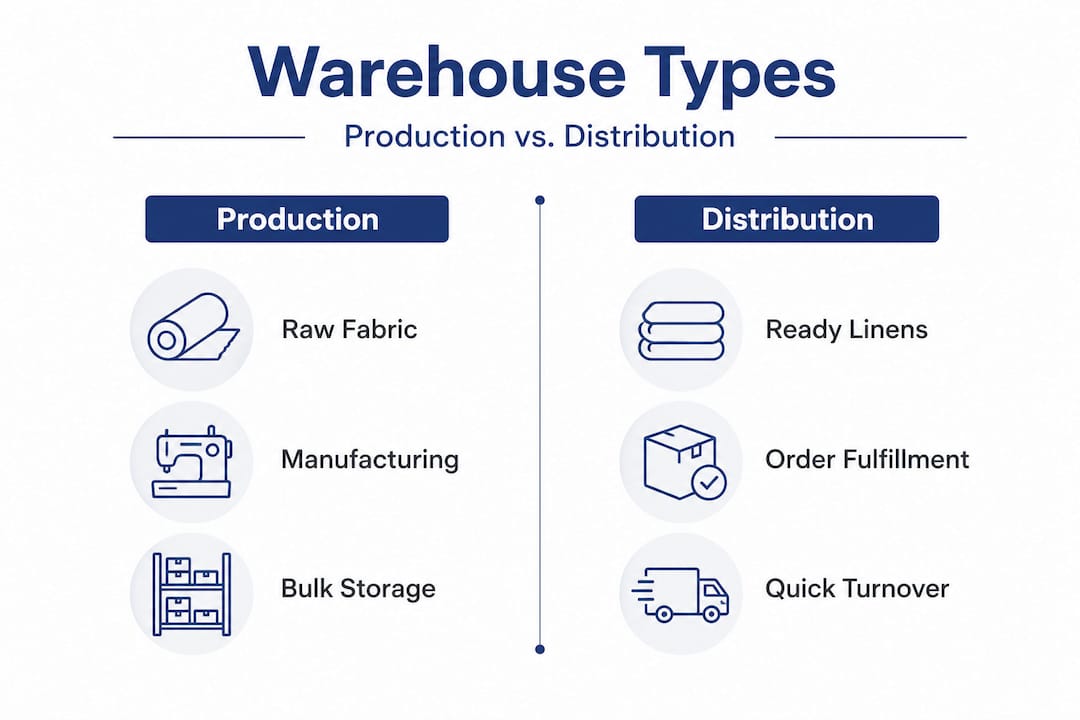
Production warehouses are primarily associated with manufacturers. They hold raw materials such as unprocessed fabric rolls, yarn, and trimmings, as well as work-in-progress items that are partway through a production cycle. These facilities are optimized for feeding manufacturing lines, not for rapid order fulfillment to end-users. For a hotel purchasing manager, a supplier operating only a production warehouse will typically have longer lead times and less flexibility on short-notice orders.
Distribution warehouses, by contrast, are built for speed and turnover. As warehousing research confirms, distribution warehouses focus on temporary storage and fulfillment for end-users like hotels, with inventory already finished and ready to ship. These facilities are designed to receive large volumes, organize stock for fast picking, and dispatch orders efficiently. For hospitality operations, a supplier backed by a strong distribution warehouse model means faster replenishment cycles and more predictable delivery windows.
| Warehouse type | Primary function | Stock type | Best for hospitality? |
|---|---|---|---|
| Production | Manufacturing support | Raw materials, WIP | Limited, longer lead times |
| Distribution | Fulfillment and turnover | Finished goods | Yes, fast replenishment |
| Integrated (both) | End-to-end supply chain | Raw through finished | Ideal for large operators |
How should you decide which model you need? A few practical criteria:
- Order volume: High-volume hotels with 50+ rooms benefit most from suppliers with dedicated distribution capacity.
- Order frequency: If you reorder towels and linens monthly or more, distribution warehouse proximity is critical.
- Product customization: If you need branded uniforms or custom-embroidered linens, an integrated supplier with both production and distribution functions is your strongest option.
- Lead time sensitivity: Seasonal hospitality businesses with sharp demand peaks need suppliers who can fulfill within days, not weeks.
You can explore how these decisions play out in practice through the hospitality textile import guide, and see how custom textile solutions for hotels work within an integrated model.
Advances in textile warehouse technology
Technology is reshaping textile warehousing, and here is what the latest systems mean for hospitality operations.
The gap between a manually managed textile warehouse and a technology-enabled one is widening fast. For hospitality managers in Albania and the Balkans, this gap has a direct financial impact.
A Warehouse Management System, or WMS, is software that automates inventory tracking, order picking, packing, returns processing, and real-time stock visibility. According to apparel warehousing research, modern WMS platforms also integrate with ERP systems, enabling real-time visibility and best practices like ABC analysis, cross-docking, zone picking, and climate zoning for different fabric categories. In practical terms, this means your supplier always knows exactly where your next order stands, and so do you.
The performance numbers from WMS adoption are striking. Industry benchmarks for textile WMS show a 25% reduction in excess stock, order accuracy improving from 85% to 98%, shipment times cut from five days to two, fulfillment speeds increasing by 50%, and overall operational cost reductions of 30%. These are not marginal improvements. For a hotel property running on tight linen par levels, a supplier jumping from 85% to 98% order accuracy means the difference between a smooth housekeeping operation and a crisis at peak occupancy.
For managers evaluating WMS for textile reliability, the key question to ask any supplier is simple: Can you show me real-time stock levels for my account? If the answer is yes, their WMS integration is functional. If the answer is vague, their inventory tracking is likely still manual, and your supply reliability is at risk.
Pro Tip: When shortlisting textile suppliers, ask whether they offer a client-facing portal or regular digital stock reports. Suppliers who provide transparent inventory visibility through WMS integration are substantially more reliable partners for high-volume textile supply operations.
Manual systems still have a place in very small operations where order volumes are low and product variety is limited. But for any hotel above 30 rooms or any restaurant group running multiple locations, the operational risk of relying on a manually managed supplier is too high to justify a marginal cost saving.
Our take: What most Albanian hospitality managers miss about textile warehousing
Over 30 years of supplying hotels and restaurants across Albania and the Balkans, one pattern keeps repeating: hospitality managers make textile supplier decisions based primarily on unit price. They compare the cost of a towel or a tablecloth, choose the cheapest option, and discover months later that the real costs were hidden elsewhere. Replacement cycles doubled. Delivery windows were unpredictable. Quality varied between batches. These are not product problems. They are warehousing problems.
The uncomfortable truth is that price is the least revealing variable when evaluating a textile supplier. What actually determines your total cost of ownership is how that supplier stores, manages, and dispatches your textiles. Climate control protects fiber integrity across long storage periods. FIFO issuance prevents you from receiving deteriorated stock that sat unused for a year. Digital inventory visibility through WMS means you can plan procurement without safety-stocking excessively.
For Balkan hospitality operators specifically, local warehouse proximity adds a competitive layer that distant imports cannot replicate. A supplier importing from Italy, India, or Pakistan must absorb customs delays, transit time, and minimum order volumes that push your lead times to four or six weeks. A local Albanian warehouse with the same product quality can fulfill within days. That speed advantage keeps your linen par levels lean and reduces the working capital tied up in textile inventory. As apparel warehousing principles confirm, Balkans-local suppliers with WMS, climate control, and FIFO practices consistently outperform distant import models on reliability.
Here are three things you should demand from any textile provider before signing an agreement in 2026:
- Verified climate control: Ask for storage temperature and humidity specifications. If they cannot provide them, your linens are at risk.
- WMS or structured digital inventory: You need real-time or near-real-time stock visibility. Manual spreadsheets are not sufficient for a professional hospitality account.
- FIFO issuance documentation: Request evidence that their warehouse operates on a first-in, first-out basis. This protects the freshness and quality consistency of every shipment.
You can use this checklist when reviewing how to streamline your textile supply chain with a partner who meets these standards consistently.
Next steps: Find your ideal textile warehouse partner
Once you know what matters in textile warehousing, the path to a stronger supply operation becomes clear. The principles covered in this guide, climate control, structured inspection, FIFO processes, WMS integration, and local distribution strength, are not abstract. They are the operational backbone of every reliable hospitality textile program running at scale in Albania and across the Balkans today.

Gjergji H Tekstil has operated as one of Albania’s largest textile warehouses since 1994, supplying properties from boutique hotels to international brands like Marriott, Meliá, and Sheraton. The infrastructure behind that track record includes full climate-controlled storage, structured quality control, and an integrated model covering import through final delivery. If your operation needs dependable, high-volume textile fulfillment with local speed advantages, explore the full range of hotel textile warehouse solutions available. You can also review the textile production in hospitality process to understand how products are built before they reach your property. When you are ready to discuss your specific supply needs, the team behind decades of streamline textile distribution experience is available to help you build a reliable program.
Frequently asked questions
Why is climate control crucial in textile warehouses for hotels?
Climate control prevents mildew, fading, and fiber breakdown by maintaining stable temperature and humidity levels. According to apparel warehousing standards, this is a defining characteristic of purpose-built textile storage, ensuring linen quality holds up under the demanding wash cycles and daily use typical of hospitality environments.
How does a textile warehouse reduce operational costs for hotels and restaurants?
Modern textile warehouses using WMS technology reduce excess stock by 25% and cut overall operational costs by up to 30%, primarily by eliminating over-ordering, preventing waste from poor storage, and compressing shipment timelines from five days to two.
What’s the difference between production and distribution textile warehouses?
Production warehouses hold raw materials and unfinished goods to support manufacturing lines, while distribution warehouses store finished textiles and focus on rapid fulfillment to end-users like hotels and restaurants, making them the more relevant model for hospitality procurement.
Why should Balkan hospitality managers choose a local textile warehouse?
Local warehouses in Albania and the Balkans deliver finished stock in days rather than weeks, bypassing the customs delays and minimum order constraints tied to distant imports. Proximity combined with WMS-enabled inventory management gives Balkan operators a meaningful lead time advantage that directly supports leaner, more cost-efficient linen management.