

TL;DR:
- Industrial laundry involves high-volume, automated processing of textiles using purpose-built equipment like tunnel washers that operate continuously and reach high temperatures. This process requires certified fabrics, disciplined operational practices, and maintenance to ensure linen durability, reduce costs, and meet hygiene standards in hospitality settings. Treating linens as depreciating assets rather than consumables helps hotel managers optimize lifecycle costs and improve operational efficiency.
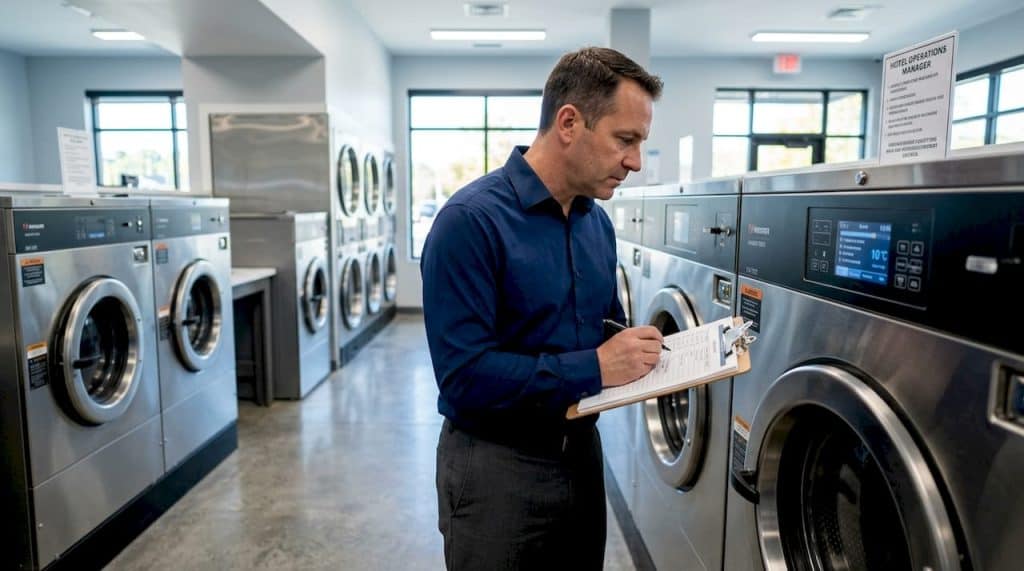
Industrial laundry is the process of cleaning large volumes of textiles using automated, heavy-duty commercial equipment designed to meet strict hygiene and durability standards at scale. For hotel managers and operational directors, understanding this process is not academic. It directly determines how long your linens last, how much you spend replacing them, and whether guests notice the difference between a crisp, well-maintained sheet and one that has been degraded by improper washing. The term “industrial laundry” is sometimes used interchangeably with “commercial laundry,” though the industry standard refers specifically to high-throughput operations using purpose-built machinery like tunnel washers, flatwork ironers, and high-efficiency presses.
What is industrial laundry and how does it differ from commercial washing?
Industrial laundry is defined as a high-volume, automated textile cleaning operation that uses specialized equipment, controlled chemical dosing, and standardized wash programs to process hundreds or thousands of items per hour. Tunnel washers can reach up to 40 feet in length and process items continuously rather than in isolated batches. That continuous-flow design is the core operational difference between industrial and standard commercial laundry.
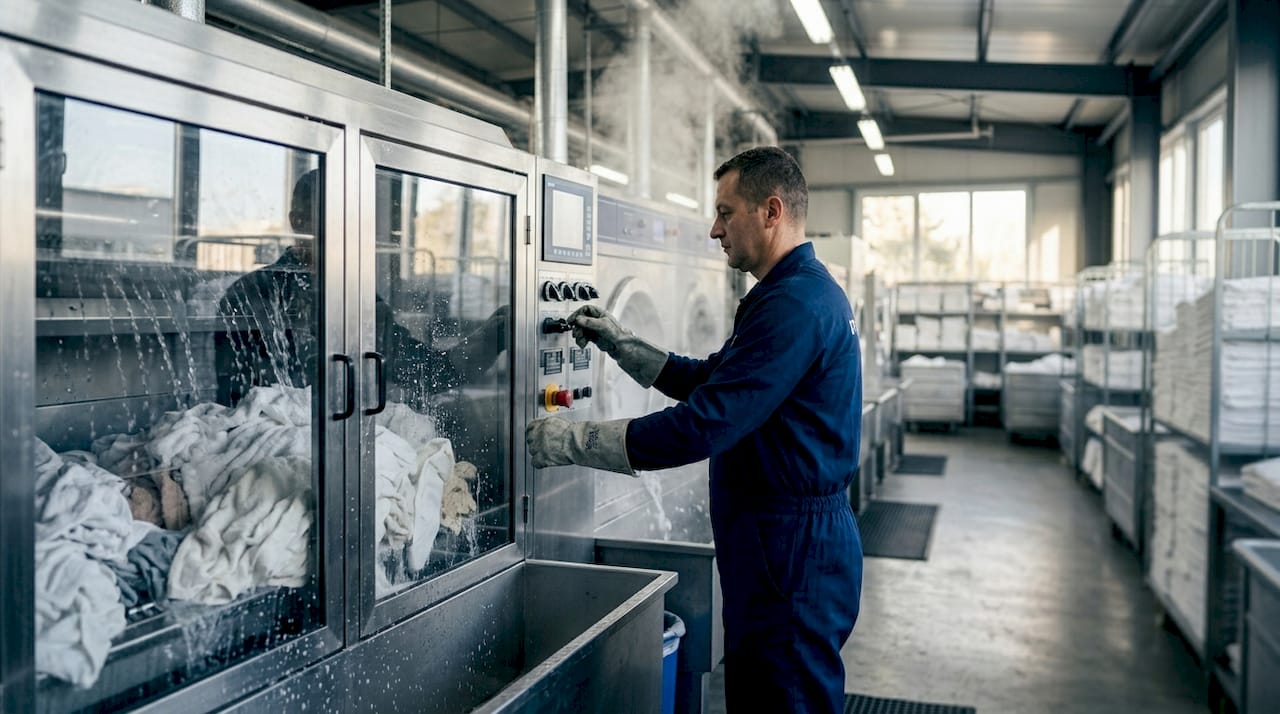
To understand why this distinction matters for your hotel, consider the comparison below.
| Feature | Residential/Light Commercial | Industrial Laundry |
|---|---|---|
| Equipment type | Top-load or front-load washers | Tunnel washers, flatwork ironers |
| Throughput | 10–20 kg per cycle | Hundreds of kg per hour |
| Wash temperature | 40–60°C | 75–85°C |
| Machine lifespan | 8–12 years (residential) | 15–25 years (commercial-grade) |
| Certification standard | None required | DIN EN ISO 15797 |
Commercial washers last 15–25 years under heavy use, compared to 8–12 years for residential machines. Using residential equipment in a commercial setting voids warranties and accelerates failure, which means higher replacement costs and unplanned downtime at the worst possible moments.
The key operational differences go beyond machine size:
- Scale and continuity: Industrial systems run continuously, processing linen flows without stopping between loads.
- Chemical precision: Dosing systems inject exact quantities of detergent, bleach, and softener at programmed intervals, protecting fabric integrity.
- Temperature control: Industrial wash cycles reach 75–85°C to meet hygiene standards required in healthcare and hospitality.
- Centrifugal extraction: Industrial machines operate at centrifuge speeds exceeding 350G, removing moisture far more efficiently than standard spin cycles.
For a hotel operating 100 or more rooms, the difference between industrial and non-industrial laundry is not a matter of preference. It is a matter of operational viability.
What fabric standards and textile types perform best under industrial washing?
Industrial laundry durability is governed primarily by the DIN EN ISO 15797 standard, which certifies that a textile can withstand the mechanical, chemical, and thermal stresses of high-intensity washing. ISO 15797 requires a maximum of 3% shrinkage and maintained colorfastness after 50 to 75 or more wash cycles. Fabrics that do not meet this standard often fail within 12 to 20 industrial wash cycles due to pilling, shrinkage, or color degradation.
The reason so many hospitality textiles degrade prematurely is a direct result of what industry professionals call the “three pillars of industrial stress.” These three pillars are high-temperature water at 75–85°C, alkaline chemical agents, and intense centrifugal forces applied simultaneously during every wash cycle. A fabric that handles one of these stresses well but not the others will still fail quickly.
The most widely used textile solution for industrial laundry environments is the 60/40 polycotton blend, which combines 60% polyester with 40% cotton. Polyester provides dimensional stability and resistance to shrinkage and pilling. Cotton contributes absorbency and the soft tactile quality guests expect from hotel linens. Together, this blend withstands repeated industrial cycles while maintaining the appearance and comfort standards that define a quality guest experience.
Pro Tip: Before purchasing linens in bulk, request a sample batch and run it through 20 to 30 industrial wash cycles. Any fabric that shows visible pilling, shrinkage beyond 2%, or color shift at this stage will cost you significantly more in replacements over a 12-month period than a higher-quality certified alternative.
Standardizing your linen inventory to tested, high-density polycotton blends and respecting mechanical limits can reduce lifetime textile costs by up to 40%. That figure represents a meaningful budget impact for any property managing thousands of linen pieces annually.
How does the industrial laundry process work from intake to finished linen?
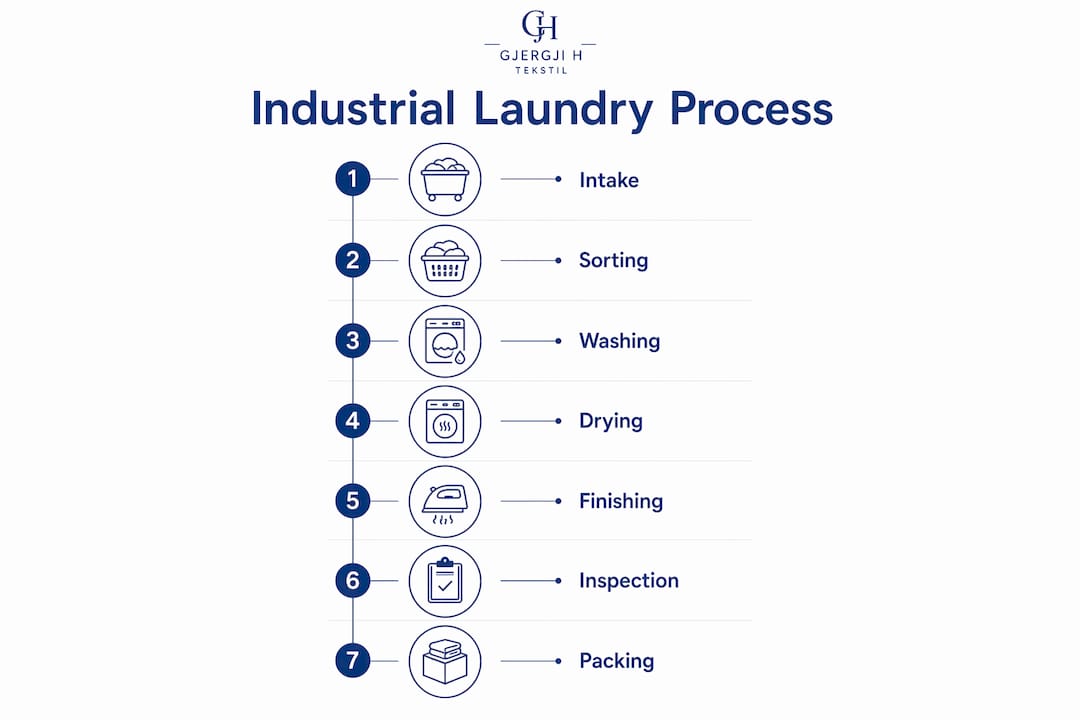
The industrial laundry process follows a structured sequence designed to maximize throughput while protecting fabric quality at every stage. Understanding this sequence helps hotel managers set realistic expectations for turnaround times and identify where process failures occur.
- Sorting and pre-treatment. Soiled linens are sorted by fabric type, color, and soil level. Heavily stained items receive pre-treatment with targeted chemical agents before entering the main wash cycle.
- Tunnel washer processing. Items move through a continuous-batch tunnel washer divided into functional zones: pre-wash, main wash, bleaching, rinsing, and softening. Counterflow rinsing and heat recovery reduce water and energy consumption per kilogram of linen substantially compared to traditional batch washers.
- High-efficiency pressing. After washing, items pass through integrated presses that extract residual moisture. High-efficiency presses remove roughly half a gallon more water per load than conventional presses, which speeds drying time and reduces energy costs in the drying stage.
- Drying and finishing. Dryers operate at calibrated temperatures matched to fabric type. Flatwork ironers then process sheets, pillowcases, and tablecloths, delivering a finished, pressed product ready for folding.
- Quality inspection and folding. Finished items are inspected for staining, damage, or dimensional irregularities before being folded and packaged for return to inventory.
- RFID tracking and inventory management. Modern operations integrate RFID tracking to trace each linen piece through the full cleaning cycle, reducing loss and enabling accurate lifecycle reporting.
Technology platforms like Girbau’s Evo7 and Evolis systems represent the current standard for resource optimization in industrial laundry, combining automated dosing, real-time monitoring, and energy recovery into a single integrated workflow. These systems are not luxury additions. For a hotel processing 500 or more kilograms of linen daily, they translate directly into measurable cost reductions.
Pro Tip: When evaluating an outsourced laundry service provider, ask specifically whether they use tunnel washers with heat recovery and whether their presses are high-efficiency models. These two factors alone determine the majority of the energy cost and fabric wear difference between providers.
What best practices should hotel managers apply to get the most from industrial laundry?
Operational decisions made before linen enters the wash cycle determine most of the outcome. The following practices separate hotels that control their textile costs from those that constantly replace degraded inventory.
Standardize your textile inventory. Mixed linen inventories with varying fabric compositions, thread counts, and construction types require different wash programs. Running incompatible fabrics together in the same cycle forces a compromise that damages the more delicate items. Standardizing to a single certified polycotton blend for bed linens and a separate specification for towels simplifies programming and reduces wear.
Respect machine loading limits. Overloading a tunnel washer or batch washer reduces wash quality and increases mechanical stress on both the machine and the fabric. Correct washer sizing and proper installation are among the most significant factors in machine longevity. Undersizing machines or consistently overloading them leads to premature failure and higher operational costs.
Control chemical dosing precisely. Excess detergent does not clean better. It leaves residue in fabric fibers that accelerates degradation and irritates guests with sensitive skin. Automated dosing systems calibrated to your specific water hardness and linen type produce better results than manual dosing.
Remove incompatible items before washing. Industrial machines operating at centrifuge speeds exceeding 350G will be damaged by metal hardware, zippers, or decorative elements left on linens or uniforms. A single item with a metal buckle can damage both the machine drum and surrounding textiles in the same load.
Invest in preventive maintenance. Well-maintained industrial laundry equipment reduces downtime, extends textile life, and directly supports guest satisfaction. Establish a scheduled maintenance contract with a qualified service provider and keep spare parts for high-wear components on site. Brands like Milnor and Speed Queen build machines designed for long service lives, but only when supported by correct installation and local service infrastructure.
Work with vendors who understand hospitality specifications. Your linen supplier should be able to confirm ISO 15797 compliance, provide wash cycle test data, and advise on the correct fabric specification for your property’s laundry setup. A supplier who cannot answer these questions is selling you a product, not a solution. For guidance on balancing guest comfort with durability, the right partner makes this decision straightforward.
Key takeaways
Industrial laundry requires certified fabrics, purpose-built equipment, and disciplined operational practices to protect textile lifespan and control costs at hospitality scale.
| Point | Details |
|---|---|
| Industrial vs. commercial distinction | Tunnel washers and continuous-flow systems define true industrial laundry, not just machine size. |
| ISO 15797 certification | Only certified fabrics reliably survive 50 or more industrial wash cycles without shrinkage or pilling. |
| Three pillars of industrial stress | Heat, alkaline chemicals, and centrifugal force act simultaneously and require polycotton blends to resist. |
| Lifecycle cost over cost per load | Operators who track total textile lifecycle costs consistently outperform those focused only on wash cost. |
| Preventive maintenance pays | Scheduled maintenance and correct machine sizing reduce both equipment failure and textile replacement rates. |
Why hotel directors need to think about linens as depreciating assets
Most hotel operations treat linens as a consumable expense. You buy them, wash them until they fail, and replace them. That model is operationally convenient but financially costly. The more accurate frame is to treat linens as depreciating assets with a calculable useful life measured in wash cycles, not years.
When you know that a non-certified fabric fails at 15 wash cycles and a certified polycotton blend survives 75 or more, the cost-per-cycle math changes the procurement decision entirely. A linen that costs 30% more but lasts five times longer is not a premium purchase. It is the lower-cost option when measured correctly. Hospitality directors shifting focus from cost-per-load to total lifecycle cost are the ones linking laundry decisions directly to profitability.
The future of industrial laundry in hospitality sits at the intersection of sustainability and technology. Water and energy reduction are no longer optional considerations. They are regulatory and competitive requirements. Hotels that partner with laundry operations using modern tunnel systems with heat recovery and RFID tracking are already operating at a lower cost per kilogram than those using older batch systems. That gap will widen as energy costs increase.
My direct advice to any operational director: audit your current linen specification against ISO 15797 before your next procurement cycle. If your supplier cannot confirm compliance, you are almost certainly paying more in replacements than you realize. The textile maintenance workflow you build around certified fabrics and properly maintained equipment is what keeps your operation running without interruption.
— Xpert
How Gjergjihtextil supports hotel textile operations
Gjergjihtextil has supplied hospitality-grade textiles to properties including Marriott, Meliá, and Sheraton for over 30 years, with a supply chain that runs from import through production to delivery. Every product in the hotel linen range is specified for durability under industrial washing conditions, with polycotton blends and construction standards matched to the demands of high-frequency laundry cycles.
For hotel managers who need to match fabric specification to their laundry setup, Gjergjihtextil offers direct advisory support alongside wholesale pricing. The hotel textiles catalog covers bed linens, towels, duvets, and pillows, all sourced and tested for operational consistency. If you are reviewing your current linen inventory or preparing for a property upgrade, this is the starting point for getting the specification right the first time.
FAQ
What is industrial laundry in simple terms?
Industrial laundry is the large-scale, automated cleaning of textiles using heavy-duty equipment like tunnel washers and flatwork ironers, designed for continuous high-volume operation in hospitality, healthcare, and similar sectors.
How many wash cycles should hotel linens withstand?
Hotel linens specified for industrial laundry should withstand a minimum of 50 to 75 wash cycles without significant shrinkage or pilling. The DIN EN ISO 15797 standard sets this benchmark, and non-certified fabrics often fail within 12 to 20 cycles.
What fabric blend works best for industrial laundry?
A 60/40 polycotton blend is the industry standard for hotel linens in industrial laundry environments. Polyester provides dimensional stability and resistance to shrinkage, while cotton delivers the absorbency and softness guests expect.
Why does machine loading affect linen quality?
Overloading industrial washers reduces wash effectiveness and increases mechanical stress on fabrics. Correct loading ensures that chemical dosing, water temperature, and centrifugal extraction all perform within the parameters the wash program was designed to deliver.
What is the difference between industrial and commercial laundry services?
Commercial laundry services use standard front-load or batch washers suited for moderate volumes. Industrial laundry services use tunnel washers and continuous-flow systems capable of processing hundreds of kilograms per hour, with integrated heat recovery and automated chemical dosing.