


TL;DR:
- A structured multi-stage textile inspection workflow significantly improves fabric quality in hospitality supply chains. Implementing proper sampling, inspector training, and technology like barcode tracking and AI cameras enhances consistency and accountability. Consistent documentation and re-inspection clauses help maintain quality and reduce audit failures.
A workflow for textile inspection is a systematic, multi-stage process that verifies fabric and finished goods meet defined quality standards before reaching hospitality guests. For quality control managers in hotels and restaurants, this process covers four distinct stages: Pre-Production Inspection, During Production Inspection, Pre-Shipment Inspection, and Container Loading Inspection. Industry standards such as the Four-Point System and Acceptable Quality Limits (AQL) provide the scoring framework. A multi-stage inspection process reduces defects by up to 60%, which means fewer guest complaints, fewer returns, and lower replacement costs. Gjergjihtextil has built its supply chain around exactly this kind of structured quality control, serving major hospitality brands across the region for over 30 years.
What tools and requirements does a textile inspection workflow need?
The right equipment determines whether an inspection produces reliable results or just paperwork. Every inspection station requires a fabric inspection machine or a flat inspection table with adequate lighting, a measuring tape or digital length counter, and a calibrated tension gauge for stretch fabrics. Inspectors also need defect classification charts aligned to the Four-Point System, standardized inspection forms, and a camera or smartphone for photographic evidence.

Sampling requirements are non-negotiable. At least 10% of a fabric batch must be inspected, with rolls selected randomly across colors and lot numbers. This minimum threshold exists because smaller samples introduce statistical bias that can mask widespread defects. For hospitality textiles like bed linens and towels, color consistency across the batch is a guest-facing issue, so color coverage in sampling is mandatory, not optional.
Inspector training is the third pillar. An inspector must understand defect categories (major, minor, critical), know how to assign Four-Point scores, and be able to write a clear, decision-ready report. Inspectors who lack defect classification training tend to under-score problems, which pushes defective goods through to the property floor.
Pro Tip: Use a tablet-based inspection app to record defect locations, photos, and point scores in real time. Mobile-first defect marking eliminates paper slips and updates fabric grades automatically in your inventory system, cutting data entry delays significantly.
- Fabric inspection machine or flat table with strong overhead lighting
- Digital length counter and tension gauge
- Four-Point System defect classification chart
- Standardized inspection forms with AQL reference tables
- Camera or tablet for photographic documentation
- Random roll selection log to prove sampling integrity
How do you execute each step of the textile inspection workflow?
The step-by-step textile inspection process follows a fixed sequence. Skipping a stage does not save time. It transfers risk forward, where fixing problems costs more.
-
Pre-Production Inspection (PPI). Verify raw materials before production begins. Check yarn counts, greige fabric weight, fiber composition, and shrinkage test results. Confirm that the supplier’s materials match the purchase order specifications. A failed PPI stops a defective batch before a single meter is woven.
-
During Production Inspection (DUPRO). Conduct in-line checks when 20%–30% of production is complete. Inspect seam integrity, stitch density, color consistency against the approved sample, and dimensional accuracy. DUPRO catches process drift early, when corrections are still inexpensive.
-
Pre-Shipment Inspection (PSI). Inspect finished textiles when at least 80% of the order is packed. Apply the Four-Point System to randomly selected rolls or finished pieces. Assign defect points per linear yard: 1 point for defects up to 3 inches, 2 points for 3–6 inches, 3 points for 6–9 inches, and 4 points for defects over 9 inches. Compare the total points per 100 linear yards against the AQL threshold. Inspection reports must be delivered within 24 hours of the PSI, including photos, defect analysis, and a clear decision: accept, reject, or rework.
-
Container Loading Inspection (CLI). Supervise the physical packing and loading process. Verify that carton quantities match the packing list, that labeling is correct, and that goods are loaded without damage. CLI prevents substitution of uninspected goods at the last stage.
The table below summarizes each stage, its trigger point, and its primary output.
| Stage | Trigger point | Primary output |
|---|---|---|
| Pre-Production Inspection | Before production starts | Material approval or rejection |
| During Production Inspection | 20%–30% of production complete | Process correction or hold |
| Pre-Shipment Inspection | 80%+ of order packed | Accept, reject, or rework decision |
| Container Loading Inspection | Loading day | Verified packing and loading record |
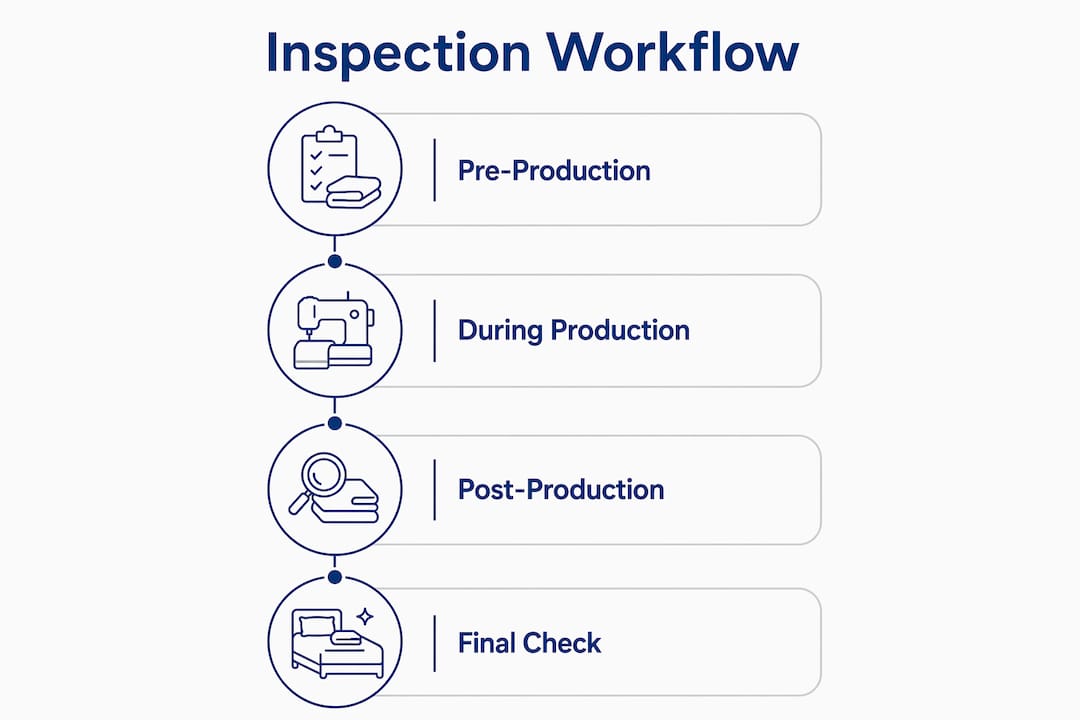
For hospitality textile fabric testing, each stage feeds data into the next. A clean PPI record makes the PSI faster. A documented DUPRO reduces surprises at the final check.
What are common mistakes in textile inspections and how do you fix them?
The most damaging inspection errors are process errors, not measurement errors. They happen before the inspector touches a single roll.
- Non-random sample selection. Allowing factory staff to pre-select rolls for inspection invalidates the entire sample. Inspectors must personally select rolls at random, with no adjustments from factory personnel. This rule exists because biased sampling produces results that protect the supplier, not the buyer.
- Inaccurate defect scoring. Under-scoring defects is the most common error in hospitality textile inspections. A 3-inch snag on a hotel duvet cover is a major defect. Treating it as minor because it “might not be noticed” is a judgment call that bypasses the Four-Point System entirely.
- Incomplete reports. A report without photographs, defect locations, and an AQL-based decision is not an inspection report. It is a note. Audit failures in textile inspections most often trace back to poor documentation rather than actual product defects.
- Cutting fabric samples unnecessarily. Fabric cutting during inspection is only permitted for physical tests such as colorfastness or tensile strength. Cutting outside of tests destroys sample integrity and compromises the roll’s usability.
“Audit failures often stem from poor documentation rather than textile defects. Accurate record-keeping is as important as inspection rigor. Experts recommend quarterly internal audits and annual external audits to maintain quality records that hold up under scrutiny.”
Pro Tip: Assign a unique barcode to each incoming lot upon goods receipt. Barcode-integrated traceability links every defect finding back to a specific yarn lot or production batch, which makes re-inspection and supplier accountability conversations far more direct.
Including re-inspection clauses in purchase orders places the financial burden of failed batches on the supplier. This single contractual practice changes supplier behavior more reliably than any verbal quality agreement.
How can technology improve textile inspection workflows in hospitality?
Technology does not replace inspector judgment. It removes the friction that causes inspectors to cut corners.
The most practical gains come from three areas. First, mobile-first data entry lets inspectors mark defects directly on a tablet diagram of the fabric roll, with GPS-stamped photos attached automatically. This replaces handwritten slips that get lost or misread. Second, digital defect marking feeds directly into textile ERP systems, where inventory grades update in real time. Manual record systems increase recall risk and compliance costs. Lot-level SKU tracking eliminates the gap between what the system says is in stock and what is physically on the shelf.
Third, AI-assisted fabric inspection cameras can detect surface defects, weave irregularities, and color deviations at speeds no human inspector can match. These systems work best as a first-pass filter, flagging rolls that require closer human review. They do not replace the Four-Point System; they make it faster to apply.
For hospitality textile stocktaking and auditing, the combination of barcode traceability and digital inspection records means that a quarterly internal audit takes hours instead of days. Every defect finding links back to a supplier, a lot of number, and a date. That level of traceability is what separates a defensible quality program from a paper exercise.
- Mobile tablet apps for real-time defect marking and photo capture
- ERP integration for automatic inventory grade updates
- Barcode and lot-level traceability from receipt through distribution
- AI-assisted camera systems for surface defect detection
- Digital audit trails that support quarterly and annual review cycles
Key Takeaways
A structured, multi-stage workflow for textile inspection is the single most reliable method for maintaining quality and compliance in hospitality textile supply chains.
| Point | Details |
|---|---|
| Four-stage process | Run PPI, DUPRO, PSI, and CLI in sequence to catch defects at the lowest correction cost. |
| Sampling discipline | Inspect at least 10% of each batch with personally selected random rolls across all colors. |
| Report within 24 hours | Deliver inspection reports with photos and an AQL-based decision within 24 hours of completion. |
| Documentation prevents audit failures | Weak record-keeping causes more audit failures than actual product defects. |
| Technology accelerates accuracy | Barcode traceability and mobile defect marking reduce errors and speed up quarterly audits. |
What I have learned running textile inspection programs in hospitality
The hardest part of building a reliable textile inspection workflow is not the technical side. Most quality control managers understand the Four-Point System and AQL thresholds within a week. The hard part is consistency, specifically, running the same process with the same rigor on the 200th inspection as on the first.
The properties that struggle most with textile quality are not the ones with bad suppliers. They are the ones with inconsistent inspection records. When an audit arrives and the documentation is incomplete, the conversation shifts from “our textiles meet standard” to “we cannot prove our textiles meet standard.” Those are very different positions.
The technology argument is real, but it is easy to over-invest early. A tablet app and a barcode scanner solve 80% of the traceability problem at a fraction of the cost of a full AI inspection system. Start with digital records and lot-level tracking. Add camera-based defect detection once your baseline data is clean enough to make the AI output meaningful.
Supplier accountability through contract language is underused. Re-inspection clauses that place failed-batch costs on the supplier change the dynamic of every quality conversation. Suppliers who know they bear the cost of a failed PSI invest more in their own process controls. That is the most cost-effective quality improvement a procurement team can make.
— Xpert
Gjergjihtextil: quality textiles built for inspection-ready supply chains
Gjergjihtextil has supplied hospitality textiles to properties including Meliá, Marriott, and Sheraton for over 30 years. That track record exists because the company treats quality control as a supply chain function, not an afterthought.

When your inspection workflow is solid, the textiles you source need to match that standard. Gjergjihtextil’s wholesale hotel textiles are sourced from Italy, China, India, and Pakistan, selected for durability under industrial washing cycles and consistency across large-volume orders. Every product line is designed to pass the same multi-stage inspection process described in this guide. If you are building or tightening your textile quality program, contact Gjergjihtextil to discuss your property’s specifications and volume requirements.
FAQ
What is the Four-Point System in textile inspection?
The Four-Point System is a standardized fabric grading method that assigns defect points based on defect length, from 1 point for defects under 3 inches to 4 points for defects over 9 inches. Total points per 100 linear yards determine whether a fabric roll passes or fails against the AQL threshold.
How much of a fabric batch must be inspected?
At least 10% of the fabric batch must be inspected, with rolls selected randomly across colors and lot numbers. Smaller samples introduce statistical bias that can hide widespread defects across the shipment.
When must an inspection report be delivered?
Inspection reports must be delivered within 24 hours of the inspection, including photographs, defect analysis, and a clear decision based on AQL standards.
What causes most textile audit failures?
Poor documentation causes more audit failures than actual product defects. Incomplete inspection records, missing photographs, and weak inventory controls are the primary reasons audits fail.
How do re-inspection clauses protect hospitality buyers?
Re-inspection clauses in purchase orders place the cost of failed inspections on the supplier, which creates a direct financial incentive for suppliers to maintain consistent quality before shipment.