

Choose a full-service, factory-backed hotel textile supplier that can prove batch traceability, hold OEKO-TEX Standard 100 (or equivalent) certification, and back its fabric with measured industrial-wash durability data. Gjergji H Tekstil is one example of this supplier profile, and it’s the model to follow whether you buy locally or overseas.
Before you sign anything, take three steps. First, request a master sample plus written wash-test results, not just a swatch card. Second, confirm the certification paperwork covers the exact SKUs you’re ordering, not just the supplier’s general catalog. Third, run a pilot order under AQL pre-shipment inspection at an appropriate level so a defect rate gets caught before it reaches your linen room.
- Ask what wash-cycle count the fabric is rated for. Guidance across the hospitality supply chain points to a high number of commercial wash cycles indicating hotel-grade durability as a realistic hotel-grade benchmark.
- Get the minimum order quantity and lead time in writing before you compare price per unit.
- Check the contract for warranty and replacement terms tied to specific defect thresholds, not vague “satisfaction guaranteed” language.
Quick signal check: a supplier that can’t produce a signed wash-test report or a sealed reference sample on request is telling you something about how they’ll handle your reorder in eighteen months.
Key Takeaways
Choosing a factory-backed hotel textile supplier with certified, batch-tested fabric and a structured pilot process is the single decision that most reliably controls both durability and total cost of ownership.
| Point | Details |
|---|---|
| Prioritize factory control | Suppliers with sealed master samples and production archives avoid batch drift that trading middlemen often introduce. |
| Calculate par levels from your own data | Use your occupancy, laundry cycle time, and damage history rather than industry defaults. |
| Require AQL 2.5 inspection | Build pre-shipment inspection and replacement SLAs into every contract, not just the pilot order. |
| Track total cost of ownership | Factor in wash-cycle durability and replacement frequency, since linens run roughly a small but significant portion of rooms’ revenue. |
| Consider a full-service partner | Gjergji H Tekstil offers factory-backed production, certification, and structured pilot workflows for hotel linen programs. |
Table of Contents
- What “Hotel Textile Storage Solutions” Means in This Guide
- How Do You Choose a Hotel Textile Supplier?
- How Do You Calculate Par Levels for Hotel Linens?
- What Service Levels Should You Expect From a Supplier?
- How Should You Run a Pilot Order Before Full Deployment?
- Why Does Wash-Cycle Durability Determine Real Lifecycle Cost?
- Best Practices for Storing Linens to Extend Their Lifespan
- What Delivery Frequency Keeps Supply Consistent Without Overstocking?
- What Does Total Cost of Ownership Actually Look Like Over a Contract?
- How Do You Manage the Risk of Supply Disruptions?
- Why Factory Control Changes Everything About Long-Term Reliability
- A Full-Service Textile Partner Cuts Your Testing and Sourcing Load
- Sources
What “Hotel Textile Storage Solutions” Means in This Guide
For this guide, hotel textile storage solutions means the sourcing and supply-chain side of hotel linens: bulk purchasing, contract structure, and inventory planning for sheets, towels, duvets, pillows, curtains, and table linens. It’s not about shelving units or linen-room racking.
That distinction matters because the supplier you need and the tests you should run depend entirely on which problem you’re solving. A hotel-grade sheet has to survive dozens of commercial wash cycles without pilling or shade drift. A storage rack doesn’t. This guide covers product specification, certification, par-level math, and contract terms, because those are the levers that actually determine whether your linen program holds up under a 200-room laundry schedule.
Roughly a small but significant portion of rooms revenue typically goes toward linen procurement, which is reason enough to treat sourcing as a strategic decision rather than a purchasing afterthought.
How Do You Choose a Hotel Textile Supplier?
Start with who actually makes the fabric. A supplier that owns or directly controls its production, rather than outsourcing to a rotating set of factories, is the single best predictor of consistent quality on your third and fourth reorder. Trading companies that don’t control raw material sourcing tend to produce batch instability, meaning color and GSM (grams per square meter, the standard weight measure for fabric) can drift between shipments even when the invoice looks identical. Factory-backed manufacturers avoid this by keeping sealed master samples and production archives that every future order gets checked against.
Beyond ownership, look for OEKO-TEX Standard 100 or an equivalent certification, ISO 9001 process controls, and evidence of third-party batch testing. These aren’t marketing badges. OEKO-TEX in particular functions as a practical liability tool for guest-contact fabric, since it screens for chemical residues that could trigger skin reactions or compliance issues in export markets.
On the operational side, ask three questions before you request pricing:
- Does the supplier retain a sealed master sample and shade band for every SKU you order, so a reorder in ten months matches what you approved today?
- What is their production capacity relative to your annual volume, and can they ramp during your peak season without extending lead times?
- What’s the minimum order quantity, and does it scale reasonably as your property or portfolio grows?
Once you’re past the credentials check, put these terms into the contract itself, not just the sales conversation, much like the detailed procurement process outlined in The Complete Buying Guide for Catering Kitchens.
- AQL pre-shipment inspection at an appropriate level on every batch, with the right to reject or renegotiate on failure.
- A defined replacement and warranty clause tied to specific defect rates, not general language.
- A price validity period, so a quote from March doesn’t quietly shift after production starts.
- A firm lead time with a penalty clause for late delivery during peak seasons.
- A documented sample approval process before bulk production begins.
Pro Tip: Score every supplier you evaluate on the same seven dimensions: lead time reliability, MOQ and replenishment cadence, guaranteed wash-cycle durability, certification, price-to-quality, customization capability, and warranty terms. A supplier that wins on price but scores low on the other six is rarely the cheaper option once you calculate total cost of ownership.
How Do You Calculate Par Levels for Hotel Linens?
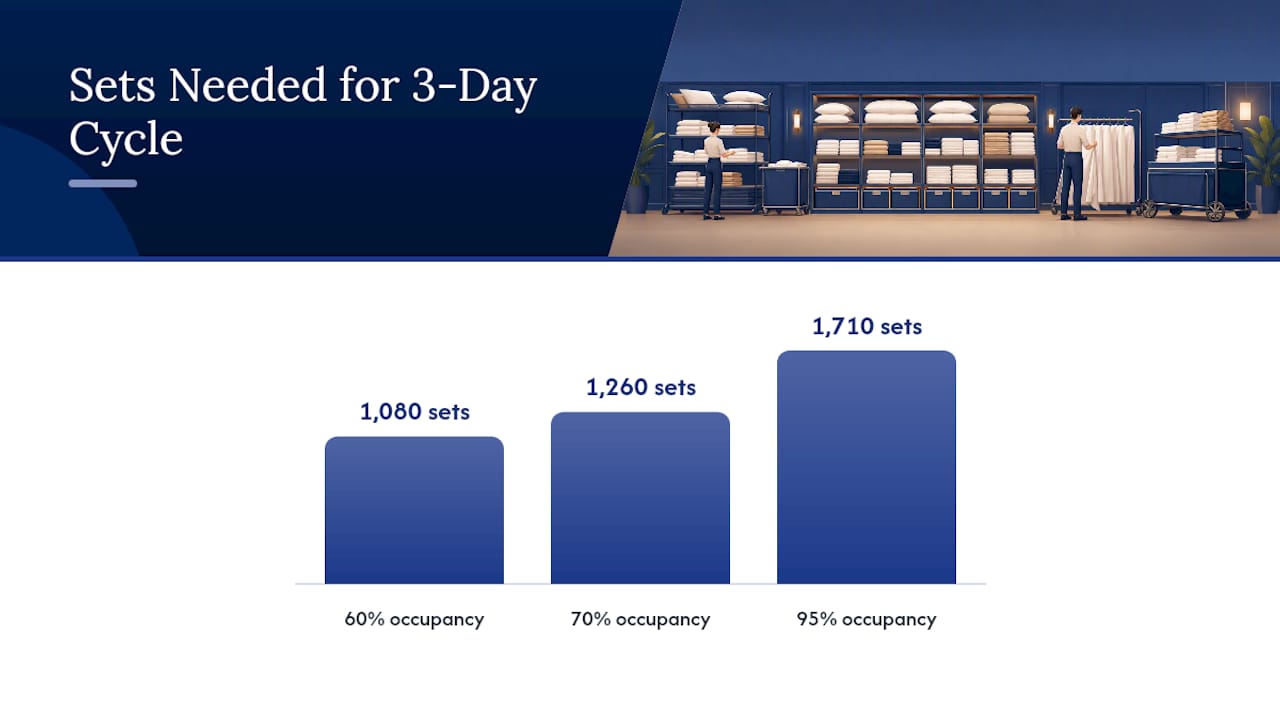
The working formula is straightforward: par level = (daily room usage × laundry cycle time in days) + safety stock. Daily room usage comes from your linen sets per occupied room multiplied by expected occupancy. Laundry cycle time is however many days it takes a set to go from stripped bed to clean shelf, including any outsourced laundry turnaround. Safety stock covers the gap between what you expect and what actually happens, driven by damage rates, no-show laundry batches, or a supplier shipment running late.
Here’s how that plays out for a 200-room property. At 70% average occupancy, you have 140 rooms in use nightly, each needing roughly three sheet sets in rotation. That’s 420 sheet sets in daily circulation. If your laundry cycle runs three days door-to-door, you need 1,260 sets just to keep pace, before accounting for anything going wrong.
- Pull your occupancy forecast and confirm it against actual bookings for the past twelve months, not projected averages.
- Calculate linen sets per room based on your actual housekeeping standard, not an industry default.
- Measure your real laundry cycle time, including any third-party turnaround delays.
- Layer in a damage and withdrawal rate based on your own replacement history, typically higher for towels than sheets.
- Add safety stock sized to your supplier’s lead time variability, not a flat percentage.
Seasonal swings and events need their own adjustment. A property that jumps from 60% to 95% occupancy during a conference week should temporarily inflate its safety stock rather than wait for a stockout to force an emergency order.
Pro Tip: Recalculate par levels quarterly, and always build them from your own damage and withdrawal history rather than an industry default figure. A property with an aggressive housekeeping standard burns through towels faster than the textbook number assumes.
What Service Levels Should You Expect From a Supplier?
A factory-backed supplier should deliver consistent batch quality, a sealed master sample for every product line, predictable lead times, and a testing report attached to each shipment, not just the first one. If that documentation stops showing up after order three, that’s your early signal to escalate.
Build these KPIs into the contract and track them on a quarterly scorecard:
- On-time delivery rate, measured against the lead time actually committed in writing.
- Order accuracy, meaning the shipment matches the purchase order in quantity, size, and shade.
- AQL pass rate across pre-shipment inspections.
- Replacement turnaround time when a batch fails inspection.
- Confirmed wash-cycle durability performance against what was promised at contract signing.
Working with a factory-backed supplier instead of a trading middleman has shown 28% to 35% lower long-term running costs in chain-hotel procurement, largely because fewer batches fail inspection and fewer emergency reorders happen.
| Contract Milestone | What to Confirm |
|---|---|
| Pre-production approval | Sealed sample and shade band signed off before bulk manufacturing starts. |
| Pilot order window | Small batch shipped and inspected before committing to full volume. |
| Bulk production lead time | Fixed in writing, with penalty terms for delays past the agreed date. |
| Pre-shipment inspection | AQL 2.5 standard applied to every batch before it leaves the factory. |
| Replacement SLA | Turnaround time defined for any batch that fails inspection. |
On the logistics side, align delivery frequency with your actual laundry cycle rather than ordering in large infrequent batches. Pairing this with Vendor-Managed Inventory or direct PMS integration lets your supplier restock against real usage data instead of guesswork, which cuts down on both stockouts and the working capital tied up in oversized storage.
How Should You Run a Pilot Order Before Full Deployment?
Run every new supplier through a structured pilot before committing to volume. That means a sealed master sample approval, a simulated commercial laundry run of 120-plus cycles where the product category warrants it, and AQL 2.5 inspection on the pilot batch itself.
- Request the master sample along with a full technical spec sheet covering fiber content, GSM, and construction.
- Run wash and aging tests either in your own commercial laundry or through a certified third-party lab.
- Review the washed sample for pilling, shrinkage, lint shedding, colorfastness, and handfeel against your written standard.
- Approve a shade band and lock in a sealed reference sample that every future shipment gets checked against.
- Place the pilot order with pre-shipment inspection built into the purchase agreement.
Who runs the tests matters. In-house laundry testing is faster and cheaper, but a certified lab gives you defensible documentation if a dispute comes up later. Either way, define acceptable tolerance ranges up front for pilling, shrinkage, colorfastness, and tensile strength before the pilot starts, not after you see the results.
Pro Tip: Keep a supplier-signed master sample archive on file and require a batch test report with every single shipment, not just the pilot. Quality drift almost always happens gradually, and the archive is the only reliable way to catch it before guests do.
Why Does Wash-Cycle Durability Determine Real Lifecycle Cost?
Hotel-grade textiles are built to survive commercial laundering chemicals, high-heat drying, and daily handling in ways that consumer-grade fabric simply isn’t. That gap shows up fast. A retail-grade sheet might look fine for a few dozen washes before pilling, thinning, or losing its finish, while a properly specified hotel fabric maintains its handfeel and appearance across a much longer commercial wash cycle, which is exactly why 120-plus cycles has become a common sourcing benchmark.
The variables that determine where a fabric lands on that curve are fiber blend, thread construction, and finishing treatment. A tightly woven cotton-polyester blend with a durable press finish generally resists pilling and shrinkage better than a loosely woven, low-thread-count alternative, even if both are marketed as “hotel quality” on a spec sheet.
Lifecycle expectations should factor into your budgeting directly. If a towel line is rated for 200 commercial washes and your laundry runs it through the cycle twice a week, you can forecast the replacement window months in advance instead of discovering it through a spike in guest complaints about thin, worn stock. That kind of forecasting is what separates a reactive linen budget from one built on actual data.
Best Practices for Storing Linens to Extend Their Lifespan
How linens are stored between wash cycles has a direct effect on how long they last, independent of fabric quality. Damp storage, overcrowded shelving, and prolonged exposure to direct sunlight all accelerate fiber breakdown, fading, and mildew risk, even on a well-specified fabric.
Rotate stock on a first-in, first-out basis so newer inventory doesn’t sit untouched while older sets get overused. Uneven rotation is one of the most common reasons a property sees some linen sets wear out early while others in the same order look nearly new after a year.
Keep linens fully dry before shelving, and store them in a well-ventilated space away from direct sunlight, since UV exposure fades color and weakens fiber structure over time. Separate stock by condition, category, and property section, ideally with clear damage-tracking so you can compare actual wear rates against the supplier’s rated wash-cycle performance.
Track damage and withdrawal rates by category rather than treating linens as a single line item. Towels typically wear out faster than sheets given handling frequency, and pillowcases usually outlast duvet covers. That breakdown feeds directly back into your par-level calculations, and it’s also the data you should bring to your supplier when negotiating replacement terms or renegotiating a contract. For a deeper look at the fabric-side choices that affect longevity, see this guide on maximizing hotel textile durability.
What Delivery Frequency Keeps Supply Consistent Without Overstocking?
Align delivery frequency with your actual laundry cycle rather than defaulting to a fixed monthly or quarterly schedule. If your laundry turnaround is three days, ordering in six-month batches means you’re carrying far more working capital in shelved inventory than your operation actually needs.
A better model ties replenishment to real usage. Vendor-Managed Inventory arrangements let your supplier monitor consumption patterns and trigger restocking before you hit a shortage, rather than waiting for a purchasing manager to notice inventory is low. Integrating your property management system with inventory tracking accomplishes something similar even without a formal VMI agreement, since it flags depletion trends automatically instead of relying on manual counts.
Seasonal demand needs its own logistics plan. A resort property with a summer occupancy spike should schedule a pre-season delivery increase weeks ahead of the surge, not during it, since even a reliable supplier’s lead time doesn’t compress on demand. Build that seasonal delivery calendar into your annual contract discussion rather than treating it as an emergency order every year.
The tradeoff to manage is storage capacity against stockout risk. Too frequent, and you’re paying more in shipping and administrative overhead per unit. Too infrequent, and a single delayed shipment or damaged batch can leave housekeeping short during a high-occupancy week. Most mid-size properties land on a biweekly to monthly replenishment cadence for high-turn items like sheets and towels, adjusted seasonally.
What Does Total Cost of Ownership Actually Look Like Over a Contract?
Unit price tells you almost nothing about what a linen program will actually cost over a two or three-year contract. Total cost of ownership includes the purchase price, but also replacement frequency, laundry-related damage rates, labor time spent on quality disputes, and the working capital tied up in safety stock.
For a 200-room hotel at 70% occupancy, linen procurement alone can run a substantial annual expenditure on linens, depending on product mix and replacement frequency. A supplier offering a 10% lower unit price but a shorter wash-cycle lifespan can easily cost more over the contract term once you factor in earlier replacement cycles.
Batch instability adds a hidden cost too. When shade or GSM drifts between orders, hotels often end up retiring otherwise-usable stock early just to keep room presentation consistent, which quietly inflates the real cost per usable set. Factory-backed suppliers that maintain sealed master samples avoid this drift, which is a large part of why the 28% to 35% cost reduction associated with factory-direct sourcing tends to hold up over multi-year contracts rather than just the first order.
When comparing quotes, ask each supplier for a cost-per-wash-cycle estimate rather than a cost-per-unit figure. Dividing unit price by rated wash cycles gives you a number that actually reflects lifecycle value, and it often reorders your supplier shortlist once you run the math.
How Do You Manage the Risk of Supply Disruptions?
Every hotel textile program needs a contingency plan, because even a well-vetted supplier can face a raw material shortage, a shipping delay, or a factory disruption. The properties that avoid a linen crisis are the ones that planned for disruption before it happened, not the ones scrambling for emergency stock mid-quarter.
Start by qualifying a backup supplier alongside your primary one, even if you never place an order with them under normal conditions. Having a vetted second source with a signed technical spec on file means you can pivot in days rather than weeks if your primary supplier hits a delay.
Size your safety stock to your supplier’s actual lead time variability rather than a flat percentage buffer. A supplier with a historically consistent four-week lead time needs less safety stock than one whose lead times have swung between three and eight weeks. That variability data should come directly from your own order history, factored into the par-level calculation discussed earlier in this guide.
Diversifying raw material exposure matters too. A supplier sourcing cotton from a single region carries more disruption risk than one with multiple approved fiber sources. Ask your supplier directly how they’d handle a regional shortage, and treat a vague answer as a warning sign rather than reassurance.
Why Factory Control Changes Everything About Long-Term Reliability
Factory control and sealed master samples are the real reason certain suppliers outlast the bargain option a property tried two contracts ago. Anyone can quote a low price on a single order. Very few can guarantee that the sheets you receive on reorder eleven match the ones you approved on reorder one.
The most common buyer mistake isn’t picking a bad supplier outright. It’s chasing the lowest unit price without asking who controls production, trusting an unusually low MOQ without checking whether it signals thin quality control, or skipping laundry simulation because the sample “feels fine” out of the package. Every one of those shortcuts is checkable in an afternoon. A wash test costs a fraction of what a failed batch costs once it’s already on 200 beds.
A Full-Service Textile Partner Cuts Your Testing and Sourcing Load
Gjergji H Tekstil is built around the exact model this guide recommends: factory-backed production, sealed master sample archiving, OEKO-TEX-aligned certification, and a structured pilot process, so procurement teams don’t have to piece together sourcing, testing, and quality control across separate vendors. That consolidation is the practical advantage over splitting your linen program across a trading intermediary for pricing and a separate lab for testing. One accountable partner means one set of documents, one point of contact when a batch needs a replacement, and no finger-pointing between a factory and a broker when something goes wrong.

The wholesale catalog covers sheets, towels, duvets, pillows, curtains, and table linens, with custom branding and framework contracts built around defined SLAs rather than one-off invoices. If you’re ready to move past research, request a pilot order or a technical packet directly through the hotel textile page, and come prepared with your expected volumes, preferred lead times, and current technical specs so the first sample round actually reflects what your property needs.
Sources
- Hotel Linen Supplier Sourcing Guide 2026: How Hotels Avoid Sourcing Risks – News – Guanghao
- Hotel Linen Sourcing Guide for Procurement Managers: From Specification to Delivery | Anabyn Export Intelligence
- Ultimate Guide to Hotel Stock Replenishment – Switch Solutions
- A Complete Guide to Hotel Supply Chain Management