

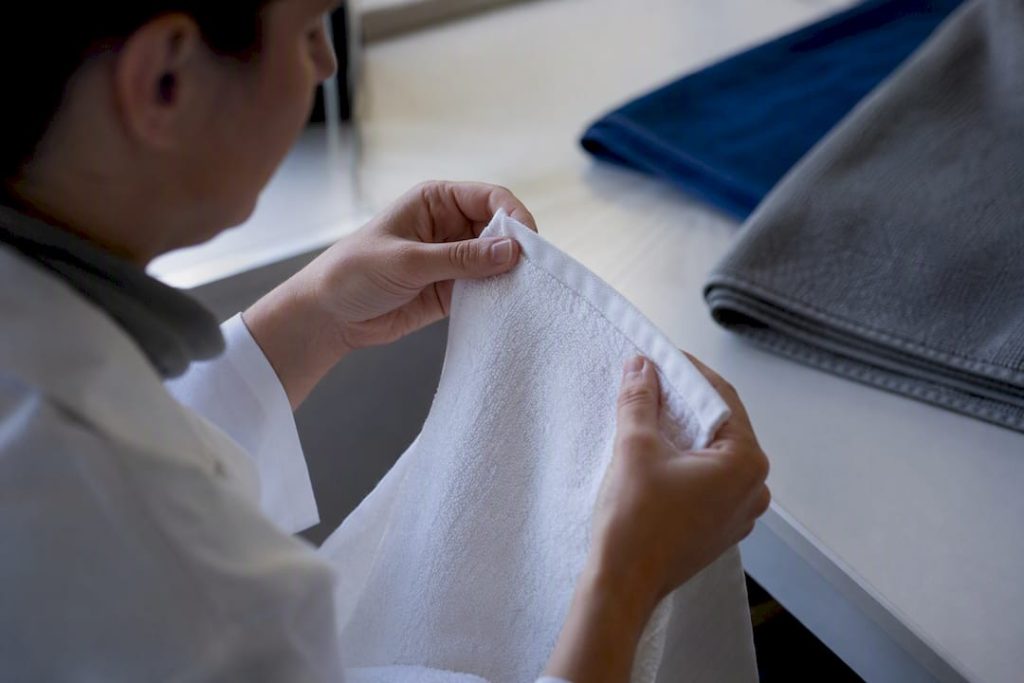
OEKO-TEX Standard 100 certifies that a finished textile, not just the raw fabric, has been tested for harmful substances down to every button, thread, and seam. For hotel procurement, that means one thing in practice: request the supplier’s OEKO-TEX certificate number for each SKU, verify it on the official label check portal, and confirm the certificate’s scope and expiry before it goes near your PO.
That single step separates a supplier claim from a documented one. STANDARD 100 covers finished articles and every component that touches skin, which makes it the right baseline for bedding, towels, and robes.
- Request certificate numbers per SKU, not a general company logo.
- Verify each number on the OEKO-TEX portal before signing off on production batches.
- Confirm the certificate covers the finished product, not just fabric rolls.
Pro Tip: If your sustainability positioning depends on organic fiber claims or supply-chain traceability, OEKO-TEX alone won’t cover it. Pair it with GOTS or MADE IN GREEN depending on what you’re actually promising guests.
Key Takeaways
OEKO-TEX Standard 100 verifies finished-textile safety at the product level, and procurement protects itself by requesting and verifying a certificate number for every SKU rather than trusting a supplier logo.
| Point | Details |
|---|---|
| Verify, don’t assume | Check every certificate number on the OEKO-TEX label check portal before finalizing an order. |
| Match product class to use | Specify Class II for skin-contact items like sheets, towels, and robes. |
| Know the label’s limits | OEKO-TEX covers chemical safety only; add GOTS or MADE IN GREEN for organic or traceability claims. |
| Spec durability alongside safety | Require GSM, colorfastness, and shrinkage limits suited to industrial laundering. |
| Choose a supplier that verifies upstream | Gjergjihtextil integrates OEKO-TEX checks into its own quality control, reducing the verification workload for hotel procurement teams. |
Table of Contents
- What Does OEKO-TEX Certification Cover for Hotel Textiles?
- OEKO-TEX vs GOTS and MADE IN GREEN: Which One Do You Actually Need?
- How Do You Verify an OEKO-TEX Certificate Before Ordering?
- What Belongs in Your Purchase Order Specification Sheet?
- How a Standards-Aware Supply Partner Simplifies OEKO-TEX Sourcing
- Why OEKO-TEX Matters Beyond the Safety Checkbox
- How OEKO-TEX Certification Builds Guest Trust and Marketing Value
- What Does OEKO-TEX Certification Cost a Hotel’s Linen Budget?
- Where OEKO-TEX Fits Into a Hotel’s Sustainability and CSR Program
- What Hotels Consistently Get Wrong About OEKO-TEX
- Get OEKO-TEX Verified Linens Without Managing the Paperwork Yourself
- Frequently Asked Questions
- Sources
What Does OEKO-TEX Certification Cover for Hotel Textiles?
OEKO-TEX Standard 100 is product-level testing. It examines the finished article, meaning the fabric, thread, buttons, zippers, and any coating or print, all together as a single unit rather than as separate raw materials tested in isolation. That distinction matters for hotels because a supplier can source “certified cotton” and still assemble it with an uncertified trim or finish that never gets tested.
The system uses four product classes based on intended use, and Class II is the one that matters most for hospitality. It covers textiles with direct and extended skin contact, which describes sheets, pillowcases, towels, and robes almost exactly. Class I applies to baby items with even tighter limits; Class III and IV cover décor and non-contact materials like curtains or upholstery where exposure risk is lower.
Testing under STANDARD 100 screens for a defined list of substances: heavy metals, pesticide residues, formaldehyde, allergenic and carcinogenic dyes, and increasingly PFAS. Limit values are frequently stricter than what national regulation requires, which is part of why OEKO-TEX functions as a de facto industry floor rather than a marketing add-on.
- Class II applies to sheets, pillowcases, towels, and bathrobes.
- Testing covers heavy metals, formaldehyde, allergenic dyes, pesticide residues, and PFAS.
- Limits often exceed national legal thresholds for consumer textiles.
What it does not do matters just as much. STANDARD 100 doesn’t verify organic fiber content, labor practices, or environmental footprint across the supply chain. It’s a safety certification for the item in your guest’s hands, nothing broader.
OEKO-TEX vs GOTS and MADE IN GREEN: Which One Do You Actually Need?
These three labels answer different questions, and confusing them leads to overpaying for a certification that doesn’t back the claim you’re making.
OEKO-TEX Standard 100 answers “is this finished product safe against my guest’s skin?” It says nothing about whether the cotton was grown organically or how the factory treats its workers. GOTS (Global Organic Textile Standard) answers a different question: it verifies organic fiber content and audits the supply chain from farm to finished good, covering labor and environmental criteria along the way. MADE IN GREEN by OEKO-TEX sits between the two, adding traceable production data and sustainability criteria on top of the same product-safety testing found in Standard 100.
For most hotel linen programs, OEKO-TEX alone is the practical, cost-efficient choice. It’s widely available across suppliers and covers skin-safety without requiring organic inputs, which keeps lead times shorter and pricing more competitive.
- Choose OEKO-TEX alone for standard guest-room linens where safety compliance is the goal.
- Add GOTS when you’re marketing organic cotton or building a premium eco-line.
- Add MADE IN GREEN when you need traceable, batch-level sustainability claims for CSR reporting.
Each added certification typically narrows your supplier pool and extends lead time, since fewer mills carry the audited chain of custody GOTS and MADE IN GREEN require.
How Do You Verify an OEKO-TEX Certificate Before Ordering?
A logo on a supplier’s website proves nothing on its own. Certificates are issued per product, for a defined period, by an accredited institute, and the only way to confirm one is real is to check it directly.
- Request the certificate number for every SKU on your order, not a blanket company-wide certificate.
- Verify it on the OEKO-TEX label check portal, which confirms the issuing institute, the product description, and whether the certificate is currently active.
- Check the validity dates. Certificates are issued for a specific timeframe and require renewal, so a certificate that looked valid at contract signing may have lapsed by the time goods ship.
- Confirm the scope covers the finished product, not just yarn or fabric rolls upstream in the supply chain.
- Ask about post-production treatments. Flame retardant finishes or stain treatments applied after certification testing can void the certified status, and suppliers should provide test documentation for anything added afterward.
- File the certificate number and a scanned copy in your procurement records, and make verification a standing step in incoming goods inspection.
Pro Tip: Build certificate verification into your receiving checklist, not just your initial supplier vetting. A supplier can pass audit once and drift on a later production run.
What Belongs in Your Purchase Order Specification Sheet?
A verbal request for “OEKO-TEX certified towels” gives a supplier too much room to interpret. Your spec sheet should mandate OEKO-TEX Standard 100 Class II (or higher where the item warrants it) and require a certificate number tied to each finished SKU before goods ship, not after.
GSM (grams per square meter) needs to match the use case, not a generic “hotel quality” description. Lightweight towels in a range of lightweight grams per square meter (GSM) appropriate for gym and pool towels suit gyms and pool decks, where quick-dry matters more than plushness. Standard guest-room towels typically run a midweight GSM range suitable for standard guest room towels, balancing softness with reasonable dry times on industrial laundry cycles. Premium spa and suite towels climb to a higher GSM indicative of luxury towels for spa or suite areas, where weight itself signals quality to the guest.
| Use Case | Recommended GSM | Priority |
|---|---|---|
| Gym and pool towels | a range of lightweight grams per square meter (GSM) appropriate for gym and pool towels | Fast drying, frequent cycles |
| Standard guest room towels | a midweight GSM range suitable for standard guest room towels | Balance of softness and durability |
| Premium spa or suite towels | a higher GSM indicative of luxury towels for spa or suite areas | Guest-perceived luxury |
Industrial laundering is unforgiving, so specify colorfastness ratings, chlorine resistance if your laundry uses bleach-based cycles, shrinkage limits after repeated washing, and reinforced hems that won’t fray after fifty cycles. Durability specs matter as much as the certification label itself for operational longevity.
- State maximum wash temperature and expected cycle count on the spec sheet.
- Require the certificate number printed on delivery paperwork, not just the invoice.
- Confirm MOQ and lead time against certified production batches, since certified runs sometimes queue separately from standard stock.
How a Standards-Aware Supply Partner Simplifies OEKO-TEX Sourcing
Verifying certificates SKU by SKU is manageable for a boutique property with forty rooms. It becomes a real administrative burden for a group buying linens across multiple properties and reordering every season. That’s the gap an integrated supplier is built to close.
Gjergji H Tekstil has operated in the hospitality textile supply chain for over 30 years, controlling import, design, and production rather than reselling whatever a mill happens to have in stock. That full-chain control has carried the company through supply relationships with international hotel brands including Meliá, Marriott, and Sheraton, properties with strict procurement standards of their own.
- Certificate numbers are collected and checked at the point of import, before goods reach a hotel’s dock.
- OEKO-TEX verification is built into quality control rather than treated as a one-time supplier onboarding step.
- SKU-level documentation is kept on file, ready for a property’s own audit trail.
Pairing OEKO-TEX with a supplier that centralizes verification and documentation reduces procurement risk and administrative overhead during audits, which is exactly the burden a busy purchasing director doesn’t need to carry alone.
A hotel group reordering linens across a dozen properties shouldn’t have to re-verify the same supplier’s certificates every quarter. That verification work belongs upstream, with the supplier, not repeated at every property’s loading dock.
Why OEKO-TEX Matters Beyond the Safety Checkbox
Skin-safety testing is the headline benefit, but OEKO-TEX certification carries weight that extends into how a hotel manages its broader footprint. Textiles that pass the harmful-substance screening tend to come from mills with tighter process controls overall, since the testing regime forces attention to dyes, finishes, and chemical inputs at every production stage.

That has a practical downstream effect. Fabrics free of excess formaldehyde and heavy residues wash cleaner over their working life, which reduces the chemical load your laundry operation handles cycle after cycle. For properties running in-house or industrial laundry contracts, that’s a quieter but real operational benefit.
There’s a social dimension too, even though OEKO-TEX doesn’t audit labor conditions directly. Mills that invest in the testing and documentation infrastructure required for STANDARD 100 certification generally operate with more oversight than uncertified suppliers, since the same quality systems tend to cover multiple compliance areas at once. It’s not a substitute for a labor audit, but it’s a signal worth reading alongside one.
For a hotel group building out its environmental commitments, OEKO-TEX certified linens are a low-friction first step. They don’t require the supply-chain overhaul that organic fiber sourcing demands, yet they give guests and inspectors alike a verifiable data point that safety and process discipline were part of how the product was made.
How OEKO-TEX Certification Builds Guest Trust and Marketing Value
Guests rarely ask a front desk agent about textile chemistry, but they respond to what certification represents: care that extends past the visible surface of a room. A hotel that can state its linens are OEKO-TEX certified is making a claim it can back with a certificate number, not a vague sustainability gesture.
That distinction shows up in review language. Guests with sensitive skin or allergies increasingly search hotel amenities pages for exactly this kind of assurance before booking, particularly at wellness-focused and family properties where skin contact with bedding and towels is constant and prolonged.
Marketing teams can use certification honestly, which is rarer than it should be in hospitality messaging, as discussed in the role of food in hospitality. Rather than a generic “eco-friendly” claim that invites skepticism, a property can point guests to a verifiable OEKO-TEX certificate number, the same kind of transparency certified textiles bring to the broader guest experience. That verifiability is what separates a defensible claim from marketing filler.
For groups managing brand standards across multiple properties, consistent OEKO-TEX specification also protects against the reputational risk of a single bad linen batch surfacing in a guest complaint or, worse, a review that goes viral over a skin reaction. Certification doesn’t eliminate every risk, but it gives a documented answer when a guest or a journalist asks what’s actually next to their skin at night.
What Does OEKO-TEX Certification Cost a Hotel’s Linen Budget?
Certified textiles carry a price premium, though it’s smaller and more predictable than most first-time buyers assume. The added cost sits primarily at the mill level, where testing fees and compliance documentation get built into the wholesale price rather than passed along as a separate line item.
For hotels sourcing at volume, that premium tends to shrink further. Suppliers running large annual import volumes negotiate better unit pricing across their certified product lines, and that negotiating leverage gets passed down to the properties buying from them. A boutique hotel ordering fifty sets of sheets pays a proportionally higher premium than a resort group ordering several thousand.
The real cost conversation isn’t the sticker price, though. It’s the cost of skipping verification and dealing with the fallout: a guest allergic reaction, a batch of towels that fails colorfastness testing after ten industrial washes, or a compliance gap that surfaces during a brand-standard audit. Those costs dwarf the incremental price of certified sourcing.
Lead time is the other variable worth budgeting for. Certified production runs sometimes queue separately from standard stock, particularly with smaller mills, so properties planning a renovation or a seasonal restock should build in extra weeks rather than assuming certified inventory sits ready on a shelf. Working with a supplier that holds certified stock at scale, rather than ordering certified runs to spec each time, is often the more reliable way to manage that timeline.
Where OEKO-TEX Fits Into a Hotel’s Sustainability and CSR Program
Corporate sustainability programs in hospitality increasingly need documentation, not just intentions. OEKO-TEX certification gives a property something concrete to report: a certificate number tied to a specific product line, verifiable by a third party, that speaks to chemical safety across the textile supply chain.
It works best as one component of a broader program rather than the entire pitch. A hotel group building a CSR report can point to OEKO-TEX for product safety, then layer in energy or water-use data, waste diversion metrics, or GOTS-certified lines where organic claims matter to a specific market segment. Treating OEKO-TEX as the complete sustainability story oversells what it actually verifies.
For groups pursuing formal sustainability certifications like Green Key or EarthCheck, OEKO-TEX documentation often supports the procurement and supply-chain sections of those audits, since assessors increasingly want to see documented chemical safety standards for guest-facing textiles, not just energy metrics. Having certificate numbers on file, tied to specific purchase orders, turns a vague “we prioritize sustainable sourcing” statement into an auditable claim.
That documentation discipline also makes future reporting cycles faster. Once certificate verification becomes a standing procurement habit rather than a one-time project, the CSR team isn’t scrambling to reconstruct sourcing evidence every time a report or an investor questionnaire comes due.
What Hotels Consistently Get Wrong About OEKO-TEX
Most guidance on this topic treats OEKO-TEX as a box to check once, at supplier onboarding, and then forgets about it. That’s the biggest gap in conventional procurement advice. A certificate verified in January says nothing about a production run shipped in September, especially once a supplier has swapped a dye lot or added a finish that was never tested.
The industry also tends to oversell what OEKO-TEX proves. It’s a safety standard, not a sustainability credential, and treating it as a complete environmental claim invites the kind of scrutiny that damages a hotel’s credibility faster than having no certification at all. Buyers who understand this distinction ask better questions of suppliers and avoid overpromising to guests.
What should come first, ahead of any specification debate over GSM or wash resistance, is building certificate verification into a recurring procurement habit rather than a one-time supplier check. A hotel with a disciplined verification process on a mid-tier certified towel will outperform, on actual risk exposure, a hotel that trusted a premium supplier’s word without ever checking a certificate number. The label matters less than the habit of confirming it means what it claims.
Get OEKO-TEX Verified Linens Without Managing the Paperwork Yourself
Gjergjihtextil handles certificate verification as part of the sourcing process itself, not as an extra step a hotel’s procurement team has to chase down after the fact. Every certified SKU comes with a documented certificate number, checked against the OEKO-TEX portal before it ever reaches your loading dock, and backed by over 30 years of supply-chain control across import, production, and distribution for hospitality clients.

If your property is planning a linen refresh or building out a new procurement spec, the hotel textile selection guide walks through GSM ranges, certification requirements, and durability standards by room type. For groups managing multiple properties, supply chain optimization support can consolidate certified sourcing across your entire portfolio. Reach out for a certificate-backed quote and skip the back-and-forth of chasing documentation from a supplier who treats it as an afterthought.
Frequently Asked Questions
Does OEKO-TEX certification cover organic cotton claims?
No. OEKO-TEX Standard 100 tests for harmful substances in the finished product only. If you need to market organic fiber content, look for GOTS certification alongside it.
How long is an OEKO-TEX certificate valid?
Certificates are issued for a defined timeframe and require renewal, so always confirm the current validity dates when your supplier provides a certificate number.
Can a supplier’s OEKO-TEX certification cover fabric but not the finished towel or sheet?
Yes, and this is a common gap. Confirm the certificate specifically covers the finished article, including trims and finishes, not just the base fabric.
What product class should hotels request for bedding and towels?
Class II, which covers textiles with direct and extended skin contact, is the standard requirement for sheets, pillowcases, towels, and robes.
Does adding a flame retardant finish affect OEKO-TEX certification?
It can. Post-production treatments applied after certification testing may void the certified status, so request updated test documentation whenever a finish is added later.