

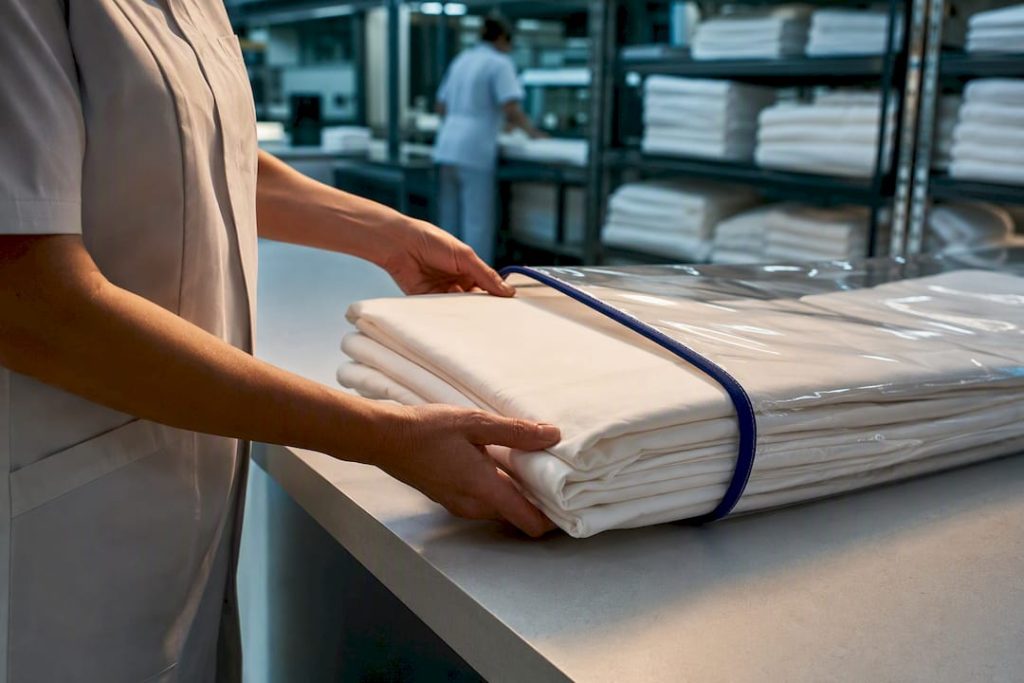
For hospitality procurement, the safest default is heat-sealed non-woven covers or fiber-based heat-seal wraps, with double packaging reserved for guest-facing or clinical items. Both formats meet the microbial-barrier logic behind standards like DIN EN ISO 11607 and DIN EN 868-2 and have been supplied at scale for decades by operators in the hospitality textile supply chain. Before ordering in bulk, request samples and run a sealing-compatibility test on your own equipment.
TL;DR:
- Use heat-sealed non-woven covers or fiber-based wraps for most hospitality textiles, ensuring they meet microbial barrier standards like DIN EN ISO 11607.
- Request supplier test certificates for seal strength, barrier performance, and grammage, and verify equipment compatibility before placing large orders.
- Match packaging formats to textiles: fiber-based covers for guest linens, non-wovens for towels, and simple plastics for uniforms, considering the handling speed and presentation needs.
- Shift towards recyclable and compostable options driven by Albanian regulation, but confirm disposal pathways and conduct pilot tests before full deployment.
- Conduct rigorous pre-shipment inspections and store packaging in controlled environments to maintain seal integrity and shelf life.
Table of Contents
- What Is Paketim Higjienik Tekstilesh and Why Does It Matter?
- Which Materials Work Best for Hygienic Textile Packaging?
- What Standards Should You Request From Suppliers?
- How Do Packaging Formats and Sealing Methods Fit Your Workflow?
- How Should You Match Packaging to Different Textile Categories?
- Why Are Sustainable Packaging Alternatives Gaining Ground?
- How Gjergji H Tekstil’s Experience Shapes These Recommendations
- What Should You Check Before Packaging Ever Reaches the Shelf?
- How Should You Store Hygienic Packaging to Preserve Shelf Life?
- Why Presentation Matters as Much as the Barrier Itself
- How Gjergji H Tekstil Supports Your Packaging Transition
- Sources
- FAQ
What Is Paketim Higjienik Tekstilesh and Why Does It Matter?
Paketim higjienik tekstilesh, the Albanian term for hygienic textile packaging, describes any wrap, bag, or cover that shields cleaned linens, towels, and uniforms from dust, moisture, and microbial contact between the laundry line and the guest room. It’s the barrier standing between a freshly washed duvet cover and whatever happens to it in transit, in storage, and on the delivery cart. That protective function is the entire point of hygienic packaging, and it applies whether the textile is a hotel pillowcase or a restaurant napkin bundle.
Procurement teams tend to underestimate how much this single decision affects both guest perception and operational cost. A poorly sealed cover that tears in transit defeats its purpose before the linen even reaches housekeeping. A well-chosen one keeps textiles clean, presentable, and ready to use with minimal handling.
Which Materials Work Best for Hygienic Textile Packaging?
Three material families dominate hospitality and industrial laundry packaging, and each fits a different operational profile.
- Non-woven heat-sealable covers are the workhorse choice for professional laundries. Performance depends on grammage (grams per square meter), seal strength, and microbial barrier rating. Stericlin’s non-woven wrapping material line shows how grammage scales with mechanical resistance, and heavier non-wovens also dry faster after sterilization, which matters for clinical-grade textile handling.
- Conventional plastic covers (PE or PP) remain common because they’re transparent, inexpensive, and easy to source. Their drawback is regulatory exposure. Albania has moved to restrict disposable plastic packaging, which puts long-term procurement plans built entirely around single-use plastic on shaky ground.
- Fiber-based heat-sealable alternatives, in the style of Paptic’s hygiene packaging, convert on standard heat-seal machinery while offering a recyclable, paper-like feel that reads as premium to guests. Compostable or water-soluble films exist too, but they’re a niche fit best reserved for specific sustainability pilots rather than full-scale rollout.
For bed linens and towels, non-woven or fiber-based covers strike the best balance. Uniforms tend to tolerate simpler plastic wrap since they aren’t guest-facing. Event textiles, which often need to look pristine on arrival, benefit most from the tactile upgrade fiber-based covers provide.
What Standards Should You Request From Suppliers?
DIN EN ISO 11607 and DIN EN 868-2 govern packaging for sterile medical devices, and they define exactly the kind of microbial-barrier performance hospitality buyers should benchmark against, even when a hotel operation doesn’t need medical-grade certification outright. Spas, wellness centers, and any hospitality business handling clinical-adjacent textiles (think in-house medical linens or high-touch treatment towels) should treat these standards as a floor, not a ceiling, per Raumedic’s packaging and sterilization guidance.
When you evaluate a vendor, ask for these in writing:
- Heat-seal strength data, since a weak seal defeats the packaging’s entire purpose during transit or storage.
- Grammage specifications for non-wovens, because higher grammage generally means better mechanical resistance and barrier function.
- Microbial barrier test results tied to a recognized standard rather than a marketing claim.
- Moisture vapor transmission rate, if the supplier tracks it, since this affects how textiles hold up in humid storage conditions.
- Sample batches and certificates, so your own team can verify performance before committing to a bulk order.
Vendors who can’t produce test certificates on request usually can’t back their barrier claims either.
How Do Packaging Formats and Sealing Methods Fit Your Workflow?
The format you choose has to match the machinery already running in your laundry or distribution center, or you’ll end up paying for equipment upgrades you didn’t budget for.
- Heat-sealed flat covers work well for folded linens and towels moving through high-throughput lines.
- Wicket bags suit automated bagging systems where speed matters more than presentation.
- Adhesive-seal bags need no heat source at all, useful for smaller operations without sealing equipment.
- Folded wraps are common for uniforms and lower-turnover items where speed is less critical than cost.
Double-packaging, running two successive wrapping operations, reduces contamination risk during unpacking and is standard practice for hygiene-sensitive textile handling. It makes the most sense for guest-facing linens (the pillowcase a guest sees first) and any textile with clinical exposure. For back-of-house uniforms, single packaging is usually sufficient.
Pro Tip: Before switching packaging suppliers, run one full batch through your existing sealing machine on-site. A material that seals perfectly in a supplier’s demo video can behave completely differently on your equipment, especially if your machine runs at a different temperature or speed.
Check machine compatibility, storage footprint, and handling ergonomics before signing any bulk contract. A hotel laundry operation built around efficient throughput can lose those gains fast if the new packaging jams the sealer twice a shift.
How Should You Match Packaging to Different Textile Categories?
Not every textile in a hospitality operation needs the same wrap. Matching material to use case saves money without sacrificing hygiene standards.
- Bed linens and pillowcases: Fiber-based heat-seal covers work best here because the tactile, quiet unwrapping experience reinforces guest confidence at the exact moment they notice the packaging. Presentation carries real weight in this category, arguably as much as barrier performance.
- Towels: Non-woven covers with solid seal strength handle towels well, especially in high-volume resort operations where turnover is constant.
- Uniforms: Simpler plastic or folded wraps are usually adequate since uniforms rarely reach guest eyes before wear.
- Event textiles: Fiber-based or premium non-woven covers protect table linens and drapery during transport, where a torn or dusty cover on arrival can undercut an otherwise flawless event setup, an angle explored further in natural stone’s role in luxury hospitality presentation.
Before finalizing a supplier, run through this checklist: Do they reference DIN EN ISO 11607 or DIN EN 868-2 where relevant? Will they provide free samples? Can their material run on your existing sealing machine? What’s their minimum order quantity and lead time? And what disposal guidance do they offer for the packaging itself? Weigh single-use costs against reusable cover options too. Reusable covers cost more upfront but can lower per-cycle costs for high-turnover operations willing to manage the extra washing step.
Why Are Sustainable Packaging Alternatives Gaining Ground?
Albania’s regulatory shift away from single-use plastic packaging is pushing hospitality procurement toward recyclable and fiber-based materials faster than most buyers expected even a year or two ago. This isn’t a distant compliance issue. It’s already reshaping which materials suppliers stock as their default option.
- Fiber-based heat-seal covers convert on standard machinery, making the transition from plastic relatively painless from an equipment standpoint.
- Home-compostable options, like the Organixtex system, run on standard impulse sealing machines and break down without industrial composting facilities.
- Recyclable films exist too, but recyclability depends heavily on local collection infrastructure.
The distinction between home-compostable and industrial-compostable claims matters more than most procurement teams realize. A material that needs an industrial composting facility does little good if no such facility exists nearby, so verifying the actual disposal pathway before committing to a “compostable” claim is worth the extra ten minutes. Pilot any new sustainable material on one property before a full rollout, and tell guests plainly why the packaging looks different if the change is visible.
How Gjergji H Tekstil’s Experience Shapes These Recommendations
Decades of supplying major hotel brands have shown which packaging choices hold up under real industrial laundry volume and which ones look good in a catalog but fail on the line. That track record informs the packaging guidance above: barrier performance and presentation both matter, but neither counts for much if the material doesn’t run cleanly on the equipment a laundry already owns.
A practical rollout follows four steps: request samples from your shortlisted materials, test compatibility on your own sealing equipment, run a limited pilot across one property or one textile category, then scale to full rollout once seal integrity and guest reception both check out.
What Should You Check Before Packaging Ever Reaches the Shelf?
Quality control on hygienic packaging happens in two places: before it reaches your facility, and again right before it touches clean textiles. On arrival, inspect a sample from each batch for seal consistency, checking that every edge is fully bonded with no gaps or weak points where microbial contact could occur. Hold a few units up to light to check for pinholes or thin spots in non-woven material, since inconsistent grammage often shows up as visibly thinner patches.
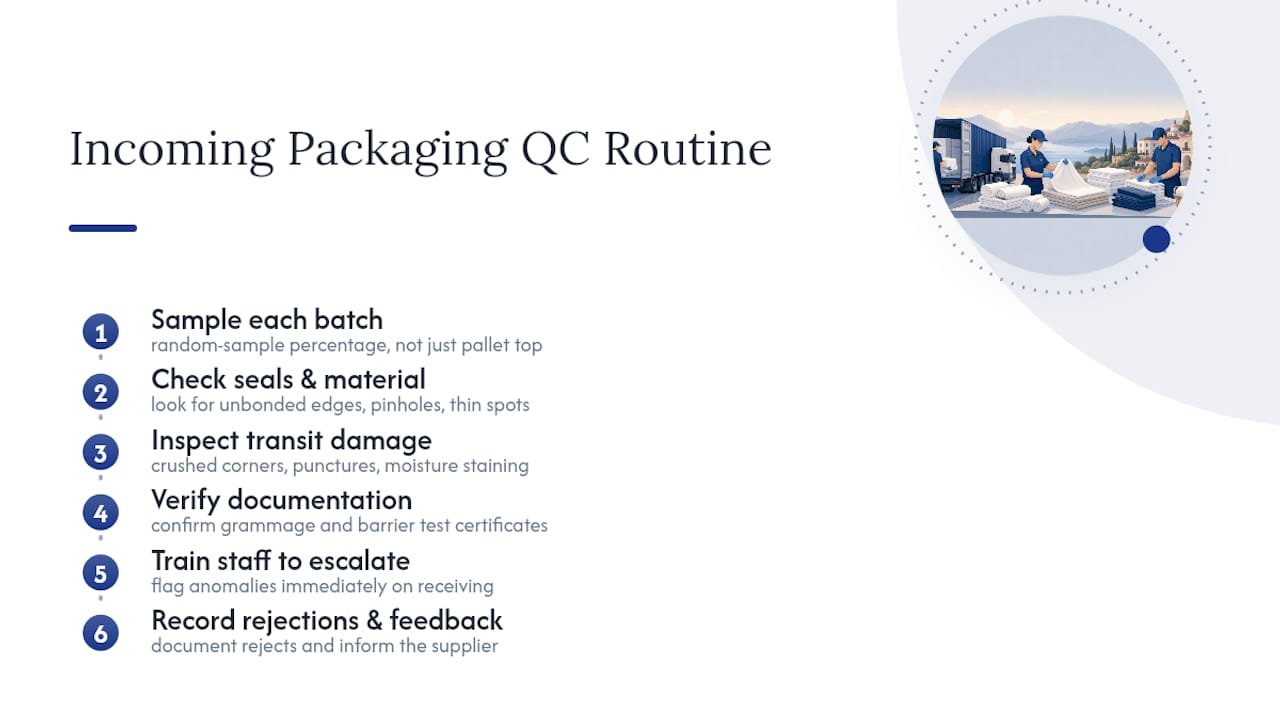
Check the packaging’s exterior for any signs of transit damage: crushed corners, punctures, or moisture staining that could compromise the barrier before the cover even touches a folded towel. Confirm the batch documentation matches what the supplier promised, particularly grammage specs and any barrier test certificates you requested during procurement. Random-sample a percentage of each shipment rather than trusting the top layer of a pallet, since packaging near the bottom of a stack can shift or compress during transport in ways that aren’t visible from outside.
Train the staff who handle incoming packaging to flag anything unusual immediately rather than assuming it will be fine once the linen goes inside. A five-minute inspection routine at receiving catches problems that would otherwise surface at the worst possible moment, when a guest unwraps a torn cover. Document rejected batches and share that feedback with your supplier. A vendor worth keeping will adjust; one that ignores repeated quality issues is telling you something about the rest of their operation too. This inspection discipline pairs naturally with the broader QC checklist hospitality teams already run on incoming textiles.
How Should You Store Hygienic Packaging to Preserve Shelf Life?
Storage conditions determine whether hygienic packaging actually performs when it’s finally used, and this gets overlooked more often than the packaging choice itself. Non-woven and fiber-based materials should be stored in a dry, climate-controlled space away from direct sunlight, since UV exposure and humidity both degrade seal integrity and material strength over time. A storeroom that swings between hot and cold, common in older Albanian hospitality properties, accelerates wear on packaging faster than the manufacturer’s shelf-life estimate accounts for.
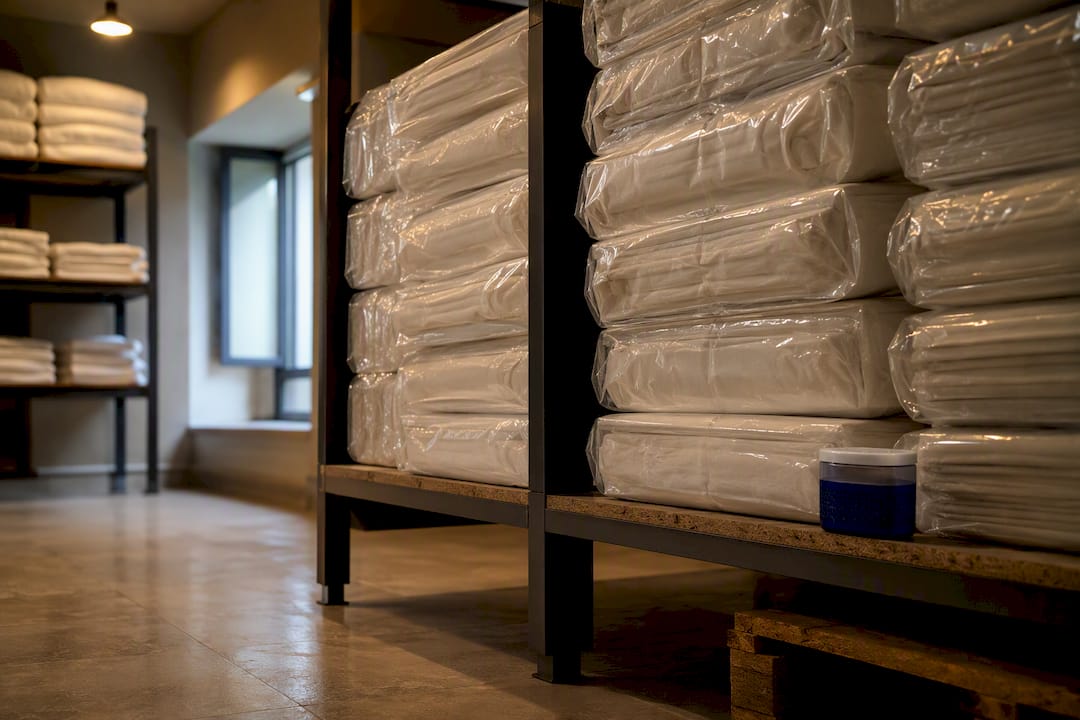
Keep packaging off the floor on shelving or pallets to avoid moisture wicking up from concrete, and leave enough airflow around stacked units that condensation doesn’t build up between layers. Rotate stock on a first-in, first-out basis. Packaging that sits unused for months, especially compostable or bio-based materials, can start to lose structural integrity well before it reaches a hard expiration date.
Most suppliers list a shelf-life window for their hygienic packaging, but that number assumes ideal storage. If your storage area runs warmer or more humid than a controlled warehouse, treat the supplier’s stated shelf life as optimistic and plan to cycle through stock faster. When in doubt, test a sample from older stock before deploying an entire batch, particularly if the packaging is protecting guest-facing linens where a failed seal is far more visible than in back-of-house storage.
Why Presentation Matters as Much as the Barrier Itself
The conventional advice on hygienic textile packaging treats it as a pure engineering problem: pick the material with the best barrier rating and move on. That’s incomplete. A cover with excellent microbial protection but a cheap, crinkly feel undercuts the exact guest confidence it’s supposed to protect. Presentation and barrier performance aren’t competing priorities; they’re the same decision viewed from two angles, and treating them separately is where a lot of procurement teams go wrong.
What gets overrated in this category is chasing the lowest per-unit cost on plastic covers without accounting for Albania’s regulatory direction. That math looks fine for one budget cycle and falls apart the moment restrictions tighten further. What gets underrated is the sealing-compatibility test. Buyers skip it constantly, assuming any heat-seal material works the same on any machine, and then discover mid-rollout that their equipment runs too hot or too slow for the new stock.
If there’s one thing to prioritize first, it’s this: test before you commit volume. Everything else, standards, sustainability, format, only pays off if the packaging actually seals right on your floor.
— Xpert
How Gjergji H Tekstil Supports Your Packaging Transition
Gjergji H Tekstil already runs the supply chain most hospitality procurement teams are trying to build from scratch: wholesale import volume, in-house manufacturing, and direct experience outfitting hotel brands at scale. That means a packaging conversation with Gjergji H Tekstil isn’t limited to covers alone. It extends into the linens, towels, uniforms, and event textiles those covers are meant to protect.

If you’re evaluating a switch to hygienic textile packaging, the practical next step is to request samples alongside a quote for the textile lines you already source or plan to source. Ask about machine compatibility for your existing sealing equipment, current lead times, and minimum order quantities before committing to a full rollout. Procurement teams sourcing hotel and Airbnb textile packages can bundle that request directly with linen and towel orders, which simplifies vendor management and keeps packaging and textile quality aligned under one supply relationship instead of two separate contracts.
Sources
Verify vendor claims against DIN EN ISO 11607, DIN EN 868-2, and the Paptic hygiene packaging and Organixtex material specifications before finalizing bulk orders.
- Albania will ban use of disposable plastic packaging
- Sustainable Hygiene Packaging – Paptic
- Packaging, sterilisation and certification (Raumedic)
- stericlin® wrapping material non-woven
FAQ
What Is the Most Hygienic Packaging Material for Hotel Linens?
Non-woven heat-sealable covers and fiber-based heat-seal wraps offer the strongest combination of barrier protection and guest-facing presentation for hotel linens.
Do Hotels Need Medical-Grade Packaging Standards?
Most hotel textiles don’t require full medical-grade certification, but standards like DIN EN ISO 11607 and DIN EN 868-2 are a useful benchmark for spas, wellness centers, or any clinical-adjacent textile handling.
What Is Double-Packaging and When Should You Use It?
Double-packaging means wrapping a textile twice in successive sealing operations to reduce contamination risk during unpacking, and it’s most appropriate for guest-facing linens and clinical-grade items.
Are Compostable Textile Covers Actually Better for the Environment?
Only if the compostability claim matches your local disposal infrastructure. Home-compostable materials like Organixtex break down without special facilities, while industrial-compostable claims require access to a facility that may not be nearby.
Does Gjergji H Tekstil Supply Hygienic Packaging Alongside Textiles?
Gjergji H Tekstil supplies hotel, restaurant, uniform, and event textiles through wholesale import, in-house manufacturing, and custom production, and can advise on packaging compatibility as part of a bulk textile order.