

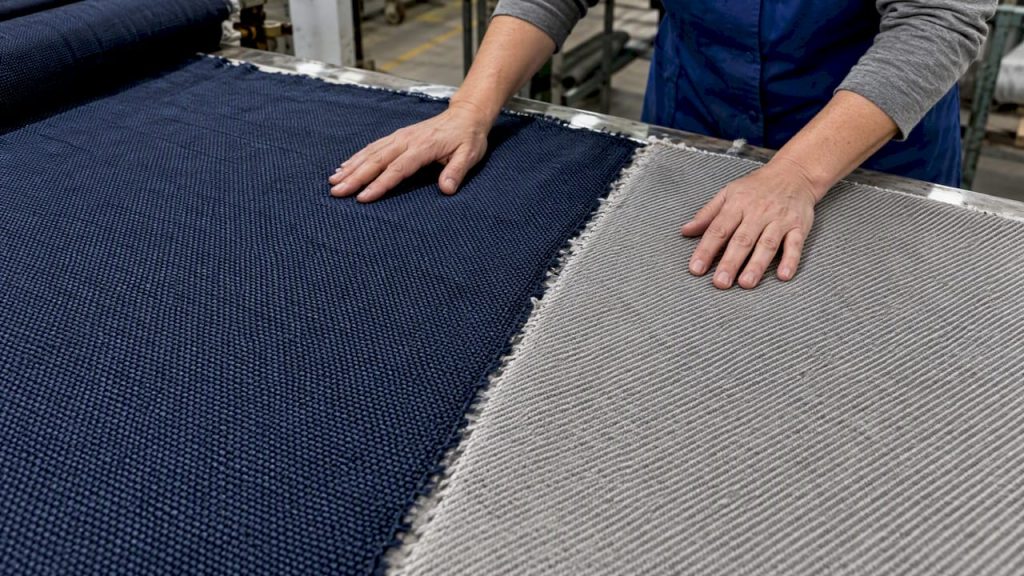
Plain weave interlaces every yarn one over, one under, which makes a compact, stable cloth that resists abrasion and pilling. Twill offsets its floats to form a diagonal wale, trading some of that tightness for a softer hand, better drape and stronger crease recovery. Pick plain for sheets and table linens, and twill for uniforms, tailored pieces and upholstery.
TL;DR:
- Comparative tests measured cover factors of 22.65 for plain and 21.26 for twill, while crease recovery reached about 105° and 110°, respectively.
- Plain locks yarns in place to resist snagging and seam slippage, while twill groups them to absorb stress but may lose tensile strength faster.
- Frequent industrial laundering favors plain’s lower wear and pilling, while twill’s soil hiding and crease recovery help uniforms stay presentable through long shifts.
- Ask suppliers for ISO abrasion and pilling reports, crease recovery, GSM, yarn type, and construction notation, because yarn and finishing also affect performance.
- Wash matching construction swatches at your laundry’s temperature and chemistry before committing, since laboratory results may not predict actual laundering performance.
Table of Contents
- How plain and twill weaves are made and how to recognize them
- Evidence-backed properties comparison: compactness, abrasion, pilling and crease recovery
- Typical uses and examples: which weave suits sheets, table linens, uniforms, upholstery and drapery
- How to choose between plain and twill when specifying hospitality textiles
- What research and practitioners say about plain and twill performance
- How we apply these choices in the field
- How Gjergji H Tekstil can help with sourcing, testing and custom production
- FAQ
- Sources
How plain and twill weaves are made and how to recognize them
A woven cloth is built from warp yarns running lengthwise and weft yarns crossing them. The weave is the rule that decides which warp yarn goes over or under each weft yarn.

Plain weave is the simplest rule. It repeats on two ends and two picks, and a balanced version has equal warp and weft weight, which is why it covers everything from canvas to fine organza (plain weave basics). Percale and broadcloth are typical examples.
Twill uses floats. A 2/1 twill reads as “two up, one down”: each weft passes over two warp yarns, then under one, and the start point steps over by one yarn on each row. A 3/1 floats longer. That offset creates diagonal ribs, and the cloth has a technical face and a back (twill structure). Twill needs more harnesses on the loom than plain, which can add to weaving cost.
Quick checks on a swatch:
- Look for diagonal ribs. Visible lines mean twill; a fine checkerboard grid means plain.
- Flex the sample in your hand. Twill usually feels more pliable.
- Compare both sides. A distinct face and back points to twill.
- Remember that finishing, such as brushing or softening, can change the hand without changing the weave.
Evidence-backed properties comparison: compactness, abrasion, pilling and crease recovery
Comparative testing found a cloth cover factor of about 22.65 for plain weave and 21.26 for twill, which shows greater compactness in plain weave. Cover factor describes how much of the cloth surface the yarns fill. A higher value means fewer gaps, so less room for soil and fiber movement.
Crease recovery points the other way. Measurements put twill at about 110° against about 105° for plain, so twill recovers from creasing better. Tighter interlacement also keeps plain fabrics steadier underwear, with those experiments showing a lower wear index and less pilling than twill.
| Property | Plain weave | Twill weave |
|---|---|---|
| Cover factor | about 22.65 | about 21.26 |
| Crease recovery angle | about 105° | about 110° |
| Abrasion and pilling | Lower wear, fewer pills | Higher wear, more pilling |
| Drape | Crisp, smooth | Softer, more supple |
A 2023 study reported that plain fabrics showed superior abrasion resistance and a significantly lower tendency to pill than twill, attributing this to tighter interlacement that limits fiber migration (study). Twill lost more mass during abrasion and washing cycles.
What this means in practice:
- Items that go through frequent industrial laundering and need a clean surface favor plain.
- Items that must look pressed after a long shift favor twill.
- Strength depends on yarn and construction too, so a lab number never replaces a sample wash.
- Durability has several failure modes. Plain resists snagging and seam slippage because each thread is locked in place, while twill groups yarns to absorb stress (durability profiles).
For more on how pilling develops and how to control it, see our guide to fixing fabric pilling.
Typical uses and examples: which weave suits sheets, table linens, uniforms, upholstery and drapery
Practitioners choose by end use, not by a single “best” label. Plain weave is preferred where stability matters, such as bed sheeting and tablecloths, while twill is chosen where flexibility and wrinkle resistance matter, such as uniforms and upholstery (end-use guidance).
Where plain weave fits:
- Percale sheets, where a crisp, smooth surface and minimal pilling define the guest experience.
- Table linens, where stable seams and hems hold up through repeated pressing.
- Any item that needs a firm, balanced cloth.
Where twill fits:
- Staff uniforms and tailored garments, where drape and recovery keep people looking neat.
- Denim-like workwear and aprons that take daily abuse.
- Heavy drapery and upholstery, where the cloth should hang or sit well and hide marks.
On maintenance, twill hides soiling better and bounces back from creasing, so it forgives a busy service. Plain presents a clean, smooth face but may show stains more readily. The same source also notes that plain weave tends to resist long-term mechanical aging better, while twill can lose tensile strength faster under equal conditions. For flexibility in hospitality settings, our piece on why textile flexibility matters adds context.
How to choose between plain and twill when specifying hospitality textiles
Start with a short checklist, then back the decision with paperwork.
- Define the contact and use. Skin contact, table service and kitchen work each stress cloth differently.
- Note laundering frequency and method. More cycles favor the structure that holds its surface.
- Set the required life in wash cycles. Write it down before comparing quotes.
- Choose a soil strategy. Decide whether the cloth should hide marks or show them for cleaning staff.
- State the appearance goal. Crisp and smooth points to plain; relaxed and recovering points to twill.
When you request quotes, ask suppliers for:
- ISO abrasion and pilling reports
- Crease recovery angle
- GSM (weight per square meter)
- Yarn type, such as ring-spun or open-end
- Fabric construction notation, such as 1/1 or 2/1
Request swatches with the stated construction and matching test reports, run sample launder cycles if you can, and write performance expectations into the contract.
Pro Tip: Wash every swatch at your own laundry’s temperature and chemistry before you commit, because lab results and your wash room rarely agree exactly.
Our pages on key traits of durable hotel fabrics and hotel textile selection tips cover the same decisions in more depth.
What research and practitioners say about plain and twill performance
The numbers above come from published comparisons, and they line up. One study reports cover factors of 22.65 for plain and 21.26 for twill, and crease recovery angles of about 105° and 110° (plain vs twill study). Related work applied ISO test methods to measure wear and pilling.
Plain fabric showed a lower wear index and less tendency to pill, while twill had better crease recovery but lower abrasion resistance.
Lab results show direction, not the exact laundry-room outcome, so we weigh test data together with finishing and yarn type. We advise buyers on applying these findings to their own operations. Our guide to textile fabric testing explains which reports matter.
How we apply these choices in the field
In our own supply work, the weave decision is always a three-way balance: guest comfort, industrial laundering and cost, supported by options like Indoor Polo fabrics that meet specific technical needs. We consider the needs of each application when specifying guest sheets. For staff uniforms, we lean toward twill, because drape, recovery and soil-hiding pay off over a long shift. We rarely treat one weave as universally better. We ask where the cloth will work, how often it will be washed and what the buyer wants it to look like in year three.
— Xpert
How Gjergji H Tekstil can help with sourcing, testing and custom production
We supply hotel linens, restaurant textiles and uniforms, and we support hospitality buyers with custom production. If you are specifying plain or twill for your property, tell us the use and wash routine, and we will propose a construction to match. Find more information through our hospitality textiles page, and we will get back to you with options.

FAQ
What is plain weave fabric?
Plain weave is the simplest weave, where each weft yarn goes over one warp yarn and under the next. It repeats on two ends and two picks, which gives a balanced, stable cloth (plain weave overview). Percale and canvas are common examples.
What does a twill weave pattern look like?
Twill shows parallel diagonal ribs across the surface. They come from offset floats such as 2/1 or 3/1, and the cloth has a distinct technical face and back (twill overview). Denim is the familiar example.
How can I tell plain and twill apart when checking a sample?
Look closely at the surface. Diagonal lines mean twill, while an even grid of tiny squares means plain. Twill also tends to feel more pliable in the hand, though finishing can change that feel.
Which weave pills less?
Plain weave pills less, because its tighter interlacement limits fiber movement. Tests found plain fabrics with a lower tendency to pill and better abrasion resistance than twill (comparative study). Yarn type and finishing still matter.