


TL;DR:
- Flexible textile production enables hotels to respond quickly to demand fluctuations, reducing inventory risk and improving operational efficiency. Digital textile printing supports sustainability and customization by minimizing waste and allowing rapid design changes. Small-batch and on-demand manufacturing lower costs, increase flexibility, and strengthen supply chain resilience for hotel procurement.
Most hotel procurement managers assume that flexible textile production is simply a way to get custom logos on towels or branded colors on linens. That assumption is costing them money. The real value of why flexible textile production matters lies in operational agility: the ability to replenish faster, reduce overstock, align supply with seasonal demand, and keep guest-facing quality consistent year-round. For mid to large-sized hotels and resorts across the Balkans, where tourism peaks are sharp and off-season inventory carrying costs are real, understanding the full impact of flexible textile production is not a luxury. It is a procurement discipline.
Table of Contents
- Understanding flexible textile production and its operational advantages
- How flexible production enhances sustainability and customization with digital textile printing
- Reducing costs and risks with small-batch and on-demand textile production
- Maximizing textile durability and total cost of ownership in hotel operations
- Reframing flexible textile production: Beyond customization to operational resilience
- Discover Gjergji H Tekstil’s flexible hotel textile solutions
- Frequently asked questions
Key Takeaways
| Point | Details |
|---|---|
| Operational efficiency | Flexible textile production shortens planning time and increases on-time delivery to improve hotel supply chains. |
| Sustainability benefits | Digital textile printing reduces water, waste, and energy use while enabling hotel customizations. |
| Inventory risk reduction | Small-batch production reduces overstock and enables quick replenishment aligned to hotel demand. |
| Lower lifecycle costs | Durable textiles from flexible production reduce replacements and laundering expenses for hotels. |
| Focus on agility | Hotels should value operational resilience over unlimited customization for practical textile sourcing. |
Understanding flexible textile production and its operational advantages
Flexible textile production refers to manufacturing systems and supplier arrangements that allow production runs to be adjusted quickly in response to changing order volumes, specifications, or timelines. For hotels, this means your supplier can recalibrate output between high-thread-count bed linens for premium suites and heavier pool towels for resort use, without the rigid lead times that bulk-only manufacturers demand.
The operational benefits are measurable. When production planning integrates real-time order data, suppliers reduce the time spent manually coordinating production schedules, and hotels receive orders more reliably. A 2024 to 2025 case study showed that on-time delivery performance rose from 75% to 85% and planning time dropped from 40 hours per week to 30 hours per week after implementing integrated planning tools. That 25% reduction in planning time translates directly into faster order confirmation and shorter replenishment windows for hotel buyers.
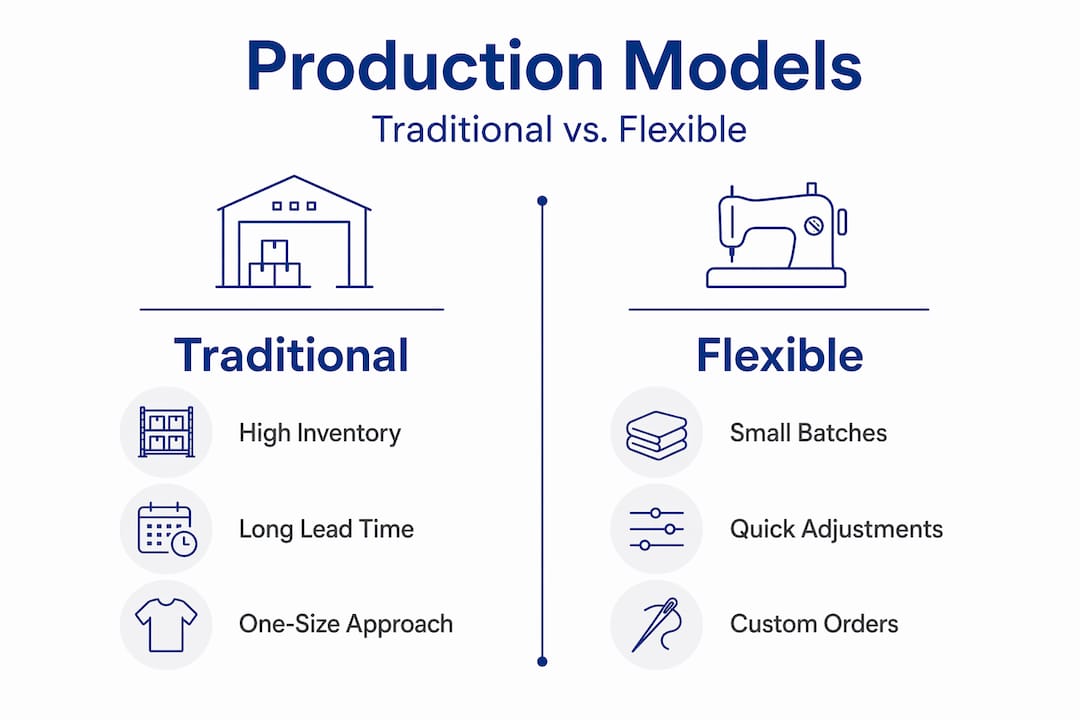
The connection between textile flexibility for hospitality and operational results becomes clear when you look at what actually breaks down in traditional procurement. Delays happen because suppliers cannot quickly shift capacity. Overstock happens because minimum order quantities are too large. Both problems are structural, and flexible production processes solve them at the source.
Here is what hotels gain from suppliers operating on flexible production models:
- Faster order confirmation because production schedules adapt to real demand rather than fixed monthly batch runs
- Improved on-time delivery driven by tighter planning visibility across the production floor
- Higher capacity utilization allowing suppliers to accommodate urgent replenishment without premium surcharges
- Reduced planning friction between the hotel’s procurement team and the supplier’s scheduling staff
- Greater product variety within a single order cycle, covering multiple textile categories without separate lead times
Pro Tip: When evaluating a textile supplier, ask specifically how they handle mid-cycle order changes. A supplier with genuine production flexibility will describe a concrete process. A supplier without it will give you a vague answer about “doing their best.”
How flexible production enhances sustainability and customization with digital textile printing
Digital textile printing (DTP) is one of the clearest examples of how flexible textile manufacturing translates theory into practice. Unlike conventional screen printing, which requires physical screens per design and generates significant setup waste, DTP applies color directly from digital files. That means no minimum run penalty for a custom pattern, no wasted ink from screen preparation, and no leftover dye bath to dispose of.
For Balkan hotels pursuing ESG goals or simply trying to reduce operational costs tied to waste, sustainable textile production through DTP delivers on both fronts. Industrial DTP systems can reach up to 1,100 m² per hour, with AI-driven workflow tools managing color accuracy and print sequencing. That speed, combined with dramatically lower water and chemical consumption compared to conventional wet printing, positions DTP as the production method of choice for hotels that need both volume and variety. The digital textile printing benefits extend beyond production into how quickly a hotel can refresh its visual identity, seasonal décor, or event-specific textile setups.
Statistic to note: Industrial digital printers achieving 1,100 m² per hour production output represent a shift away from the assumption that sustainable production is necessarily slow production.
The sustainability and customization advantages for hotel textiles include:
- Lower water consumption compared to conventional dyeing and printing processes
- Reduced chemical waste because dye is applied only where needed, with no excess bath
- Faster design turnaround from concept to finished textile without tooling delays
- Smaller minimum order quantities enabling hotels to test new designs without committing to large volume
- Event-specific customization for tablecloths, napkins, and event linens that match a specific function’s branding or color scheme
This matters particularly for resorts in the Balkans that run seasonal programming, weddings, or corporate retreats. Instead of ordering thousands of generic napkins and storing them, you can order the right quantity in the right design for each event cycle.
Reducing costs and risks with small-batch and on-demand textile production
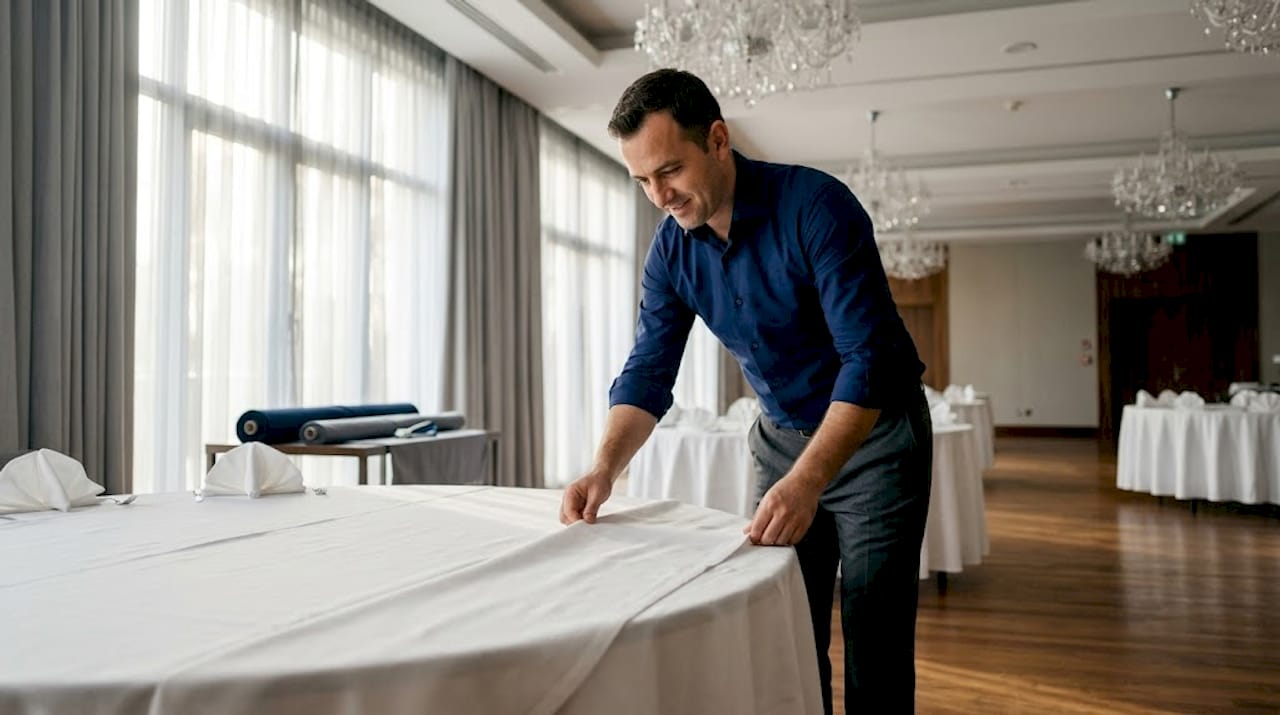
Small-batch production means manufacturing textiles in quantities matched to confirmed demand, rather than forecasting large lots months in advance. On-demand production takes this further, triggering production only when an actual order is placed. Both approaches reduce the financial exposure that comes with carrying large textile inventories through periods of low occupancy.
Small-batch manufacturing reduces inventory risk by aligning output directly to confirmed orders, enabling instant replenishment and greater variety, which is critical for hospitality operators managing diverse room categories and event spaces simultaneously.
Here is how small-batch production reduces inventory and replenishment risks in a hotel context:
- Define your actual consumption rate by tracking how many linens, towels, and table textiles move through laundry cycles per week during peak and off-peak periods.
- Set reorder points by category rather than ordering all textiles on a single annual cycle. Bed linens may need quarterly replenishment; specialty event linens may only need seasonal top-up.
- Place smaller, more frequent orders with a supplier equipped for flexible runs, avoiding the cost of storing six months of inventory in a warehouse.
- Review and adjust quarterly based on actual occupancy data, eliminating guesswork from the procurement process.
- Reserve bulk orders for stable, high-volume categories such as standard white towels, where demand is predictable and variety is not needed.
The financial comparison between traditional bulk ordering and small-batch production shows a clear difference in risk profile:
| Factor | Traditional bulk orders | Small-batch production |
|---|---|---|
| Inventory cost | High, with significant carrying costs | Lower, matched to real demand |
| Lead time | Long, typically 60 to 120 days | Short, often 10 to 30 days |
| Flexibility | Low, fixed SKUs and quantities | High, adjustable per order |
| Overstock risk | High, especially during off-season | Minimal |
| Variety within one order | Limited by minimum quantities | Multiple categories per run |
For textile maintenance optimization, this model pairs well with a rotation tracking system. When you know exactly how many cycles each textile has completed, you can time replenishment precisely rather than ordering reactively when stock runs critically low.
Pro Tip: When assessing supplier flexibility for small-batch capability, ask how quickly their machines can be recalibrated between fabric types and constructions. A supplier handling both percale weaves and terry cloth in the same production window has genuine operational flexibility. One that requires dedicated runs for each category does not.
Maximizing textile durability and total cost of ownership in hotel operations
Total cost of ownership (TCO) is the metric that changes how procurement decisions get made. Rather than comparing price per unit at the point of purchase, TCO accounts for how long a textile lasts, how many wash cycles it withstands before quality degrades, and what replacement frequency those factors produce. A cheaper linen that deteriorates after 100 wash cycles will cost more over three years than a higher-quality one that maintains integrity through 300 cycles.
Durable hotel textiles reduce replacement frequency and laundry costs when sourced with TCO in mind. The formula is straightforward: cost per use equals total cost divided by number of wash cycles. A linen costing $12 that lasts 300 cycles costs $0.04 per use. One costing $8 lasting 100 cycles costs $0.08 per use. Flexible production supports this calculation by allowing hotels to specify construction quality precisely, rather than accepting whatever standard comes with a bulk order.
Hotels operating commercial laundry equipment at high daily volume see this impact clearly. Fabrics that pill, shrink, or lose color saturation quickly create compounding costs: more frequent replacement orders, higher emergency procurement expenses, and lower guest satisfaction scores tied to room presentation.
The benefits of sourcing durable textiles through flexible production channels include:
- Fewer replacement cycles over a 12 to 36 month period, directly reducing procurement budget pressure
- Lower laundry costs per cycle because durable textiles maintain their integrity without requiring special handling or shorter machine programs
- Consistent room presentation because textiles that hold their appearance keep the guest-facing standard stable across seasons
- Better supplier relationships when you specify clearly what construction and wash-cycle performance you require, rather than accepting what is available
- Reduced emergency orders because durable stock does not deplete unpredictably under heavy commercial use
Flexible production is what makes this specificity possible. When your supplier can adjust yarn weight, weave density, or finishing treatment per order, you source precisely for textile cost efficiency rather than accepting a compromise between what the market offers and what your operation actually needs.
Material selection also matters. Cotton-polyester blends with a 60/40 or 70/30 ratio are widely used in commercial hospitality because they balance softness against durability under industrial washing at 60 to 90 degrees Celsius. Pure cotton is more comfortable but wears faster under high-cycle commercial conditions. Flexible production means you can specify the right blend for each use case, not a single material for all categories.
Reframing flexible textile production: Beyond customization to operational resilience
Here is the uncomfortable truth about how most hotels approach textile procurement: they focus on aesthetics first and supply chain performance second. Custom embroidery, color matching, branded monograms. These are not bad requirements. But they are surface features. The deeper value of flexible production lies in what happens between orders, not at the moment of design approval.
Operational resilience in textile supply means you can absorb a 30% spike in occupancy during a peak summer weekend without running out of clean, presentable bed linens. It means your supplier can execute a partial reorder for a specific room category without forcing you into a full-batch commitment. It means that when a laundry machine fails for three days and your stock buffer runs low, replenishment arrives in days, not weeks.
“Flexible production benefits hotels most by shortening the replenishment cycle through improved production visibility, integration, and data-driven planning, rather than unlimited customization.”
The planning time reduction and on-time delivery improvements documented in real case studies are not just supplier metrics. They translate directly into how reliably you can serve guests. When a supplier’s planning time drops by 25% and their on-time delivery rate reaches 85%, your procurement workflow becomes predictable. That predictability keeps hospitality operations on track during the high-demand periods that define a resort’s revenue performance.
The mindset shift we encourage at Gjergji H Tekstil is this: evaluate textile flexibility insights not by what a supplier can print on a pillowcase, but by how quickly they can respond when your actual operational situation changes. Seasonal demand swings, unexpected group bookings, event-driven surges, these are the situations where flexible production either pays for itself or reveals its absence.
Pro Tip: Ask any textile supplier for their on-time delivery rate for partial or rush replenishment orders specifically. Standard lead-time data for full production runs tells you very little about how they will perform when you actually need them.
Discover Gjergji H Tekstil’s flexible hotel textile solutions
The operational gains described throughout this article, from reduced planning friction to durability-driven cost savings, are exactly what Gjergji H Tekstil is built to deliver for hotels and resorts across the Balkans. With over 30 years of supply chain experience and a client portfolio that includes internationally recognized hotel brands, the company operates as a production and distribution partner, not just a product vendor.

Gjergji H Tekstil’s hotel textile wholesale solutions cover bed linens, towels, duvets, curtains, and event textiles, all available with customizable specifications, sustainable material options, and replenishment cycles designed around your occupancy patterns. Explore the hotel textile selection tips to understand how to specify correctly for your property’s laundry load and guest tier. And if you want to see how the right textile sourcing strategy connects directly to guest experience with textiles, that resource will show you the full picture from procurement to room presentation.
Frequently asked questions
What is flexible textile production in the context of hotels?
It is a manufacturing approach that enables quicker, smaller, and more adaptable textile runs tailored to hotel demand, improving supply chain agility and reducing inventory risk. Flexible production cuts lead times by enabling faster response to order changes and tighter production planning.
How does digital textile printing support sustainable hotel textile production?
It significantly reduces water, chemical, and energy usage while enabling faster production and customization to meet hotel needs with minimal waste. Digital printing applies dye only where needed, eliminating the excess chemical baths that conventional wet printing requires.
Why is total cost of ownership important for hotel textile procurement?
Because it accounts for fabric durability and laundering costs over time, helping hotels optimize expenses beyond just initial purchase price. Cost per use equals total cost divided by number of wash cycles, linking durability directly to lower lifecycle costs.
What are the benefits of small-batch textile production for hotels?
It reduces overstock risk, enables faster replenishment, and allows hotels to better align textile supply with fluctuating occupancy and event needs. Small-batch models align production output to real confirmed demand rather than forward-looking volume forecasts.