

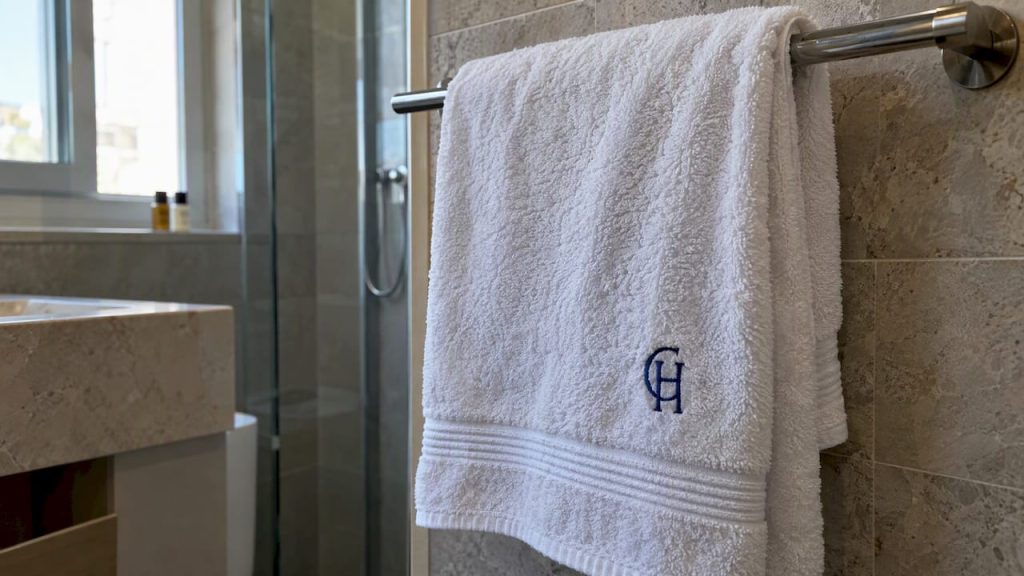
Branding hotel linens means choosing three things: which items carry your mark, which method applies it (embroidery, woven jacquard, printed or sewn-in label), and where it sits so it survives hundreds of industrial wash cycles. Get those three right and the linen works as a quiet brand signal and a laundry control tool. Get them wrong and you pay for a logo that fades, puckers or shows up on the wrong side of a pillowcase.
This guide is written for hotel managers and owners in Albania, Kosovo, Montenegro and North Macedonia who buy textiles in volume and want a brief they can hand to a supplier.
TL;DR
- Brand the items guests see and touch first: towels, bathrobes, pillowcases and the duvet cover edge. Leave flat sheets mostly plain.
- Embroidery and woven jacquard last longest. Prints and heat-applied logos are cheaper but wear faster under industrial laundering.
- Keep the logo small and placed away from seams and heavy-friction zones. Our own specs are linked below.
- Order a sample, wash it repeatedly and inspect it before committing to a full run.
- Put a sewn-in label on every item. It helps laundry sorting and stock counts as much as it helps the brand.
Table of Contents
- What branding linens actually does for a hotel
- Which items to brand first
- Choosing the method: embroidery, jacquard, print or label
- Size and placement that survive laundry
- Fabric first, logo second
- Keeping the look consistent beyond the guest room
- A practical brief to give your supplier
- Perspective: what we see after 30 years of supplying hotels
- Where to start with Gjergji H Tekstil
- Common mistakes to avoid
- FAQ
- Sources
What branding linens actually does for a hotel
Guests rarely read a brand book, but they notice a towel. A monogram on a bath towel or a discreet woven band on a duvet cover tells them the property pays attention to detail. That is the marketing side.
The operational side is just as useful. Branded items are harder to lose or mix up with another property’s stock when you use an external laundry, and a label with size or item code speeds up sorting and par-level counts. Both reasons should shape your decisions, because they push you toward durable, small, consistently placed marks rather than decorative ones.
The brand voice here is pragmatic: the logo is not the product. The product is a towel that stays soft and a pillowcase that stays crisp. Branding should never reduce that.
Which items to brand first
You do not need a logo on everything. Rank items by guest visibility and by how long they stay in circulation.
| Item | Visibility | Recommended mark | Priority |
|---|---|---|---|
| Bath and hand towels | High | Embroidery or woven border band | First |
| Bathrobes and slippers | High | Embroidery on chest or collar | First |
| Pillowcases | Medium | Small embroidery on the hem or woven label | Second |
| Duvet covers | Medium | Embroidery or tab at the open edge | Second |
| Flat and fitted sheets | Low | Sewn-in label only | Optional |
| Pool and spa towels | High at the pool | Larger logo, woven or embroidered | First if you run a spa |
| Restaurant napkins and tablecloths | High | Small corner embroidery | Depends on venue |
If you have to pick one starting point, pick towels. Our guide on which four hotel textiles to personalize first goes deeper into the order that avoids costly reorders.
Choosing the method: embroidery, jacquard, print or label
Embroidery
Embroidery is the standard for towels and robes, and it is what readers usually mean when they search for embroidered hotel towels. Thread is stitched into the fabric, so the logo has texture and a premium feel. Retail examples show the idea: a hotel towel from a well-known Italian linen house is sold as white terry with two lines of satin-stitch embroidery in a chosen color. Simple, clean lines are the point.
The weak spots are stitch density and thread quality. A very dense logo on thin terry can pull the pile and pucker after drying. Lower stitch counts on a heavier towel behave better. Choose polyester or other wash-resistant thread, and test colors, because bright threads on white can bleed or fade under bleach-containing programs.

Woven jacquard
In jacquard, the logo is woven into the fabric itself, as a border band on a towel or a motif on a bedding edge. There is nothing to peel, fray or unpick. It needs a minimum order because it is set up on the loom, so it suits properties that buy at volume and plan for several years. One supplier of hospitality bedding describes a dual-zone approach: a logo area at the visible edge using jacquard weaving or 3D embroidery, designed to withstand frequent washing. The principle is useful regardless of who supplies it: put the brand on one defined zone and keep the rest of the item clean.
Printing and heat transfer
Screen prints and heat-applied logos are quick and cheap for small runs, uniforms or event textiles. They wear faster than stitched or woven marks under industrial washing and tumble drying. Use them where the item has a short life or a changing design, such as event napkins or seasonal staff aprons, and not on your core towel stock.
Sewn-in labels
A woven or printed label at the seam is the least visible and most practical mark. It carries your brand, size, item type and sometimes a care symbol. For beds, it is also how housekeeping knows which edge is the head. Use labels on every item, including those with no visible logo.
| Method | Durability in industrial laundry | Look | Best use | Cost level |
|---|---|---|---|---|
| Embroidery | High with good thread and moderate density | Textured, premium | Towels, robes, pillowcases | Medium |
| Woven jacquard | Very high | Integrated, refined | Towel borders, bedding edges | Higher setup, lower per unit at volume |
| Print / heat transfer | Lower | Flat, graphic | Events, uniforms, short-life items | Low |
| Sewn-in label | High | Discreet | All items | Low |
The ranking above reflects general textile practice, not a lab study, so treat it as a starting point and confirm with a wash test on your own fabric.
Size and placement that survive laundry
Placement matters as much as method. A logo placed across a hem, a seam or a high-friction zone will wear first, because folding, mangle ironing and tumble drying concentrate stress there.
Some rules of thumb we apply:
- Keep marks compact. A chest logo on a robe or uniform should be small, not a billboard. Our specification page on logo size and tab dimensions that survive laundry gives the exact ranges.
- Place towel logos on the border band, away from the folded edge and the hem stitching.
- Put pillowcase marks on the hem or a corner that will not be tucked inside the pillow.
- For duvet covers, use the open edge so the logo is visible when the bed is turned down.
- Keep the same position on every item of one type, so housekeeping can fold to show the logo.
For towels specifically, we have documented wash-tested logo towels and what to ask a supplier to prove.
Fabric first, logo second
A logo cannot rescue a poor base fabric. Thin terry loses pile and shape after repeated washes, and a thin cotton blend pills long before the embroidery fails. Weight, yarn quality and finishing decide how long the product stays presentable. Read our notes on the traits of durable hotel fabrics and our buyer’s checklist for linen quality before you fix the branding.
One point on certification. If a supplier claims safety certification, ask for the certificate. The OEKO-TEX STANDARD 100 label covers textiles tested for harmful substances, from yarn to finished product. That is relevant to branding because dyes, threads and prints are part of the tested article. Do not assume a certificate for the base fabric covers every thread and label added later: ask whether the finished, branded item was included.
Keeping the look consistent beyond the guest room
Branding works when the guest sees one language from the room to the restaurant to the event hall. That does not mean the same logo everywhere. It means a fixed palette, a fixed logo position logic and a limited set of fabric textures.
For banquets and weddings, the same thinking applies to table linens for events, where planners need to confirm what is supplied and in which colors well ahead of the date. If your hotel hosts events, decide early whether event textiles carry your logo or stay neutral so the client can add their own styling.
For ideas on palette and layering, see our pieces on hotel textile design inspiration and bedroom textile design ideas for guest rooms.
A practical brief to give your supplier
A vague request produces vague samples. Send a one-page brief with these points:
- Items and quantities per room type, plus a par level for spare stock.
- Logo files in vector format, with the maximum number of colors.
- Method per item and placement drawn on a simple sketch.
- Laundry conditions: in-house or external, typical temperature, chemicals and drying method.
- Certificates required for the finished item.
- Sample approval: a physical sample washed several times before you sign off.
- Reorder terms: how closely a future batch will match color and logo, and how long reorders take.
The seventh point is where hotels get caught. A first order looks perfect, then a reorder arrives in a slightly different white or with a shifted logo. Agree a reference sample and keep it.
Perspective: what we see after 30 years of supplying hotels
We founded Gjergji H Tekstil in 1994 and we import, manufacture and distribute hospitality textiles, so we see the same branding mistakes repeat. The most common is starting from the logo instead of the laundry. A hotel falls in love with a large embroidered design, and only after a few months of washing does it notice that the border has puckered or the color has dulled.

Our advice is plain. Brand fewer items, brand them well and keep the mark small. Spend the budget on the base fabric and on a wash test. Because we control import, design and production in one chain, we can adjust a logo, a thread or a label before the full run rather than after it, and we can match a repeat order to the original sample. That is what we mean by keeping the service on rails.
If you manage a boutique property or an Airbnb portfolio, the same logic holds at smaller scale: one clean mark on towels and a label on everything else beats a logo on every item.
— Xpert
Where to start with Gjergji H Tekstil
If you are planning a branded linen program, our hotel and Airbnb textiles range covers bedding, towels and curtains, and our professional textile services include custom orders and workwear. Send us your logo, your room count and your laundry setup, and we will propose a method and placement for each item. For wider selection advice, our hotel textile selection tips are a good companion read.
Common mistakes to avoid
- Logos on every item. It raises cost and reduces the effect.
- Oversized marks. They distort the fabric and wear faster.
- Skipping the wash test. A sample that looks perfect new tells you nothing about month six.
- Ignoring laundry conditions. An external laundry using high heat and strong chemicals is harder on thread than a gentle in-house cycle.
- No reference sample. Without one, repeat orders drift.
- Branding a weak fabric. The logo outlasts the towel, and you replace both.
For cost control across the whole textile stock, see how to maximize hotel textile durability and cut costs.
FAQ
What is the best way to put a logo on hotel towels?
Embroidery on a border band is the most common choice, and woven jacquard is the most durable if your volume justifies the loom setup. Keep the logo compact and away from hems. Always wash-test a sample first.
Do I need to brand sheets?
Usually not. Sheets are covered by blankets or duvets and are hard to show off, so a sewn-in label is enough. Spend your branding budget on towels, robes and the visible edges of duvet covers and pillowcases.
How many colors can an embroidered logo have?
Fewer is better. One or two thread colors are easier to keep consistent across reorders and fade more evenly. Complex gradients and fine detail do not translate well to stitching on terry.
How do I make sure a branded batch matches my reorder later?
Keep a signed reference sample and record thread colors, logo size and placement in writing. Ask your supplier how reorders are matched and what tolerance applies before the first order.
Sources
- OEKO-TEX: our standards
- Dual-zone customization for hotel bedding
- Frette hotel classic bath towels, embroidery example