

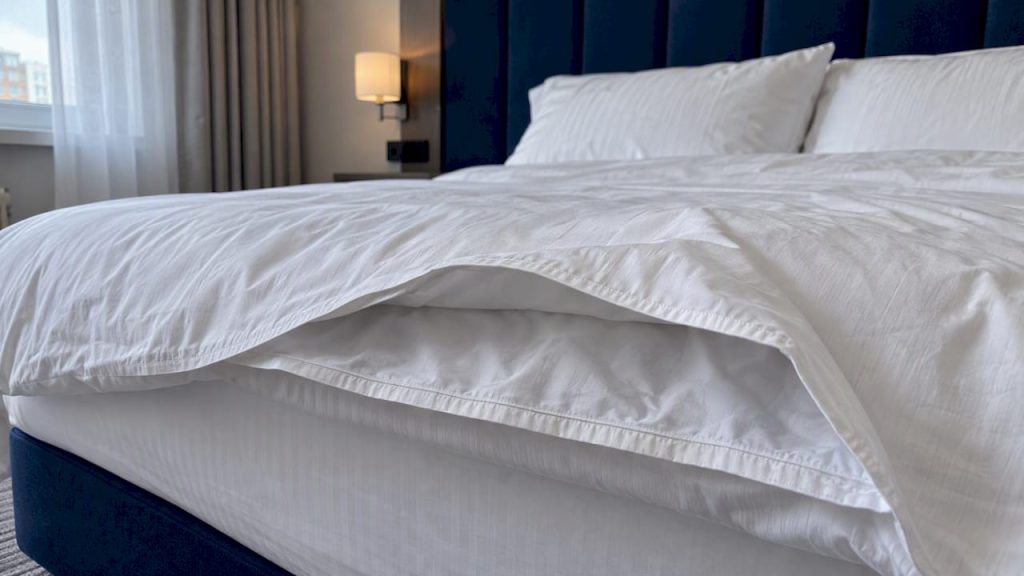
There are four closure types you will meet on duvet covers: envelope (an overlapping flap), zipper, buttons and ties. For a hotel, the right one depends on how fast housekeeping must change a bed, how the cover behaves in an industrial wash and what look you want in the room. This guide compares them as a procurement decision, not as a home-decor choice.
TL;DR
- Envelope closures have no hardware, so nothing can break or snag in the wash, and the cover is quick to make up. The trade-off is that the insert can shift if the overlap is too short.
- Zippers hold the duvet fully enclosed and look clean, but the zipper tape and slider have to survive your laundry cycles.
- Buttons and ties give a more decorative finish and suit boutique rooms, with more points to check for wear.
- Specify the closure together with overlap depth, corner ties and fabric weight, not as a single word on the order.
Table of Contents
- The main closure types at a glance
- Envelope closure: simple and wash-friendly
- Zipper closure: the tidy, fully enclosed option
- Button closure: a classic finish with more to inspect
- Tie closures and snaps: for design-led rooms
- How to choose: five questions for hotel buyers
- What to put in the specification
- Our perspective
- Get duvet covers made to your specification
- FAQ
- Sources
The main closure types at a glance
A duvet cover is a removable case for the duvet. Wikipedia’s entry on the duvet cover lists buttons, plastic clasps, zips and ties as the usual closures, and notes that a cover with no closure is known as flat, flap or envelope. In practice, buyers work with four options.
| Closure | How it works | Main strength | Main watch point |
|---|---|---|---|
| Envelope | Fabric flap overlaps at the opening | No hardware, fast to make up, easy to launder | Needs a deep overlap to keep the insert in |
| Zipper | Zip along one edge or the foot | Insert stays enclosed, tidy look | Zip can jam, rust or pop open if poorly made |
| Buttons | Row of buttons and buttonholes | Classic, decorative look | Buttons can crack or loosen in heavy washing |
| Ties | Fabric ribbons sewn in pairs | Soft, linen-style finish | Ties can knot in the wash and need regular checks |
None of these is right for every property. A 40-room city hotel with fast turnover has different needs from a boutique guesthouse or an AirBnB with a handful of apartments.
Envelope closure: simple and wash-friendly
An envelope closure is a fabric flap that overlaps to keep the duvet inside, with no zipper or buttons. It is the simplest construction, which is why it appears so often in hospitality bedding.
The advantages for a hotel are practical:
- Nothing to break. With no metal, plastic or buttons, there is nothing to catch other linens in the drum, nothing to scratch a washing machine and nothing to replace.
- Fast bed making. Housekeepers slide the duvet in through the overlap without fiddling with fasteners.
- Easier ironing and folding. The cover lies flat, which helps if you run it through a flatwork ironer.
- Lower risk of complaints. Guests never feel a zipper or button against the skin.
The weakness is security. If the overlap is shallow, the duvet can work its way out at the opening, especially on large beds. The fix is in the specification: ask for a generous overlap, and for corner ties inside the cover so the duvet stays anchored at all four corners. Corners are the first place where a cover and duvet drift apart.
For the same reason, envelope covers work best when the duvet size matches the cover size closely. A cover that is much larger than the insert will let the duvet slide around, whatever closure it has.
Zipper closure: the tidy, fully enclosed option
A zipper closes the opening completely, so the duvet cannot slip out and the bed looks neat when the cover is pulled flat. Many hotels like it for the clean line it gives at the foot of the bed.
Two details separate a good hotel zipper from a problem one:
- Hidden construction. A zipper sewn inside a fabric placket keeps the metal or plastic away from the guest and away from the other items in the wash.
- Quality of the zipper itself. In industrial laundering, the zipper goes through repeated heat, moisture and mechanical stress. A slider that loosens or tape that frays means the cover is out of service, even though the fabric is still fine.
Zippers also add a step to bed making and to inspection. Staff must close and check each one. If housekeeping time is your tightest constraint, count that in. Our guide on housekeeping efficiency textiles looks at how product choices affect minutes per room.
Button closure: a classic finish with more to inspect
Buttons give a covered look that many guests associate with a higher-end room. A row of buttons along the foot, on a crisp cotton or sateen cover, looks deliberate and finished.

The cost is maintenance. Every button is a point of failure. Hospitality washing includes long cycles, high temperatures and mechanical action, and an ordinary button can crack or loosen. Missing buttons then show up in guest rooms, and housekeeping has to stop and replace them or retire the cover.
If you choose buttons, ask about:
- how the buttons are attached (thread count in the stitching, reinforced facing around each buttonhole);
- the button material and whether it is made for industrial washing;
- how many buttons the opening has, since more points mean more checking.
The fabric under the buttons matters too. If you are comparing finishes, our article on sateen versus satin sheets explains what to read on the label.
Tie closures and snaps: for design-led rooms
Ties are pairs of fabric ribbons sewn along the opening. They suit linen-look bedding and boutique properties that want a relaxed, natural style. Snaps (press studs) are a less common cousin, mostly used for a flat, hidden fastening.
Ties are quiet and gentle on other linens, but they can tangle in the drum, and a torn tie leaves a gap. They are a design choice rather than an operational one. If your concept calls for them, plan for slightly longer inspection and keep spare covers on the shelf.
For how closures fit into the overall room look, see our notes on bedroom textile design ideas for hotel guest rooms.

How to choose: five questions for hotel buyers
Start from your operation, not from the catalog.
1. How fast must a room turn around? If you handle many same-day checkouts, the closure that is quickest to make up usually wins. That tends to be an envelope with corner ties.
2. How is the linen washed? In-house laundries and external laundries treat fasteners differently. If your laundry is rough on hardware, favor closures with none.
3. What is the room positioning? A business hotel can run envelope covers without any guest complaint. A boutique property may justify buttons or ties for the look.
4. How often will you replace covers? A cover is retired when its weakest component fails. With no zipper or buttons, that component is the fabric itself, which you control through weight and weave. Our guide on maximizing hotel textile durability and cutting costs covers this lifecycle thinking.
5. What is inside the cover? The duvet fill affects how much it slides and how heavy the insert is to handle. The hotel bedding fill types guide helps you match insert and cover.
A simple rule of thumb many hotel buyers use: choose envelope for volume and speed, zipper for a tidy finish where staff time allows, buttons or ties where design leads.
What to put in the specification
The word “envelope” or “zipper” alone is not a specification. Two covers with the same closure can behave very differently. When you request quotes, write down:
- Closure type and position: at the foot, at the side or at the head.
- Overlap depth for envelope covers, measured in centimeters, so that offers can be compared.
- Internal corner ties: yes or no, and how they are attached.
- Fabric composition and weight, so the cover survives your wash cycle.
- Cover size relative to duvet size, to prevent slipping.
- Stitching: reinforcement at the opening, where stress is highest.
- Hardware (if any): zipper type and button material, with a wash-resistance requirement.
Request a sample and run it through your own laundry process before you commit to a volume. Then inspect the opening and the corners after several washes. It is the most reliable test there is.
If you also need to decide between a duvet cover and top sheet for your rooms, our comparison of the duvet cover and the sheet sets out the washing and housekeeping differences.
Our perspective
In our experience supplying hotels, the closure is a laundry and housekeeping decision before it is a style decision. A cover that looks good on the first day but loses a button after a few weeks of industrial washing costs more than it saved.
That is why we approach it from the full chain. We import, design and produce, so the closure, the overlap, the fabric weight and the stitching are specified together and can be adjusted to your property, instead of being taken from a fixed catalog. Our work is designed around durability under industrial washing and consistent hotel-grade standards.
For most hotels in Albania and the region, we would start the conversation with an envelope cover with internal corner ties: no hardware to fail, quick to make up, simple to launder. Where a property wants a particular look, we can produce zipper, button or tie versions to the same quality standard, and we can make custom sizes when your duvets are not standard.
Since 1994, we have supplied hospitality businesses and we know that the best specification is the one your housekeeping team can use every day without thinking about it.
Xpert
Get duvet covers made to your specification
If you are planning a refit or a replacement cycle, we can supply and produce bedding for hotels and short-stay properties, with the closure and fabric chosen to suit your laundry and your guests. See our textiles for hotels and AirBnB page and send us your room count, bed sizes and washing method.

For custom sizes or a particular finish, our professional textile services cover made-to-order production.
FAQ
What is an envelope closure on a duvet cover?
It is an opening where one fabric panel overlaps another, like the back of an envelope, so the duvet stays inside without a zipper or buttons. It is also called a flap closure. The depth of the overlap decides how well the duvet stays in place.
Is an envelope closure good enough for a hotel?
Yes, it is widely used in hospitality because it has no hardware to break and is quick to make up. Choose a deep overlap and add internal corner ties so the duvet cannot slide out. Test a sample through your own laundry before ordering in volume.
Are zippers or buttons better on a duvet cover?
Zippers enclose the duvet fully and look tidy. Buttons give a classic look but add more points to inspect and replace. For high-turnover rooms, many buyers choose neither and go with an envelope; for design-led rooms, either can work if the hardware is made for industrial washing.
Do duvet covers need corner ties?
They are not required, but they help. Ties sewn inside the cover attach to loops on the duvet and keep the corners from bunching or shifting. They are especially useful with envelope closures.
Can I order a duvet cover in a custom size or closure?
Yes. We produce custom textiles for hospitality businesses, so closure, size and fabric can be specified to your beds and your laundry process. Contact us with your requirements for a quote.