


TL;DR:
- Balkan regional suppliers offer faster (7-10 days) and more cost-effective textile sourcing than Asian counterparts.
- High-volume procurement from reputable regional suppliers ensures consistent quality and operational reliability.
- Proper planning, QC checks, and supplier relationships are key to successful high-volume textile sourcing for hotels.
Many hospitality procurement managers assume that ordering textiles in large volumes locks them into rigid contracts, inflated prices, and slow delivery schedules. That assumption is wrong, and it costs hotels real money every season. The Balkan region sits in a uniquely advantageous position: direct proximity to Turkish and Bulgarian manufacturers means faster shipments, fewer intermediaries, and tighter cost control. This article walks you through the true economics of high-volume textile sourcing, what regional supply chains actually deliver in practice, and how to avoid the mistakes that turn a smart procurement strategy into an operational headache.
Table of Contents
- The true costs and logistics of textile sourcing
- Why high-volume supply ensures quality and reliability
- How Balkan supply chains cut costs and simplify procurement
- Pitfalls to avoid when scaling up textile supply
- What most hotels get wrong about textile supply and how to win
- How Gjergji H Tekstil helps hotels master textile supply
- Frequently asked questions
Key Takeaways
| Point | Details |
|---|---|
| Regional sourcing slashes costs | Hotels in the Balkans can reduce textile acquisition expenses by 30-50% by leveraging local and Turkish/Bulgarian suppliers. |
| Fast, reliable supply chains | Choosing high-volume regional sources means textile shipments arrive in days—not weeks—reducing operational risk for hotels. |
| Quality assured through volume | Bulk buying enables rigorous quality checks and ensures consistent guest experiences across all hospitality properties. |
| Procurement made easier | Local supply networks and customs benefits simplify forecasting, ordering, and logistics for hospitality managers. |
The true costs and logistics of textile sourcing
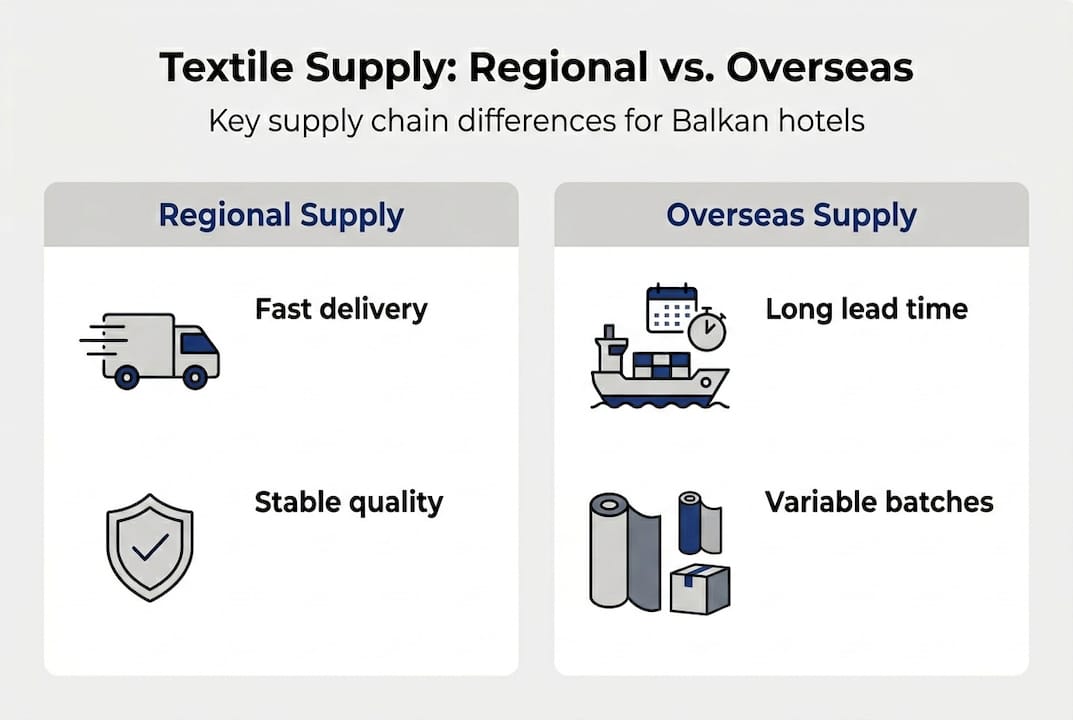
Sourcing textiles for a mid-sized hotel seems straightforward until you start adding up the real costs. Lead times from Asian manufacturers typically run 45 days or longer. Add customs clearance, freight forwarding fees, agent markups, and currency fluctuation buffers, and the landed cost can be 30 to 50 percent above the original quoted price. For a property that needs to refresh 200 rooms worth of linens before peak season, that gap is significant.
The calculus changes dramatically when you look at streamlining textile logistics through Turkish or Bulgarian suppliers. Trucks from Turkey typically arrive in 7 to 10 days. There are fewer agents in the chain, documentation is simpler under EU Customs Union frameworks, and communication happens in real time rather than across time zones.
Importing textiles for hotels from regional partners also reduces the risk of quality surprises. When your supplier is close, you can visit the facility, verify batch consistency, and resolve disputes quickly. That is not possible when your order is sitting in a container on the other side of the world.
The table below illustrates how these two supply routes compare across the metrics that matter most to procurement managers:
| Factor | Asia sourcing | Turkey or Bulgaria sourcing |
|---|---|---|
| Lead time | 45 or more days | 7 to 10 days |
| Logistics cost | High, multiple freight legs | Low, direct truck routes |
| Middlemen | Multiple agents | Few or none |
| Quality control | Limited, distant | On-site visits possible |
| Cost savings | Base price lower | 30 to 50% lower total landed cost |
The statistic worth emphasizing here is this: for Balkan hotels, proximity to Turkish and Bulgarian high-volume manufacturers cuts logistics costs and middlemen markups by 30 to 50 percent, with EU Customs Union benefits further simplifying cross-border movement. That is not a marginal gain. It is a structural cost advantage built into the geography.
Why high-volume supply ensures quality and reliability
There is a widespread belief that buying textiles in high volume means accepting whatever comes off the production line. In practice, the opposite is true. When you commit to regular, large orders with a reputable regional supplier, you earn leverage. Suppliers prioritize your batches, maintain dedicated production lines, and deliver consistent thread counts, weave grades, and colorfast treatments across every shipment.
For a hotel operation, consistency is everything. A guest checking into room 214 should find the same towel quality as a guest in room 412. Color variations, uneven weave density, or unexpected softness changes signal poor supply management to guests, even if they cannot articulate exactly what feels off. High-volume procurement through a reliable partner eliminates that inconsistency.
Regional suppliers offer a clear edge in procurement guidance for managers: local Bulgarian and near-Turkey partners ideal for mid and large resorts provide free QC samples as standard practice, allowing you to test actual production quality before committing to a full order.
Pro Tip: Always request a production sample from the actual batch, not a showroom display piece. Top regional suppliers routinely provide free QC samples. Use them to verify wash resistance, color retention, and shrinkage before signing any purchase order.
Here are the key quality risks that high-volume, continuous supply helps you avoid:
- Color batch variations that create a mismatched look across room categories
- Accelerated wear from lower-grade weaves that inflate replacement frequency
- Emergency reorders placed under time pressure, which typically come at a premium
- Supplier switching costs when a small vendor cannot fulfill a large seasonal order
The comparison below puts on-demand small orders against planned high-volume supply across four operational dimensions:
| Dimension | On-demand small orders | Planned high-volume supply |
|---|---|---|
| Quality consistency | Variable, batch by batch | Controlled, uniform across shipments |
| Unit pricing | Higher per item | Lower due to volume negotiation |
| Supply reliability | Dependent on spot availability | Secured through forward agreements |
| Supplier support | Minimal | Dedicated account management |
Choosing high-volume supply is not just a cost decision. It is a quality infrastructure decision. Hotels that get this right find that cutting textile costs through volume actually raises the guest experience standard rather than compromising it.
How Balkan supply chains cut costs and simplify procurement
Understanding why regional supply works is one thing. Knowing how to operationalize it is another. Here is a practical sequence procurement teams can follow to shift toward high-volume regional sourcing:
- Forecast annual textile needs by category. Break down your requirements by product type: bed linens, towels, table textiles, uniforms. Use occupancy data from the previous two seasons to project realistic quantities, and add a 15 percent buffer for unexpected demand.
- Qualify two to three regional suppliers. Request product catalogs, certifications, and QC sample kits. Evaluate on-time delivery records, minimum order quantities, and customization capabilities before shortlisting.
- Negotiate annual framework agreements. Lock in pricing for 12-month periods where possible. Suppliers reward commitment with better unit rates, priority production slots, and flexible delivery scheduling.
- Schedule shipments around operational peaks. For Balkan resorts, summer season preparation typically begins in March and April. Plan your bulk orders to arrive 30 days before you need them, accounting for any unpacking and inspection time.
- Manage ongoing replenishment through buffer stock. Rather than waiting until supplies run critically low, maintain a safety stock of roughly 20 percent of your monthly usage. This eliminates the emergency reorder problem entirely.
Pro Tip: Leverage bulk textile importing agreements with Balkan suppliers who maintain local warehouse stock. This buffer capacity means you can place smaller top-up orders between major shipments, giving you flexibility without sacrificing your negotiated pricing.
For step-by-step procurement teams new to regional sourcing, the customs simplification under EU-adjacent trade agreements is a genuine operational benefit. Fewer documentation requirements mean your logistics coordinator spends less time on paperwork and more on textile maintenance workflow optimization. Truck transit from Turkey runs 7 to 10 days compared to 45 or more days from Asia, and regional suppliers maintain extensive stock and operational capacity across the Balkans specifically to support this model.
Pitfalls to avoid when scaling up textile supply
High-volume procurement done well is highly effective. Done carelessly, it creates storage problems, cash flow strain, and quality surprises. Knowing where the common mistakes occur helps you sidestep them before they cost you.
The most frequent pitfalls procurement managers encounter when scaling up include:
- Over-ordering without projected needs data. Buying 12 months of stock based on last year’s peak occupancy without accounting for seasonal shifts wastes capital and creates storage pressure.
- Neglecting QC sample verification. Skipping the sample stage to save time is a false economy. A single defective batch across 150 rooms is far more expensive than the week it takes to run a proper quality check.
- Ignoring reorder timelines. Even with regional suppliers, lead times exist. Procurement managers who wait until stock is nearly exhausted end up paying spot-order premiums or facing operational gaps.
- Underestimating storage requirements. High-volume orders require adequate receiving and storage space. If your back-of-house cannot handle a full seasonal delivery, you will pay for off-site storage or accept partial shipments at less favorable terms.
Test samples via free QC from partners before any large commitment. Regional suppliers expect this request and provide it as standard. It is the single most effective risk reduction step available to procurement managers at no cost.
Before confirming any high-volume order, run through this checklist:
- Have we validated annual demand projections against actual operational data?
- Have we received and tested production-grade QC samples?
- Is our storage infrastructure ready to receive the full order volume?
- Have we confirmed the reorder schedule and built it into the procurement calendar?
- Do the textiles meet our property’s guest experience standards for feel, durability, and appearance?
Custom textile solutions providers can help you align product specifications with guest expectations before the purchase order is placed, removing a significant source of post-delivery disappointment. Hospitality standards are not generic. Your procurement decisions should not be either.
What most hotels get wrong about textile supply and how to win
Most hotels approach textile procurement as a cost-minimization exercise. They chase the lowest unit price, often overseas, and measure success by what they saved on the invoice. This is the wrong frame entirely.
The real risk in textile supply is not overstocking. It is the absence of a reliable regional relationship that can respond when something goes wrong, a missed shipment, a quality failure, a sudden spike in occupancy demand. Hotels that treat their textile suppliers as transactional vendors are always one disruption away from a guest-facing problem.
The winning approach is to treat regional suppliers as operational partners. That means sharing your occupancy forecasts, giving suppliers enough lead time to plan production, and building the kind of ongoing relationship where a phone call gets you a solution, not a ticketing system. The advisory for hospitality savings that comes with a genuine partnership is often worth more than any unit price discount.
Chasing the cheapest overseas option often results in longer lead times, quality inconsistencies, and limited recourse when things go wrong. Volume buying through regional partners is ultimately about operational reliability and protecting your property’s reputation, not just reducing cost per pillowcase.
How Gjergji H Tekstil helps hotels master textile supply
With more than 30 years supplying hospitality operations across Albania and the wider Balkan region, Gjergji H Tekstil understands what high-volume procurement actually requires at the property level.

The company offers wholesale textiles for hotels sourced through established import networks from Turkey, Italy, and beyond, combined with in-house production capabilities for customization. Whether you need custom textiles for hotels tailored to your brand standards or a straightforward bulk supply agreement for bed linens and towels, the team can structure a solution around your operational reality. Want to understand exactly how the supply chain works end-to-end? The production process explained gives you full visibility. Contact the team for a tailored consultation or to request QC samples for your next procurement cycle.
Frequently asked questions
How much can Balkan hotels save by sourcing textiles in high volume from local or Turkish suppliers?
Hotels typically save 30 to 50 percent on logistics and middlemen costs compared to ordering from Asia, thanks to regional proximity and EU Customs Union benefits that reduce freight stages and documentation complexity.
How quickly can hotels in the Balkans receive textile shipments from regional suppliers?
Textile shipments from Turkey or Bulgaria arrive in 7 to 10 days, significantly faster than the 45 or more days typical of Asian sourcing, which makes seasonal preparation far more manageable.
Do high-volume textile orders reduce quality risks for hotels?
Yes. Bulk orders placed with reputable regional suppliers ensure production batch consistency and allow for free QC sampling before full commitment, lowering the risk of receiving defective or inconsistent stock.
What pitfalls should hotels avoid when switching to high-volume textile supply?
Common mistakes include skipping QC sample verification, over-ordering without demand data, underestimating storage capacity, and failing to plan reorder schedules far enough in advance to avoid operational gaps.