


TL;DR:
- Hotel textiles in the Balkans must withstand industrial laundering, ensuring durability, comfort, and hygiene. Proper evaluation of weave, thread count, fabric quality, and regular testing are crucial for maximizing lifespan and operational efficiency. Local testing and tailored procurement help hotels avoid costly replacements and maintain guest satisfaction.
Walk through any well-run hotel in the Balkans and you will notice something: the rooms feel right. The sheets are cool and smooth, the towels are thick, and nothing looks worn out after a dozen wash cycles. That feeling is not accidental. It is the result of deliberate textile sourcing decisions made through a commercial-grade sourcing lens, where every fabric must perform under industrial laundering, sustain repeat guest use, meet hygiene standards, and deliver predictable total cost of ownership. This article gives hotel managers in Albania and the wider Balkans region a practical, criteria-driven framework to make those decisions with confidence.
Table of Contents
- Essential criteria for evaluating hotel textiles
- Bedding: Weave, thread count, and fabric structure
- Towels and bath textiles: Absorbency, weight, and durability
- Quality control tests: How to validate before buying
- Lifespan benchmarks and replacement schedules
- A fresh perspective: Why local testing and planning win over specs alone
- Get expert support for your hotel textile sourcing
- Frequently asked questions
Key Takeaways
| Point | Details |
|---|---|
| Prioritize commercial durability | Choose textiles engineered for industrial use, not just appearance or thread count. |
| QC test before large purchases | Require and review third-party textile test reports for every bulk order. |
| Balance comfort with operations | Select fabrics that maintain guest comfort and withstand commercial laundering conditions. |
| Plan for realistic lifespans | Build in replacement cycles based on tested wash benchmarks and usage, not just supplier promises. |
| Match textiles to local laundry | Validate samples in your hotel’s own washing and drying environment for the best results. |
Essential criteria for evaluating hotel textiles
With the stakes clear, let’s break down exactly what you should evaluate before choosing any textile for your hotel.
Selecting textiles for a hospitality operation is not the same as buying fabric for a household. The demands are fundamentally different. A single set of hotel bed linens can go through industrial washing dozens of times per year, exposed to high-temperature cycles, strong detergents, and mechanical stress that most consumer-grade products simply cannot withstand. Your evaluation framework must reflect that reality.
The core criteria every manager should assess before committing to a supplier or product line include the following:
- Durability under commercial laundering. Fabrics must maintain structural integrity, shape, and color through repeated industrial wash cycles. Certified durability approaches replicate hospitality conditions, measuring abrasion resistance, tear resistance, and color/shape retention under industrial washing and friction. Ask suppliers for documented test results, not just verbal claims.
- Guest comfort and handfeel. A fabric that survives washing but feels rough or scratchy is not fit for purpose. The balance between softness and operational durability is achievable but requires careful specification.
- Material certifications and allergen/hygiene compliance. OEKO-TEX Standard 100 and similar certifications confirm that fabrics are free from harmful substances. This is particularly relevant for guests with sensitivities and for properties targeting international standards.
- Total cost of ownership (TCO). Unit price is the starting point, not the endpoint. Factor in replacement frequency, laundry cost per cycle, and the labor cost of handling substandard items. A cheaper textile that wears out in 60 wash cycles is more expensive than a higher-grade option that lasts 150 cycles.
- Operational compatibility. This includes laundry machine capacity, detergent chemistry compatibility, drying temperatures, and your PAR level (the number of sets needed to keep rooms fully operational at all times, accounting for items in use, in laundry, and in storage).
Pro Tip: When comparing two textile options, calculate cost-per-wash-cycle rather than unit price. Divide the unit cost by the expected wash-cycle lifespan. That single number tells you far more about real value than any brochure. You can also maximize durability and cut costs by standardizing fabric specifications across your property.
Bedding: Weave, thread count, and fabric structure
With a grasp of general criteria, let’s zoom into one of the most critical categories: hotel bedding.
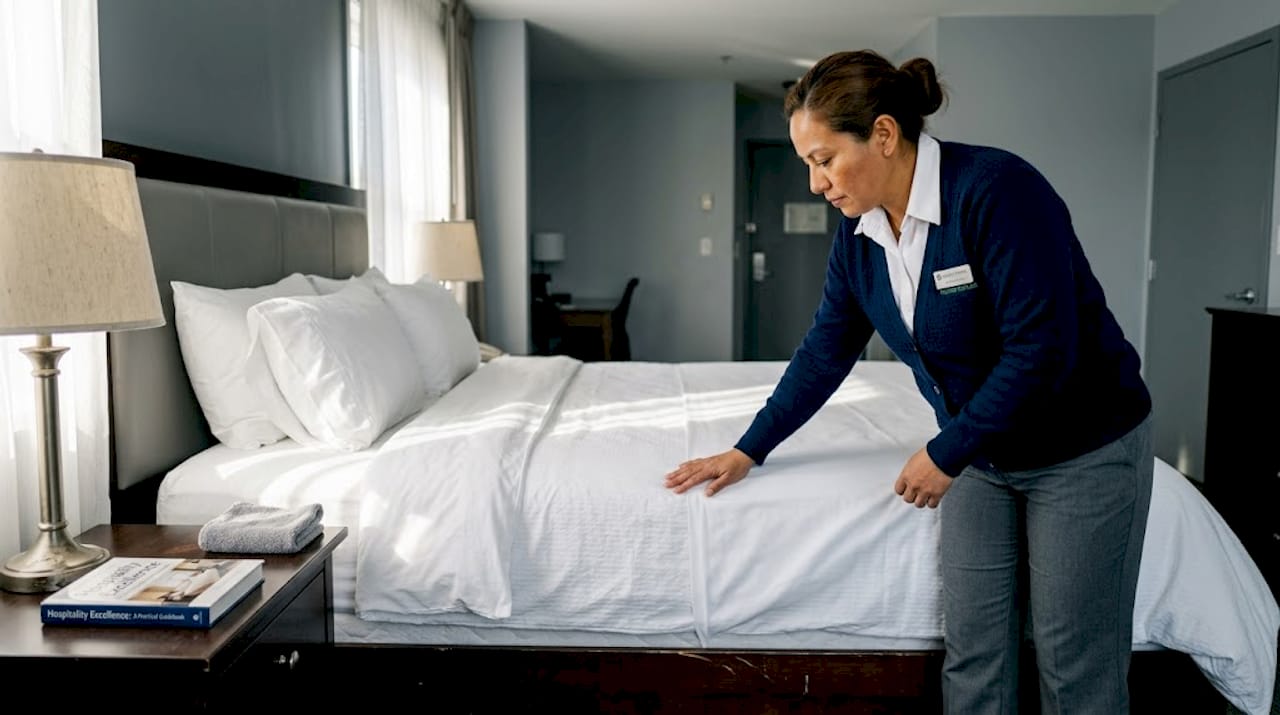
Thread count is one of the most misunderstood metrics in hotel textile purchasing. It measures how many threads are woven per square inch, but a high number is not automatically better. Thread count should be treated cautiously: ultra-high counts can actually reduce breathability and performance under commercial laundry if the underlying yarn quality is poor. Marketing inflates thread count by using multi-ply yarns, which distorts the number without delivering real benefits.
What matters more is weave structure. Here is how the most common options perform in hotel environments:
- Percale weave (plain weave). A one-over, one-under structure that produces a crisp, matte finish. It is cool to the touch, highly breathable, and performs consistently under industrial washing. Ideal for warm-climate properties, which is very relevant for the Albanian coastal and summer resort market.
- Sateen weave. A four-over, one-under pattern that produces a smooth, silky surface with a slight sheen. It feels luxurious but is more prone to pilling and snagging over time compared to percale. Best suited for upper-tier or boutique properties where the premium feel is part of the guest proposition.
- Twill weave. Recognizable by its diagonal rib pattern. It offers good durability and a substantial feel but is less commonly used in bed sheets. More relevant for heavier textile items.
For practical thread count ranges, hotels prioritize weave structure over thread count targets and match those targets to their wash, chemical, and dryer conditions. A range of 200 to 300 thread count in a good percale weave delivers the right balance of handfeel and stability for most Albanian and Balkan hotel tiers. Budget operations can perform well at 180 to 200; upper-market properties may push to 300 to 400 in sateen.
Key insight: A 250 thread count percale sheet sourced from a certified supplier will consistently outlast and outperform a 600 thread count sheet made with low-grade multi-ply yarn. Specify by weave and yarn quality, not marketing numbers alone.
Common quality control pitfalls in bedding procurement include excessive shrinkage after the first few commercial wash cycles, colorfastness failures that cause white linens to look gray or cream items to yellow, and pilling caused by loose fibers from short-staple cotton. Before you approve a bedding procurement order, sample laundering under your actual operational conditions is essential. Our detailed procurement guide for bedding outlines the full specification process.
Towels and bath textiles: Absorbency, weight, and durability
Bedding is just one part. Towels and bath textiles are another high-wear category needing their own criteria.
Towels operate under some of the most punishing conditions in a hotel. They are used multiple times per day, washed at high temperatures, and exposed to guest skin products, pool chemicals, and bleach-based detergents. The key performance factors are:
- GSM (grams per square meter). This is the standard weight measure for towels. A GSM of 400 to 500 suits budget and mid-range hotels well, offering an acceptable balance of absorbency and drying time. Luxury properties typically work in the 600 to 700 GSM range for a denser, more plush feel. Higher GSM means heavier towels, which affects drying time and laundry load capacity.
- Edge and hem construction. Double-stitched or dobby-bordered hems extend towel lifespan significantly. Poorly finished edges fray quickly under commercial washing, shortening usable life and creating a worn appearance.
- Absorbency rating. The loop pile construction in terry cloth creates the surface area needed for rapid water absorption. Longer loops absorb faster but are more prone to snagging. Twisted loops are more durable but absorb slightly more slowly.
For high-usage hotel towels, picking for absorbency, weight balance, softness, and resistance to frequent washing must include laundering and care practices as part of the selection equation. This means you should test not only the new towel but the towel after 20 and 50 wash cycles.
| GSM range | Best suited for | Typical lifespan (wash cycles) |
|---|---|---|
| 300 to 400 | Budget hotels, gym towels | 80 to 100 |
| 400 to 500 | Mid-range hotels, resorts | 100 to 130 |
| 600 to 700 | Luxury and upper-tier properties | 120 to 150 |
Industrial laundry is particularly hard on towels when water hardness is high, which is common across several regions in Albania and the Balkans. Hard water deposits reduce absorbency over time and create stiffness. Incorporating a periodic descaling or softening step into your laundry protocol can extend towel lifespan by 20% or more.
Pro Tip: Optimize your textile maintenance workflow by separating towel cycles from sheet cycles. Towels tolerate higher temperatures and more aggressive detergents; sheets require gentler chemistry to protect fiber integrity.
Quality control tests: How to validate before buying
Even after selecting specs and samples, robust quality control is your safeguard before major purchases.
Visual inspection is not enough. A fabric can look perfect fresh off the production line and fail within 30 wash cycles. Standard QC tests for hotel linens include tensile and tear strength, shrinkage, abrasion resistance such as Martindale or Wyzenbeek methods, pH and colorfastness, and seam integrity. Require documented evidence of these tests before approving any bulk purchase.
Here is the practical sequence for a pre-purchase QC plan:
- Request supplier-provided test certificates from accredited third-party labs covering the specific items you are ordering.
- Take sample units from the delivery batch, not from a pre-approved sample pack.
- Run at least 10 accelerated wash cycles under your property’s actual laundry conditions (temperature, detergent type and concentration, dryer settings).
- Measure post-wash dimensions against pre-wash to calculate shrinkage percentage. Industry tolerance is typically under 3% for sheets.
- Assess colorfastness by comparing post-wash color against the original sample under neutral lighting.
- Conduct a simple abrasion check by rubbing the fabric against a standardized surface and observing pilling or fiber loss.
| Test type | What it checks | Minimum standard |
|---|---|---|
| Tensile strength | Fabric resistance to pulling force | Per supplier specification |
| Shrinkage | Dimensional stability post-wash | Under 3% for sheets |
| Abrasion (Martindale) | Surface wear resistance | Category-specific cycles |
| Colorfastness | Dye stability under washing and light | Grade 4 minimum (ISO scale) |
| Seam integrity | Stitching strength under tension | No seam failure at rated load |
Testing textiles with your textile fabric testing process before committing to large orders is one of the highest-return activities in hotel operations. The cost of running a proper QC test is minimal compared to the cost of replacing an entire linen inventory 12 months ahead of schedule.
Lifespan benchmarks and replacement schedules
The best selection can fail without the right maintenance and replacement strategy.
Every textile category has a realistic operational lifespan, and planning around that lifespan is what separates operationally mature hotels from those constantly reacting to linen failures. Sheets commonly target 100 to 150 commercial wash cycles, and replacement schedules for pillows, sheets, and blankets should be operationalized to prevent guest-impacting wear.
| Textile item | Expected lifespan (wash cycles) | Recommended replacement interval |
|---|---|---|
| Bed sheets | 100 to 150 | Every 12 to 24 months |
| Bath towels | 80 to 130 | Every 12 to 18 months |
| Pillowcases | 100 to 150 | Every 12 to 24 months |
| Pillows | 50 to 80 (use cycles) | Every 18 to 24 months |
| Duvet covers | 80 to 120 | Every 18 to 24 months |
PAR level planning is directly linked to lifespan. PAR stands for the total number of textile sets in circulation per room, including one set in the room, one in laundry, and one in storage. A PAR of 3 to 4 is standard practice. Running a PAR of 2 is a false economy; it forces textiles through laundry faster with less recovery time, accelerating wear and increasing replacement frequency.
Key operational practices to protect lifespan include:
- Sort by color and soil level before washing to prevent cross-contamination and dye transfer.
- Avoid overloading laundry machines, which increases mechanical abrasion per cycle.
- Use pH-neutral detergents where possible, as high-alkaline formulas degrade cotton fiber faster.
- Store textiles in cool, dry conditions away from direct sunlight to prevent fiber degradation between uses.
Pro Tip: Build a simple tracking spreadsheet per textile category. Record purchase date, quantity, and wash cycle count. When a category approaches 80% of its expected lifespan, initiate procurement for replacements. You can refer to our resource on how to extend textile lifespans and our hotel textile turnover guide for more structured planning frameworks.
A fresh perspective: Why local testing and planning win over specs alone
International benchmarks and supplier spec sheets are useful starting points. But here is what years of working with hospitality businesses across Albania and the Balkans has shown us: the spec sheet does not wash your sheets. Your laundry does.
Textile performance is contextual. Water chemistry in Tirana is different from water chemistry in a coastal Saranda resort or a mountainside property in North Macedonia. Detergent formulations vary. Dryer temperature calibration varies. These variables mean that a product certified to perform to a European industrial standard may behave very differently under your specific conditions. The practical selection workflow for Albania and Balkans hotels should follow this sequence: map each textile category to your wash, dry, and chemistry capability; sample and validate under your own commercial laundry conditions; lock acceptance QC tests covering shrinkage, tensile and tear strength, abrasion, and colorfastness; then plan PAR and replacement intervals so guest comfort never degrades into tired, worn linen states.
This is the insight that separates hotels with strong linen programs from those that perpetually over-spend on replacements. The manager who validates samples in their own laundry room before buying 500 sets will outperform the manager who trusts the brochure every single time. For region-specific guidance, our contextual hotel textile tips cover these local operational realities in more detail.
Get expert support for your hotel textile sourcing
Selecting the right textiles for your hotel means navigating a complex set of trade-offs between comfort, durability, cost, and operational fit. The criteria and frameworks in this article give you the foundation, but applying them to your specific property requires experience, reliable suppliers, and access to properly tested product lines.
Gjergji H Tekstil has been supplying hospitality businesses across Albania and the Balkans since 1994, working with international hotel brands including Marriott, Sheraton, and Meliá. Whether you need wholesale hotel textiles sourced from certified production facilities, or you want to work through the full specification and testing process with a team that understands your operational environment, we offer a genuinely integrated service. From import to delivery, our supply chain is designed to give you competitive pricing without compromising on standards. Explore our professional textile selection tips or contact us directly to discuss your property’s requirements.
Frequently asked questions
What is the ideal thread count for hotel sheets?
A 200 to 300 thread count is optimal for most hotels, balancing feel, breathability, and durability under commercial laundering; ultra-luxury properties may use up to 400, but higher counts can reduce airflow and wash performance.
How often should hotel towels and linens be replaced?
Sheets typically last 100 to 150 commercial wash cycles, which translates to roughly 12 to 24 months of use; towels and pillows often require replacement sooner depending on usage frequency and laundry conditions.
What are the most important QC tests for hotel textiles?
Critical QC tests for linens include tensile and tear strength, shrinkage, abrasion resistance (Martindale or Wyzenbeek methods), pH and colorfastness, and seam integrity, all of which should be documented before any bulk purchase.
How can hotels improve textile lifespan and reduce costs?
Maintain appropriate PAR levels and care practices to prevent overuse and short-cycling through laundry; commercial-grade textiles matched to your wash chemistry and drying conditions will consistently deliver a lower total cost of ownership than budget alternatives.
Recommended
- Expert tips for selecting textiles to elevate hotel and dining spaces
- How to maximize hotel textile durability and cut costs
- Textile cost efficiency explained: Maximize value in hospitality
- Why invest in custom textiles for hotels: boost guest experience