

TL;DR:
- Effective management of linen movement reduces costs and maintains guest-ready supply in hospitality. RFID, AI, and lean strategies like 5S streamline inventory, reduce waste, and lower linen loss rates significantly. Centralized procurement enhances costs savings and inventory control across multiple hotel properties.
Hospitality textile flow optimization is defined as the systematic management of linen and textile movement across procurement, storage, laundry, and distribution to reduce costs and maintain consistent guest-ready supply. Hotel operations managers who master this process cut annual linen loss rates, free up capital tied in excess stock, and keep housekeeping running without delays. The core enablers are RFID item-level tracking, AI-driven PAR level forecasting, lean management tools like 5S and Value Stream Mapping, and centralized procurement standards. Gjergjihtextil has supported hotels across the region for over 30 years by building supply chains that make this kind of operational discipline possible from day one.
How to optimize hospitality textile flow: foundations and tools
Efficient textile flow in hospitality starts with knowing exactly what you have, where it is, and how fast it moves. Without that baseline, every other improvement is guesswork.
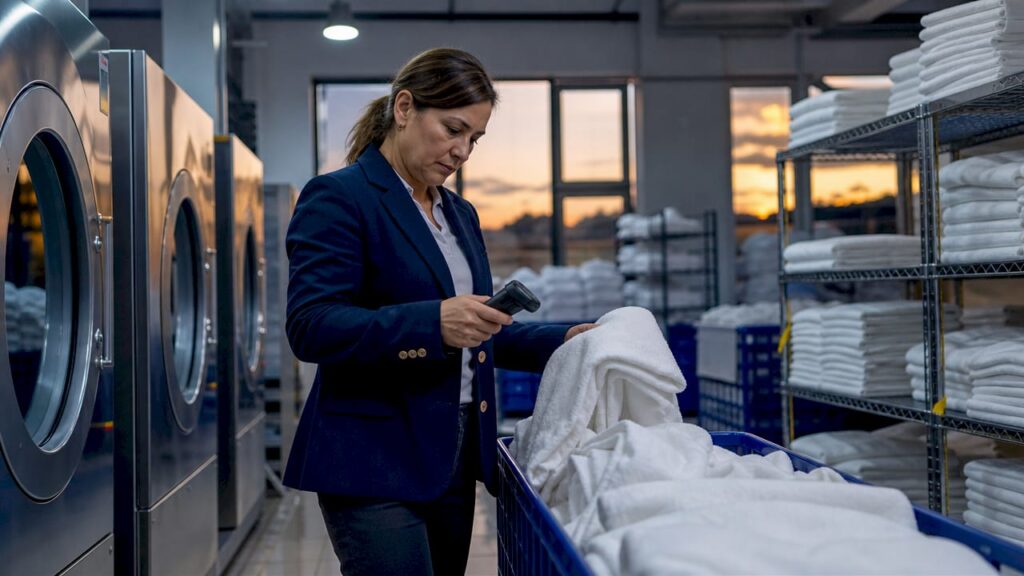
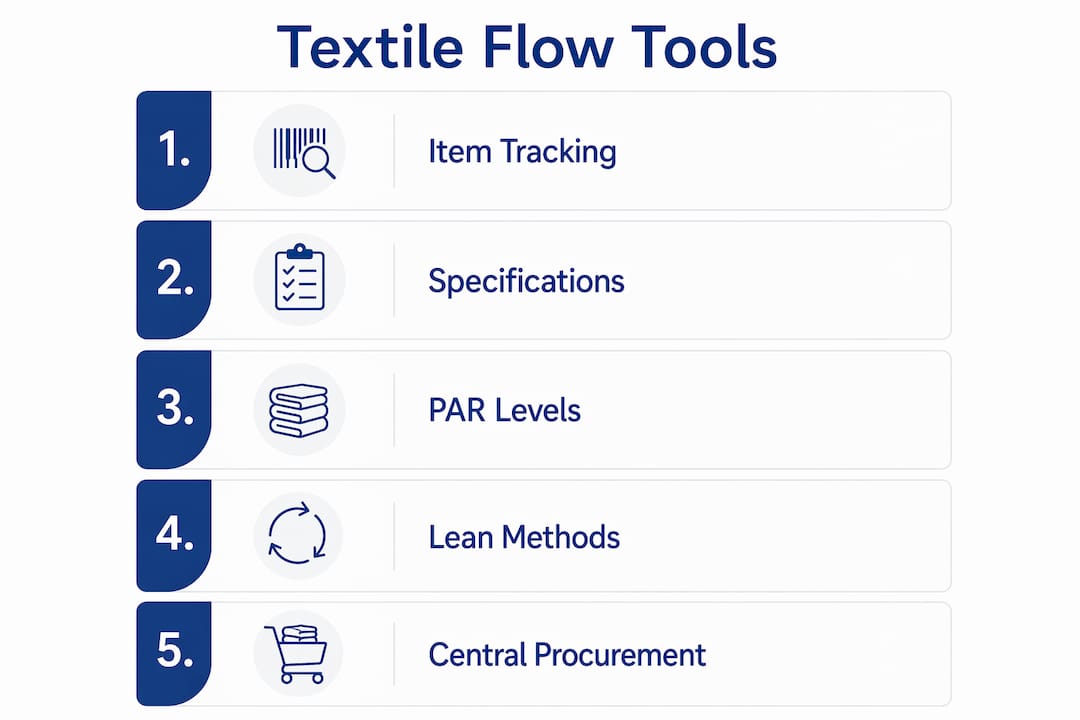
The first tool to deploy is item-level tracking. RFID tags designed for industrial laundering survive hundreds of wash cycles and report location data automatically. This replaces manual counts, which are slow and error-prone, with real-time visibility across every linen category. Before committing to a full rollout, a 30–60 day pilot phase validates system accuracy and builds staff confidence. Skipping the pilot is the single most common reason RFID projects stall after deployment.
The second foundation is standardized technical specifications. Procurement managers should define GSM weight, yarn count, and weave type for every linen category before placing orders. Standardization prevents the accumulation of incompatible stock and makes it possible to compare supplier quotes on equal terms. Gjergjihtextil works with hotels to set these specs upfront, which removes ambiguity from every subsequent reorder.
The third element is PAR level discipline. PAR (Periodic Automatic Replenishment) defines the minimum quantity of each textile category needed to keep operations running through a full wash cycle. Most hotels without tracking systems carry 6+ PAR levels as a buffer against uncertainty. That excess stock ties up cash and storage space that could serve other operational needs.
Pro Tip: Map your current textile flow on paper before buying any technology. Identify where items sit idle longest. That single exercise reveals the highest-value intervention point in your operation.
| Tool | Primary benefit |
|---|---|
| RFID item tagging | Real-time location and loss tracking |
| PAR level system | Prevents overstocking and stockouts |
| GSM/yarn count specs | Standardizes procurement and quality |
| 5S and Value Stream Mapping | Reduces handling time and waste |
| AI forecasting | Adjusts PAR levels to actual demand |
How does technology improve textile inventory optimization?
RFID and AI forecasting work together to cut two of the biggest cost drivers in hospitality linen management: excess inventory and unexplained losses.
On the inventory side, RFID combined with AI forecasting reduces PAR levels from 6+ down to 3–4 while cutting annual loss rates from 15–20% to 3–5%. That is a direct reduction in capital tied up in stock and a measurable drop in replacement spend. For a 200-room hotel, that difference can represent tens of thousands of dollars annually in avoided purchases.
On the loss side, automated dashboards built on RFID data allow operations managers to run root cause analysis on missing items. You can see whether losses concentrate in a specific laundry shift, a particular floor, or a single linen category. Pool towels experience annual loss rates of 20–30% in hospitality settings. That rate drops sharply when each towel carries a tag and every movement is logged.
Lifecycle tracking is a less discussed benefit. When you know how many wash cycles each item has completed, you can retire linens before they fail in a guest room rather than after. This extends usable linen life and protects the guest experience. Industry experience shows that lifecycle tracking extends linen lifespan by 20–30% compared to time-based replacement schedules.
RFID also changes how you pay for laundry. Per-item billing replaces weight-based billing when RFID tracking is active. Per-item billing is more predictable and easier to audit, which matters when laundry costs represent a significant share of housekeeping’s operating budget.
- Real-time location data eliminates manual linen counts
- AI demand forecasting adjusts reorder points by season and occupancy
- Lifecycle dashboards flag items approaching end of service life
- Per-item laundry billing replaces unpredictable weight-based invoicing
- Loss concentration reports identify specific failure points in the flow
What lean management strategies reduce waste in hotel textile operations?
Lean management applied to textile operations treats every unnecessary movement, wait time, or storage step as waste to be removed. The two most practical tools are 5S and Value Stream Mapping.
5S (Sort, Set in order, Shine, Standardize, Sustain) applied to a hotel linen room produces immediate results. Sorting removes obsolete or damaged stock. Setting in order means every category has a fixed location that any staff member can find without asking. Standardizing creates written procedures that survive staff turnover. A lean case study in textile operations found that applying these tools reduced item retrieval time by 30%, cut waste by 25%, and dropped machine idle time by 45%. Those are not marginal gains. They represent real labor hours recovered and equipment used more productively.
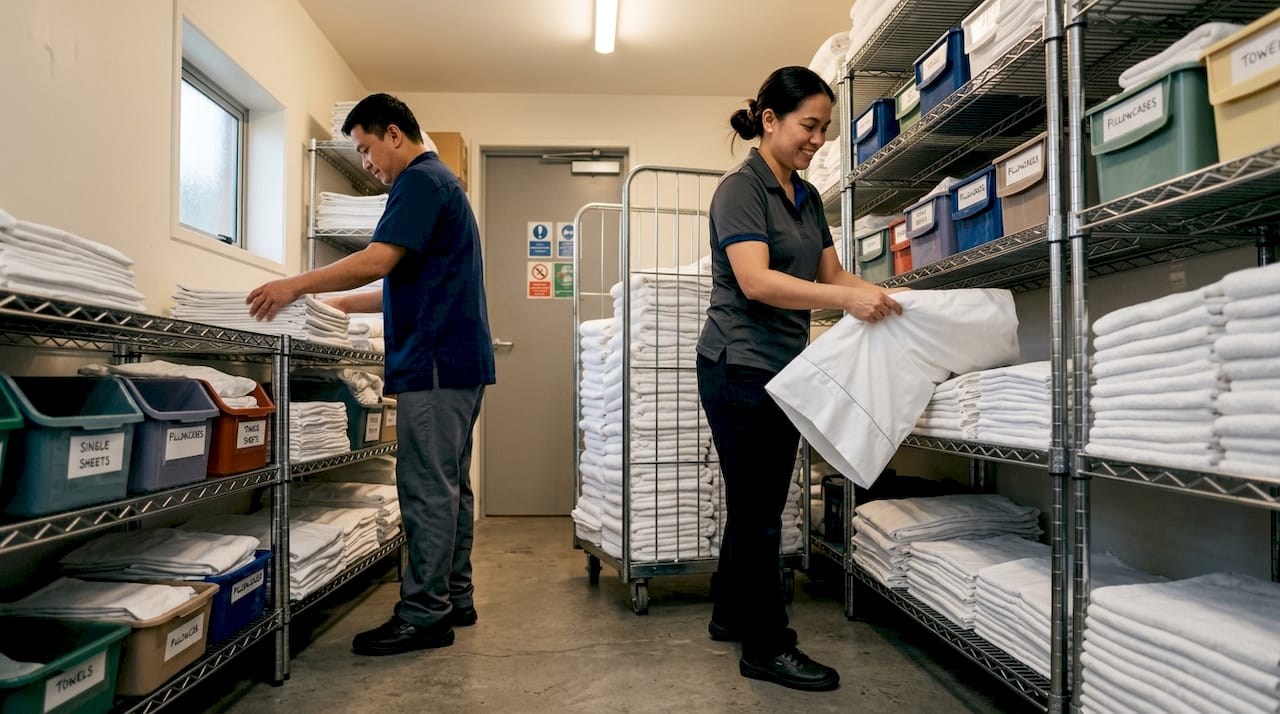
Value Stream Mapping traces the path of a single linen item from delivery to guest room and back to storage. The map reveals every handoff, wait, and redundant step. Most hotels discover that linens spend more time waiting between steps than they spend in actual use or processing. Transitioning from storage-heavy to flow-focused systems reduces handling times and frees capital tied in unused stock.
Pro Tip: Run a Value Stream Map for your highest-volume linen category first, typically bed sheets. The pattern you find there will repeat across every other category, so one mapping exercise gives you a template for the whole operation.
The layout of your linen storage and laundry areas directly affects flow speed. Placing clean linen storage adjacent to the laundry exit, and soiled collection points near elevator banks, cuts the distance staff travel per cycle. That reduction compounds across hundreds of daily movements.
- Map the current state of your textile flow from delivery to guest room
- Identify the three longest wait times in the flow
- Apply 5S to linen storage areas before addressing laundry layout
- Measure retrieval times and machine idle time as your baseline metrics
- Run a 30-day improvement cycle and compare results to baseline
How does centralized procurement benefit multi-location hotel chains?
Centralized procurement is the practice of consolidating textile purchasing decisions at the group level rather than allowing individual properties to buy independently. The operational and financial benefits are significant.
The most immediate benefit is the elimination of Maverick Buying. When individual properties purchase ad hoc, they pay retail or near-retail prices, accept inconsistent quality, and accumulate incompatible stock that cannot be redistributed across the group. Centralizing linen procurement standardizes technical specs and logistics, avoids Maverick Buying, and secures lower unit costs. That cost reduction is not a one-time event. It compounds with every reorder cycle.
Distribution strategy is the second decision centralization forces you to make deliberately. Hub and Spoke models route all stock through a central warehouse before distribution to properties. Direct Drop models ship from supplier to property, bypassing the warehouse. Hub and Spoke suits groups that need tight quality control and buffer stock management. Direct Drop suits groups with reliable suppliers and predictable demand. Gjergjihtextil’s supply chain structure supports both models depending on the client’s property footprint.
Logistics cost reduction is another lever that centralization unlocks. Vacuum packing pillows and duvets reduces shipping volume by 50–60%, which cuts landed costs substantially on bulk international orders. That saving is only accessible when you order in sufficient volume, which centralized procurement makes possible.
Vendor-Managed Inventory (VMI) is a natural extension of centralized procurement. Under VMI, the supplier manages replenishment based on agreed stock levels, reducing stockout and overstocking risks for the hotel group. VMI works best when the supplier has visibility into consumption data, which RFID tracking provides. For hostel and budget hospitality operators, similar linen flow principles apply at smaller scale, with fast movement from delivery to room as the primary objective.
- Centralized specs prevent incompatible stock accumulation across properties
- Volume purchasing secures lower unit costs and better supplier terms
- Hub and Spoke distribution suits quality-controlled, buffer-managed groups
- Direct Drop suits properties with stable demand and trusted suppliers
- VMI transfers replenishment responsibility to the supplier, reducing internal workload
Key Takeaways
Efficient hospitality textile flow requires combining item-level tracking, lean operational processes, and centralized procurement into a single coordinated system.
| Point | Details |
|---|---|
| Deploy RFID with a pilot phase | Run a 30–60 day pilot before full rollout to validate accuracy and staff adoption. |
| Reduce PAR levels with AI forecasting | AI-driven forecasting cuts PAR from 6+ to 3–4, freeing capital and storage space. |
| Apply lean tools to linen operations | 5S and Value Stream Mapping reduce retrieval time, waste, and machine idle time measurably. |
| Centralize procurement to cut costs | Group-level purchasing eliminates Maverick Buying and unlocks volume discounts. |
| Use vacuum packing on bulk orders | Packing pillows and duvets under vacuum cuts shipping volume by 50–60% on large orders. |
What I’ve learned about textile flow that most guides skip
Most articles on hospitality linen management treat technology as the solution. In practice, technology reveals problems that already exist. RFID does not fix a poorly designed linen room. It shows you exactly how poorly designed it is, which is valuable but only if you are prepared to act on what you find.
The operations managers I respect most start with the physical flow before they buy a single tag. They walk the path a sheet takes from the laundry exit to a made bed and count every unnecessary step. That exercise costs nothing and produces a prioritized list of improvements that technology can then accelerate.
The second thing most guides miss is the human side of pilot programs. A 30–60 day RFID pilot is not just a technical validation. It is the period when housekeeping staff decide whether they trust the system. If the pilot is designed without their input, adoption stalls regardless of how accurate the technology is. The best pilots I have seen involve frontline staff in designing the tagging workflow from the start.
On procurement centralization, the resistance usually comes from property-level managers who fear losing purchasing autonomy. The practical answer is to centralize the specification and the supplier relationship while giving properties flexibility on timing and volume within agreed parameters. That structure captures the cost benefits without creating the friction that kills compliance.
The 2026 trend worth watching is AI forecasting integrated directly with property management systems. When occupancy data feeds directly into linen reorder logic, PAR levels adjust automatically to seasonal demand. That integration is available now, and the hotels that deploy it will carry meaningfully less inventory than those still running static PAR calculations.
— Xpert
Gjergjihtextil: a supply partner built for this kind of operation
Gjergjihtextil has supplied wholesale hotel textiles to properties including Meliá, Marriott, and Sheraton for over 30 years. That track record is built on supply chain control from import through distribution, not just product availability. For hotel operations managers and procurement specialists implementing the strategies covered here, Gjergjihtextil offers standardized technical specifications, bulk pricing that supports centralized procurement models, and advisory support on textile selection for durability under industrial washing cycles. You can also review textile selection guidance to align your linen specs with guest comfort and cost targets before your next procurement cycle.
FAQ
What is hospitality textile flow optimization?
Hospitality textile flow optimization is the process of managing linen movement across procurement, storage, laundry, and distribution to reduce costs and maintain consistent supply. The goal is to eliminate idle stock, cut losses, and keep guest-ready linens available without overstocking.
How much can RFID reduce linen loss rates?
RFID combined with AI forecasting reduces annual linen loss rates from 15–20% down to 3–5%. Pool towels, which experience the highest loss rates at 20–30% annually, show the sharpest improvement with item-level tracking.
What is a PAR level in hotel linen management?
A PAR level is the minimum quantity of each linen category needed to sustain operations through one full wash cycle. Hotels without tracking systems typically carry 6+ PAR. AI-driven forecasting reduces that to 3–4 PAR, freeing capital and storage space.
How does centralized procurement reduce textile costs?
Centralized procurement eliminates Maverick Buying by individual properties, standardizes technical specifications, and enables volume purchasing that secures lower unit costs. Vacuum packing bulky items like pillows and duvets further cuts shipping costs by 50–60% on large orders.
What lean tools apply directly to hotel linen operations?
5S and Value Stream Mapping are the most practical lean tools for hotel textile operations. Applied together, they have reduced item retrieval time by 30%, waste by 25%, and machine idle time by 45% in documented textile facility case studies.