

TL;DR:
- Textile rotation involves cycling linens through usage, laundering, and storage to maintain quality and availability. Implementing a 3-par to 4-par system with FIFO discipline and proper storage conditions prevents shortages and fabric degradation. Proper staff training and seasonal adjustments are essential for optimizing costs, guest experience, and linen lifespan.
Textile rotation is defined as the systematic process of cycling hotel and restaurant linens through use, laundering, and storage to maintain consistent availability and fabric quality. Without a structured rotation system, properties run short during peak occupancy, accelerate linen wear, and create inconsistent guest experiences. The industry standard for managing this is the par level system, specifically the 3-par to 4-par model, which Gjergjihtextil recommends to every hospitality client it serves. Knowing how to organize textile rotation is not a housekeeping detail. It is a core operational decision that directly affects your cost per cover and your guest’s first impression.
How to organize textile rotation: key components and prerequisites
A functioning rotation system requires the right inventory depth before anything else. The 3-par to 4-par system ensures one set is in active use, one is in the laundry cycle, one is clean and ready to deploy, and a fourth set rests to prevent shortages during peak occupancy. Skipping the fourth par is the most common cause of laundry bottlenecks in busy hotels and restaurants.
Beyond inventory depth, your storage environment determines whether rotation works in practice. Shelving must be dry, well-ventilated, and organized by linen category. Towels, bed linens, tablecloths, and napkins each need dedicated zones. Mixing categories creates sorting delays and slows the entire rotation cycle.
Two inventory control methods work especially well in hospitality settings:
- FIFO (First In, First Out): New stock goes behind older stock. Staff always pull from the front, so every item rotates evenly through the wash cycle.
- Two-bin Kanban: One bin holds active stock. When it empties, the second bin triggers a reorder. This visual system prevents both shortages and overstock without requiring software.
- Par level tracking: A physical or digital log records how many sets are in each stage of the cycle at any given time.
- Seasonal adjustment: Par levels should increase by at least one set during peak season to absorb higher turnover without service gaps.
Pro Tip: Label each shelf section with the linen category and the par count. Staff can confirm inventory status at a glance without counting every item.
| Storage Factor | Why It Matters |
|---|---|
| Ventilation | Prevents mildew and fabric degradation between cycles |
| Dedicated zones by category | Speeds sorting and reduces handling errors |
| Accessible shelving height | Reduces the temptation to top-load, which causes uneven wear |
| Climate control | Protects fabric tensile strength, especially for cotton linens |
How to implement textile rotation step by step in hotels and restaurants
A clear sequence keeps the rotation cycle consistent regardless of staff turnover. Follow these steps to build a system your team can execute without supervision.
-
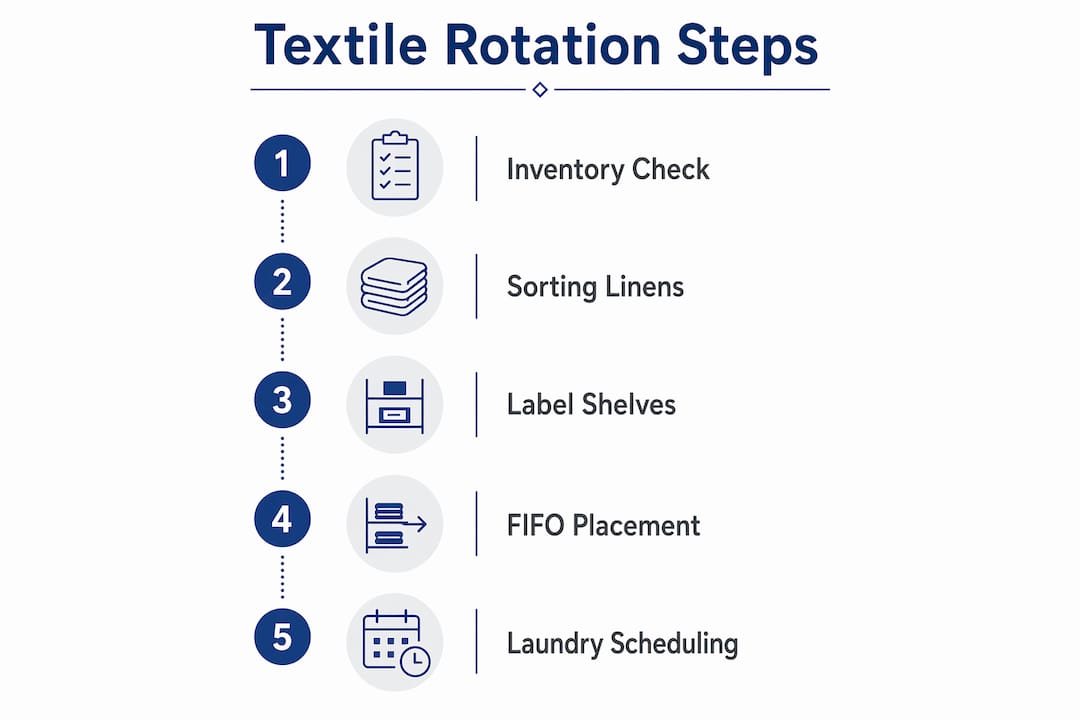
Receive and sort on arrival. When clean linens return from laundry, sort immediately by type: bed sheets, pillowcases, towels, tablecloths, napkins. Never store unsorted loads. Mixed piles create delays and encourage top-loading.
-
Apply FIFO at the shelf. Place freshly laundered items at the back of each shelf section. FIFO rotation places fresh linens behind older stock so the oldest textiles are always used first. This prevents some items from being washed excessively while others sit unused.
-
Enforce the 24-hour resting rule. Luxury hotels apply a 24-hour resting period after industrial washing and ironing to allow cotton fibers to rehydrate. This increases softness and tensile strength considerably. A linen pulled straight from the dryer and put into service skips this recovery window and wears out faster.
-
Track the laundry turnaround. A 24-hour laundry turnaround is the industry standard for active hospitality businesses. It keeps linens fresh and prevents stains from setting permanently. If your laundry partner cannot meet this benchmark consistently, your rotation system will break down regardless of how well you manage the storage side.
-
Log each cycle. Record the date each set enters laundry and the date it returns. A simple spreadsheet or a whiteboard log works. The goal is to identify which sets are cycling too frequently and which are sitting idle.
-
Train staff on the protocol. Rotation fails when staff improvise. Every team member who handles linens needs to understand FIFO placement, par level expectations, and what to do when a set is damaged or stained. A 15-minute onboarding session with a visual shelf diagram is enough to align a new hire.
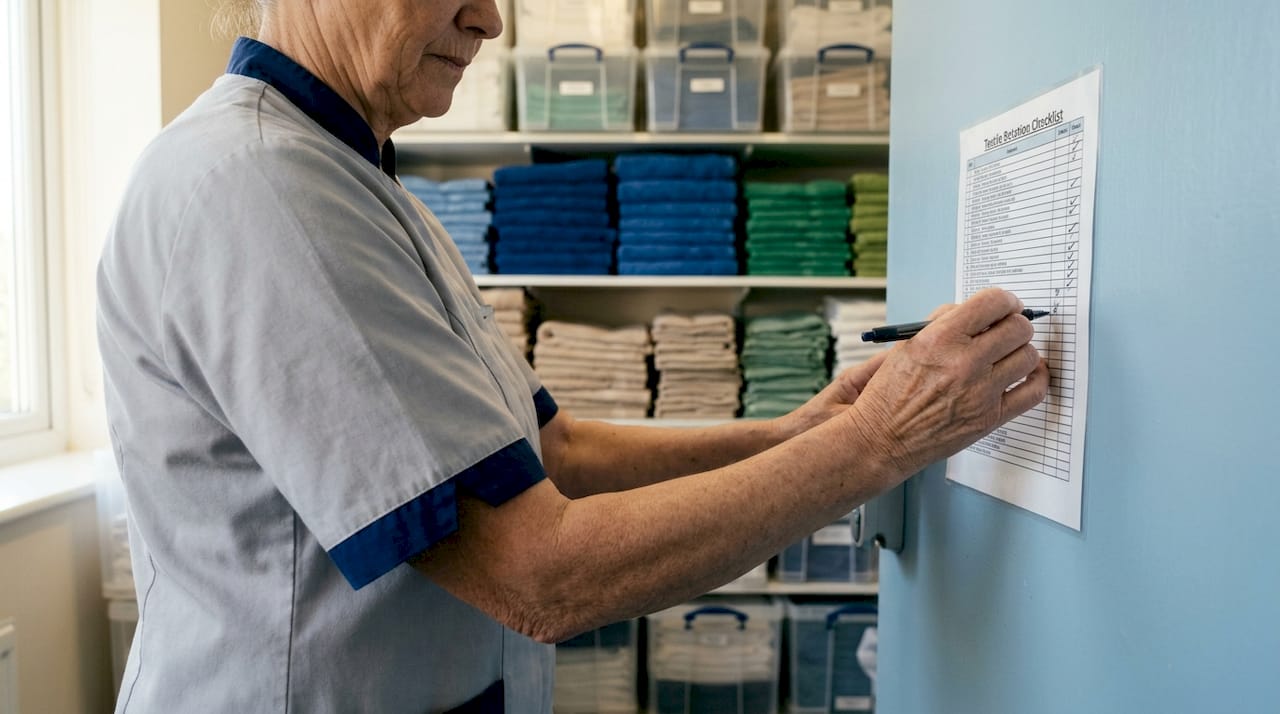
Pro Tip: Post a laminated rotation checklist inside each linen storage room. Include the par count, FIFO placement rule, and the laundry turnaround deadline. Consistency comes from visible reminders, not memory.
What common mistakes to avoid in textile rotation?
Most rotation failures trace back to a small number of repeatable errors. Recognizing them early saves significant replacement cost.
- Top-loading shelves: Staff place clean linens on top of existing stock instead of behind it. This means the same items cycle repeatedly while others never rotate. Top-loading causes uneven wear patterns and shortens the lifespan of your most-used sets.
- Ignoring stain triage: Stained linens that enter the general rotation without treatment contaminate the sorting process and often return from laundry still marked. Pull stained items at the point of collection, treat them separately, and log them out of the active count until cleared.
- Static par levels: Managers set par levels at opening and never revisit them. Occupancy shifts seasonally, and a par count that works in February will cause shortages in July. Review par levels at the start of each peak season.
- Overcrowding storage shelves: Packing linens too tightly causes creasing, restricts airflow, and makes FIFO placement physically difficult. Leave enough space on each shelf for staff to slide items in from the back without disturbing the front.
- Skipping damage audits: Linens degrade gradually. Without a monthly audit, worn or thinning sets stay in rotation and reach guests. Pull any item showing fraying, permanent staining, or thinning fabric and retire it from guest-facing use.
“Textile inconsistency in age or cleanliness is immediately noticeable by guests. Linen management directly affects brand perception in luxury hospitality. A single worn tablecloth at a premium table communicates more about your standards than any marketing effort can correct.”
Seasonal adjustment deserves its own attention. Increase your active par count before high-occupancy periods, not during them. Waiting until you are already short forces emergency laundry runs, which compress the resting period and accelerate fabric wear.
What are advanced strategies to optimize textile rotation and inventory management?
Once the foundational system is running, three areas offer the clearest gains in cost and quality.
Integrating Kanban with digital tracking
Kanban inventory systems use visual signals and defined stock limits to smooth textile supply and prevent both shortages and overstock. The two-bin method works well at the shelf level, but pairing it with a digital log adds a layer of data that manual systems cannot provide. You can track reorder frequency, identify which linen categories deplete fastest, and set maximum stock limits that prevent over-purchasing. Kanban requires workforce training and regular audits to maintain accuracy. The payoff is a team that manages consumption in real time rather than reacting to shortages after they occur.
Choosing the right fabric for rotation efficiency
Material choice has a direct impact on how well your rotation system performs. Spun polyester textiles cost roughly 50% less to maintain than cotton, resist stains better, do not fade, and require no ironing if folded warm from the dryer. That maintenance reduction shortens the laundry cycle and reduces the resting time required before redeployment. For restaurants with high tablecloth turnover, spun polyester is the practical choice. For hotels where guest comfort is the primary metric, a cotton-polyester blend balances softness with durability.
Evaluating laundry economics
The decision between outsourced laundry and in-house operations affects your rotation cycle directly. In-house laundry ownership is more cost-effective long term, with annual costs of roughly $1,000 post-startup versus $7,800 per year in rental fees for a 100-seat restaurant. In-house control also means you set the turnaround schedule, which protects the 24-hour resting window. Rental contracts introduce dependency on an external timeline that can compress your rotation cycle during peak periods.
| Laundry Approach | Turnaround Control | Annual Cost Range | Best For |
|---|---|---|---|
| In-house laundry | Full control | Lower long-term | High-volume hotels and restaurants |
| Outsourced service | Dependent on vendor | Higher ongoing | Properties without laundry infrastructure |
| Hybrid model | Partial control | Variable | Mid-size properties managing peak surges |
Pro Tip: If you use an outsourced laundry service, negotiate a guaranteed 24-hour turnaround in your contract. Without it in writing, your rotation schedule is at the vendor’s discretion.
Aligning your rotation system with textile procurement planning ensures that reorder points match actual consumption data rather than estimates. Use six months of cycle logs to calculate your true monthly depletion rate, then set reorder triggers accordingly.
Key Takeaways
Effective textile rotation requires a 3-par to 4-par inventory system, strict FIFO discipline, and a 24-hour laundry turnaround to protect fabric quality and prevent service gaps.
| Point | Details |
|---|---|
| Use the par level system | Maintain 3–4 sets per linen category to cover use, laundry, deployment, and rest. |
| Apply FIFO at every shelf | Place fresh linens behind older stock so every item rotates evenly through the cycle. |
| Enforce the 24-hour rest rule | Allow washed linens to rest before redeployment to restore fiber strength and softness. |
| Audit and adjust seasonally | Review par levels before peak occupancy periods to prevent shortages and emergency runs. |
| Match fabric to rotation needs | Spun polyester reduces maintenance costs and shortens cycle time in high-turnover settings. |
What disciplined rotation actually costs you if you skip it
After working closely with hospitality operations across different property sizes, one pattern stands out clearly. The properties that treat textile rotation as a housekeeping task rather than an inventory management discipline consistently overspend on linen replacement. They buy more than they need because they cannot account for what they have. They also deliver inconsistent guest experiences because the same table or room may receive a crisp new napkin one visit and a worn, slightly gray one the next.
The 24-hour resting rule is the most underused practice I see. Managers understand FIFO intellectually, but they skip the resting window under pressure. The result is linens that feel rough to guests and wear out in half the expected cycles. That cost is invisible on a weekly basis but significant over a year.
Staff training is the other gap. A rotation protocol written in a manual and never reinforced at the shelf level does not function. The properties that get this right post visual guides in storage rooms, run brief refreshers at the start of each season, and hold team leads accountable for par level accuracy. The investment is minimal. The operational consistency it produces is not.
Effective textile rotation also reflects directly on hospitality brand quality. Guests notice linen inconsistency before they notice almost anything else at a table or in a room. Getting the rotation system right is one of the highest-return operational decisions a manager can make.
— Xpert
Gjergjihtextil’s role in your textile rotation system
Gjergjihtextil has supplied hotels, restaurants, and hospitality operators across the region since 1994, building supply chains that support consistent rotation at scale. The company sources bed linens, towels, tablecloths, and napkins from Italy, India, Pakistan, and China, giving clients access to volume pricing without sacrificing quality standards. Properties like Meliá, Marriott, and Sheraton have relied on Gjergjihtextil’s supply consistency to maintain their linen programs.

Whether you manage a 30-room hotel or a high-volume restaurant, Gjergjihtextil offers hotel-grade textile solutions built for industrial wash cycles and rotation-intensive environments. For restaurant operators, the restaurant textile catalog covers tablecloths, napkins, and runners selected for stain resistance and durability under daily rotation. Contact Gjergjihtextil to align your next procurement cycle with a rotation system that holds up under real operational pressure.
FAQ
What is the standard par level for hotel linen rotation?
The industry standard is a 3-par to 4-par system, meaning three to four complete sets per linen category. This covers one set in use, one in laundry, one ready to deploy, and one resting.
How does FIFO apply to textile rotation?
FIFO requires placing freshly laundered linens behind existing stock on the shelf. Staff always pull from the front, ensuring the oldest items rotate through the wash cycle first and wear distributes evenly across all sets.
Why do linens need a 24-hour rest after washing?
Washing and ironing stress cotton fibers. A 24-hour rest period allows fibers to rehydrate, which restores softness and tensile strength. Skipping this step accelerates wear and reduces the effective lifespan of each set.
How often should par levels be reviewed?
Review par levels at the start of each peak season. Occupancy changes alter consumption rates, and a par count set during low season will cause shortages when demand increases.
Is spun polyester a good choice for restaurant textile rotation?
Spun polyester costs roughly 50% less to maintain than cotton, resists stains, and requires no ironing if folded warm from the dryer. These properties make it well-suited for high-turnover restaurant rotation systems.