

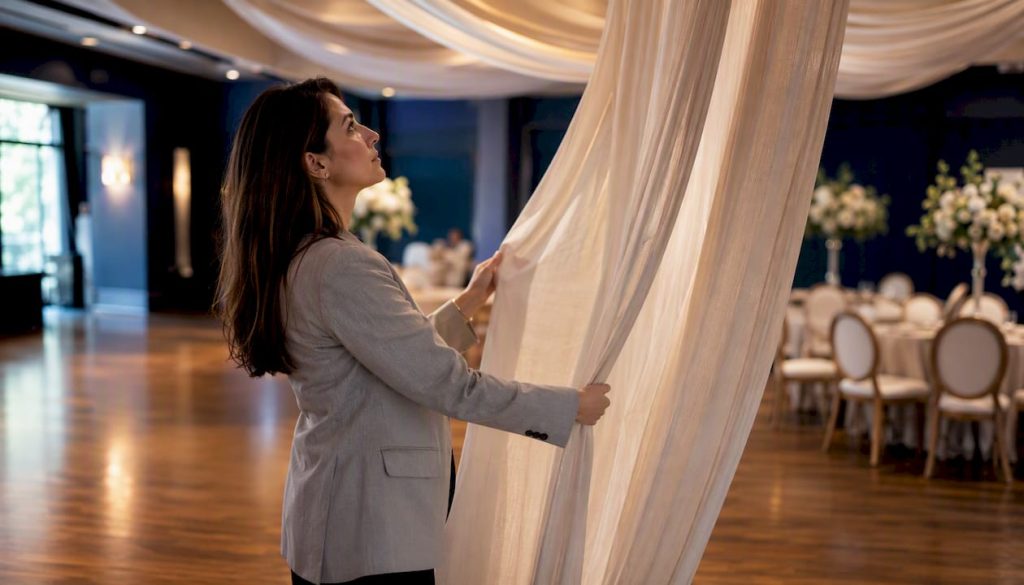
The fastest path to true flexibility in event staging is pairing the right fabric family with the right construction method. Sheer fabrics (voile, chiffon, organza) handle ceiling drapes and layered backdrops. Midweight fabrics (poplin, satin, linen blends) cover banquet tables and wall panels. Stretch and technical blends take fitted covers and tensioned graphic displays. Heavy masking fabrics (duvetyne, commando cloth) control light and define stage boundaries. Combine any of these with tension systems, modular panels, or grommeted hardware, and you have the core of every practical event textile flexibility option available today.
Quick recommendations by event context:
- Wedding ceilings: Voile or chiffon in commercial widths (approximately standard widths), wired hems, and ceiling track clips for adjustable swag height
- Trade show backdrops: Stretch PRO (a midweight fabric engineered for tensioned graphics) or PolyStretch P8 (a midweight fabric engineered for tensioned graphics) for tensioned printed graphics that stay undistorted
- Outdoor tents: Engineered 4-way stretch fabrics with high memory recovery for structural stretch tent systems; decorative stretch fabrics do not meet the engineering specs
- Banquet linens: Polyester poplin for wrinkle resistance and durability through repeated commercial laundering
Procurement rule: If you run more than six events per year with consistent branding, buying is almost always cheaper than renting over a two-year horizon. For one-off or highly varied events, rental with installation-ready finishing (hems, eyelets, pole pockets) saves time and storage cost.
Pro Tip: Order one sample panel in your chosen fabric and hang it at the actual venue ceiling height before committing to a full order. Drape behavior changes dramatically between a 10-foot and a 20-foot drop.
Key Takeaways
The most reliable approach to event textile flexibility is specifying the right fabric family for each functional role, requiring supplier data points before ordering, and pre-planning modular hardware so on-site adjustments take minutes rather than hours.
| Point | Details |
|---|---|
| Match fabric to function | Sheers for ceilings, midweight for tables, stretch for fitted covers, heavy masking for AV and blackouts. |
| Require three supplier data points | Weight (g/m²), stretch and recovery percentage, and FR certificate with accredited lab stamp. |
| Pre-plan modular hardware | Numbered panels, pre-punched grommets, and labeled hardware bags cut re-hang time significantly. |
| Verify FR compliance by treatment type | Inherently FR fabrics maintain certification through laundering; topically treated fabrics require re-treatment after a specified wash cycle count. |
| Gjergjihtextil for procurement | Gjergjihtextil’s integrated supply chain delivers batch-traceable FR documentation and custom finishing for hospitality event textiles. |
Table of Contents
- Which fabric families give you the most flexibility for events?
- How to read supplier specs for fabric performance
- What fire safety certifications you must require for event textiles
- On-site construction methods that make fabrics perform flexibly
- How venue and weather change your fabric selection
- Procurement choices: rent, buy, or hybrid
- A procurement checklist for event textile solutions
- Care, cleaning, and durability for event textiles
- How textile flexibility affects acoustics and sound management
- Safety considerations for flexible textiles in crowded spaces
- A supplier’s perspective on real-world trade-offs
- Gjergjihtextil: a direct supplier for hospitality event textiles
- Sources
Which fabric families give you the most flexibility for events?
The Fabric Wiki from Liba Fabrics is a reliable starting reference for understanding how each family performs in professional event contexts. Here is how the four main families break down.
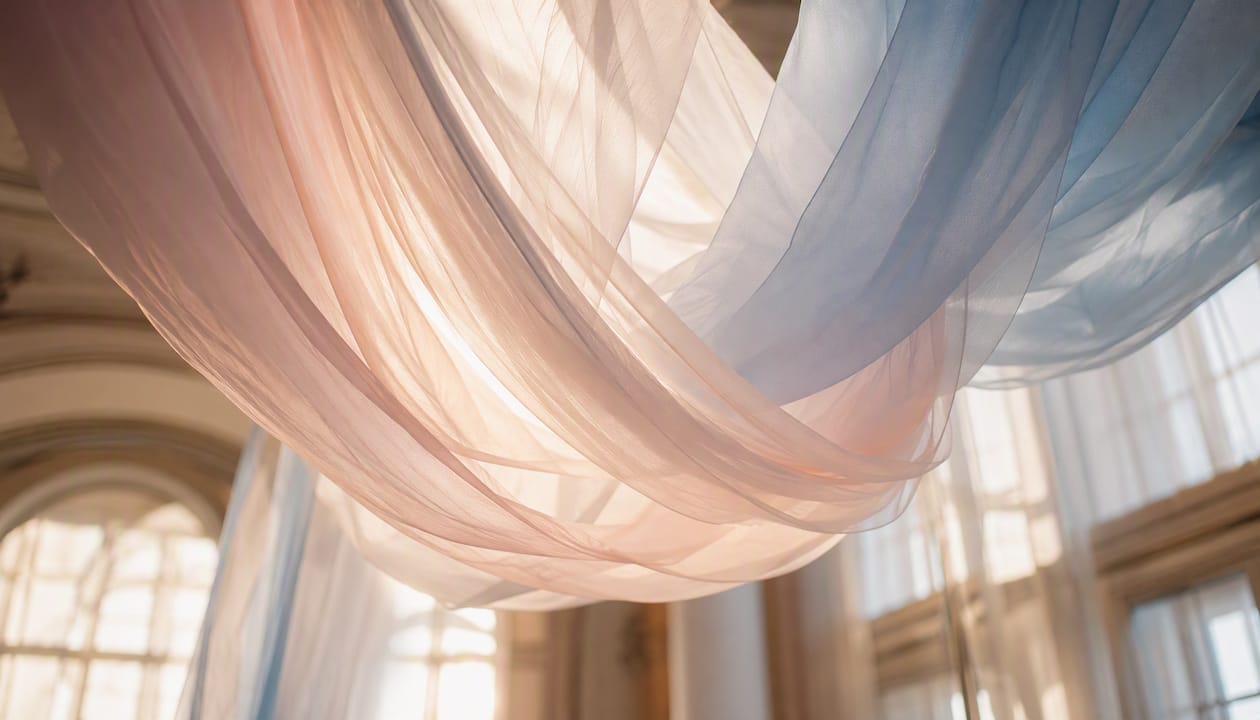
Sheers (voile, chiffon, organza, tulle) are the most versatile ceiling and backdrop fabrics. They diffuse light softly, layer well, and pack into small volumes. Voile and chiffon drape in long, fluid falls. Organza holds more body and catches light differently, making it useful for structured swags. Tulle adds texture and volume without significant weight. Ceiling drape choices in this family strongly affect perceived ceiling height and lighting diffusion, with lightweight sheers creating softer, taller-feeling spaces.
Midweight fabrics (poplin, satin, linen blends) are the workhorses of banquet and table linen programs. Polyester poplin balances opacity, wrinkle resistance, and durability for repeated commercial laundering. Satin adds a reflective finish suited to formal events but shows handling marks more readily. Linen blends work well for outdoor summer events where breathability matters, though they wrinkle more than polyester.
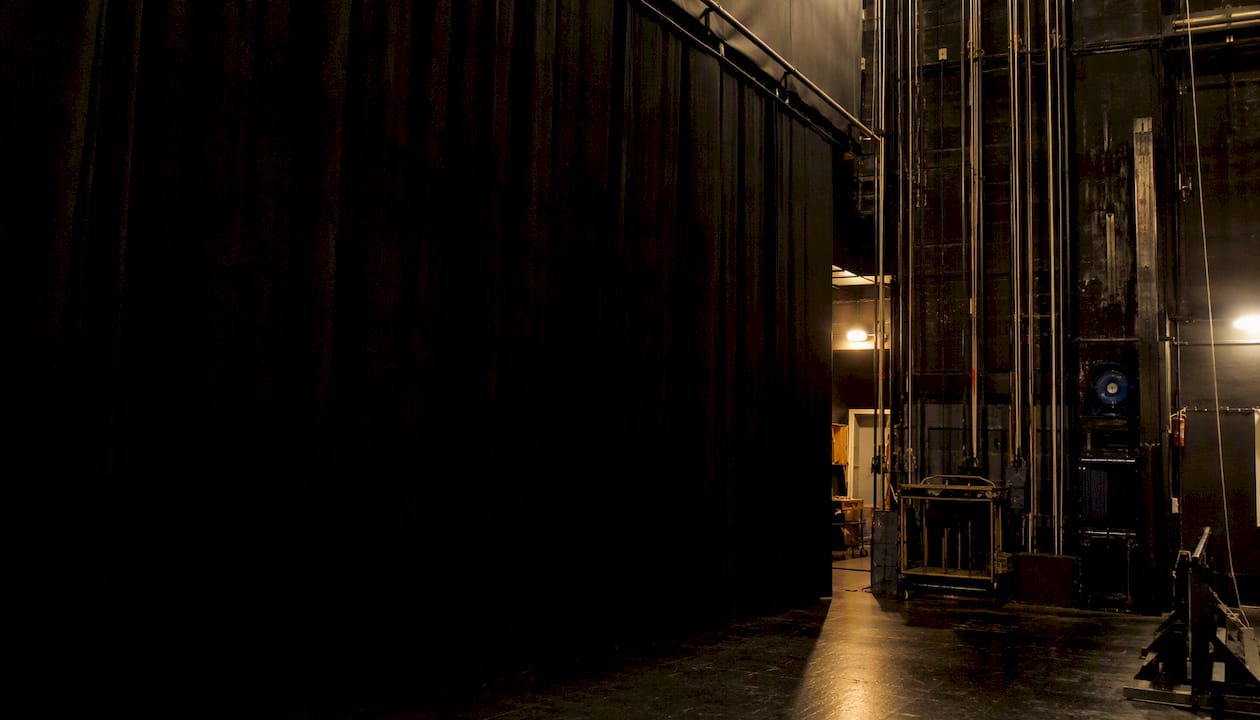
Heavy/masking fabrics (duvetyne, commando cloth, velvet) serve a structural role rather than a decorative one. Duvetyne and commando cloth have a matte, light-absorbing finish that makes them the standard choice for AV staging, blackouts, and masking unsightly rigging or walls. Velvet works for formal winter events where warmth and richness of texture matter, but it is heavier to ship and harder to launder at scale.
Stretch and technical fabrics (spandex blends, 4-way stretch, coated stretch substrates) cover two distinct applications. For fitted table covers and chair skins, a standard 4-way stretch spandex blend works well. For large printed tensioned graphics, substrate engineering matters far more than most buyers realize: specialist substrates like Stretch PRO (240 g/m²) are built with specific elastane content to keep graphics undistorted under tension.
How to read supplier specs for fabric performance
Weight (g/m²), stretch percentage, and recovery are the three numbers that determine whether a fabric will perform under event conditions. Weight controls hang quality: fabrics below 80 g/m² tend to billow in any air movement, while fabrics above 200 g/m² hang cleanly but add shipping and rigging load. Stretch percentage (1-way vs. 4-way) tells you how much the fabric can extend without distorting. Recovery, sometimes called “memory,” tells you how completely it returns to its original dimensions after being stretched.
These properties trade off against each other in predictable ways. Higher stretch content often reduces opacity, which matters if you are using a fabric as a backdrop for projection. Heavier weight improves hang quality but reduces packability, which affects transport costs for touring events. A fabric with excellent abrasion resistance (measured in Martindale rub cycles) will survive more event cycles before showing wear, directly affecting lifecycle cost.
Three data points to request from any supplier before ordering flexible-install fabrics:
- Fabric weight in g/m² and the test method used (ISO 3801 or ASTM D3776)
- Stretch percentage in both directions and recovery percentage after 50 stretch cycles
- Flame-retardant treatment type (inherent vs. topical) and the specific test certificate number
Pro Tip: When you receive a sample swatch, pull it diagonally (bias direction) and measure how much it extends, then release it and measure again after 30 seconds. A fabric with poor recovery will stay stretched. Photograph both states for your supplier records.
What fire safety certifications you must require for event textiles
Always require NFPA 701 (the U.S. standard for flame propagation of textiles and films) for any fabric used in a public event space. For tent applications, CPAI-84 is the relevant standard. European venues typically require EN 13501-1 or equivalent national certifications. Check your specific venue’s requirements before specifying any fabric, because local fire marshals often enforce stricter standards than the national baseline.
The distinction between inherently FR and topically treated fabrics matters for durability. Inherently FR fabrics are manufactured with flame-resistant fibers throughout the material; the protection does not wash out. Topically treated fabrics have a chemical finish applied after weaving, which can degrade after repeated laundering. For event textiles that go through industrial washing cycles, inherently FR fabrics are the more reliable long-term choice.
Documents to request from suppliers for any FR textile:
- FR certificate referencing the specific test standard (NFPA 701, CPAI-84, or EN equivalent)
- Lab test report from an accredited testing laboratory, including sample description, pass/fail criteria, and test date
- Manufacturer batch number matching the certificate to the specific production run
- Labeling claims on the fabric itself (permanent labels for inherent FR; care labels for topical treatments)
- Re-treatment protocol if the fabric is topically treated (how many wash cycles before re-treatment is needed)
Include this language in every purchase order and rental agreement: “Supplier warrants that all textiles supplied comply with [NFPA 701 / CPAI-84 / EN 13501-1 as applicable] and will provide lab test certificates and batch traceability upon request.”
On-site construction methods that make fabrics perform flexibly
Modular panels, tensioning systems, and sewn-in stretch inserts are the three fastest ways to add flexibility to any textile installation without swapping materials mid-event. Each method solves a different problem.
Step-by-step for the most common techniques:
- Grommets and webbing: Punch grommets every 12"–18" along the top hem of any panel. Thread webbing through and attach to ceiling track or pipe-and-drape uprights. This distributes load evenly and allows height adjustment without re-sewing.
- Wired hems: Sew a channel along the bottom hem and thread stainless wire through it. The wire adds weight and keeps the panel hanging straight, eliminating billowing without adding visible hardware.
- Pocketed panels for poles: Sew a 2"–3" sleeve along the top and/or bottom of the panel. Slide a fiberglass or aluminum pole through the sleeve. This creates a self-supporting banner that needs no additional hardware at the top.
- Tension straps: Attach ratchet straps or bungee cord loops to corner grommets and anchor to floor weights or wall anchors. This keeps outdoor panels taut in wind without rigid framing.
- Rigid frame with stretch skin panels: Build a lightweight aluminum frame and stretch a spandex skin over it using silicone edge grips or Velcro. The frame holds shape; the stretch fabric conforms to it without wrinkles.
Hardware and fasteners to specify:
- Grommets: #2 (3/8") for lightweight sheers; #4 (1/2") for midweight and heavy fabrics
- Webbing: 1" polypropylene for light loads; 2" for heavy masking panels
- Ratchet straps: 500 lb. working load minimum for outdoor applications
- Velcro: hook-and-loop grade 88 (heavy duty) for panels that will be re-hung repeatedly
- Snap fasteners: size 24 (15/16") for modular panel joining
- Silicone edge grips: 10 mm channel for standard stretch frame systems
Pro Tip: Number every panel and its corresponding hardware bag with a permanent marker before packing. A modular kit with numbered components cuts re-hang time by roughly half and prevents on-site improvisation that damages fabric edges.
How venue and weather change your fabric selection
Indoor versus outdoor is the first decision, and it determines whether you prioritize weight and water resistance or acoustics and flame safety. Climate factors narrow the choice further.
Quick recommendations by condition:
- Wind-prone outdoor events: Use heavy masking fabrics or engineered stretch tent systems with structural 4-way stretch and high memory recovery. Avoid sheers unless they are fully secured with wired hems and tension straps at every anchor point.
- Humid climates: Polyester and polyester blends outperform natural fibers. Linen and cotton absorb moisture, sag, and take longer to dry between events. Mold risk increases with natural fibers stored damp.
- Cold-weather events: Velvet and heavier midweight fabrics add visual warmth and perform better in low temperatures than sheers, which can look sparse in winter lighting. Velvet for winter and formal events, chiffon and voile for layered, airy summer designs.
- Low ceilings with heavy AV rigging: Lightweight sheers reduce rigging load. Avoid heavy masking fabrics on low-ceiling rigs unless the rigging is rated for the additional weight.
- Projection and lighting: Matte black duvetyne absorbs light and eliminates hotspots behind projection screens. Reflective satin creates unwanted glare in the projection path but works well for ambient uplighting effects. For rear-projection backdrops, use a semi-opaque midweight fabric with no sheen.
Procurement choices: rent, buy, or hybrid
The decision between renting and buying event textiles comes down to three variables: how often you run events, how much storage you have, and whether your branding changes between events. Buy when you run the same setup more than six times per year. Rent when the setup changes frequently or storage is limited.
Rent vs. buy vs. hybrid at a glance:
For printed panels and custom-branded textiles, purchasing makes more sense because rental suppliers rarely stock custom graphics. Production houses that deliver installation-ready event textiles commonly offer finishing services including hemming, eyelets, and pole pockets, which saves on-site time and reduces the risk of ad hoc modifications that damage fabric edges.
For printed tensioned graphics, substrate choice is the decisive factor. Stretch PRO (a midweight fabric engineered for tensioned graphics) and PolyStretch P8 (a midweight fabric engineered for tensioned graphics) are engineered with specific elastane content and weave construction to prevent graphic distortion under tension. A lighter, cheaper stretch substrate may look fine flat but will distort the image when tensioned on a frame.
On sustainability: recycled polyester (rPET) fabrics are now available in most midweight and stretch categories. They carry comparable abrasion resistance to virgin polyester and perform similarly through industrial wash cycles. Tencel (lyocell) is an option for premium table linens where a natural hand feel matters, but it requires gentler laundering and is not suited to high-volume industrial washing programs.
A procurement checklist for event textile solutions
A reproducible checklist is the fastest way to standardize your procurement process and protect yourself from FR compliance gaps, color mismatches, and on-site surprises. The following 9-step checklist covers the full cycle from spec to installation.
- Define the spec: fabric family, weight (g/m²), width, color, finish, and FR standard required
- Request a sample swatch: confirm color, hand feel, drape, and stretch behavior before ordering
- Require the FR lab report: accredited lab, test method, batch number, and pass criteria (see the fire safety section above)
- Order a pre-production mock: for custom printed panels, require a printed sample at actual scale before full production runs
- Confirm finishing details: hems (type and depth), grommets (size and spacing), pole pockets (width), and any panel joining method
- Request a color-proof photo: digital proof against a physical Pantone or RAL reference before printing
- Run a wash test: for any fabric going through repeated laundering, request wash test results at the specified cycle count and temperature
- Inspect production QA documentation: batch consistency report and any deviation notes from the manufacturer
- Conduct a mock hang: hang one panel at the actual venue before the full install to confirm drape, color under venue lighting, and hardware fit
Gjergjihtextil’s event textile solutions checklist provides a vendor-backed version of this process, with supplier-side documentation requirements and production QA language you can copy directly into RFPs. The company’s integrated manufacturing and distribution model, built over more than 30 years of hospitality supply, means FR compliance documentation and batch traceability are part of the standard delivery package, not an afterthought.
Care, cleaning, and durability for event textiles
Industrial laundering is where most event textiles fail prematurely. The key variables are wash temperature, mechanical action, and drying method. Polyester and polyester-blend fabrics tolerate temperatures up to 60°C (140°F) in commercial washers without significant color loss or dimensional change. Natural fibers, including linen and cotton, require lower temperatures and gentler cycles to avoid shrinkage.
Abrasion resistance, measured in Martindale rub cycles, predicts how long a fabric will look presentable under repeated use. For banquet linens and table covers that are folded, stacked, and unfolded dozens of times per event cycle, a minimum of 15,000 Martindale rubs is a reasonable threshold. Stretch fabrics used for fitted covers need both abrasion resistance and recovery retention: a fabric that loses its stretch after 20 wash cycles will no longer fit the cover it was made for.
Topically treated FR fabrics require re-treatment after a specified number of wash cycles, typically noted on the care label. Skipping re-treatment means the fabric no longer meets the FR standard it was certified to, which creates a compliance liability at the venue. Track wash cycles per item and schedule re-treatment before the threshold, not after.
Storage matters as much as washing. Fold heavy masking fabrics flat rather than rolling them, as rolling creates permanent creases in duvetyne. Store sheers loosely rolled on tubes to prevent fold lines that are difficult to steam out on-site.
How textile flexibility affects acoustics and sound management
Fabric density and surface texture have a direct effect on how sound behaves in an event space. Dense, heavy fabrics absorb mid and high frequencies, reducing echo and reverberation. This is why velvet drapes and heavy commando cloth are standard in theater and concert staging: they deaden the room and give the sound engineer a more controlled acoustic environment.
Sheers and lightweight fabrics do almost nothing for sound absorption. A room draped entirely in voile will still have the acoustic character of the bare space underneath. If your event requires controlled acoustics (a conference, a product launch with amplified speech, a live music performance), layer a heavy masking fabric behind any decorative sheer to get both the visual effect and the acoustic benefit.
Stretch fabrics on rigid frames create a different acoustic condition. A taut stretch panel acts more like a reflective surface than an absorptive one, particularly at lower frequencies. For events where both visual impact and acoustic control matter, combine stretch panels for structure with hung fabric baffles in the ceiling plane to manage reverberation.
Outdoor events have no acoustic containment by default. Fabric choices there affect neighbor noise and internal clarity rather than reverberation. Heavy perimeter draping can reduce sound bleed to adjacent areas, though the effect is modest compared to purpose-built acoustic barriers.
Safety considerations for flexible textiles in crowded spaces
Flexible textiles in high-occupancy event spaces create specific safety risks that go beyond FR compliance. The most common issues are trip hazards from floor-level fabric, restricted sightlines to emergency exits, and fabric that can be pulled down by crowd movement.
Any fabric that reaches the floor in a high-traffic area must be secured at the base, either with a weighted hem, floor anchors, or a sewn-in base pocket filled with ballast. Loose floor-level fabric in an aisle or near an emergency exit is a trip hazard and a fire risk if it can be pulled into a heat source.
Emergency exit sightlines must remain clear. Fabric panels used as room dividers or corridor draping must not obscure exit signage or block the direct line of sight to exit doors. Check your venue’s fire marshal requirements before installing any full-height fabric partition. In most jurisdictions, a minimum clear width of 44 inches must be maintained at all egress paths, and exit signs must be visible from any point in the room.
For stretch fabric installations on frames, verify that the frame anchoring can withstand lateral crowd pressure. A stretch panel on a lightweight frame that tips over in a crowded room creates both a physical hazard and a potential FR compliance failure if the fabric contacts a heat source on the floor. Anchor all freestanding frames to floor plates or wall anchors rated for the expected load.
A supplier’s perspective on real-world trade-offs
The trade-off that comes up most consistently in hospitality event work is between visual ambition and operational reality. Planners often specify sheers for their ceiling impact, then discover on-site that the venue’s rigging points cannot support the weight of a full ceiling drape at commercial widths, or that the fabric billows under the HVAC airflow in ways that were not visible in the showroom. The practical default that works across the widest range of venues is a midweight polyester with a matte finish: it hangs cleanly, photographs well under most lighting conditions, and survives industrial laundering without the care overhead of natural fibers or the compliance uncertainty of topically treated FR fabrics.
Integrated manufacturing and distribution, the model Gjergjihtextil has operated for over 30 years, shortens the lead time between specification and delivery and keeps FR documentation tied to specific production batches. That traceability is what makes compliance verification straightforward rather than a last-minute scramble before a venue inspection. For procurement teams who need consistent quality across multiple events or properties, that supply chain visibility is worth more than a marginally lower unit price from a supplier who cannot provide batch-level documentation.
Gjergjihtextil: a direct supplier for hospitality event textiles
For event companies and hospitality buyers who need consistent quality, batch-traceable FR documentation, and custom finishing without managing multiple vendors, Gjergjihtextil offers a direct path from specification to delivery.
With over 30 years supplying hotels, resorts, and event venues across the region, including properties operating under Marriott, Meliá, and Sheraton standards, Gjergjihtextil brings manufacturing integration and supply chain control that most distributors cannot match. Custom production covers everything from printed stretch panels and ceiling drape to banquet linens and fitted table covers, with finishing (hems, grommets, pole pockets) handled before shipment so textiles arrive installation-ready.
For procurement teams planning bulk orders or long-term supply agreements, the hospitality textile wholesale catalog is the right starting point. For custom printed panels and in-house finishing, the textile printing service page details production capabilities and turnaround. Contact Gjergjihtextil directly to request a sample pack and FR documentation for your next event specification.
Sources
- Fabric Wiki: Practical Guide to Event & Stage Fabrics
- Bedouinflex premium stretch tents (product page)
- Event Dressing with Fabric: How to Choose Textiles for Special Occasions – Sewing Studio Fabrics
- Custom Printed Fabrics for Event Decoration | Muzefab