

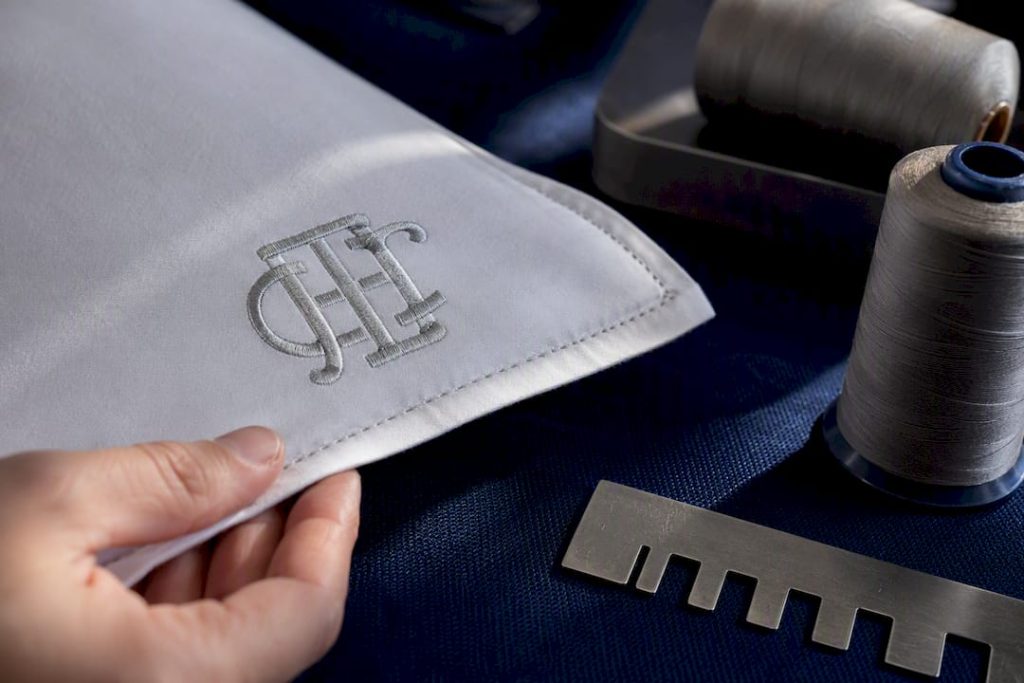
Prioritize four categories when you personalize hotel textiles: towels, bed linens, table linens, and staff uniforms. These touchpoints get the most guest contact and the most wash cycles, so they carry your brand the hardest and wear out the fastest. Before you sign anything, request a supplier’s sample pack along with an industrial-wash and colorfastness report — that single step prevents most of the costly reorders hotels regret later.
TL;DR:
- Personalized towels and uniforms require embroidery for durability, while bed linens and decorative items allow for more bold branding choices during production.
- The choice of customization method, such as embroidery or jacquard weaving, impacts wash resistance, with embroidery being most durable but more costly.
- Orders should be phased with pilot batches to verify quality, and suppliers’ lead times depend heavily on sample approval and order volume.
- Focusing on high-touch categories like towels, sheets, and uniforms first ensures branding longevity and guest perception benefits.
- Proper fabric selection, wash testing, and supplier control over production are essential to maintain logo appearance over multiple wash cycles.
Table of Contents
- Which hotel textiles should you personalize first?
- Embroidery, print, or jacquard: which method actually holds up?
- What drives lead times, MOQs, and pricing on custom orders?
- How do you choose fabric weight and wash durability?
- Where should your logo actually go?
- Why supply-chain control matters when you order custom textiles
- How do you keep personalized textiles looking sharp over time?
- How do you vet a hotel textile supplier before committing?
- What most hotels get backward about textile customization
- How to request samples and a quote from Gjergji H Tekstil
- Sources
Which hotel textiles should you personalize first?
Not every textile in your inventory deserves a logo. Some categories earn back their customization cost in guest recognition and repeat bookings; others just add expense without moving the needle. Here’s how to think through each one before you send an RFQ.
Bed linens carry the most visual real estate in a guest room, so logo placement matters more than logo size. A small embroidered mark on the pillowcase hem or a woven monogram at the top sheet border reads as refined rather than branded. Confirm fabric weight (GSM) on the actual sample, not the spec sheet, and check the seam finishing where the embroidery sits. Puckering at that seam after one wash is a warning sign, not a coincidence.
Towels and bath linens take the heaviest abuse in a hotel’s textile inventory, often 200 to 300 wash cycles a year in a busy property. Corner embroidery on bath towels tends to outlast printed logos by a wide margin. For terry-weight bath sheets, keep the design simple. A dense multicolor crest on high-pile cotton will blur within a season of industrial laundering.
Bedding and decorative items like duvet covers or throw pillows are where you can afford more visual boldness, since they see fewer wash cycles than sheets or towels.
Table linens and napkins need a different lens entirely: stain resistance and fold-friendly branding. A logo placed where the napkin fold naturally displays it, rather than buried in a corner, does more marketing work per unit.
Curtains and decorative textiles call for color matching against your existing palette before anything else. Blackout curtains and decorative sheers wash on completely different schedules, so specify which you mean before requesting quotes.
Uniforms benefit most from embroidered names and logos on durable poly-cotton blends. Minimum order quantities here are often driven by size runs, not design complexity, so plan your headcount before you request pricing.
For a broader look at how these categories affect guest perception day to day, textiles shape hospitality experience in ways that go beyond aesthetics. Common high-impact categories that hotels personalize tend to overlap closely with what’s listed above, which is a useful sanity check when you’re building your first RFQ.
Embroidery, print, or jacquard: which method actually holds up?
The customization method you choose determines how your logo looks after wash number one hundred, not just wash number one. Here’s how the four common methods stack up:
- Embroidery is the standard for towels and uniforms. It’s durable, dimensional, and holds its shape through repeated industrial laundering, though it costs more per unit and takes longer to produce than printed alternatives.
- Screen or digital printing works well for bold graphics on decorative pieces like table runners or event banners, but wash resistance varies widely by ink type. Always ask the supplier for wash-cycle test results before committing to a print run.
- Jacquard or woven logos get built directly into the fabric during weaving. This makes them nearly impossible to peel, crack, or fade, which is why they suit subtle brand cues on linens and throws better than loud graphics.
- Heat transfer is the fastest, cheapest option for small runs, but it’s the least durable under industrial wash conditions. Treat it as a short-term or low-volume solution, not a long-term fixture.
Customization methods including embroidery, screen or digital printing, jacquard weaving, and heat transfers each carry distinct tradeoffs in cost, lead time, and wash durability, and reputable suppliers should be able to walk you through all four without steering you toward whichever margin suits them best.
Pro Tip: Ask every supplier for ISO or EN colorfastness test references before approving a method. Absence of test data should be considered a red flag, not an oversight.
What drives lead times, MOQs, and pricing on custom orders?
Custom textile orders live and die on three variables: minimum order quantity, lead time, and how transparently a supplier breaks down cost. Get these wrong and you either overpay for volume you don’t need or wait months longer than expected.
Minimum order quantities vary by item. Towels and uniforms often carry lower MOQs than bed linens because the personalization setup cost is spread across more standardized sizing. A smart approach is phasing your order: run a pilot batch in moderate quantity, confirm quality and fit in real operating conditions, then place the full rollout order once you’re satisfied. Pilot batches and staged deliveries reduce both financial risk and the odds of a full-scale reorder.
Lead times for custom production typically stretch several weeks beyond stock items, but a fast sample-approval cycle shortens the overall timeline more than almost any other factor.
Pricing drivers worth interrogating in any quote:
- Fabric type and GSM (higher weight costs more but usually lasts longer)
- Personalization method (embroidery costs more per unit than heat transfer)
- Order volume (unit price drops meaningfully past certain thresholds)
- Design complexity (multicolor logos cost more to set up than single-color marks)
Before signing, request a quality control checklist covering industrial-wash test reports, seam strength checks, and pre-shipment photos. Contract terms should spell out defect replacement policies, acceptable color tolerance, and delivery milestones in writing, not verbally.
How do you choose fabric weight and wash durability?
Fabric choice determines whether your personalized textiles look sharp for two years or fade into an embarrassing memory after six months. Match the fiber to the job, not the marketing copy.
- Sheets and pillowcases: long-staple cotton offers the best balance of softness and durability; percale weaves in the 180 to 250 GSM range tend to hold logo embroidery well without feeling stiff.
- Towels: cotton terry or high-GSM blends in the 400 to 600 GSM range strike the right balance between guest-facing plushness and wash-room survival.
- Quick-dry options: microfiber blends work well for spa or pool towels where turnaround speed matters more than plush feel.
Ask every supplier for shrinkage rate data and ISO or EN colorfastness figures rather than relying on generic durability claims. Objective specs like GSM and shrinkage rate tell you far more than a glossy product description ever will. Understanding what makes hotel fabric durable before you request samples puts you in a stronger negotiating position, since you’ll know which claims are meaningful and which are filler.
Calculate cost-per-wash rather than cost-per-unit when comparing supplier quotes.
Where should your logo actually go?
Placement decisions either reinforce your brand or quietly undermine it. Get the basics right and the rest follows.
- Towel hems work better than towel corners for legibility, especially on high-pile terry where fine detail gets lost in the loops.
- Bathrobe chest placement mirrors retail apparel branding and reads as premium when done with restraint.
- Pillow shams suit subtle jacquard or embroidered monograms rather than bold graphics.
- Napkin folds should display your mark exactly where the fold naturally reveals it, not buried in a corner nobody sees.
Contrast and legibility matter more after wash fifty than they do on day one. A tiny, intricate logo on heavy-pile toweling will blur into a smudge within months, so simplify before you commit to a design. Keep a consistent color palette across categories, but allow small variations, like a slightly bolder mark on uniforms versus a whisper-subtle one on bed linens, so each category still fits its context.
Pro Tip: If your property leans luxury, go subtle. If you’re building chain-wide recognition across multiple properties, size and visibility should win over understatement.
Why supply-chain control matters when you order custom textiles
Gjergji H Tekstil has operated in hospitality textile supply for more than 30 years, and its approach reflects a straightforward principle: the fewer hands a product passes through, the fewer places quality can slip. Controlling import, design, in-house production, and distribution under one roof means a supplier managing the full chain can hold consistent standards across a large hotel rollout instead of hoping three separate vendors stay aligned.
The typical project flow runs through consultation, sample approval, production, industrial-wash verification, and delivery, in that order, with no shortcuts around sample sign-off. Experience supplying international hotel brands including Meliá, Marriott, and Sheraton properties reflects the kind of scrutiny that only comes from working at that level of standard, not from a sales pitch.
How do you keep personalized textiles looking sharp over time?
Personalization only pays off if it survives the wash room. Industrial laundries run hotter cycles, harsher detergents, and faster tumble speeds than any home machine, and that combination is exactly what degrades embroidery thread and printed ink fastest.
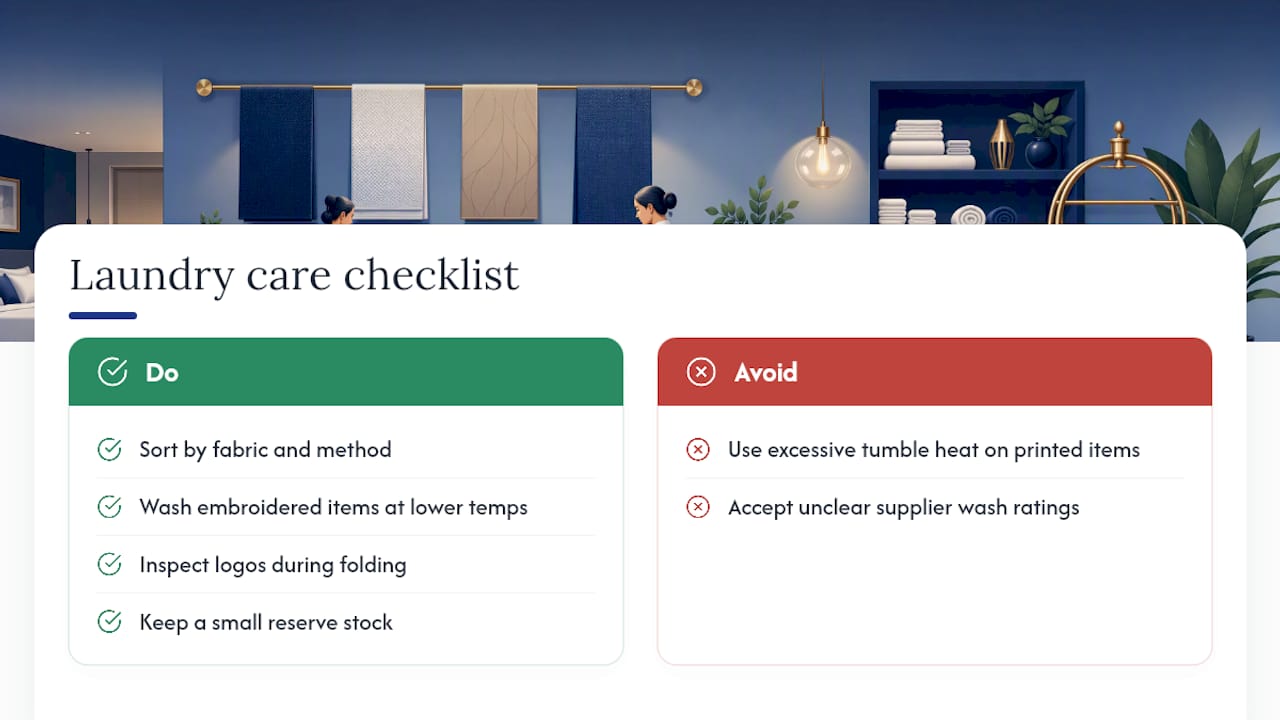
Sort personalized items by fabric type and personalization method before washing, since embroidered pieces often tolerate different temperature settings than printed ones. Lower wash temperatures preserve thread color longer on embroidered logos, while excessive tumble-dry heat is usually what cracks printed or heat-transferred designs first, not the wash cycle itself.
Train laundry staff to inspect logos during folding, not just check for stains. Catching a loose embroidery thread early means a quick repair instead of a discarded towel. Keep a small reserve stock of replacement units for high-traffic items like bath towels and pillowcases, so a damaged piece never leaves a room short during turnover.
Ask your supplier upfront how many wash cycles their personalization method is rated to withstand, and get that figure in writing as part of your quality documentation. A supplier confident in their work will provide this without hesitation. One that hedges or changes the subject is telling you something worth hearing before you place a large order, not after. Maximizing textile durability starts with proper laundry protocol just as much as it starts with fabric selection.
How do you vet a hotel textile supplier before committing?
Reliability in this business shows up in details most buyers overlook until it’s too late. A few checks separate a dependable long-term partner from a vendor you’ll be replacing within a year.
Ask for references from properties similar in size and category to yours, not just a generic client list. A supplier that has outfitted 30-room boutique hotels may handle a 200-room resort differently, and you want proof they’ve done it before. Request physical samples rather than digital mockups. Fabric hand-feel, embroidery density, and stitch quality simply don’t translate through a photo.
Verify the supplier’s actual production model. Some businesses import branded stock and slap a logo on it; others control import, design, and manufacturing under one operation. Local suppliers offering both stocked hotel textiles and custom production illustrate that this hybrid model is common in the region, so ask directly which parts of your order are made in-house versus outsourced.
Finally, confirm defect and replacement policies in writing before the first order ships, not after a batch arrives with visible flaws.
What most hotels get backward about textile customization
The conventional advice treats textile personalization as a design decision. Pick a nice logo, find a printer, done. That framing misses the point entirely. The actual decision is a supply-chain decision wearing a branding costume, and treating it as pure aesthetics is how hotels end up with faded logos, mismatched reorders, and vendors who disappear after the first shipment.
The research here points to one clear priority: sample-and-wash-test before you commit to volume, every time, no exceptions. Skipping that step to save two weeks of lead time is the single most common mistake procurement managers make, and it’s almost always the most expensive one.
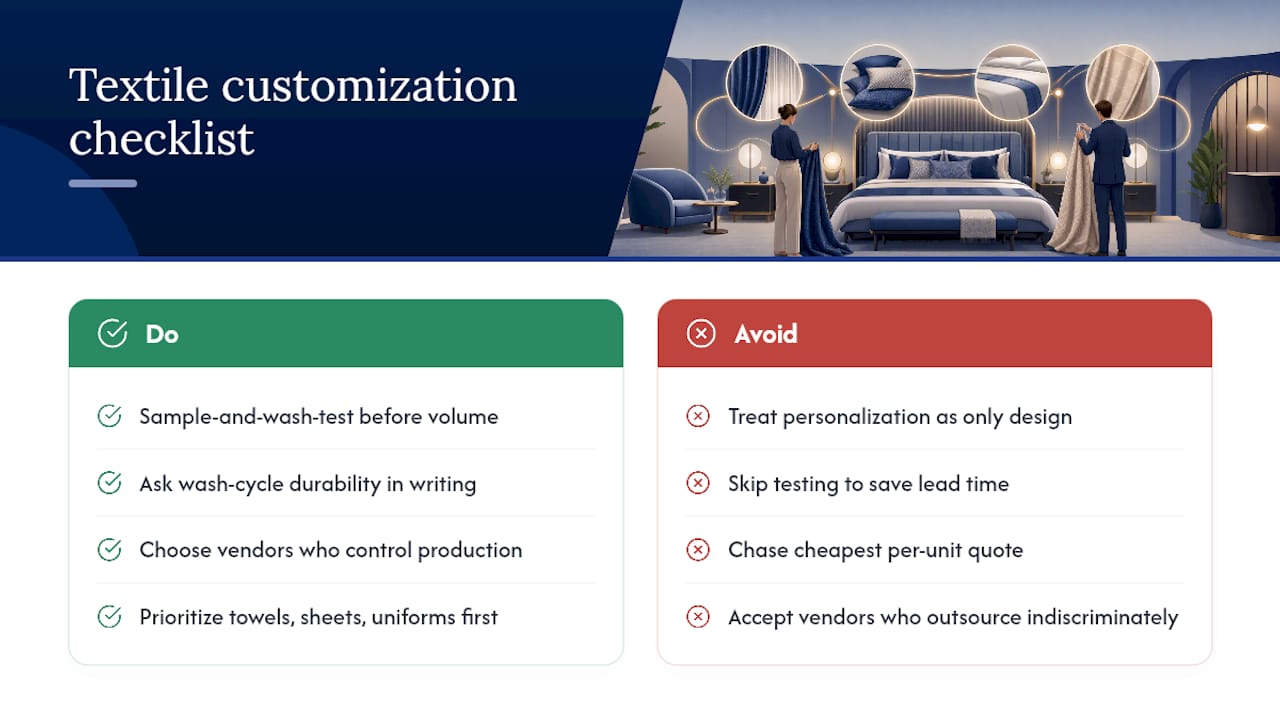
What’s overrated is chasing the cheapest per-unit quote. What’s underrated is asking a supplier how many wash cycles their embroidery survives and whether they’ll put that number in writing. A vendor who controls their own production, rather than outsourcing to three different subcontractors, is worth a slightly higher quote if it means your logo still looks sharp on wash cycle two hundred.
Start with the categories that touch guests most: towels, sheets, and uniforms. Everything else can wait until those three are right.
— Xpert
How to request samples and a quote from Gjergji H Tekstil
Gjergji H Tekstil gives hotel buyers something most vendors can’t: a single point of accountability across import, design, in-house production, and distribution, so there’s no finger-pointing between a fabric supplier and a print shop when something goes wrong. That control translates into more predictable lead times and consistent quality across large rollouts, which matters most when you’re outfitting an entire property at once.
Start by requesting a sample pack along with an industrial-wash report and a detailed quote broken down by fabric, personalization method, and volume tier. Gjergji H Tekstil handles custom design work, controlled production runs, and the logistics that come with large hospitality orders, from a single boutique property to a multi-hotel rollout. For practical guidance on choosing the right categories and specs before you submit an RFQ, review the hotel textile selection guide, or check the event textile solutions checklist if your order includes banquet or event spaces. Reach out to request your sample pack and quote today.