

TL;DR:
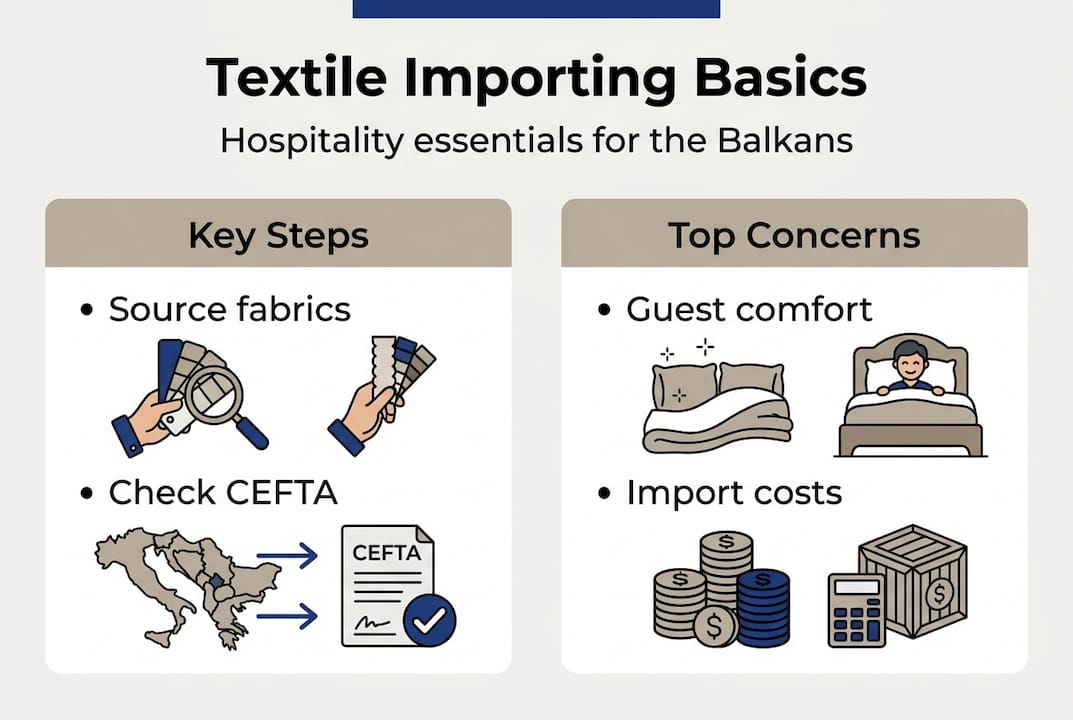
- Textile importing for hotels involves regulated sourcing from abroad to ensure quality, cost-efficiency, and brand standards. Understanding regional customs laws, trade agreements, and proper documentation like proof of origin is essential for cost savings. Building strong supplier relationships and consolidating orders can significantly reduce overall procurement costs and enhance guest satisfaction.
Textile importing is not simply a matter of shipping towels and sheets across a border. For hospitality managers and procurement officers in Albania, Kosovo, Montenegro, and North Macedonia, it is a regulated, cost-sensitive process that directly shapes guest satisfaction, brand standards, and operational budgets. Many hotel operators underestimate how much customs rules, supplier selection, and proof-of-origin documentation affect their bottom line. This guide cuts through that confusion. You will find clear definitions, a breakdown of regional regulations, a step-by-step look at how imports actually work, and practical strategies to get more value from every procurement decision.
Table of Contents
- What is textile importing and why does it matter for hospitality?
- Understanding Balkan textile import regulations and costs
- How hotels and resorts import textiles in the Balkans
- Strategies to optimize textile importing for hotels
- Our perspective: Why smart textile importing sets hospitality leaders apart
- Upgrade your hotel textiles with expert support
- Frequently asked questions
Key Takeaways
| Point | Details |
|---|---|
| Regional duty exemptions | Hotels can often import textiles duty-free from CEFTA or EU countries with proper documentation. |
| Cost control strategies | Smart import planning, such as bulk orders and supplier audits, results in savings and higher quality. |
| Process impacts operations | Textile import processes directly affect guest experience, hotel branding, and operating costs. |
| Compliance is essential | Customs paperwork and VAT requirements must be managed to avoid costly delays or penalties. |
What is textile importing and why does it matter for hospitality?
Textile importing, in plain terms, means purchasing fabrics, linens, towels, uniforms, and related goods from foreign manufacturers or distributors and bringing them into your country for commercial use. For a hotel or resort, this typically covers bed linens, duvets, pillows, bath towels, table napkins, curtains, and staff uniforms. Most of these products are sourced from Italy, Turkey, China, India, or Pakistan, because domestic production in the Balkans cannot match the volume, variety, or price points available internationally.
Why does this matter so much for hospitality? Because the textiles your guests touch every single day are not neutral objects. A rough towel, a pillow that loses shape after ten wash cycles, or a tablecloth that fades after one season sends a clear message about your standards. Guests may not articulate it, but they feel it. Textile quality is one of the most tactile and immediate signals of how seriously a property takes its guest experience.
Beyond guest comfort, importing textiles at the right price point is a core cost-control lever. A hotel with 80 rooms might need 600 or more sets of bed linens, plus towels, uniforms, and restaurant textiles. The difference between a well-negotiated import contract and an ad-hoc local purchase can represent tens of thousands of euros per year. Understanding the textile production process helps you ask better questions when evaluating suppliers.
There is also a regulatory dimension that many operators overlook until it creates a problem. Albania customs import duties and equivalent rules in neighboring countries determine how much you pay in duties and taxes on every shipment. These rates vary by product type, country of origin, and whether preferential trade agreements apply. Getting this wrong means paying more than you should, or facing customs delays that disrupt your operations at the worst possible moment.
Here is a quick summary of why textile importing matters for your property:
- Cost efficiency: International sourcing offers better price-to-quality ratios than most local options.
- Product range: You gain access to hotel-grade specifications not available domestically.
- Brand consistency: Importing in bulk ensures uniform quality across all rooms and departments.
- Regulatory exposure: Duties, VAT, and documentation requirements affect your total landed cost.
“Hospitality is an experience, not just furniture. The textiles your guests interact with are part of that experience, and sourcing them strategically is part of running a serious operation.”
Understanding Balkan textile import regulations and costs
With a working definition in place, it is essential to understand the specific rules and costs shaping textile imports in your region. The regulatory environment across Albania, Kosovo, Montenegro, and North Macedonia is shaped by a combination of national customs laws, regional trade agreements, and alignment with EU standards.

The most important trade framework for this region is CEFTA, the Central European Free Trade Agreement. Under CEFTA, goods traded between member countries, including Albania, Kosovo, Montenegro, and North Macedonia, can benefit from reduced or zero tariffs, provided you can demonstrate the correct proof of origin. Similarly, the Stabilization and Association Agreements (SAA) that these countries have with the European Union allow textiles originating in EU member states to enter with preferential duty rates, often zero, when accompanied by a valid EUR.1 certificate or a supplier’s declaration.
When preferential agreements do not apply, Most Favored Nation (MFN) duty rates kick in. For textiles, MFN duties range 5 to 15% depending on the product category, with VAT applied on top at 20% in Albania and 18% in Kosovo, Montenegro, and North Macedonia. For large procurement budgets, this difference is significant.
Here is a simplified comparison of import cost factors by country:
| Country | MFN Duty (Textiles) | VAT Rate | Preferential Agreements |
|---|---|---|---|
| Albania | 5-15% | 20% | CEFTA, EU/SAA |
| Kosovo | 5-15% | 18% | CEFTA |
| Montenegro | 5-15% | 18% | CEFTA, EU/SAA |
| North Macedonia | 5-15% | 18% | CEFTA, EU/SAA |
For any shipment valued above EUR 150, a formal customs declaration is required. Below that threshold, simplified procedures may apply, but for hospitality procurement, you will almost never be below this limit. Standard paperwork includes the customs declaration form, the EUR.1 movement certificate for EU-origin goods, commercial invoices, and packing lists. Missing any one of these documents can result in a customs hold that delays your delivery by days or even weeks.
Pro Tip: Always request the EUR.1 certificate from your supplier before the shipment departs. Trying to obtain it after the goods arrive at the border is far more complicated and time-consuming.
For bulk textile imports, planning your documentation in advance is not optional. It is the difference between a smooth delivery and an expensive delay. Review your textile procurement steps carefully before committing to any supplier contract.
How hotels and resorts import textiles in the Balkans
Armed with a cost and compliance framework, you can now see how the process plays out within hospitality operations. The import journey for hotel textiles typically follows a clear sequence, though each step carries its own risks if not managed carefully.
- Supplier identification and qualification: Research suppliers by product category, certifications, minimum order quantities, and lead times. Request samples before committing.
- Negotiation and purchase order: Agree on price, delivery terms (Incoterms such as FOB or CIF), and documentation requirements.
- Production and quality control: For custom orders, confirm specifications in writing. Request a pre-shipment inspection for large contracts.
- Shipping and freight forwarding: Choose a freight forwarder familiar with Balkan customs procedures. They handle logistics and often assist with documentation.
- Customs clearance: Submit the customs declaration, EUR.1 certificate, invoice, and packing list. Pay applicable duties and VAT.
- Final delivery and inspection: Receive goods at your warehouse, inspect for quality and quantity, and log into your inventory system.
One of the most practical decisions you will face is whether to import directly, use a local distributor, or join a regional procurement group. Here is a direct comparison:
| Approach | Cost | Complexity | Best For |
|---|---|---|---|
| Direct import | Lowest per unit | High documentation burden | Large hotels, 80+ rooms |
| Local distributor | Moderate | Low, handled for you | Smaller properties |
| Regional procurement group | Competitive | Shared administration | Multi-property operators |
The textile import process in the Balkans involves customs declarations, proof of origin, VAT, and often benefits from CEFTA and EU preferential rates. Hotels that understand this early avoid the most common roadblocks, which include missing proof-of-origin documents, incorrect tariff classification of products, and last-minute orders that leave no time for customs processing.
Pro Tip: Work with a freight forwarder who has specific experience in textile imports for the hospitality sector. Generic logistics providers often misclassify textile products, which leads to incorrect duty assessments and delays.
Understanding textile distribution workflows and exploring custom hotel textile options early in your planning cycle gives you more flexibility and better pricing leverage.
Strategies to optimize textile importing for hotels
With an understanding of the import process, let’s focus on how you can boost both value and reliability through smarter strategies. The most effective hotel procurement teams treat textile importing as an ongoing program, not a one-time transaction.
Consolidate orders and use proof of origin. Bulk purchasing reduces your per-unit cost and makes it easier to justify the administrative effort of securing preferential duty treatment. When you buy in volume from EU or CEFTA-origin suppliers, you can often eliminate the 5 to 15% MFN duty entirely. Over a full year of procurement, optimizing your import strategy through tariff knowledge and supplier selection can produce meaningful savings.
Key strategies to implement now:
- Audit suppliers before signing contracts. Check production certifications, washing durability test results, and references from other hospitality clients.
- Plan procurement calendars. Order at least 8 to 12 weeks before you need delivery, especially for custom or large-volume orders.
- Classify products correctly. Work with your customs agent to ensure the right HS tariff codes are used. Wrong classification is one of the most common and costly mistakes.
- Leverage CEFTA and EU agreements. Always ask suppliers for proof of origin documentation upfront, not after the shipment is en route.
- Explore sustainable sourcing. Certified sustainable textile materials are increasingly available from EU suppliers and can strengthen your hotel’s brand positioning without major cost premiums.
Statistic: Hotels that consolidate textile procurement into two or three annual bulk orders rather than frequent small purchases typically reduce their total landed cost by 15 to 25%, primarily through lower freight rates and better duty optimization.
Pro Tip: Build a simple procurement tracker that logs each order’s supplier country, HS code, duty rate paid, and delivery time. After two or three procurement cycles, you will have clear data showing where your biggest savings opportunities are.
For a structured approach, the hospitality textile procurement guide covers the full decision framework. You can also find targeted advice on how to reduce textile costs and access expert textile selection tips for specific room and dining categories.
Our perspective: Why smart textile importing sets hospitality leaders apart
Most hotel operators approach textile importing as a cost-minimizing exercise. Find the cheapest supplier, keep documentation in order, and move on. That mindset works well enough to keep operations running, but it misses the real opportunity.
The hotels that consistently outperform their competitors in guest satisfaction scores treat textile sourcing as an investment in brand identity. When you work with a supplier who understands hospitality-grade durability standards, offers custom branding on linens and uniforms, and can scale with your growth, you are building something that generic procurement cannot replicate. Guests notice consistency. They notice when towels feel the same quality on visit five as they did on visit one.
There are also soft benefits that most operators overlook entirely. A strong supplier relationship gives you flexibility during peak season demand spikes. It opens the door to sustainability messaging that resonates with modern travelers. It allows you to differentiate your property through custom textile design rather than using the same catalog products as every competitor in your market.
The cost-cutting strategies for hotels that actually work long-term are not about finding the lowest price. They are about building supply chain relationships that deliver consistent quality at a price that makes operational sense. That is the mindset shift that separates hospitality leaders from operators who are always reacting to the next procurement crisis.
Upgrade your hotel textiles with expert support
If you are ready to streamline textile sourcing and elevate guest experiences, here is where to start. Gjergji H Tekstil has been supplying hotels, resorts, and hospitality businesses across Albania and the broader Balkan region since 1994, working with properties that range from boutique hotels to international brands like Marriott and Sheraton.

Whether you need wholesale textiles for hotels, want to follow a structured textile procurement guide, or want to understand the full hotel textile production process before committing to a supplier, the resources and expertise are here. We handle import logistics, custom production, and quality control so your team can focus on delivering exceptional guest experiences.
Frequently asked questions
What is a proof of origin and why does it matter for hotel textile imports?
Proof of origin, such as the EUR.1 certificate, confirms where goods were manufactured and allows hotels to benefit from duty-free textile imports under CEFTA or EU preferential agreements. Without it, you pay standard MFN duty rates regardless of where the goods actually came from.
What are the main import taxes and duties for textiles in Albania and neighboring countries?
Hotels typically face MFN duties of 5 to 15% on textile products, plus VAT at 20% in Albania or 18% in Kosovo, Montenegro, and North Macedonia, unless CEFTA or EU agreements apply to reduce or eliminate the duty component.
Is it better for hotels to import textiles directly or use a local distributor?
Direct importing delivers the lowest per-unit cost for larger properties with the capacity to manage documentation, while local distributors offer a simpler, lower-risk option for smaller hotels that lack dedicated procurement resources.
Are there regulations for sustainable or eco-friendly textiles in the Balkans?
No specific import regulations target sustainable textiles in this region, but sourcing certified eco-friendly products from verified suppliers can support your hotel’s brand positioning and appeal to environmentally conscious guests.