


TL;DR:
- Choosing a reliable textile partner ensures consistent quality, enhances guest satisfaction, and reduces operational risks. A true partner proactively monitors standards, supports sustainability, and offers verified certifications, lowering long-term costs and compliance concerns. Long-term collaborations foster innovation, stability, and competitive advantage in the evolving Balkan hospitality market.
Selecting a textile vendor might seem like a straightforward procurement task, but the wrong choice can quietly erode guest satisfaction, inflate your operating costs, and expose your property to compliance risk. Hotels across the Balkans that treat textile sourcing as a simple commodity purchase often discover the hidden price later: linen that pills after forty wash cycles, towels that lose absorbency before the season ends, or a supplier who cannot fulfill a bulk order during peak summer demand. This guide explains exactly how to identify, evaluate, and integrate the right textile partner so your property maintains consistent standards and keeps guests coming back.
Table of Contents
- How a textile partner impacts hotel operations and guest experience
- Key criteria for evaluating textile partners
- The business case: Cost efficiencies, compliance, and risk reduction
- Integrating and managing your textile partnership
- Our perspective: Why smart textile partnerships outlast any trend
- Partner with experts for your textile needs
- Frequently asked questions
Key Takeaways
| Point | Details |
|---|---|
| Strategic partner value | A reliable textile partner directly boosts guest satisfaction and operational stability. |
| Certification matters | OEKO-TEX, CE, and GRS certifications protect hotels from compliance and quality risks. |
| Thorough evaluation | Using a checklist for certifications and references ensures you choose the right supplier. |
| Ongoing management | Regular communication and performance reviews help maintain high service standards. |
| Long-term savings | Strategic partnerships drive cost efficiencies by extending textile lifespans and reducing urgent replacement expenses. |
How a textile partner impacts hotel operations and guest experience
Having highlighted the common misconceptions about supplier selection, let’s clarify how a dedicated textile partner changes the game for hotel operations and guest experience.
Most hospitality managers think of a textile supplier as someone who ships goods and sends an invoice. A true textile partner operates differently. They track your consumption rates, flag quality issues before they reach housekeeping, and proactively suggest products when your current stock starts showing wear. That distinction, though easy to overlook during procurement, has a measurable impact on how smoothly your property runs day to day.
Guest comfort is directly tied to the physical quality of what they touch. Thread count, fabric weight, and weave density all influence how a bed feels after a long flight or a demanding day of meetings. A tired guest who sleeps poorly on rough, worn sheets will rarely frame their complaint as “the linens were substandard.” Instead, you see it as a three-star review citing vague dissatisfaction. Working with certified textile benefits translates directly into fewer of those ambiguous negative reviews.
Operational efficiency is just as important. Housekeeping teams waste significant time sorting, discarding, and replacing substandard items mid-season. A reliable textile partner maintains consistency across deliveries, so every batch of pillowcases matches the last in weight and dimensions. This keeps laundry workflows predictable and reduces the manual labor involved in separating damaged items from usable stock.
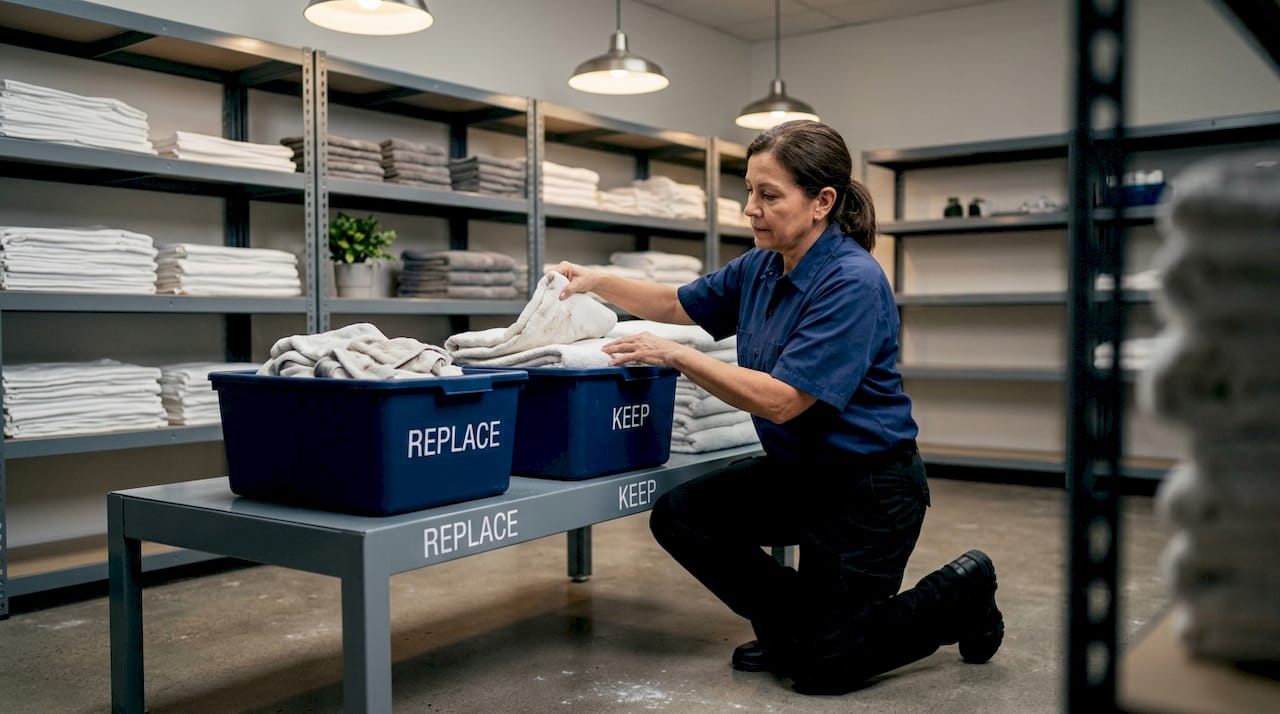
There are also sustainability and hygiene dimensions to consider. Hotels that partner with suppliers holding verified credentials protect both guests and staff from chemical residues left in poorly processed fabrics. Understanding how choosing laundry services for hospitality connects with textile quality is important, because the two functions are interdependent. A textile that cannot withstand industrial wash cycles at high temperatures is a liability, not an asset.
Key benefits of working with a genuine textile partner include:
- Consistent product quality across every order, eliminating batch-to-batch variation
- Technical advisory support on fabric selection suited to your laundry infrastructure
- Proactive restocking aligned with your occupancy calendar
- Compliance documentation available on request for regulatory audits
As the Strategic Sourcing Guide for Hotel Textile Suppliers notes, partners should demonstrate compliance and credentials that procurement teams can verify, including OEKO-TEX, CE, and recycled-content standards such as GRS where relevant.
“Textile quality is not a back-of-house detail. It is a front-line guest experience driver that affects your scores, your reputation, and your repeat bookings.”
Pro Tip: Ask potential textile partners to provide a sample batch from their standard production run, not a specially prepared showcase batch. Test those samples through your actual laundry protocol at least five times before committing to a contract. Real performance shows up under real conditions.
Key criteria for evaluating textile partners
Once you appreciate what the right textile partner can deliver, the critical next step is knowing exactly what criteria distinguish top candidates from the rest.
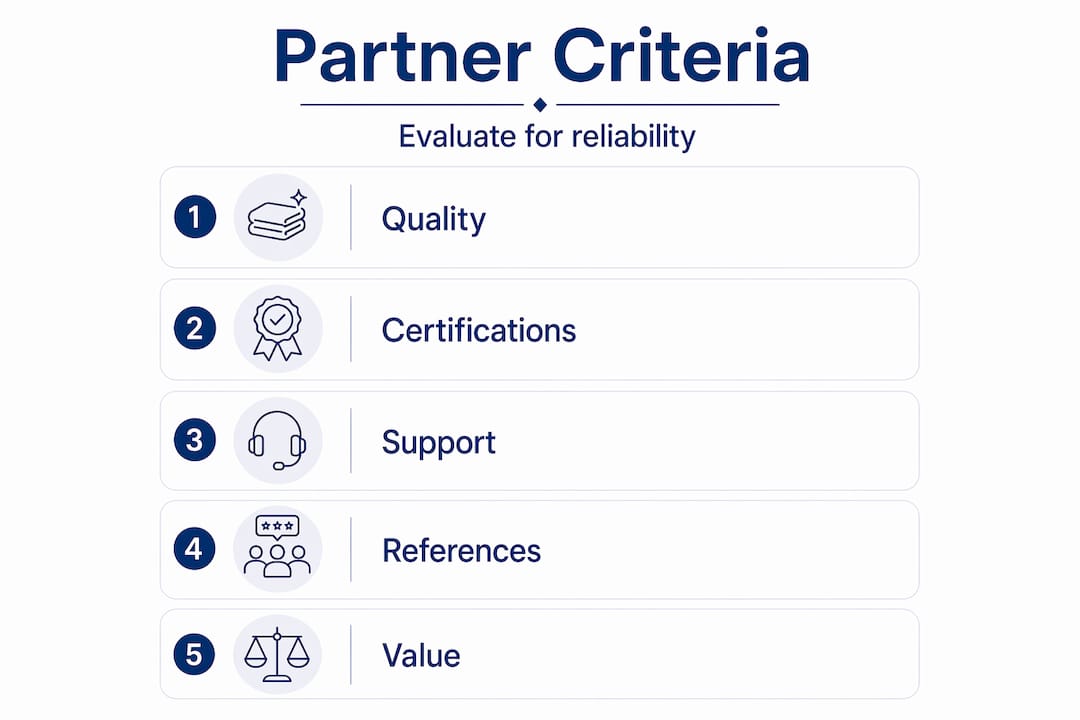
Procurement teams often default to comparing price sheets. That approach fails to capture total cost of ownership and long-term operational risk. A more rigorous evaluation framework looks at certifications, supply chain reliability, references, after-sales support, and transparency.
Certifications to verify
| Certification | What it confirms | Why it matters for hotels |
|---|---|---|
| OEKO-TEX Standard 100 | No harmful substances in the finished textile | Protects guests and staff from chemical irritants |
| CE marking | Product meets EU safety and performance standards | Essential for properties operating under EU-aligned regulations |
| GRS (Global Recycled Standard) | Verified recycled content in production | Supports sustainability commitments and green certifications |
| ISO 9001 | Quality management system in place | Indicates consistent production processes |
The strategic sourcing guide confirms that technical credentials should be verifiable by procurement teams, not simply claimed in marketing materials. Request the actual certificate numbers and cross-check them on the issuing body’s database. This step takes fifteen minutes and instantly separates credible partners from those trading on unverified claims.
A step-by-step evaluation process:
- Request a full certification portfolio and verify each certificate directly with the issuing authority.
- Ask for three hospitality-specific references from properties of comparable size and category to yours.
- Conduct a supply chain audit or request a documented supply chain map showing sourcing origins.
- Assess lead times against your seasonal demand peaks, particularly for summer and holiday periods.
- Review after-sales protocols, including replacement timelines for defective batches and escalation paths for quality disputes.
- Evaluate financial stability by requesting trade credit history or bank references, since a supplier who cannot manage their own cash flow poses a delivery risk to you.
Understanding certified professional standards in adjacent service categories can also sharpen your evaluation instincts, as suppliers who integrate with professional laundry operations tend to design their products with industrial durability in mind.
The manager’s procurement guide provides additional frameworks for evaluating specific product categories such as bed linens, towels, and food and beverage textiles.
Pro Tip: Do not skip reference checks simply because the supplier has a recognizable client list. Call the procurement contact at two or three of those properties and ask specifically about delivery reliability and how the supplier responded when something went wrong. That response pattern tells you everything.
The business case: Cost efficiencies, compliance, and risk reduction
With clear criteria for supplier selection, let’s quantify why the best textile partners drive greater value over time, far beyond mere price tags.
The most persistent myth in hospitality procurement is that choosing the lowest-price supplier saves money. In practice, the total cost of ownership for low-grade textiles is often far higher than the invoice suggests. Fabrics that degrade after thirty wash cycles must be replaced twice as often as quality alternatives that hold up for eighty or more. If your property cycles through three hundred bath towels per year instead of one hundred fifty because of premature wear, you have not saved money on unit price. You have doubled your annual spend and added avoidable procurement overhead.
Total cost of ownership comparison:
| Cost factor | Low-price supplier | Strategic textile partner |
|---|---|---|
| Unit price | Lower | Moderate to higher |
| Replacement frequency | High (every 6-8 months) | Low (every 18-24 months) |
| Laundry damage rate | Higher, shorter lifespan | Lower, engineered for industrial wash |
| Compliance risk | High (unverified standards) | Low (certified products) |
| Guest complaint rate | Higher | Lower |
| Emergency order premium | Frequent | Rare |
Valid certifications like OEKO-TEX and GRS explicitly reduce risk for hotels by confirming supplier quality and sustainable practices. This is not just an environmental argument. Properties that cannot demonstrate responsible procurement face growing scrutiny from corporate travel buyers and booking platforms. Sustainability credentials are becoming a filter, not a bonus.
Key insight: Hotels that switched to fully certified textile suppliers report an average reduction of 30 to 40 percent in emergency procurement events annually, based on operational patterns observed across medium to large Balkan properties. Fewer emergency orders means lower per-unit costs and less operational disruption during peak occupancy.
The compliance dimension is particularly important for properties affiliated with international chains or pursuing green certification. Brands like Marriott and Meliá require their properties to maintain documented sourcing standards. A supplier who cannot produce current certification is not just a quality risk; they are a contractual liability.
Key financial and operational benefits of working with a certified partner include:
- Extended textile lifespan reduces annual replacement spend
- Fewer guest complaints related to room comfort protect your review scores
- Lower risk of regulatory non-compliance penalties in markets with evolving textile import standards
- Predictable procurement cycles allow more accurate budget forecasting
Understanding laundry’s role in hospitality reinforces this point, because the durability of your textiles determines how long your laundry operation can maintain quality output before degradation becomes visible to guests.
Keeping pace with textile trends 2026 and consulting a solid hotel sourcing guide will also help you anticipate product innovations before they become industry standard requirements.
Integrating and managing your textile partnership
Once you’ve committed to a textile partner, effective onboarding and relationship management ensure you realize all the anticipated benefits. Here is how to do it right.
Selecting the right partner is only the first step. Many hotels invest significant effort in evaluation and then fail at integration, leaving value on the table because the internal handoff to operations is poorly managed. A structured onboarding process closes that gap.
Steps for effective onboarding and ongoing management:
- Define your product specifications in writing before the first order. Include fabric weight, thread count, color fastness requirements, and wash cycle resistance targets. Ambiguous specs lead to disputes and off-standard deliveries.
- Establish key performance indicators (KPIs) from day one. Useful KPIs include on-time delivery rate (target: 98% or above), defect rate per batch (target: under 1%), and response time for quality complaints (target: 48 hours).
- Schedule quarterly quality reviews with your supplier contact. Review KPI performance, flag emerging issues, and discuss upcoming demand changes such as seasonal peaks or planned renovations.
- Create a clear escalation protocol so your housekeeping and procurement teams know exactly who to contact when something goes wrong, and what the resolution timeline should be.
- Validate certifications annually rather than assuming they remain current. Certifications have expiry dates, and some lapse without proactive renewal.
- Plan an annual strategic review that goes beyond operational metrics to assess whether the partnership still aligns with your property’s evolving standards and sustainability goals.
The Strategic Sourcing Guide makes clear that ongoing certification monitoring should be a standard part of procurement practice, not just an initial vetting step. Markets change, suppliers restructure, and production sources shift. A partner who met your standards eighteen months ago needs periodic revalidation.
The framework provides a structured walkthrough of exactly this process in the Albanian and Balkan hospitality context, accounting for the specific regulatory and supply chain conditions in the region.
Pro Tip: Build a simple supplier scorecard using your KPIs and share it with your textile partner at each quarterly review. Transparency about performance creates accountability on both sides and signals that you are a serious long-term client worth prioritizing.
Our perspective: Why smart textile partnerships outlast any trend
Having covered the practical side, it is worth addressing a bigger-picture view from years of supporting hospitality success in the Balkans.
Short-term thinking in textile procurement is one of the most consistent sources of avoidable operational problems we observe. A hotel that switches suppliers every twelve to eighteen months in search of a marginally lower unit price rarely saves money in aggregate. Each transition brings onboarding friction, batch inconsistency, and the risk that the new supplier simply has not been stress-tested in your specific operational environment.
The hotels that sustain the highest guest satisfaction scores over time are almost always the ones with stable, multiyear textile partnerships. That stability is not accidental. It reflects a deliberate decision to treat textile sourcing as a strategic function rather than a cost center to be minimized. When a supplier knows they have your long-term business, they invest in understanding your laundry protocols, your peak season patterns, and your brand standards. That knowledge cannot be replicated quickly by a new vendor, no matter how competitive their pricing.
What most procurement teams overlook is that a genuine textile partner also enables innovation. A supplier with deep industry knowledge will alert you to new fabric technologies that offer better durability at similar price points, or to regulatory changes that will require updated product specifications. That proactive intelligence is genuinely valuable and is simply not available from a commodity vendor operating on thin margins.
The Balkans hospitality market is growing, and guest expectations are rising with it. Properties that want to compete with international brands need supply chain partners who operate at the same level of discipline and consistency those brands demand. Exploring wholesale hotel textile partners who can meet those standards is not an optional upgrade. It is a prerequisite for sustained competitiveness.
Partner with experts for your textile needs
Ready to put thoughtful strategy into action? The next step is connecting with a textile partner who meets and exceeds these standards.

Gjergji H Tekstil has supplied certified, hotel-grade textiles to properties including Meliá, Marriott, and Sheraton, building over thirty years of operational expertise in the Balkans and beyond. Whether you manage a resort with two hundred rooms or a boutique property scaling up, the product range, certification portfolio, and advisory capability are in place to support your specific needs. Explore the full range of hotel wholesale textiles and learn how the right fabrics directly shape your textiles and guest experience. Contact the team for a tailored consultation and let the numbers guide your next procurement decision.
Frequently asked questions
What certifications should hotel textile partners have?
The most important certifications are OEKO-TEX, CE, and GRS for recycled content, as verifiable compliance credentials confirm quality, safety, and sustainability across the supply chain.
How do textile partners affect guest experience directly?
Quality textiles ensure comfortable stays, fewer hygiene concerns, and fewer complaints, which in turn protect your online review scores and drive repeat bookings.
What are the risks of using uncertified textile vendors?
Uncertified vendors increase the risk of guest complaints, non-compliance penalties, and premature replacement costs, as certified standards like OEKO-TEX and GRS exist specifically to eliminate those risks.
How often should hotels review their textile partners?
Annual strategic reviews combined with quarterly operational check-ins are the recommended cadence to ensure continued compliance, delivery performance, and alignment with your property’s evolving standards.
What makes a textile “sustainable” for hotels?
Sustainable textiles are produced with certified recycled processes such as GRS that verify recycled content and confirm reduced environmental impact throughout the supply chain, not just at the finished product stage.