

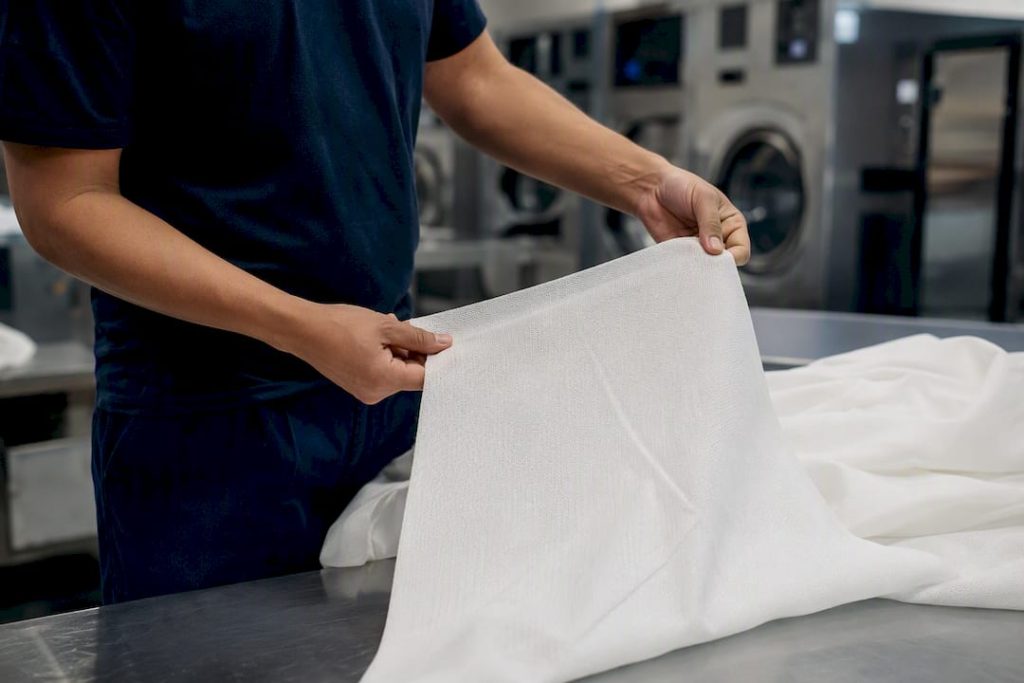
Thread count in hospitality, known technically as numri i fijeve, refers to the number of single-ply threads woven per square inch of fabric, measured on an institutional T-number scale. Most properties should specify between T-180 and T-300 depending on tier: budget and midscale hotels do well on T-180 to T-200, while upscale and resort properties often move to T-250 or T-300. The number alone won’t tell you much, though. Weave, fiber blend, and yarn construction all decide whether that number actually holds up in an industrial laundry.
TL;DR:
- Properties should prioritize T-180 to T-250 for optimal durability and comfort based on their laundry frequency and guest turnover.
- Single-ply yarn measurement ensures true thread count, while multi-ply yarns in retail claims often result in poorer performance after commercial washing.
- Fabric weave, fiber blend, and GSM significantly influence how linens hold up in industrial laundry, affecting drying time and fabric longevity.
- Higher T-numbers increase drying time and labor costs, which can outweigh the perceived quality benefits, especially in high-volume operations.
- Suppliers should provide transparent wash-cycle durability data, yarn-ply information, and real-world testing results to ensure specifications match operational realities.
Table of Contents
- What Numri i Fijeve Actually Measures
- How to Choose the Right T-Number for Your Property
- Why Weave and Fiber Blend Change What the Number Means
- What Higher Thread Count Costs You in the Laundry Room
- How Gjergji H Tekstil Applies These Specs at Scale
- Why Procurement Teams Get This Wrong More Often Than You’d Think
- Request a Spec Sheet From Gjergji H Tekstil
- Sources
What Numri i Fijeve Actually Measures
Numri i fijeve, or thread count, counts the threads running in both directions of a woven fabric, warp and weft, within one square inch. In hospitality procurement, that count is expressed as a T-number: T-180, T-200, T-250, T-300. Each T-number is built on single-ply yarn, meaning one continuous strand per thread counted. That distinction is the whole ballgame for buyers.
Retail thread-count claims of 400, 600, even 1,000 threads almost always rely on multi-ply yarns, where two or more thin strands get twisted together and counted as multiple threads. A 400-thread-count consumer sheet might use two-ply yarn that, measured the way hospitality suppliers measure it, would register closer to T-200. Higher retail thread counts built on multi-ply yarns can actually perform worse under industrial laundering than a well-constructed T-200 or T-250 percale, because the denser, twisted yarns trap moisture and break down faster under repeated hot-water washing and high-heat drying.
That’s why hospitality suppliers publish T-number specifications rather than consumer-style thread counts. It keeps procurement consistent across properties and laundries, and it stops vendors from padding numbers that don’t survive commercial wash cycles.
Here’s how the common T-number tiers generally break down:
- T-180: Entry-level, single-ply, budget-friendly, moderate durability under frequent laundering.
- T-200: The most common institutional standard, balancing hand-feel with wash resilience.
- T-250: A step up in density and softness, typical for upscale properties with moderate laundry volume.
- T-300: Premium tier, denser weave, best paired with lower laundry frequency or gentler cycles.
How to Choose the Right T-Number for Your Property
Matching T-number to property tier isn’t guesswork. It’s a rule of thumb tied directly to average daily rate (ADR) and laundry volume. Budget and select-service properties, typically running high turnover and in-house or contracted commercial laundries, do best on T-180 to T-200. Midscale and upscale hotels usually land on T-200 to T-250, where T-200 percale is frequently cited as the balance point between guest comfort and laundering efficiency. Resorts and luxury properties can justify T-250 to T-300, especially where laundry cycles are less frequent or outsourced to gentler commercial systems.
Use this checklist when writing a purchase order or evaluating a supplier’s spec sheet:
- Confirm the T-number is based on single-ply yarn, not a multi-ply-inflated count.
- Specify weave type (percale or sateen) alongside the T-number.
- Request fiber composition as a percentage (100% cotton vs. cotton-poly blend).
- Ask for GSM (grams per square meter) to gauge fabric weight and density.
- Request documented wash-cycle durability data, not marketing claims.
- Order and commercial-wash a sample batch before committing to full inventory.
Ask suppliers directly for wash-cycle test data, yarn-ply transparency, and a written replacement or defect policy. A supplier who can’t answer those three questions in writing is a red flag, regardless of how good the fabric feels on the showroom table.
Pro Tip: Run any sample through your property’s actual laundry equipment and detergent, not a lab simulation. Real-world drying temperatures and chemical exposure reveal weaknesses that spec sheets never show.
Why Weave and Fiber Blend Change What the Number Means
A T-200 percale and a T-200 sateen won’t behave the same way in your laundry room, even though the number on the invoice is identical. Percale uses a simple over-under weave that produces a crisp, matte hand and tends to hold its structure well through repeated commercial washing. Sateen uses a weave where threads float over multiple yarns before interlacing, giving it a smoother, silkier feel, but percale generally launders better under industrial conditions while sateen demands more careful handling to avoid snagging and pilling.
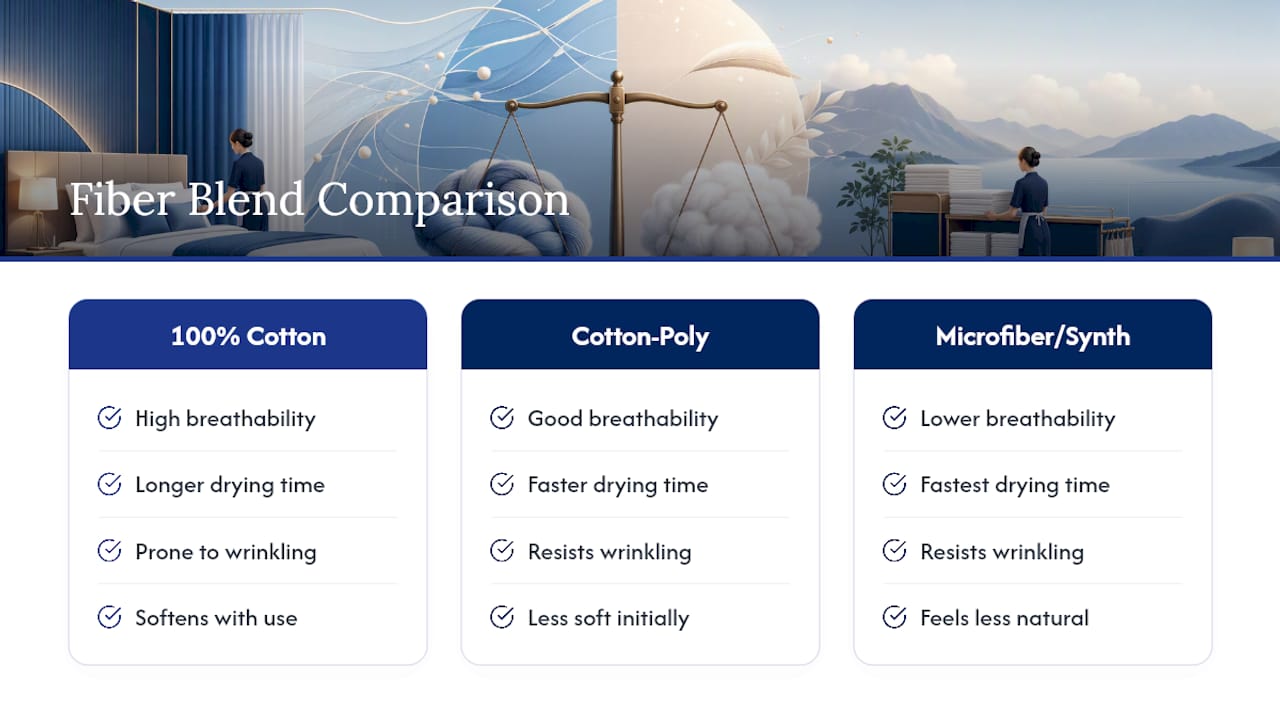
Fiber blend matters just as much. 100% cotton breathes well and softens with use, but it can wrinkle more and take longer to dry. Cotton-rich blends (typically cotton-polyester) dry faster and resist wrinkling, which cuts ironing labor, though they don’t develop the same broken-in softness over time. Microfiber and full synthetic blends dry fastest and resist staining but often feel less breathable to guests overnight.
GSM (grams per square meter) tells you the actual fabric weight, and it interacts directly with drying time. A heavier GSM fabric holds more water and takes longer in the dryer, which adds labor and energy cost per cycle. Request GSM figures alongside T-number and blend percentage. Buying decisions made on thread count alone, without weave, blend, and GSM data, leave procurement teams working with incomplete specs that don’t predict real-world performance.
What Higher Thread Count Costs You in the Laundry Room
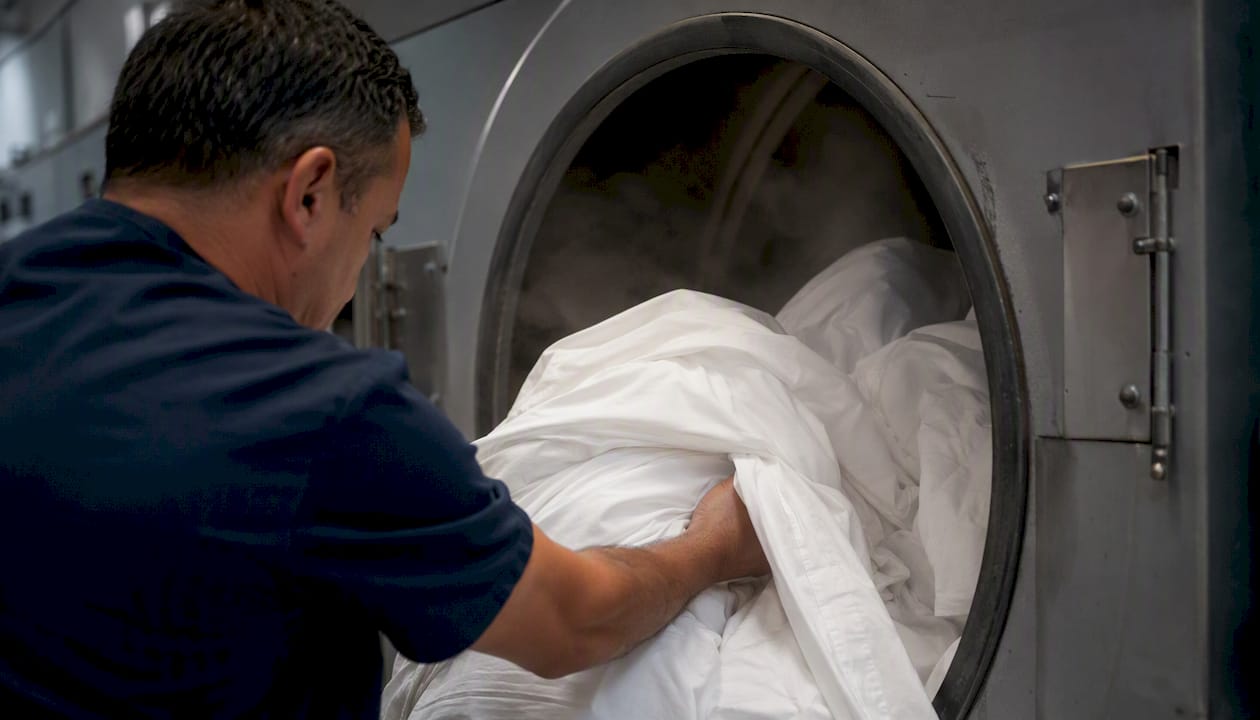
Higher T-numbers generally mean denser weaves, and denser weaves take longer to dry and often need more ironing to look crisp. That’s a direct labor and energy cost, not just a comfort upgrade. A T-300 sheet might look and feel better on day one, but if your laundry runs three cycles a day, the added drying time and wash-cycle wear can shorten its usable life compared to a T-200 built for exactly that workload.
A simple cost-per-use model helps here: divide the total purchase price by expected wash cycles before replacement, then factor in labor minutes for ironing and drying per cycle. Collect three inputs before you calculate: replacement frequency by SKU, laundry throughput per week, and energy cost per drying cycle.
A few practical habits extend service life regardless of T-number:
- Rotate inventory on a three-par system so no single set absorbs all the wear.
- Moderate tumble-dry heat settings rather than maximizing for speed.
- Separate high-wear items (like restaurant napkins) from bedding in wash loads.
- Track defect rates by batch to catch a bad production run early.
Industry procurement guides commonly recommend a T-180 to T-250 range as the sweet spot for commercial laundry durability, precisely because it balances guest-facing quality against these operational costs.
How Gjergji H Tekstil Applies These Specs at Scale
Thirty years in hospitality textile supply teaches you which specs survive contact with a real laundry operation, and which ones only look good on paper. Gjergji H Tekstil has supplied linens to properties operating under international hotel brands, which means every T-number recommendation gets tested against actual commercial wash cycles, not showroom conditions.
That experience shapes how Gjergji H Tekstil approaches hotel textile selection for clients across property tiers:
- Customizing T-number and fiber blend to match each property’s laundry frequency and guest profile.
- Controlling import, production, and quality assurance in-house rather than outsourcing to third parties.
- Providing wash-tested sample batches before full production runs.
- Advising on weave and GSM trade-offs specific to a property’s operational realities.
That kind of integrated supply chain, from raw import to finished batch, is what lets a procurement team specify with confidence instead of trial and error.
Why Procurement Teams Get This Wrong More Often Than You’d Think
Most thread-count advice online still treats the number as the whole story. It isn’t. The real judgment call in hospitality procurement is matching T-number, weave, and fiber blend to your laundry’s actual workload, and that gets ignored constantly in favor of chasing a bigger number because it sounds like more quality.
Conventional wisdom pushes buyers toward higher thread counts as a default upgrade. That advice comes from consumer retail thinking, where a sheet gets washed once a week in a home machine. Hospitality laundries run hotter, harder, and far more often. A T-300 sateen bought for a midscale property with heavy turnover will likely underperform a well-built T-200 percale, and cost more per use once you factor in drying time and wash-cycle wear.
If you take one thing from this guide, prioritize wash-cycle data and single-ply transparency over the number printed on a spec sheet. Ask your supplier to prove durability, not just state it. The properties that get procurement right treat thread count as one input among several, not the final answer.
— Xpert
Request a Spec Sheet From Gjergji H Tekstil
Gjergji H Tekstil is the direct route to hospitality-grade textiles built around the specs this guide covers, not a retailer selling by thread-count marketing alone. As a wholesale importer, in-house manufacturer, and long-term B2B partner, the company controls import, production, and quality checks under one roof, so a property gets consistent T-number, weave, and GSM across every batch instead of guessing between suppliers.

If your property is evaluating a new linen program or replacing an underperforming batch, request a spec sheet or sample set matched to your laundry’s actual workload and property tier. Gjergji H Tekstil’s team can also walk through custom blends, wash-cycle data, and volume pricing for multi-property portfolios. Start by reviewing hotel textile selection guidance built specifically for procurement teams, then request a sample batch tested against your own laundry conditions before committing to a full order.
Sources
Bulk hotel sheets buyer’s guide and durable hotel fabric traits cover related specification detail.