

Egyptian and Pima cotton can perform almost identically when both are genuine extra-long-staple fiber, so the name on the label matters less than whether the claim can be verified. Staple length drives softness and durability, verification through Supima or a named Giza cultivar separates fact from marketing, and weave or construction usually shapes how a sheet actually sleeps.
TL;DR:
- Choose percale for warm sleepers who want a crisp, breathable feel; choose sateen for cooler rooms and a smoother, heavier drape.
- For verification, look for a Supima trademark and license number or a named Giza cultivar such as Giza 45, Giza 87, or Giza 88.
- Treat thread counts above 400 for percale or 600 for sateen with caution, because yarn with multiple plies can inflate counts without improving quality.
- Hotel buyers should specify roller ginning, yarn spun as one ply, traceable sourcing, and finish test records for sheets facing repeated commercial laundering.
Table of Contents
- Comparing staple length, hand, durability, and price signals
- How to verify cotton claims before you buy
- Choosing sheets: weave first, then verify the fiber
- What hospitality procurement teams actually require
- The real lesson: verification beats the label
- FAQ
- Sources
Comparing staple length, hand, durability, and price signals
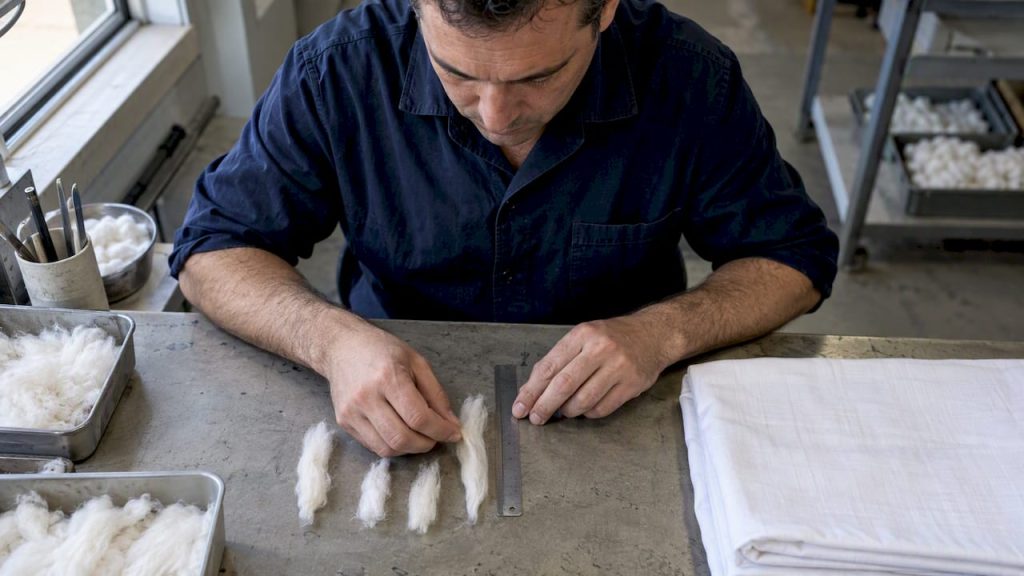
Fiber length is the mechanism behind nearly every claim either cotton makes. Upland cotton, the kind used in most everyday textiles, runs about 0.9 to 1.1 inches. Long-staple cotton reaches 1.25 to 1.4 inches, and extra-long-staple, or ELS, covers 1.4 to 1.6 inches and above. Both Pima and genuine Egyptian cotton belong to this top ELS band, which is why a well-made sheet from either can feel equally smooth and resist pilling equally well.

Pima cotton is a cultivated form of Gossypium barbadense, the same species that produces authentic Egyptian cotton and Sea Island cotton. Longer fibers spin into finer, stronger yarn, and that structural advantage is what reduces pilling and gives the fabric its characteristic smooth hand. Shorter fibers leave more loose ends exposed on the surface of the yarn, which catch on each other and on skin, forming the small balls of fiber we call pilling.
Price tends to track that fiber quality, which makes pricing a useful, if imperfect, check. Genuine ELS cotton costs more to grow, gin, and spin, so a set of sheets claiming Egyptian or Pima origin at a price matched to ordinary cotton deserves a second look. Independent testing has repeatedly found that a meaningful share of bedding labeled “Egyptian” contains little or no actual ELS fiber, which is less a flaw of the fiber itself and more a labeling problem buyers need to watch for.
Construction often matters as much as fiber origin once you are comparing two legitimate ELS products. The difference between a crisp, cool percale sheet and a silky, heavier sateen one comes from the weave, not the cotton behind it:
- Percale uses a simple over-under weave that feels crisp, breathes well, and tends to soften with washing rather than pilling.
- Sateen uses a weave with more threads running in one direction over several threads in the other, producing a smoother, slightly heavier, more lustrous surface.
- Single-ply yarn construction generally outlasts cheaper multi-ply yarns twisted together to inflate a thread-count number.
For hospitality buyers comparing options at scale, our guide on sateen vs. satin sheets walks through the practical checks hotel procurement teams use to settle this choice before fiber pedigree even enters the conversation, including the right types of event furniture for hotel ballrooms to complement the setting.
How to verify cotton claims before you buy
Verification is where most buyers get stuck, because “Egyptian cotton” is a geographic term, not a protected classification in most retail markets. Anyone can print it on a label. Two checks actually hold up.
- Look for the Supima trademark and license number, which signals American-grown Pima cotton backed by supply-chain traceability and DNA testing on the finished product.
- Look for a named Giza cultivar, such as Giza 45, Giza 87, or Giza 88, which identifies a specific, checkable Egyptian variety rather than a vague origin claim.
- Check the thread count against honest ranges: roughly 200 to 400 TC for percale and 300 to 600 TC for sateen; numbers well above that usually come from multi-ply yarn counted as if each ply were a separate thread.
- Confirm single-ply construction where the label states it, since multi-ply counting is the most common way thread counts get inflated without adding real quality.
- Treat an unusually low price on a labeled Egyptian or Pima product as a warning sign rather than a bargain.
Pro Tip: If a label names a mill, a license number, or a specific Giza variety, that specificity itself is a good sign; vague claims with no traceable detail are the ones to question.
A quick label-reading habit catches most problems before checkout: confirm ply construction, confirm thread count sits in an honest range for the weave, and look for either a Supima license or a named cultivar rather than a bare country name.
Choosing sheets: weave first, then verify the fiber
Start with weave, not fiber, because it decides how the sheet will actually feel at night. Percale suits warm sleepers and anyone who prefers a crisp, hotel-corner feel. Sateen suits cooler rooms and buyers who want a softer drape with a slight sheen.
- Pick percale for breathability and a crisp finish, or sateen for a heavier, smoother drape.
- Confirm single-ply construction and check the fabric weight or GSM listed, since that number is a more honest quality signal than an inflated thread count.
- Verify staple pedigree last: a Supima license or a named Giza cultivar, and treat price as a sanity check against both.
Pro Tip: Buy based on weave and construction first; if two sheets share the same honest thread count and ply structure, verified fiber pedigree is what should break the tie.
Care matters as much as the initial purchase. Washing in warm rather than hot water, avoiding excess bleach, and tumble drying on low all help ELS cotton hold its strength over hundreds of cycles. For properties doing high-volume laundering, our breakdown of maximizing textile durability and cutting costs covers wash temperature and cycle limits in more detail, and our hotel fabric specification guide lays out the GSM and construction language procurement teams use when writing a purchase order.
What hospitality procurement teams actually require
Hotel buyers rarely take a label at face value, because a single order covers hundreds or thousands of units that will go through industrial wash cycles for years. Wash durability, pilling resistance after repeated laundering, and supplier traceability matter more than a brand name on the packaging.
Roller-ginning is one detail professional buyers ask about directly. This gentler ginning method preserves fiber length and strength better than saw-ginning, which matters when a sheet will be laundered commercially hundreds of times rather than washed at home once a week.
A specification a procurement manager might use looks like this:
Request roller-ginned, extra-long-staple cotton with single-ply yarn construction, backed by either a Supima license number or a named Giza cultivar, with finish testing documentation included at order confirmation.
That level of detail is exactly what full supply-chain control makes possible at scale, and it’s one reason bulk buyers lean on our hotel textile selection guidance when drafting their own specs.
The real lesson: verification beats the label
Most buyers overpay for a word on a tag rather than for a verifiable property of the fiber inside it. Extra-long-staple cotton earns its reputation through length and strength, not through geography, and that mechanism works the same whether the fiber grew in Egypt, the American Southwest, or elsewhere.
If I had to give one rule, it’s this: choose weave and construction for how you want the fabric to feel, then verify fiber pedigree through Supima or a named cultivar rather than a bare country claim. For hotel-scale buying, that same discipline, paired with a supplier who controls sourcing and testing end to end, helps keep guest-facing textiles consistent order after order.
— Xpert
FAQ
What is the difference between Pima cotton and Egyptian cotton?
Both are grown from the same species, Gossypium barbadense, and both can reach extra-long-staple length, so the practical difference is mainly geography and labeling rather than fiber quality. Pima grown in the United States can carry the Supima trademark, while Egyptian cotton relies on naming a specific cultivar like Giza 87 for a verifiable claim.
Is 100% Pima cotton good?
Yes, Pima cotton is a genuine extra-long-staple fiber that produces a smooth hand and strong resistance to pilling when woven and constructed well. Checking for the Supima trademark adds a traceable layer of verification on top of the fiber claim itself.
How is Egyptian cotton better?
Egyptian cotton is not inherently better than Pima when both are genuine extra-long-staple fiber, since the two share the same underlying species and comparable staple-length range. The advantage shows up only when the Egyptian claim is specific, such as a named Giza cultivar, rather than a generic “Egyptian cotton” label with no traceable backing.
What is the best cotton, Turkish or Egyptian?
Both Turkish and Egyptian cotton can include extra-long-staple fiber, and performance depends more on the specific variety, ginning process, and weave than on the country name alone. A specific, traceable claim, like a named cultivar paired with honest thread-count ranges, is a more useful signal than comparing countries in general.
How do thread count numbers relate to Egyptian and Pima cotton quality?
Thread count only reflects quality within an honest range for the weave, roughly 200 to 400 for percale and 300 to 600 for sateen; numbers well above that usually come from multi-ply yarn counted as multiple threads. Fabric weight and verified fiber pedigree are more reliable quality indicators than a high thread-count figure alone.
Sources
- Egyptian vs Pima Cotton: Staple Length Is the Story — BedCover
- Cotton varieties explained — CottonWorks
- SUPIMA® identity guidelines — Supima
- Cotton ginning practices and their effects — University of Minnesota (ageconsearch)