

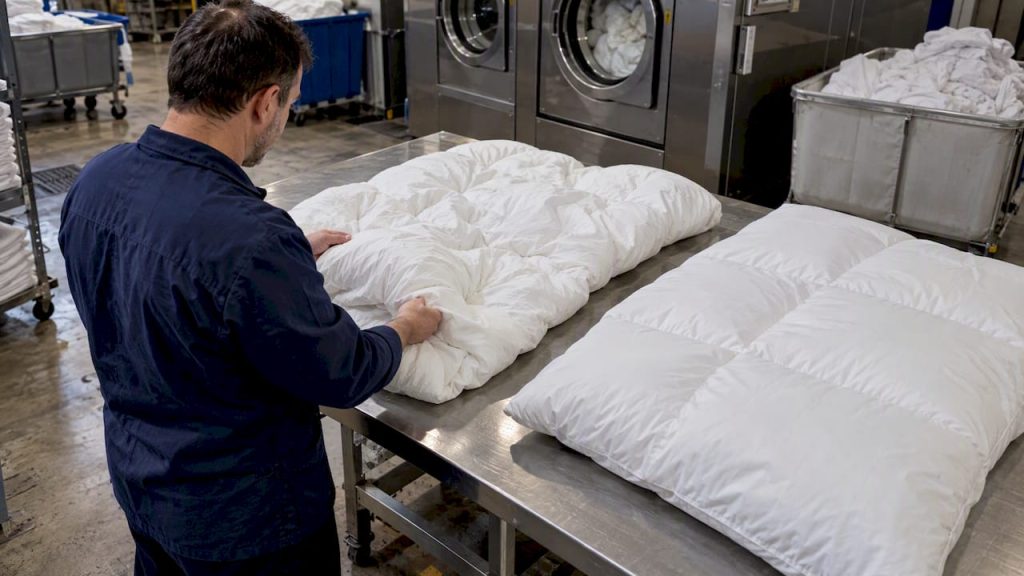
For most hotel properties, down alternative fill wins on operational grounds: it tolerates industrial washing better, costs less to replace, and performs consistently across high par-level inventories. Construction features like baffle-box stitching and down-proof ticking often matter more than the fill itself. Thirty-plus years supplying hospitality clients confirm that laundry resilience, not loft, decides replacement cost. Industry laundering guidance tracks ragout rate as the key signal of when a fill has reached the end of its service life.
TL;DR:
- Down alternative fills resist the high-frequency laundering, drying, and sanitizing chemicals typical in hotel operations better than natural down.
- Construction features such as baffle-box stitching and high stitch density are more critical than fill type for preventing fill migration and extending product life.
- Key laundry KPIs include ragout percentage, wash-cycle-to-failure data, and tensile strength loss, which should guide procurement decisions.
- Full cost calculations must consider purchase price, laundering costs, expected service life, and disposal or recyclability, not unit price alone.
- Always verify construction standards and request supplier data on wash-cycle failure, chemical compatibility, and microplastic mitigation technologies before placing large orders.
Table of Contents
- Down vs Down Alternative: Laundry Resilience, Guest Feel, and Risk
- Laundry KPIs and Testing You Should Require Before Buying
- Building a True Cost-Per-Room Lifecycle Calculation
- What to Demand in Your RFP and Specification
- What 30 Years of Hotel Supply Teaches About Duvet Fill
- How We Support Your Fill Decision With Samples and Testing
- FAQ
- Sources
Down vs Down Alternative: Laundry Resilience, Guest Feel, and Risk
Natural down holds up well in a home laundry cycle done occasionally. Hotel laundries run a different game: daily or near-daily washing, high-temperature drying, chlorine-based sanitizing agents, and heavy mechanical tumbling. Down clusters break down under that load faster than engineered synthetic fibers, and once the structure collapses, clumping and cold spots follow.
Down alternative, usually a polyester fiberfill, was built for exactly this kind of abuse. It resists the compression and moisture cycling of commercial laundering more evenly, and it dries faster, which matters when a property is turning rooms on a tight housekeeping schedule.
Guest-perceived quality, though, often comes down to construction rather than fill chemistry:
- Baffle-box stitching keeps fill distributed evenly, preventing the thin spots guests notice immediately.
- Down-proof ticking with a tight thread count reduces feather leakage and extends usable life for down products.
- Higher stitch density across the duvet face limits fill migration in both down and synthetic products.
Natural down carries two operational risks procurement should weigh directly: feather leakage through worn ticking, and a more delicate wash chemistry requirement that complicates standardization across a laundry serving multiple properties. Synthetic fills carry a different risk profile, mainly around microfiber shedding. Biodegradable polyester technologies such as CiCLO address microplastic persistence while keeping the fiber fully recyclable and holding performance steady, which gives sustainability-minded buyers a synthetic option that doesn’t trade durability for environmental responsibility. For a fuller breakdown of fill categories and how they map to property type, see our guide to hospitality bedding fills.
Laundry KPIs and Testing You Should Require Before Buying
Laundry operators do not judge textiles by touch or brand reputation. They judge by numbers, and procurement should insist on the same discipline before signing a supply contract.
The core KPIs to track:
- Total clean pounds processed, which establishes the baseline volume a fill is expected to survive.
- Ragout percentage, the rate at which items are pulled from service due to damage or wear, a direct signal of fill or construction failure.
- Rewash and reject rates, which flag items failing to meet cleanliness or appearance standards on the first cycle.
- Tensile strength loss (TSL), measuring how much the fabric and fill structure weaken after repeated laundering.
- Replacement cost per pound, which ties wear data directly to budget impact.
These are the same metrics TRSA’s linen life guidance uses to model textile lifecycle cost, and they apply just as directly to hotel duvets as to healthcare linens. High-temperature drying and bleach-based sanitizing hit natural down and synthetic fibers differently: down loses loft and clumps under repeated heat exposure, while polyester fiberfill tends to degrade more gradually and predictably.
Before committing to volume, request standardized wash-cycle-to-failure data, TSL results, and fill migration test results from any supplier. A short in-laundry trial, run through a property’s actual wash chemistry and equipment, often tells procurement more than a spec sheet ever will, a point reinforced in TRSA’s laundry operations resources.
Pro Tip: Run the trial batch through your laundry’s actual bleach and temperature settings, not a generic test cycle. Results vary more by process than by fill type.

For a deeper look at the laundry side of this equation, see our hotel laundry best practices list.
Building a True Cost-Per-Room Lifecycle Calculation
Unit price tells procurement almost nothing about what a duvet actually costs a property over its service life. A cheaper item that fails after 150 wash cycles can cost more than a pricier one that survives 400.
A workable life-cycle framework pulls together:
- Unit purchase price per duvet or pillow.
- Expected service life, expressed in wash cycles or years in rotation.
- Laundering cost per cycle, which your laundry partner can supply directly.
- Ragout and replacement rate, pulled from the KPIs suppliers and laundries should already be tracking.
- Disposal or recycling cost at end of life, which varies depending on whether the fill is recyclable.
The calculation itself is straightforward: divide total cost (purchase price plus cumulative laundering cost over the service life) by the number of wash cycles survived, then multiply by expected annual usage to get an annual cost-per-room figure. Procurement teams should request service-life and wash-cycle data directly from suppliers and laundries rather than relying on published averages, since equipment, water chemistry, and usage intensity shift these numbers property by property.
Par levels change this math substantially. A property running tight par levels replaces items faster under the same wear conditions, which raises effective cost per room even when unit price stays flat. TRSA’s inventory guidance ties low par directly to higher emergency replacement rates and added housekeeping labor, a cost that rarely shows up in a line-item budget but shows up every month in staff time. Our duvet fill cost playbook walks through spec choices that reduce replacement cadence across a full property rotation.
What to Demand in Your RFP and Specification
A specification sheet that only names a fill type leaves too much to chance. Construction details decide most of the real-world performance.
Minimum construction specs to require:
- Down-proof ticking with documented thread count.
- Baffle-box or equivalent chamber construction to prevent fill shift.
- Stitch density specification, stated in stitches per inch or equivalent.
- Fill containment features suited to your laundry’s wash chemistry.
One figure procurement should ask every supplier for directly: ragout percentage tracked against total clean pounds processed, the clearest early-warning signal that a fill or construction choice is failing under real wash conditions.
Require supplier documentation covering wash-cycle-to-failure results, TSL data, chemical compatibility notes, and an end-of-life or recyclability statement, noting whether the fill uses a biodegradable polyester technology such as CiCLO. Contract language should include a warranty against premature performance loss, a defined acceptable ragout threshold, a sample trial period before full rollout, and clear replacement terms. Run any sample through a short on-site trial, matching your actual wash chemistry, before signing volume. See our selection tips for procurement teams for a fuller walkthrough of acceptance criteria.
What 30 Years of Hotel Supply Teaches About Duvet Fill
The most common mistake we see in hotel procurement is buying on fill name alone, down or synthetic, without specifying construction. A down duvet with weak baffle-box stitching fails faster than a well-constructed down alternative, and the reverse holds too.
Experience supplying bedding programs for properties operating under major brands shows that custom construction, matched to a property’s specific laundry chemistry and par strategy, prevents premature ragout far more reliably than chasing a particular fill type. Batching duvet replacement by wear data rather than calendar date, and holding par levels tight enough to avoid emergency buys, consistently lowers effective cost per room across a full property inventory.
— Xpert
How We Support Your Fill Decision With Samples and Testing
Choosing between down and down alternative gets easier once you can test the actual construction against your own laundry conditions rather than a spec sheet. We supply hotel-grade duvets and pillows built with down-proof ticking and baffle-box construction, designed to maintain specification consistency across multi-property orders.

If you want to compare fill performance before committing to volume, request a sample set or a cost-per-room estimate through our hotel textile program, and we’ll work through construction specs and par strategy with your team directly.
FAQ
Is down or down alternative better for hotel use?
For most hotel properties, down alternative holds up better under industrial washing and costs less to replace over time, though construction details like baffle-box stitching and down-proof ticking affect both fill types significantly. The right choice depends on your laundry’s wash chemistry and your property’s par strategy as much as the fill itself.
Which fill is warmer, down or down alternative?
Down traditionally offers a slightly higher warmth-to-weight ratio, but well-constructed down alternative fills close that gap considerably in most hospitality settings. For hotel procurement, insulation performance matters less than how consistently the fill holds up across repeated commercial wash cycles.
How do I calculate the true cost per room for duvet fill?
Combine the unit purchase price with cumulative laundering cost over the expected service life, then divide by the number of wash cycles the item survives before reaching ragout. Request service-life and wash-cycle data directly from your supplier and laundry rather than relying on general industry averages, since results vary by equipment and water chemistry.
Is down alternative more environmentally friendly than down?
Standard polyester fill raises microfiber shedding concerns, but biodegradable polyester technology such as CiCLO reduces microplastic persistence while remaining fully recyclable and keeping performance steady. That makes synthetic fills with this technology a more defensible choice for sustainability-focused properties than standard polyester alone.
What testing should I request from a duvet fill supplier?
Ask for wash-cycle-to-failure results, tensile strength loss data, and fill migration test results before committing to volume. A short in-laundry trial run through your property’s actual wash chemistry, following recommended laundry testing practices, typically reveals more than supplier marketing claims about fill composition.