

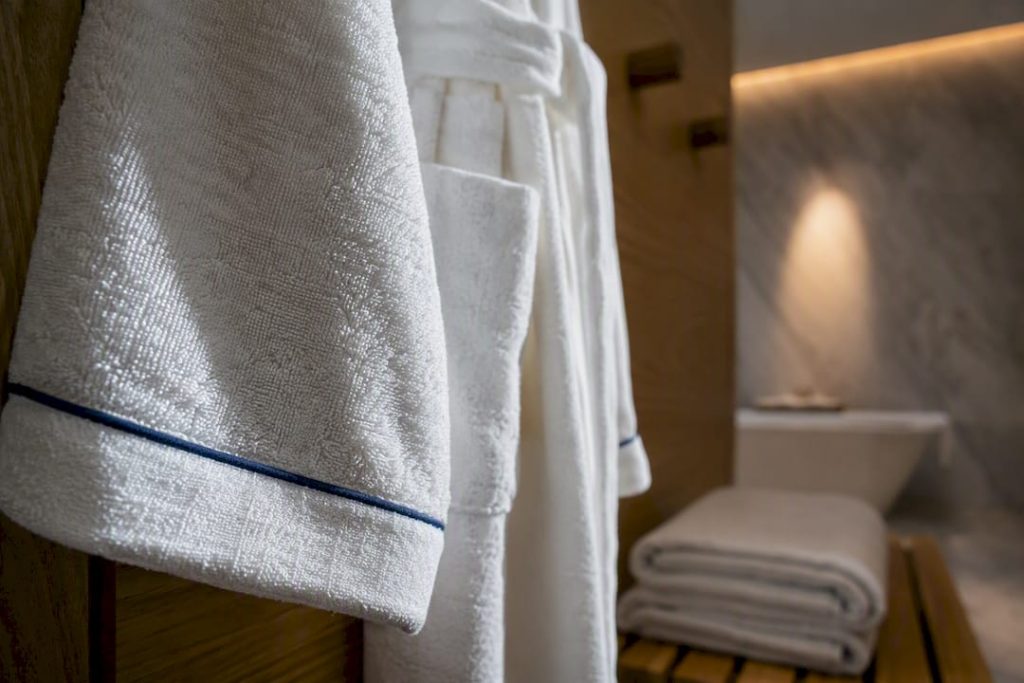
Terry cloth at 400 to 500 GSM is the right call for guest-room robes, where absorbency and a plush feel drive satisfaction scores. Waffle weave around 200 to 250 GSM, or a lightweight cotton-poly blend, works better for spa and pool areas and any property running high-volume turnover. Extended-stay and high-turnover business hotels do best with microfiber or cotton-poly blends, since drying speed and shape retention matter more than pure softness there. Whatever you land on, order representative samples in each construction and run a 10-wash in-house test before signing a bulk contract.
TL;DR:
- Natural-fiber terry robes at 400 to 500 GSM are ideal for guest rooms, providing softness and absorbency, but heavier fabrics increase drying time and energy costs.
- Waffle weave robes, around 220 GSM, suit spa and pool areas due to their quick-drying properties, while microfiber and cotton-poly blends hold shape and dry faster in high-turnover settings.
- Conduct in-house tests with your laundry equipment on samples washed at least ten times to accurately assess shrinkage, seam durability, and drying efficiency before bulk ordering.
- Verify detailed specifications such as GSM, fiber type, seam reinforcement, and wash-cycle ratings in writing, and request independent test results to avoid surprises after purchase.
- Build procurement discipline by comparing fabric samples, negotiating case-pack minimums, freight terms, and customization costs, and establish clear quality and defect criteria upfront.
Table of Contents
- What Fabric Types Work Best for Hotel Bathrobes?
- What Specs Should You Verify Before Ordering Hotel Robes?
- How Do You Test Laundry Performance and Estimate Robe Lifespan?
- What Is the Procurement Process for Bulk Hotel Robes?
- Do Hypoallergenic and Antimicrobial Robe Fabrics Matter?
- How Sustainable Are Different Bathrobe Materials?
- How Do You Evaluate a Hotel Textile Supplier Beyond the Spec Sheet?
- How Do You Negotiate Bulk Pricing on Hotel Robes?
- Why Supply-Chain Control Changes the Procurement Equation
- Get Sample Kits and Wash-Test Support for Your Robe Order
- Sources
- FAQ
What Fabric Types Work Best for Hotel Bathrobes?
Not all “cotton robe” listings mean the same garment, and the differences show up fast once a robe hits your laundry cycle. Four constructions dominate the hospitality market, and each one solves a different operational problem.
Terry cloth uses a looped pile, uncut, which maximizes surface area for water absorption. It is the standard for guest-room robes because guests associate the looped texture with a spa-caliber towel. Terry-velour takes that same base and shears one face smooth, giving a hotel-plush look that photographs well for boutique and luxury properties, though it sacrifices a little absorbency compared to full-loop terry. Waffle, or honeycomb weave, uses a grid pattern that traps less water by design, which is exactly why it dries faster and suits spa circuits. Microfiber and cotton-poly blends trade some of that natural-fiber softness for dimensional stability. They hold their shape wash after wash and resist the shrinkage that plagues cheaper all-cotton terry.
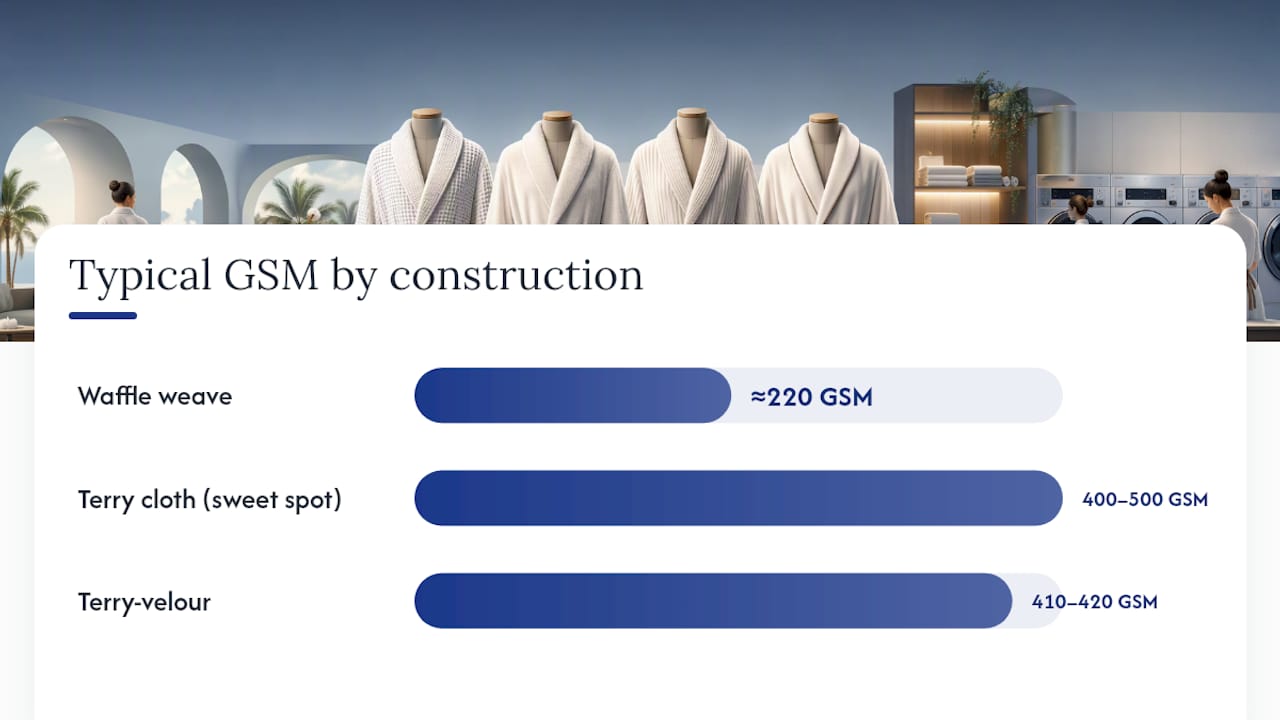
GSM, or grams per square meter, is the number that tells you how these fabrics will actually behave in your laundry room. Hotel-grade terry robes commonly run 400 to 550 GSM, and 400 to 500 GSM sits in the practical sweet spot for upscale properties. Push past 500 GSM and you get a fuller, more luxurious robe, but also a heavier wet load that takes longer to dry and costs more in dryer energy per cycle. Waffle constructions run dramatically lighter. Catalog weights put waffle robes around 220 GSM against terry-velour’s 410 to 420 GSM, a gap wide enough to change your entire laundry throughput math.
Matching fabric to property type comes down to answering one question honestly: what does this guest do in the robe, and how fast does it need to come back into rotation?
- Spa and pool facilities: waffle or lightweight blends, prioritizing quick-dry performance over plushness
- Standard guest rooms: terry or terry-velour at 400 to 500 GSM for the post-shower comfort guests expect
- Boutique and luxury properties: terry-velour, where the smooth face and heavier hand justify a premium positioning
- Extended-stay and high-turnover hotels: microfiber or cotton-poly blends for faster laundry cycling and shape retention
- Warm-climate resorts: waffle weave, since lighter construction dries faster in high-humidity conditions where dryer capacity is already strained
The tradeoff guests never see but you will feel in your utility bill: natural-fiber terry feels better against skin, but blends dry in a fraction of the time and hold their size through hundreds of industrial wash cycles.
What Specs Should You Verify Before Ordering Hotel Robes?
A supplier’s photo tells you nothing about how a robe performs after fifty commercial washes. Hotel-grade robes are defined by performance under industrial laundering, not by how they look in a sample box, so your specification sheet needs to go well beyond fabric color and size.
Before you approve a bulk order, request the following in writing:
- GSM and fiber content for the exact construction you are buying, not a general product-line average.
- Yarn type, specifically whether the cotton is ring-spun or combed, since this affects softness and pilling resistance over time.
- Finished weight per robe, which lets you calculate wet-load weight and dryer capacity before the shipment arrives.
- Reinforcement details, including double-stitched seams, bar-tacked belt loops, reinforced shoulder seams, and pocket corners. These stress points are where premium hospitality robes are built to survive repeated industrial laundering and where cheaper robes fail first.
- Wash-cycle ratings, shrinkage percentages, and color-fastness test results, ideally from an independent or supplier-run lab test.
- Anti-pilling treatment status, since untreated cotton terry pills visibly after repeated commercial washing.
Write down your acceptance criteria before the first bulk shipment lands, not after. Define exactly what shrinkage percentage, color variance, or seam defect rate triggers a rejection, and put it in the purchase agreement.
Pro Tip: Ask suppliers for shrinkage data from wash cycle five and wash cycle twenty-five, not just cycle one. A robe that looks fine after one wash can shrink another two to three percent by cycle twenty, and that gap is what throws off your sizing inventory six months in.
How Do You Test Laundry Performance and Estimate Robe Lifespan?
Retained moisture after extraction is the number that quietly runs up your utility bill. A robe that holds more water coming out of the washer’s spin cycle needs more dryer time, and dryer time is where hospitality laundry operations bleed money on energy and throughput. Testing samples on your own equipment is the single most reliable way to know how a robe will actually perform in your specific operation, because supplier datasheets reflect their own lab conditions, not your machines or your water hardness.
Run this test before committing to a bulk order:
- Wash a representative sample 10 times on your actual laundry equipment, using your standard hotel wash program.
- Weigh each robe dry, then again immediately post-extraction, to establish a real wet-weight-to-dry-weight ratio.
- Record shrinkage after cycle one, cycle five, and cycle ten to catch the sizing drift that matters for guest-facing inventory.
- Inspect seams and belt loops for early stress signs at each interval, particularly at the pocket corners and shoulder seams.
- Note color loss or graying against a fresh control sample kept unwashed.
Terry constructions built and cared for properly can deliver 150 to 200 or more commercial wash cycles before replacement becomes necessary. That range depends heavily on yarn quality, wash temperature, and whether your laundry team avoids over-drying, which breaks down fiber structure faster than the washing itself does.
Set your dryer to the lowest heat setting that still gets robes fully dry, and stop the cycle as soon as they’re done. Store robes with enough airflow to avoid mildew buildup between uses. Once you know your average cycle count per robe, divide it by your property’s typical annual laundry frequency, and you get a realistic annual replacement forecast instead of a guess.
What Is the Procurement Process for Bulk Hotel Robes?
Ordering bathrobes for a 150-room property is a different transaction than buying towels for a boutique inn, and treating it like a single quote request usually costs you money later. Four steps keep the process disciplined.
- Request fabric specs and sample kits in every construction under consideration, terry, terry-velour, and waffle alike, so you can compare them side by side under identical conditions rather than trusting a single sample from one supplier.
- Run the sample wash test described above, and ask the supplier directly for their own wash-test evidence covering shrinkage, colorfastness, and seam durability. A supplier that cannot produce this data is asking you to run the entire testing burden yourself.
- Confirm case-pack MOQ, tiered pricing breakpoints, and freight terms. Per-unit cost typically falls as order volume rises, but freight and customs can shift your real landed cost meaningfully. Get a landed-cost figure for your actual expected order size, not a headline unit price.
- Finalize customization minimums for embroidery or branding, which usually carry their own MOQ and lead time separate from the base garment order. Set written acceptance criteria for the first batch, and build a rotation schedule that maps to your realistic cycle-count expectations from the laundry test.
Our guide on hotel textile selection walks through the same discipline applied across bedding and towel categories, useful if you’re standardizing procurement criteria property-wide rather than robe by robe.
Stocking guidance follows the same logic as your linen par levels. Most mid-to-upscale properties keep two to three robes per guest hook to allow for same-day laundering without gaps in guest availability, adjusted upward for spa and extended-stay properties where turnover runs faster.
Do Hypoallergenic and Antimicrobial Robe Fabrics Matter?
Guest sensitivity to fabric finishes has become a real line item on hospitality RFPs, especially for spa and wellness-branded properties. Hypoallergenic robe options typically mean untreated, undyed, or low-chemical-finish cotton, avoiding the optical brighteners and heavy sizing agents that some guests react to as skin irritation.
Antimicrobial treatments are a separate consideration, usually applied as a fabric finish designed to slow bacterial and odor buildup between industrial washes. These treatments matter most in spa and pool environments, where robes see repeated moisture exposure and faster turnover between guests, conditions that let odor-causing bacteria establish themselves quickly if laundering intervals stretch even slightly.
If you’re sourcing for a wellness-positioned property, ask suppliers directly whether antimicrobial finishes are baked into the yarn or applied as a topical treatment. Topical finishes tend to wash out faster, sometimes within twenty to thirty commercial cycles, while yarn-integrated treatments hold longer but usually cost more per unit. Neither approach eliminates the need for consistent wash temperatures and drying practices. A finish is a supplement to good laundry hygiene, not a replacement for it.
For guests with genuine sensitivities, organic or GOTS-oriented cotton without chemical brightening remains the safer default, even without a formal antimicrobial claim attached. Ask your supplier what specific finish, if any, is applied to the fabric before it reaches your linen room, and get that answer in writing alongside your GSM and construction specs.

How Sustainable Are Different Bathrobe Materials?
Sustainability questions in hospitality procurement usually center on two things: fiber sourcing and end-of-life durability. Organic cotton addresses the first by removing synthetic pesticides and fertilizers from the growing process, though it typically comes at a modest cost premium over conventional cotton terry.
Recycled polyester blends address a different part of the equation, diverting plastic waste into fiber that behaves similarly to virgin polyester in blended fabrics, with comparable dimensional stability and drying speed. These blends fit naturally into the waffle and microfiber categories already recommended for spa and high-turnover settings, so a sustainability goal doesn’t have to conflict with your operational fabric choice.
The most overlooked sustainability lever in robe procurement isn’t fiber origin at all. It’s durability. A robe rated for 150 to 200 wash cycles that’s cared for properly keeps textile waste out of landfill far longer than a cheaper robe replaced every forty cycles, even if that cheaper robe carries a sustainability label on the hangtag. Buying for service life is itself an environmental decision, not just a cost one.
If sustainability sits high on your property’s brand positioning, ask suppliers for fiber origin documentation and any relevant certifications directly, rather than accepting general claims at face value. A credible supplier should be able to name where cotton is sourced and whether recycled content in a blend is pre- or post-consumer material.
How Do You Evaluate a Hotel Textile Supplier Beyond the Spec Sheet?
Specs tell you what a robe should do. They don’t tell you whether the supplier will still be answering your calls eighteen months into a contract, when you need a rush reorder before a holiday weekend.
Reliability shows up in lead times you can plan around, not promises. Ask for typical production lead time on a standard reorder versus a first-time bulk order, since the gap between those two numbers tells you how much buffer stock you’ll need to carry. Certifications matter, but only the ones the supplier can actually document. If a supplier claims a certification, ask for the certificate number and issuing body rather than taking the claim on faith.
After-sales support is the criterion procurement teams underweight most often. What happens when a shipment arrives with a shrinkage rate outside your acceptance criteria? A supplier with in-house manufacturing and direct import relationships can typically resolve production issues faster than a pure reseller working through multiple intermediaries, because they control more of the chain where the problem originated.
Ask every candidate supplier the same five questions: standard lead time, rush-order lead time, defect resolution process, minimum reorder quantity, and whether they can hold agreed pricing across multiple orders in a calendar year. Suppliers with real supply-chain control answer all five without hesitation. Ones working through layers of subcontractors tend to hedge, and that hedging is worth noticing before you sign, not after your first problem shipment.
How Do You Negotiate Bulk Pricing on Hotel Robes?
Tiered pricing is standard in this category, and case-pack size is your first negotiating lever. Confirm the exact volume breakpoints where per-unit pricing drops, since some suppliers hold pricing flat until a much higher volume than their initial quote implies.
Freight and landed cost deserve as much negotiation attention as the unit price itself. Ask whether pricing is quoted FOB origin or delivered, and get a landed-cost figure calculated against your actual order size before comparing quotes across suppliers. Two suppliers with identical unit prices can produce very different final costs once freight terms are factored in.
Multi-year or multi-order commitments give you leverage that a single purchase order never will. If your property replaces robes annually as part of routine cycling, ask whether committing to two or three years of forecasted volume unlocks better pricing or locked-in rates that protect you against cotton price swings.
Customization terms need their own negotiation line. Embroidery and branded packaging typically carry separate minimums and lead times from the base garment order, and rushing that timeline late in the process is a common way procurement teams end up paying rush fees they didn’t budget for.
Finally, negotiate your acceptance and remedy terms into the contract itself, not just the pricing. Specify what shrinkage or defect rate triggers a credit or replacement, and get that written into the agreement before the first bulk shipment ships, not after a problem surfaces.
Why Supply-Chain Control Changes the Procurement Equation
Most robe quality problems trace back to variability between production runs, not a single bad specification. A supplier who only resells finished goods has limited ability to fix that, because they don’t control the mill.
Gjergji H Tekstil has operated as an integrated importer and manufacturer since 1994, supplying hospitality clients that include major international hotel brands. That kind of supply-chain control matters less as a credential and more as a practical outcome: fewer surprises between the sample you approve and the pallet that arrives eighteen months later.
Whichever supplier you choose, apply the checklist above without exception, and insist on documented wash-test data before signing. It’s the single habit that separates procurement teams who get surprised by a shipment from those who don’t.
— Xpert
Get Sample Kits and Wash-Test Support for Your Robe Order
Gjergjihtextil gives hospitality buyers something most resellers can’t: direct access to the mill, so a shrinkage problem gets fixed at the production source instead of getting passed between three intermediaries while your rooms sit short on inventory. As an in-house manufacturer and importer with over 30 years supplying hotel groups across the region, Gjergjihtextil can produce sample kits in terry, terry-velour, and waffle constructions at the GSM ranges your property actually needs, then work through wash-test results with your team before a single bulk order gets confirmed.

Customization runs through the same direct channel, meaning embroidery, sizing, and branding decisions don’t add layers of negotiation with a subcontractor you never talk to. Bulk pricing and landed-cost guidance come from a team that has priced these exact freight and case-pack questions for hundreds of hospitality clients already.
If you’re ready to move past sample requests and start comparing real numbers, visit Gjergjihtextil’s hotel textile selection page to request a sample kit and start your own in-house wash test this quarter.
Sources
- Hotel Bath Robes: The Complete Buyer’s and Hospitality Guide
- Wholesale Waffle Bathrobes: Buyer’s Guide for Hotels & Spas – RobeMart
- Spa bathrobes: waffle or terry for commercial use? – TowelHub
- What Is a Premium Hospitality Robe? Your Expert Guide – Lotus Linen
FAQ
What Does GSM Mean for Hotel Bathrobes?
GSM stands for grams per square meter and measures fabric density. Higher GSM generally means more absorbency and plushness but longer drying time, with hotel-grade terry commonly ranging from 400 to 550 GSM.
Which Fabric Is Better for Spa Robes, Waffle or Terry?
Waffle weave typically wins for spa and pool settings because it dries faster and weighs less, with catalog weights around 220 GSM against terry-velour’s 410 to 420 GSM. Terry remains the better choice for guest-room robes, where guests expect maximum softness and absorbency after a shower.
How Many Sample Robes Should You Order Before a Bulk Purchase?
Order enough samples in each construction under consideration to run a full 10-wash cycle test on your own equipment, typically two to three units per fabric type so you can track shrinkage and seam stress across repeated washes. Some suppliers can provide sample kits across multiple constructions specifically for this purpose.
How Long Should Hotel Robes Last Before Replacement?
Properly constructed terry robes can deliver 150 to 200 or more commercial wash cycles before replacement becomes necessary, assuming correct wash temperatures and dryer settings. Divide that cycle count by your annual laundry frequency to build a realistic replacement budget.
What Is a Typical MOQ for Bulk Hotel Robe Orders?
Minimum order quantities vary by supplier and construction, but case-pack pricing usually drops at defined volume breakpoints rather than scaling smoothly. Ask each supplier directly for their tiered pricing sheet and landed-cost estimate against your specific expected order size before comparing quotes.