

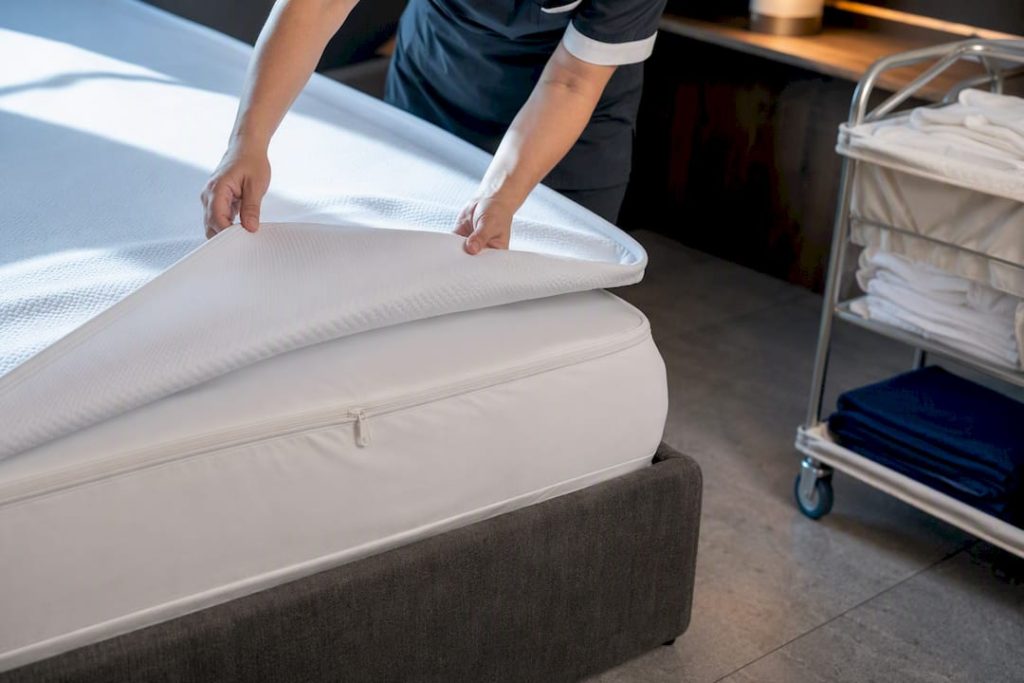
Yes, every hotel property should run mattress protection as a fixed operating standard, not an optional upgrade. Protectors cut emergency mattress replacements, keep rooms sellable after a spill instead of out of service, and lower pest and allergen risk that shows up in guest reviews. The right approach pairs a permanent encasement with a washable pad, and a short procurement checklist makes rollout straightforward property-wide.
TL;DR:
- A two-layer mattress protection system with a long-lasting encasement and a washable pad can extend mattress life by approximately 30 to 40 percent.
- Proper housekeeping routine includes blotting spills, laundering pads after each guest, and inspecting encasements monthly to ensure effectiveness and longevity.
- Fully sealed waterproof encasements with reinforced zippers and deep-pocket fit are essential components for effective hotel mattress protection.
- Cost analysis shows that the full two-layer system can roughly halve replacement expenses over five years compared to no protection, while also improving guest reviews.
- Custom sizing and supplier expertise in industrial laundry durability are crucial for ensuring proper fit and performance across diverse hotel mattresses.
Table of Contents
- Pse mbrojtës dysheku hotelier duhet të jetë pjesë e standardit operativ
- The two-layer system: encasement plus washable pad
- What to specify when buying mattress protectors for hotel use
- How should housekeeping manage mattress protectors day to day?
- What does mattress protection actually cost, and what’s the return?
- Procurement checklist for a property-wide rollout
- Why supplier experience changes protector performance
- Get procurement support for hotel mattress protection
- Sources
Pse mbrojtës dysheku hotelier duhet të jetë pjesë e standardit operativ
Housekeeping teams that skip mattress protection are betting the mattress on every guest stay, and eventually they lose that bet. A single spill, a bedbug complaint, or a stained mattress that has to be pulled from a room mid-season costs far more than the protector that would have stopped it. That’s the practical case for pse mbrojtës dysheku hotelier belongs on every purchase order, right alongside sheets and towels.
Fewer stains reaching the mattress core means fewer emergency replacements during peak occupancy, when swapping out a mattress is genuinely disruptive. Housekeeping spends less time on deep-clean escalations, and rooms come back online faster after an incident. Reviews improve too, since nothing tanks a guest’s rating faster than a musty smell or a visibly stained mattress pad glimpsed while making the bed.
Allergen and bed-bug control matters just as much operationally as it does for guest comfort. A sealed encasement blocks the crevices where bedbugs breed and cuts down dust mite exposure, which turns a health and safety liability into a manageable maintenance item instead of a five-star crisis.
- Fewer mid-season mattress swaps during high occupancy
- Faster room turnaround after a stain or spill incident
- Lower risk of bedbug and allergen complaints reaching a review site
- Reduced deep-cleaning labor for housekeeping crews
Statistic callout: Combining a permanent encasement with a washable pad can extend mattress life by roughly 30 to 40% compared to running mattresses unprotected, according to hospitality bedding guidance built specifically around hotel replacement cycles.
The two-layer system: encasement plus washable pad
The system that actually works in hotel operations has two distinct jobs split across two products, and mixing them up is where properties go wrong. A permanent, fully zippered waterproof encasement wraps the entire mattress and stays on for an extended stretch, sealing every seam where bedbugs and allergens would otherwise settle. Above it sits a washable waterproof pad, the layer guests actually touch through the fitted sheet, designed to be laundered constantly without ever coming off the mattress.
Each layer runs on its own clock. The encasement is built to stay in place for roughly a year at a time, since repeated washing stresses its seams and zipper teeth long before the fabric itself wears out. The pad, by contrast, gets laundered after every single guest, which is exactly the workload it’s engineered to survive.
Pro Tip: Never wash the encasement on the same cycle as the pad. Zippers and seams degrade faster under repeated commercial laundering, and a failed encasement zipper defeats the entire bedbug barrier.
The five-minute spill routine keeps this system working under real operating pressure:
- Blot the spill immediately with a clean, absorbent cloth. Never rub, since rubbing pushes liquid deeper into the pad fibers.
- Strip the washable pad off the encasement and bag it for laundering.
- Wipe down the encasement’s waterproof surface with an appropriate cleaner, using an enzymatic cleaner for organic stains like urine or bodily fluids.
- Let the encasement air dry fully before remaking the bed.
- Replace with a fresh pad from par stock and return the room to service.
Run this correctly and a spill becomes a five-minute housekeeping task instead of a mattress write-off. That’s the operational advantage the two-layer system is built for, and it’s why supply guides increasingly treat it as the default rather than an upsell.
What to specify when buying mattress protectors for hotel use
Procurement teams that write vague purchase orders end up with protectors that fail commercial laundry cycles within months. Specificity at the buying stage saves money later.
Backing material is the first decision point. Polyurethane (PU) backing is the standard choice across commercial hospitality mattress protectors because it balances waterproofing with enough flexibility to survive repeated industrial washing. TPU backing offers similar waterproofing with slightly better breathability, though it typically costs more per unit, and breathability trades directly against guest heat complaints if you get it wrong.
Outer fabric choice affects comfort more than most buyers expect. Some hospitality-grade pads now pair waterproof backing with cooling fabric surfaces specifically to head off the “hot plastic” complaint that cheaper vinyl protectors generate.
When specifying fit and fastening, look for:
- Deep-pocket sizing that accommodates mattress depths from roughly 8 to 21 inches without pulling loose overnight
- Full-length, reinforced zippers on encasements, not partial-zip or elastic-corner designs
- Fitted-sheet style skirts on pads for a secure, wrinkle-free surface
- Manufacturer wash-temperature limits stated clearly, since backing can fail above recommended heat thresholds
- Written commercial warranty terms, not just a retail return policy
Fabric durability under repeated industrial laundering deserves its own line item in any spec sheet. Reviewing durable hotel fabric traits before finalizing a purchase order helps procurement teams avoid the common mistake of buying on price per unit instead of cost per wash cycle survived.
How should housekeeping manage mattress protectors day to day?
A protector system only performs as well as the routine built around it. Housekeeping needs a clear, repeatable procedure rather than ad hoc judgment calls in the room level.
- On discovering a spill, follow the five-minute routine: blot, strip the pad, treat the encasement surface, air dry, and replace with fresh stock.
- Launder pads on a schedule that matches guest turnover, ideally after every checkout, using warm water and a standard detergent rather than bleach-heavy formulas that degrade waterproof coatings.
- Set dryer settings to low heat. High heat is the single most common cause of premature backing failure in commercial mattress protectors.
- Inspect encasements monthly for zipper function, seam integrity, and any lingering odor that suggests moisture has reached the mattress underneath.
- Pull and replace any pad showing visible wetness staining, persistent smell, or peeling backing, since these are the three clearest replacement triggers.
- Track par stock at two to three washable pads per room, allowing for same-day laundering turnaround plus a buffer for high-occupancy weeks.
Pro Tip: Label encasements by installation date with a discreet tag inside the zipper flap. It turns the twelve-month rotation from a guess into a scheduled task on the housekeeping calendar.
Pairing this routine with a broader hotel laundry best-practices approach keeps wash temperatures, detergent choice, and dryer cycles consistent across every textile category, not just mattress pads. Consistency here is what actually protects the warranty on both layers of the system.
What does mattress protection actually cost, and what’s the return?
The math on mattress protection is straightforward once you separate upfront cost from avoided cost. A washable pad runs a modest per-unit price and gets replaced every year or two under normal wear. A permanent encasement costs more upfront but is designed to last multiple years if handled on its slower rotation schedule.
Run the comparison across three scenarios over five years on a mid-size property, and the pattern holds consistently:
- No protection: Full mattress replacement costs recur whenever a stain, bedbug incident, or odor forces a mattress out of rotation, often multiple times across a five-year span per room.
- Pad-only: Catches most spills but leaves the mattress exposed to bedbug harborage in seams and corners, since a pad alone doesn’t seal the full mattress.
- Two-layer system: The combined approach can roughly halve total replacement costs over a multi-year horizon compared to running mattresses unprotected, based on vendor scenario modeling built around typical hotel replacement cycles.
Statistic callout: Properties using the full two-layer system report cutting emergency mattress replacements dramatically, since most stains never reach the mattress surface at all.
Non-monetary returns matter just as much to the decision. Fewer stained-mattress complaints mean fewer negative reviews mentioning cleanliness, and fewer bedbug incidents mean avoiding the reputational damage that follows a single viral complaint. Log every protector-related incident by room and date, and that record becomes the evidence procurement needs to justify property-wide rollout instead of a one-floor pilot. Reviewing the textile durability and cost-cutting playbook alongside this data helps frame protector spend as part of total textile lifecycle cost, not an isolated line item finance has to approve separately.
Procurement checklist for a property-wide rollout
A pilot before full rollout catches fit and durability issues before you’ve committed to hundreds of units. The checklist below keeps that pilot tight and the eventual purchase order specific.
- List every mattress size and depth across the property, since deep-pocket fit failures are the most common pilot complaint.
- Specify backing material (PU or TPU), wash-temperature limits, and warranty terms directly in the request for proposal, not as assumed defaults.
- Request physical samples for a fit test on at least three mattress depths before committing to a bulk order.
- Run a wash-cycle durability test: launder sample pads 15 to 20 times at your standard commercial settings and inspect for backing wear.
- Collect guest feedback over a two-week window on a pilot floor, specifically asking about temperature and noise from the protector.
- Confirm supplier delivery timelines, minimum order quantities, and whether custom sizing is available for non-standard mattress depths.
- Set par stock at two to three pads per room and one encasement per mattress, with a clear reorder trigger tied to laundering counts rather than calendar dates.
- Confirm the supplier offers technical support for warranty claims, since backing failures are the most common post-purchase dispute.
Local retail availability makes small-batch testing easier before a full commitment. Albanian buyers can see standard fitted-protector sizing already in market through listings like Dormeo Albania’s fitted protector line, which gives procurement teams a useful sizing benchmark even when sourcing bulk orders through a dedicated hospitality supplier.
Why supplier experience changes protector performance
Thirty years of supplying hotel textiles teaches you that a protector spec sheet only matters if the supplier understands commercial laundry realities, not retail assumptions. Gjergji H Tekstil has watched properties burn through cheap encasements whose zippers fail after twenty wash cycles, and has adjusted sourcing accordingly, favoring backing materials and stitching that survive industrial equipment rather than a home washer.
Custom sizing solves a problem most hotels don’t realize they have until a pilot fails: not every property runs standard mattress depths, and a protector that’s a half-inch short at the corner defeats the entire seal. Supply-chain control from import through distribution means a property can request a non-standard depth run without waiting on a manufacturer overseas to approve a small custom batch. That control is what turns a one-floor pilot into a property-wide rollout without months of delay.
— Xpert
Get procurement support for hotel mattress protection
Gjergji H Tekstil gives procurement teams something a generic textile catalog can’t: direct access to custom sizing and specification guidance built specifically around commercial hotel laundry cycles, backed by three decades of supplying hotel properties across the region.

That means fewer failed pilots from mismatched deep-pocket fits, faster reorder cycles once par stock is set, and a single point of contact instead of chasing three different suppliers for encasements, pads, and warranty support. Properties planning a rollout can request physical samples before committing to bulk quantities, which catches fit and fabric issues before they show up as guest complaints. For teams weighing disposal logistics on outgoing mattresses during a protector rollout, resources like Sydney City Rubbish Removal’s mattress disposal guidance cover the removal side of that transition.
Start by reviewing the hotel textile selection guide for a full procurement checklist, then request samples directly to begin a pilot on your own property.
Sources
- Complete Mattress Protection for Hotels: A Guide | Bargoose
- Coral Fleece Fitted Mattress Protectors | LodgMate Bedding Protection
- Mattress Armor™ Mattress Pad with “Icy Cooling Fabric” – Hospitality Sleep Systems