

Recycled textiles, including rPET, recycled cotton blends and regenerated fibers, can meet hotel-grade needs when they pass three procurement gates: documented performance specs, certified traceability such as Global Recycled Standard transaction certificates, and confirmed compatibility with industrial laundering. Skip any one of those checks and durability or guest comfort tends to suffer. The sections below walk through the tests, documents and pilot steps that make the difference.
TL;DR:
- Recycled textiles must pass documented performance tests, traceability certifications, and laundering compatibility checks to ensure durability in hotel use.
- Batch-level testing and transaction certificates are vital to verify the recycled content claims, especially since post-consumer waste quality varies.
- Supplier relationships should prioritize GRS certification, batch-specific documentation, and sourcing from controlled collection streams to reduce variability.
- Recycled blends are generally as durable as virgin fibers when tested under real industrial-laundry conditions and tailored to specific product categories.
- Piloting recycled textiles over 4 to 8 weeks with monitoring of wash survival and guest feedback helps ensure long-term performance before full-scale procurement.
Table of Contents
- Types of recycled fibers and which hotel textiles they suit
- Performance and durability: tests procurement should require
- Certifications and traceability: how to verify recycled content claims
- Sourcing and supplier due diligence checklist
- Operational implementation: laundry, care and lifecycle management
- Cost, pilot design and procurement timeline
- Operational proof points from an experienced hospitality textile supplier
- Guest perception and marketing benefits of recycled textiles
- Challenges and limitations in adopting recycled textiles in hospitality
- Why procurement should act now on recycled textiles
- How Gjergji H Tekstil can support a recycled-textile pilot
- FAQ
- Sources
Types of recycled fibers and which hotel textiles they suit
Recycled polyester (rPET), typically reclaimed from plastic bottles or textile waste, works well in blends for curtains, upholstery and some bedding components because it resists shrinkage and holds color well through repeated washing. Recycled cotton, usually mechanically shredded from pre-consumer cutting scraps or post-consumer garments, has a shorter average fiber length than virgin cotton, so mills typically blend it with virgin fiber or polyester to keep strength and softness in towels and sheets. Regenerated fibers, such as recycled viscose or lyocell blends, suit curtains and decorative textiles more than high-friction items like bath towels.
Matching material to product category avoids costly mismatches:
- Towels and bath linens: cotton-rich blends with a modest rPET share for durability, not pure recycled polyester, which can feel less absorbent.
- Sheets and pillowcases: recycled cotton or cotton-poly blends tested for pilling resistance.
- Curtains and upholstery: rPET or regenerated fiber blends, where moisture absorption matters less.
- Uniforms: polyester-recycled blends for durability under frequent industrial washing.
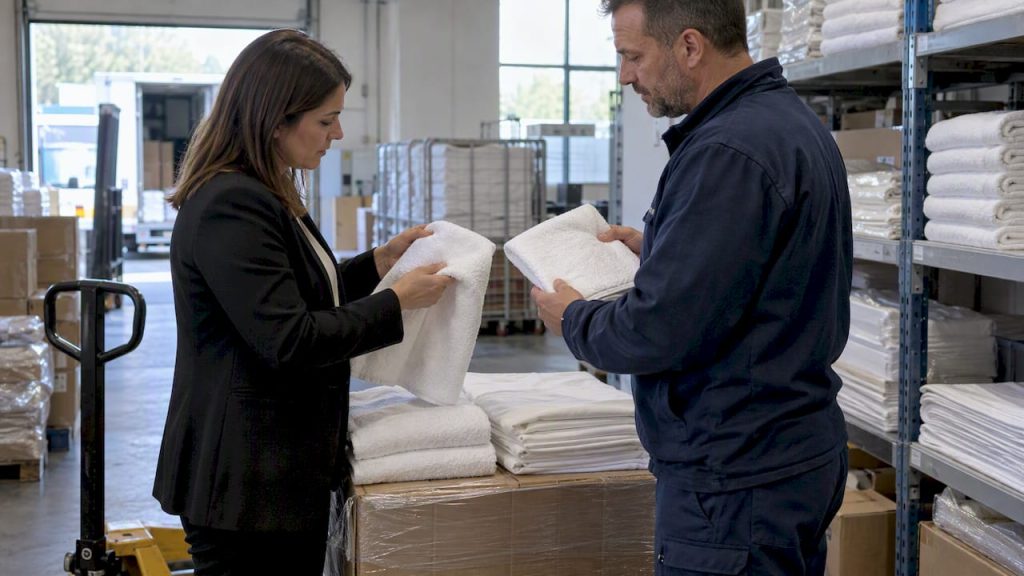
Request a physical swatch and a spec sheet before committing to volume, not just a product description.
Performance and durability: tests procurement should require
Recycled content changes nothing about the laundering reality: hotel textiles face hundreds of industrial wash cycles a year, and specs need to prove the fabric survives that. Before approving a supplier, ask for test results covering:
- Grams per square meter (GSM): confirms weight and hand match the product category.
- Martindale abrasion rating: measures wear resistance, especially for upholstery and heavy-use linens.
- Pilling resistance: graded after repeated wash-and-dry cycles, not a single wash.
- Colorfastness: checked against both washing and light exposure.
- Shrinkage percentage: measured after the number of wash cycles typical for your laundry program.
If a recycled blend tests lower than a virgin-fiber equivalent on any of these, ask the supplier whether a different blend ratio or finishing treatment closes the gap rather than accepting the lower number outright.
Pro Tip: When a recycled fabric trades a little softness for meaningfully better abrasion resistance, that is usually the right trade for high-turnover items like towels and uniforms.
Certifications and traceability: how to verify recycled content claims
The Global Recycled Standard sets the reference framework for recycled-content claims. It requires chain-of-custody documentation at every stage and, critically, transaction certificates that travel with each batch, recording whether the recycled input is pre-consumer or post-consumer. A supplier’s general claim of “recycled fabric” means little without a transaction certificate tied to the specific lot you are buying.
On average, post-consumer waste accounts for the majority of textile waste in Europe, with smaller shares from post-industrial and pre-consumer material. That split matters because post-consumer feedstock quality varies more than pre-consumer scrap, so batch-level testing becomes more important, not less, as recycled content scales.
Ask every supplier for:
- The GRS certificate pages covering their specific facility
- Transaction certificates for the batch you are purchasing
- A reclaimed material declaration or equivalent incoming-material statement
Our guide to eco labels in hotel textiles breaks down how these labels differ in practice.
Sourcing and supplier due diligence checklist
A clean supplier relationship starts with the paperwork, not the price quote. Build your request for quotation around these steps:
- Request GRS certificate pages and transaction certificates for the exact product line, not a company-wide certificate that may cover unrelated goods.
- Ask for incoming material declarations and lab testing reports tied to the batch you intend to order.
- Prioritize suppliers fed by closed-loop or hospitality-sourced collection when available, since feedstock collected directly from controlled commercial sources tends to be more consistent than mixed post-consumer streams.
- Confirm minimum order quantities and batch lead times up front, since recycled-input batches can carry longer lead times during seasonal collection peaks.
- Clarify return and remedy terms in writing before the first order ships.
Our piece on textile traceability covers how to read these documents without needing a certification background, and our procurement guide for hospitality managers lays out a fuller RFQ template.
Operational implementation: laundry, care and lifecycle management
Recycled fibers generally tolerate standard hotel laundry programs, but a few adjustments extend their useful life. Wash recycled-blend linens at the temperature the supplier specifies rather than defaulting to the hottest cycle, since excess heat accelerates fiber breakdown in blends with a shorter average fiber length. Choose detergents without harsh optical brighteners for colored recycled-cotton items, since those additives can dull recycled dye lots faster than on virgin fiber.
Build inspection into the rotation schedule:
- Check hems and seams every few wash cycles rather than waiting for visible wear.
- Rotate stock evenly so no single batch absorbs disproportionate use.
- Pull items at the first sign of pilling rather than running them to failure, which protects guest-facing quality.
Pro Tip: Track wash-cycle counts by batch, not just by purchase date. Two identical-looking towel orders can wear differently depending on their recycled-content ratio.
End-of-life items do not have to go to landfill: repair what is repairable, reroute worn-but-usable stock to back-of-house or donation, and route the rest to a certified recycler to keep the material loop closed. Our tips on hotel textile selection cover balancing comfort and cost over a product’s full lifecycle.

Cost, pilot design and procurement timeline
Unit price alone is a poor way to judge recycled textiles. A fabric priced slightly higher but rated for more wash cycles before replacement often costs less per year of service. Compare suppliers on total cost of ownership, not the invoice line.
A practical pilot sequence looks like this:
- Approve samples against the performance specs and certificates outlined above.
- Run a 4 to 8 week small-batch trial in a limited set of rooms or outlets.
- Track KPIs including wash-cycle survival, guest complaints and housekeeping feedback.
- Decide on scale only after the trial data confirms the fabric holds up under your actual laundry program.
Contract terms should lock in quality thresholds, require transaction certificates for every batch, and spell out remedies if a shipment fails to meet the agreed specification.
Operational proof points from an experienced hospitality textile supplier
Supply-chain variability is the biggest hidden risk in recycled textiles, and it is best managed through centralized control rather than hope. A supplier that imports at scale, holds in-house production capacity and warehouses stock centrally can smooth out the batch-to-batch variation that recycled feedstock sometimes introduces. We have extensive experience in hospitality textiles, which means we have seen what breaks under industrial laundering and what holds up.
When evaluating a supplier for a recycled-textile pilot, prioritize:
- Local or regional stock availability, so pilot orders do not stall on international lead times.
- Fast sample turnaround, since procurement decisions depend on physical swatches, not catalog photos.
- Materials already tested under industrial-laundry conditions, not just lab conditions.
Guest perception and marketing benefits of recycled textiles
Guests increasingly notice sustainability signals, and linens are among the few textile touchpoints they physically handle during a stay. A towel or sheet that performs well while carrying a credible recycled-content story reinforces a hotel’s broader sustainability positioning without requiring the guest to do anything differently. The key word is credible: a vague “eco-friendly” label without a certificate behind it risks the opposite effect if a guest or reviewer asks for specifics and gets none.
Properties that pair recycled textiles with visible, verifiable claims (a GRS reference on a room card, a transaction certificate available on request) tend to earn more trust than those making a general sustainability claim with no backing. This matters most for the segment of travelers who actively seek out sustainable stays, a group that resorts and boutique properties are increasingly courting. Our partner’s guide to sustainable luxury travel outlines how eco-conscious travelers now evaluate these claims before booking, which is a useful read for any property building a sustainability narrative around its textile choices.
The marketing upside is real, but it depends entirely on the procurement groundwork described above. A recycled-content claim without documentation is a liability waiting for the wrong question at the front desk. One backed by a transaction certificate and consistent laundry performance becomes a genuine differentiator, especially for resorts and spa properties where guests already expect a wellness-minded, lower-impact experience throughout the property, not just in the textiles.

Challenges and limitations in adopting recycled textiles in hospitality
The biggest practical limitation is feedstock variability. Recycled cotton’s shorter average fiber length can mean more pilling or a different hand than hotel buyers are used to, and not every recycled blend performs identically batch to batch, even from the same supplier. This is precisely why batch-level testing and transaction certificates matter more here than in categories with more uniform inputs.
Supply consistency is a second constraint. The EU27 average capture rate for separately collected household textiles and shoes was relatively low in 2022, indicating that most textile waste was not separately collected at all, meaning most textile waste was not separately collected at all. Low capture rates constrain how much high-quality recycled feedstock exists today, which can mean longer lead times or higher prices for well-documented recycled inputs compared to virgin fiber.
A third challenge is cost perception. Recycled textiles do not automatically cost less than virgin-fiber equivalents, and buyers expecting a discount purely for the recycled label are often disappointed. The economic case rests on durability and positioning, not on a guaranteed unit-price advantage.
Finally, documentation gaps remain common among smaller or newer recycled-textile suppliers who have not yet built out GRS certification or transaction-certificate systems. Procurement teams that insist on this paperwork from the outset avoid the more painful alternative: discovering mid-contract that a “recycled” claim cannot actually be verified.
Why procurement should act now on recycled textiles
Separate collection rules are expanding across Europe, and recycled feedstock is shifting from a niche option to a mainstream input. Procurement teams that pilot now, with transaction certificates and performance data locked into the contract, secure pricing and supplier reliability before demand tightens the market. Waiting until recycled content becomes the default means negotiating from a weaker position.
— Xpert
How Gjergji H Tekstil can support a recycled-textile pilot
We built our business on supply chain control: large-scale import relationships, in-house production and centralized stock that reduce the batch-to-batch variability procurement teams worry about most. For hotels exploring recycled textiles, that control translates into sample programs you can actually act on and custom production runs sized to a real pilot, not a minimum order built for someone else’s volume.

If recycled textiles are on your shortlist for the year ahead, here is where to start:
- Request physical samples against your performance spec, not a catalog description.
- Ask for transaction certificates before committing to a batch.
- Schedule a small pilot sized to one property or one product category first.
Explore our hotel and Airbnb textile line to start a sample request.
FAQ
Are recycled hotel textiles as durable as virgin fiber?
Durability depends on the specific blend and finishing, not the recycled label alone. Well-engineered recycled blends, particularly those combining recycled cotton with virgin fiber or rPET, can match virgin-fiber performance on abrasion and shrinkage when tested under real industrial-laundry conditions.
What certification should we ask suppliers for?
Ask for Global Recycled Standard certificate pages covering the specific product and batch-level transaction certificates, not a general company certificate. These documents record whether the recycled content is pre-consumer or post-consumer and trace the material through the supply chain.
Does recycled content affect laundering requirements?
Recycled blends generally tolerate standard hotel wash programs but often do better with the supplier’s specified temperature rather than the hottest available cycle. Mild detergents without aggressive optical brighteners also help preserve color in recycled-cotton items over repeated washes.
How long should a recycled-textile pilot run before scaling?
A 4 to 8 week small-batch trial, tracking wash-cycle survival and guest feedback, gives enough data to decide on scaling. Approving samples against written performance specs beforehand keeps the trial focused on real operational questions rather than first impressions.
Does Gjergji H Tekstil offer hotel-specific recycled textile products?
Our hotel and Airbnb textile line covers bed linens, towels, curtains and related products built to hotel-grade standards, with custom production available for specific material and volume needs. Pricing and material options are available on request through that page.
Sources
- Textile waste management in Europe’s circular economy (ETC-CE report)
- Capture rate for waste textiles and shoes in the EU (EEA)
- Global Recycled Standard (GRS) guidance (Textile Exchange)