


Polyester-cotton blends are the operational standard for mid-to-high-volume hospitality because they balance guest comfort with the demands of industrial laundering, consistent whiteness retention, and predictable replacement cycles. For procurement and operations teams, the choice is rarely about softness alone.
Why hospitality specifies polyester-cotton:
- A 65/35 polycotton blend retains over 85% tensile strength after 300 commercial wash cycles and typically outlasts 100% cotton by 30–50% in service life before appearance issues trigger replacement.
- Effective sanitation at moderate temperatures versus the higher temperatures often required for pure cotton, reducing energy costs and fabric stress
- Drying time significantly faster than pure cotton, cutting dryer runs and ironing labor at scale
- Dimensional stability and whiteness retention that keep rooms looking consistent across hundreds of occupied nights
The core operational case: Polyester-cotton is not a budget compromise. It is an engineered solution that preserves whiteness and dimensional stability under industrial laundering conditions where 100% cotton degrades faster and costs more to maintain.
Primary use cases span hotel bedding and pillowcases in mid-market and upper-midscale properties, front-of-house uniforms, restaurant table linens, and select decorative upholstery accents where cleanability matters as much as aesthetics.
Table of Contents
- Why does hospitality specify polyester-cotton blends?
- How does polyester-cotton hold up in industrial laundering?
- Which blend ratio is right for each hospitality application?
- What finishes and treatments should you specify?
- How does polyester-cotton compare to other hospitality fabrics?
- What should your specification checklist include?
- What do real-world programs look like in operation?
- Key Takeaways
- The procurement mistake most buyers make
- Gjergjihtextil helps you specify and source polycotton textiles right
- Useful standards and sources for procurement teams
Why does hospitality specify polyester-cotton blends?
The role of polyester-cotton in hospitality comes down to three operational realities: durability under repeated commercial laundering, lower total cost of ownership, and consistent appearance across a property’s full linen inventory.
Pure cotton feels premium in hand, but it shrinks, loses tensile strength faster under high-heat commercial cycles, and requires more pressing time. Pure polyester handles laundering well but lacks breathability and can feel clammy to guests. The blend captures the structural advantages of polyester while cotton contributes moisture management and a more natural hand.
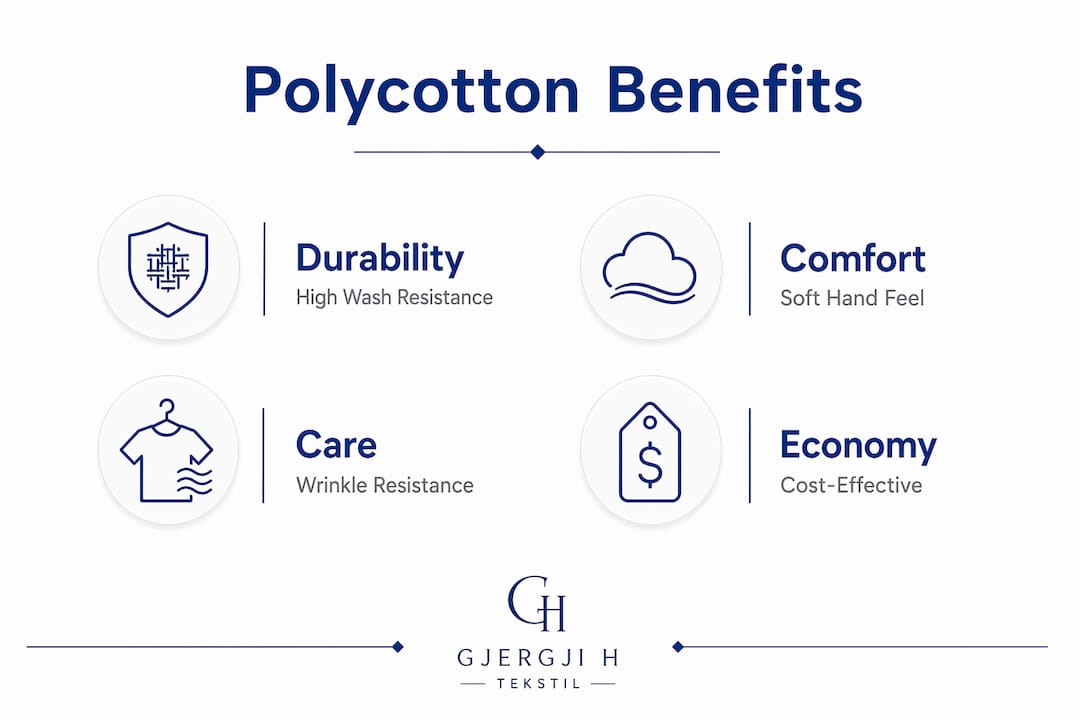
Whiteness retention and dimensional stability are the leading operational reasons hotels choose polycotton over 100% cotton, even when cotton’s softer feel is acknowledged. A sheet that arrives from the laundry looking bright and flat-pressed signals quality to a guest regardless of fiber composition.
Cost-per-occupied-room-night is the metric that matters most to operations managers. When you factor in replacement intervals, laundry throughput, energy consumption, and pressing labor, a well-specified polycotton program consistently outperforms a comparable 100% cotton program on that number. Mis-specified upholstery, by contrast, can fail in as little as 18 months when hand-feel is prioritized over durability specs.
Key operational benefits at a glance:
- Longer service life: A quality 65/35 polycotton outlasts 100% cotton by 30–50% in service life before appearance triggers replacement.
- Reduced ironing burden: polyester content keeps fabric taut and wrinkle-resistant after drying
- Faster laundry throughput: blends dry 15–25% faster than pure cotton, freeing dryer capacity
- Dimensional stability: shrinkage stays predictable and within tight tolerances across batches
- Easier stain management: polyester’s low absorbency helps soil release during washing
For uniforms specifically, polycotton is the default because the polyester component provides wrinkle resistance and dimensional stability while cotton keeps the garment breathable during long shifts.
How does polyester-cotton hold up in industrial laundering?
Industrial laundering is where polyester-cotton earns its specification. The combination of high-temperature wash chemistry, mechanical agitation, and high-heat drying would degrade a poorly specified fabric within months. A quality 65/35 blend handles this environment predictably.
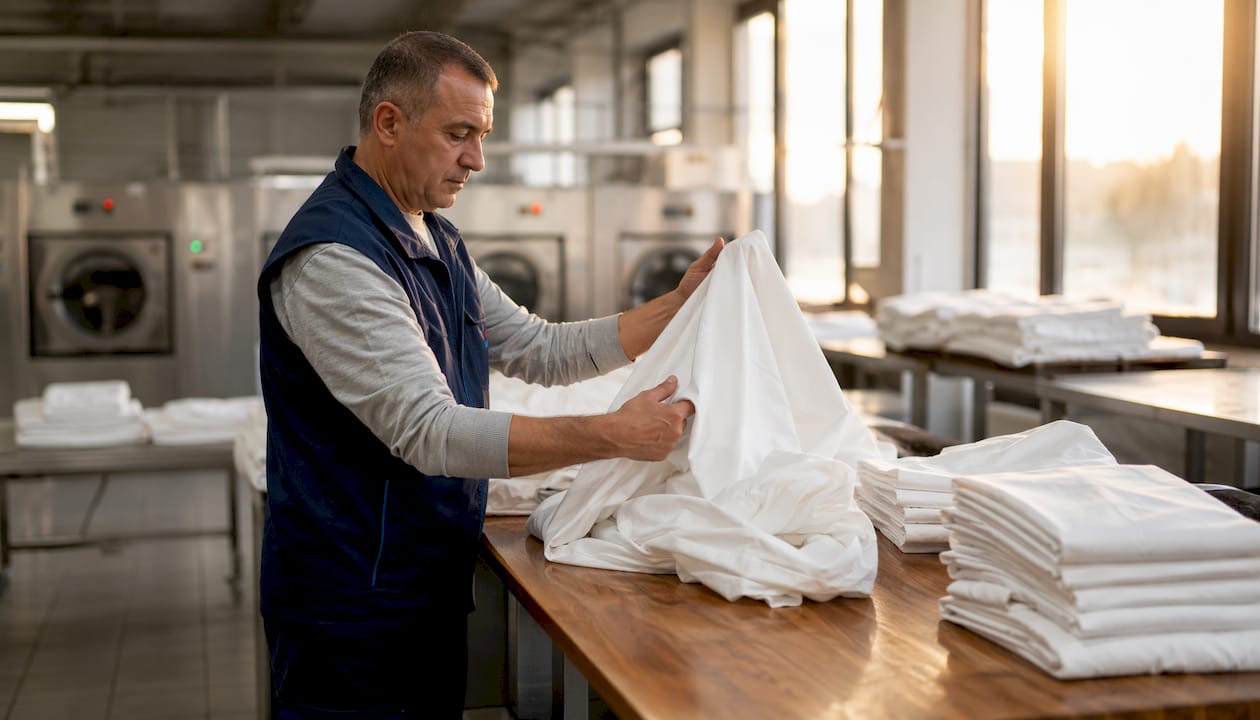
A 65/35 polycotton blend retains over 85% tensile strength after 300 commercial wash cycles and typically outlasts 100% cotton by 30–50% in service life before appearance issues trigger replacement. In practice, it is appearance, not structural failure, that ends a linen’s service life. Yellowing, pilling, or thinning fabric pulls a sheet from rotation long before it tears.
Temperature and chemistry guidance:
- Polycotton meets sanitation targets at 60 °C; pure cotton often requires 90 °C for equivalent hygiene
- Lower wash temperatures reduce energy consumption and minimize cumulative fabric stress across hundreds of cycles
- Optical brighteners in the wash chemistry work well with polycotton’s fiber structure, supporting whiteness retention
Shrinkage allowances for a well-specified polycotton should not exceed 2–3% after the first few wash cycles. Dimensional stability beyond that point is one of the blend’s strongest attributes. Whiteness retention depends on both fiber quality and wash chemistry, but polycotton’s polyester component resists the yellowing that affects cotton-heavy programs over time.
Pro Tip: Request a sample wash test on the first delivery batch before accepting the full order. Run 10–20 cycles at your standard wash temperature and chemistry, then measure shrinkage, check whiteness against a reference swatch, and inspect for pilling. This takes less than a week and catches specification drift before it scales across your entire inventory.
For operations teams looking to align wash protocols with textile choice, guidance on textile maintenance workflows can help connect laundry capability to fabric performance expectations.
Which blend ratio is right for each hospitality application?
The two dominant ratios in commercial hospitality are 65/35 (polyester/cotton) and 50/50. A 60/40 blend sits between them and appears in premium hospitality ranges where a slightly softer hand is valued without sacrificing too much durability. The ratio shifts the balance between structural performance and natural feel.

A higher polyester content means better wrinkle resistance, faster drying, and greater dimensional stability. A higher cotton content means better moisture absorption, a softer hand, and slightly more breathability. Neither extreme is universally correct; the right ratio depends on the application and the property’s operational priorities.
50/50 percale is a standard for hotel sheets, while 65/35 is used in institutional and high-wash-frequency settings where durability takes priority over hand-feel. For uniforms, 65/35 is common in shirts and scrubs because commercial durability and wrinkle resistance matter more than softness.
| Application | Recommended Blend | Key Operational Benefit |
|---|---|---|
| Hotel bedding (sheets, pillowcases) | 50/50 or 60/40 | Balanced hand-feel and wash durability; crisp appearance after pressing |
| Institutional / high-frequency bedding | 65/35 | Maximum tensile retention and whiteness stability across 300+ cycles |
| Staff uniforms and workwear | 65/35 | Wrinkle resistance, dimensional stability, breathability for long shifts |
| Restaurant table linens | 50/50 or 60/40 | Stain release, appearance retention, manageable ironing requirement |
| Decorative cushion covers / light upholstery | 50/50 or higher cotton | Softer hand for guest contact; |
| specify with soil-release finish | ||
| Towels | 100% cotton or 80/20 cotton-poly | Absorbency is primary; polyester content kept low or eliminated |
Towels are the notable exception. Absorbency is the primary performance requirement, and polyester reduces it. Most hospitality towel programs specify 100% cotton or a high-cotton blend (80/20 cotton/polyester at most) rather than a standard polycotton ratio.
For event and banquet table linens, the event textile solutions checklist covers blend and weight recommendations for high-turnover dining setups.
What finishes and treatments should you specify?
Finishes extend what a base fabric can do, but their durability under commercial laundering varies widely. Understanding the difference between inherent fiber properties and topical treatments is one of the most practical distinctions a procurement team can make.
Inherent vs. topical: why it matters
Inherent properties are built into the fiber itself, either through fiber chemistry (solution-dyed polyester) or fiber construction. Topical finishes are applied to the fabric surface after weaving and degrade with each wash cycle. For any property running industrial laundering, topical finishes have a limited useful life.
Topical fire-retardant treatments typically wash out after only three commercial launderings. For drapery and seating where flame resistance is required, the hospitality standard is to specify inherently flame-retardant (IFR) polyester rather than rely on a topical FR coating that disappears within weeks of installation.
Common finishes and realistic lifespans:
- Soil-release / stain-release finishes: Useful for table linens and uniforms; typically effective for 25–50 commercial wash cycles before reapplication or replacement is needed
- Optical brighteners: Applied during finishing or added in the wash; support whiteness retention but are not permanent and require replenishment in the laundry chemistry
- Anti-microbial finishes: Relevant for spa linens and healthcare-adjacent hospitality; durability varies by chemistry, and some silver-based treatments raise regulatory questions in certain markets
- Topical FR coatings: Avoid for any application requiring ongoing compliance; specify IFR polyester instead
For dining and high-stain environments, inherently cleanable synthetics outperform topical treatments because the finish cannot degrade with laundering when it is part of the fiber structure rather than a surface coating.
Pro Tip: When requesting stain-release or anti-microbial finishes from a supplier, ask for AATCC test results showing performance after 25 and 50 wash cycles, not just initial application. A finish that tests well at zero cycles but degrades by cycle 30 is operationally useless for a property running daily laundry.
Colorfastness for uniforms and colored table linens should be verified against AATCC 61 (accelerated laundering) and AATCC 8 (crocking). For long-term print durability on workwear, guidance on colorfastness through repeated laundering is worth reviewing before finalizing a uniform specification.
How does polyester-cotton compare to other hospitality fabrics?
Procurement teams regularly weigh polycotton against 100% cotton, high-performance polyester (including solution-dyed and microfiber), and Tencel. Each has a legitimate use case; the question is which operational priorities dominate.
When 100% cotton is the right call: Luxury and ultra-luxury properties where guest perception of softness and breathability is a brand differentiator. At T-300 thread count and above, 100% cotton delivers a feel that polycotton cannot replicate. The tradeoff is higher laundering cost, more pressing time, and shorter service life under commercial cycles.
When Tencel (lyocell) fits: Properties with strong sustainability positioning or guests with skin sensitivities. Tencel is soft, moisture-wicking, and biodegradable, but it is more expensive and requires gentler laundering protocols than polycotton. It is not a practical choice for high-volume, high-temperature laundry programs.
When high-performance polyester is preferred: Drapery, heavy upholstery, and outdoor fabrics where FR compliance, UV resistance, and abrasion ratings matter more than natural feel. Solution-dyed polyester offers superior colorfastness and can be specified with inherent FR. Contract seating commonly requires 30,000 to 100,000+ double rubs depending on use intensity, and NFPA 701 compliance is standard for drapery in US hospitality projects.
| Dimension | 100% Cotton | Polycotton (65/35 or 50/50) | High-Performance Polyester | Tencel |
|---|---|---|---|---|
| Durability / abrasion | Good | Very good | Excellent | Moderate |
| Maintenance burden | High (ironing, drying time) | Moderate | Low | Moderate to high |
| Industrial laundry compatibility | Requires 90 °C for sanitation | Effective at 60 °C | Excellent | Gentle cycle preferred |
| Stain cleanability | Moderate | Good | Excellent (solution-dyed) | Good |
| Guest comfort / breathability | Excellent | Good | Poor to moderate | Excellent |
| Upfront vs. lifecycle cost | Higher lifecycle cost | Best lifecycle value | High upfront, long life | High upfront, moderate life |
| Appearance retention | Yellows, shrinks over time | Stable whiteness and dimensions | Excellent color stability | Good but delicate |
Polycotton occupies the operational center of this comparison. It is not the softest option, and it is not the most durable in absolute terms, but it delivers the best combination of guest comfort, laundry compatibility, and lifecycle cost for the majority of hospitality applications.
What should your specification checklist include?
A clear specification sheet prevents the most common procurement failures: receiving fabric that looks right but performs poorly after 50 wash cycles, or accepting a batch that drifts from the approved sample. The checklist below covers the minimum requirements for a defensible polycotton specification.
Must-have specification items:
- Fiber ratio: State the exact polyester/cotton percentage (e.g., 65/35 or 50/50) and require it to be verified by fiber content testing (AATCC 20A or equivalent)
- Yarn type: Specify combed or ring-spun cotton yarns for better pilling resistance; avoid open-end spun for bedding applications
- Fabric weight (gsm/oz): State the target weight and acceptable tolerance (e.g., 130 gsm ±5% for percale sheets)
- Thread count or construction: For woven fabrics, specify thread count range and weave type (percale, sateen, twill)
- Shrinkage tolerance: Maximum 2–3% after five wash cycles at the specified temperature
- Colorfastness: AATCC 61 (laundering) minimum Grade 4; AATCC 8 (crocking) minimum Grade 4 for colored items
- Whiteness index: Specify a minimum whiteness index for white items and require a reference swatch with each delivery
- Finish documentation: List any applied finishes, their chemistry, and wash-cycle durability claims with supporting AATCC test data
- Certifications: Oeko-Tex Standard 100 for harmful-substance compliance; GRS (Global Recycled Standard) where recycled polyester content is claimed; certifications increasingly requested by hotel groups include EU Ecolabel for ESG-driven procurement
- FR compliance: For drapery and upholstery, require NFPA 701 test results and specify IFR polyester rather than topical FR treatment
- Sample wash report: Require a pre-delivery wash test report (minimum 25 cycles) from the supplier or an independent lab
Sample RFQ language: “Supplier shall provide, prior to bulk shipment approval, a wash-cycle performance report for the specified fabric at 60 °C using standard commercial laundry chemistry. The report shall document tensile strength retention, shrinkage, whiteness index, and colorfastness at 25 and 50 wash cycles, tested in accordance with applicable AATCC methods. Bulk shipment will not be accepted without a signed certificate of conformity referencing the approved sample swatch.”
Pro Tip: Build an acceptance sampling clause into the supply contract: test a random sample of 3–5% of units from each delivery batch against the approved swatch and wash-cycle report. Define the rejection threshold and the remediation process (replacement, credit, or re-specification) before the first order ships, not after a problem appears.
For a broader view of durable hotel fabric traits and how they translate into procurement criteria, that resource covers the key performance metrics in plain operational terms.
What do real-world programs look like in operation?
The gap between a well-specified polycotton program and a poorly specified one shows up in replacement intervals and housekeeping labor, not in the initial purchase price.
A 65/35 polycotton sheet program running 300 wash cycles before replacement compares favorably to a 100% cotton program that may require replacement after 150–200 cycles under the same industrial laundering conditions. Over a three-year period at a 200-room property running daily laundry, that difference translates into fewer replacement orders, lower per-room-night linen cost, and reduced housekeeping time spent managing worn or mismatched inventory.
Operational reality check: The most common procurement mistake is prioritizing hand-feel over durability specs. Poorly specified upholstery can need replacement in as little as 18 months, while correctly specified polyester-based blends can be engineered for decade-long life cycles. The same logic applies to bedding: a fabric that feels slightly softer at purchase but degrades in 150 cycles costs more per room-night than a blend that holds its appearance through 300.
Drying time savings compound at scale. Polycotton blends dry 15–25% faster than pure cotton, which at a property running multiple dryer loads per day reduces utility costs and increases laundry throughput without adding equipment.
Supplier best practices to require:
- Pre-shrinking during finishing (sanforizing or compressive shrinkage treatment) to minimize first-wash dimensional change
- Batch-to-batch color and whiteness consistency, verified against a reference swatch held on file
- Oeko-Tex Standard 100 certification for all items in guest contact (bedding, towels, uniforms)
- GRS certification where recycled polyester content is claimed, with chain-of-custody documentation
- Written warranty or performance guarantee language covering wash-cycle life and dimensional stability
- Independent lab test reports, not just supplier-issued certificates, for FR and finish durability claims
For teams managing hotel textile costs across multiple properties, working with a supplier who provides pre-shrunk production, batch testing, and documented lifecycle data removes the guesswork from replacement planning.
Key Takeaways
A well-specified polycotton program is the most cost-effective textile choice for mid-to-high-volume hospitality operations, delivering longer service life, lower laundering costs, and consistent appearance at a lower total cost per room-night than 100% cotton.
| Point | Details |
|---|---|
| Blend ratio drives performance | Specify 65/35 for high-wash institutional bedding and uniforms; 50/50 or 60/40 for standard hotel sheets and table linens. |
| Industrial laundering compatibility | Polycotton meets sanitation targets at 60 °C versus 90 °C for pure cotton, reducing energy costs and fabric stress. |
| Service life advantage | A quality 65/35 blend retains over 85% tensile strength after 300 commercial wash cycles, outlasting 100% cotton by 30–50% in service life before appearance issues trigger replacement. |
| Specify inherent FR, not topical | Topical FR treatments wash out after approximately three commercial launderings; require IFR polyester for drapery and seating. |
| Gjergjihtextil as supply partner | Gjergjihtextil supplies pre-shrunk, certified polycotton textiles with batch testing and lifecycle documentation for hospitality buyers. |
The procurement mistake most buyers make
The conventional wisdom in hospitality procurement is that guests notice fabric quality through touch, so hand-feel should drive the specification. That logic is not wrong, but it is incomplete, and when it dominates the decision, it consistently leads to higher total costs and shorter replacement cycles.
What guests actually notice is consistency: a bed that looks crisp and bright on check-in, a uniform that looks pressed at the end of a shift, a tablecloth that does not pill or gray after a season of service. Polycotton delivers that consistency at scale because it is engineered for the laundering environment, not just the showroom.
The buyers who get the most value from polycotton programs are the ones who treat the specification sheet as seriously as the sample swatch. They request wash-cycle performance data before approving a bulk order, they build shrinkage and whiteness tolerances into the contract, and they hold suppliers accountable to those tolerances on every delivery. The fabric itself is only half the equation. The other half is the discipline to specify it correctly and verify it consistently.
Properties that skip that discipline often find themselves replacing linen on an 18-month cycle and attributing the cost to “normal wear.” It is rarely normal wear. It is usually a specification that was never tight enough to begin with.
Gjergjihtextil helps you specify and source polycotton textiles right
Specifying polycotton correctly is straightforward when you have a supplier who understands both the fabric and the operational environment it goes into. Gjergjihtextil works with hotels, restaurants, and event venues to translate operational requirements into precise textile specifications, backed by pre-shrunk production, batch testing, and documented lifecycle data.
- Custom specification support: Gjergjihtextil advises on blend ratios, fabric weights, finishes, and certifications based on your property’s laundering setup and brand positioning
- Pre-shrunk, batch-tested production: Every delivery is verified against the approved sample for whiteness, shrinkage, and dimensional stability before shipment
- Certified supply chain: Oeko-Tex Standard 100 and GRS-certified options available for ESG-driven procurement programs
Whether you are sourcing bedding for a 200-room hotel or uniforms for a full front-of-house team, the starting point is a sample and a spec sheet. Visit the hotel textile catalog to review available polycotton programs, or contact the Gjergjihtextil team directly to request samples and a specification consultation.
Useful standards and sources for procurement teams
Every polycotton specification should reference at least the core AATCC test methods and relevant certifications. The table below lists the standards and documents to request from suppliers.
| Standard / Test | What It Covers | When to Require It |
|---|---|---|
| AATCC 61 | Colorfastness to laundering (accelerated) | All colored items: uniforms, table linens, colored bedding |
| AATCC 8 | Colorfastness to crocking (dry and wet) | Any dyed or printed fabric in guest or staff contact |
| AATCC 20A | Fiber content identification | Verify stated polyester/cotton ratio on delivery |
| — | Dimensional changes in laundering (shrinkage) | All woven items; require results at your standard wash temperature |
| — | Appearance after repeated laundering | Bedding and table linens; checks smoothness and wrinkle retention |
| NFPA 701 | Flame resistance for drapery and window treatments | All drapery and soft window coverings in US hospitality projects |
| Oeko-Tex Standard 100 | Harmful substance limits in finished textiles | All items in direct guest or staff contact |
| GRS (Global Recycled Standard) | Recycled content verification with chain of custody | Any item where recycled polyester content is claimed |
Documents to request from every supplier:
- Independent lab test reports (not self-issued certificates) for the AATCC methods above
- Oeko-Tex certificate with current validity date and scope covering the specific product category
- GRS transaction certificates if recycled content is part of the specification
- Wash-cycle performance report (minimum 25 and 50 cycles) for the specific fabric and construction being ordered
- Reference swatch held on file for whiteness and color matching on repeat orders
For procurement teams building or refining their textile sourcing process, guidance on optimizing textile ordering covers the operational and logistical side of managing supplier relationships at volume.