


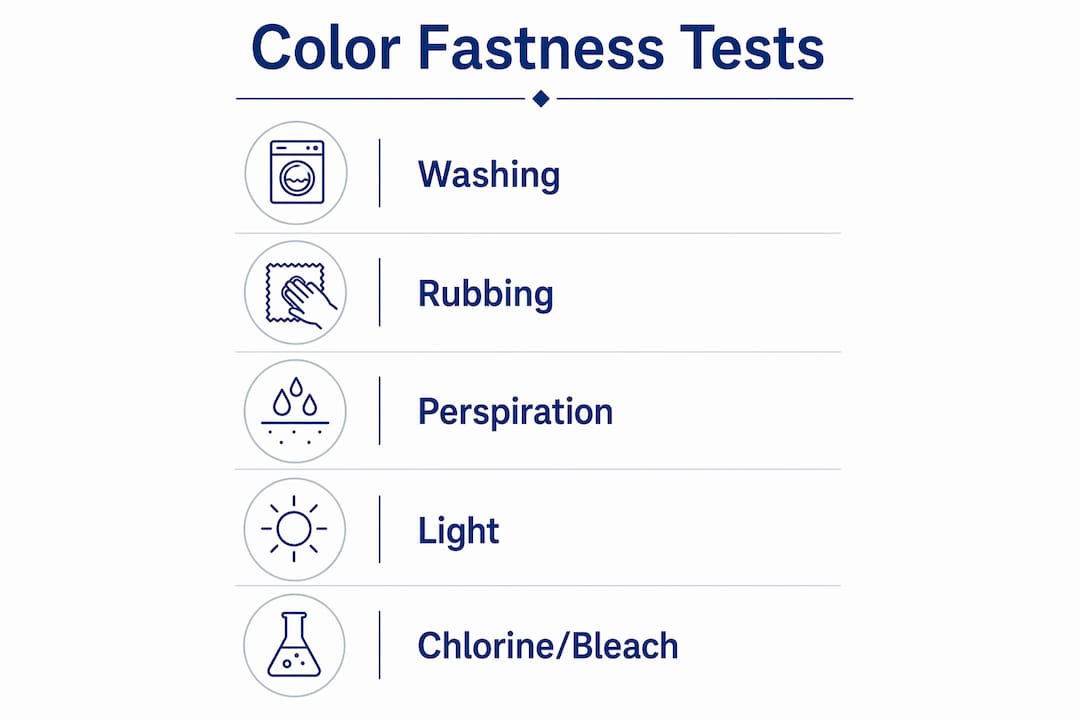
Color fastness in hotel linens is a fabric’s resistance to color change or transfer under the conditions of actual hotel use — washing, rubbing, perspiration, light exposure, and chlorine contact. It is not a single property but a family of distinct tests, each measuring a different stress. For procurement and quality teams, the practical bottom line is this: require test reports that cover all relevant exposures, rated on the ISO 1–5 scale, before signing any bulk supply contract.
The minimum thresholds to write into your procurement specifications are:
- Washing fastness: require ≥4/5 for all bed linens and towels
- Rubbing/crocking fastness: set ≥4/5 for dry and ≥3/5 for wet on all items
- Perspiration fastness: specify ≥4/5 for sheets, pillowcases, and robes
- Chlorine/bleach fastness: require ≥3/5 for towels, pool textiles, and spa linens
- Light fastness: moderate to good resistance (ISO 105-B series, light fastness 1–8 scale; for curtains, specify at least 4/8)
On the ISO 1–5 rating scale, 5 is the best possible result and 1 indicates severe color loss or transfer. Reports should reference the ISO 105 part number tested, show both color change and staining scores assessed against the ISO grey scale, and carry the full name and accreditation number of the testing laboratory. Any report missing those fields is not acceptable for procurement purposes.
Table of Contents
- What is color fastness in hotel linens, and why does it cost you money?
- Which ISO 105 tests should you require for hotel textiles?
- How are color fastness results reported and what do the numbers mean?
- How to write color fastness requirements into procurement specs and contracts
- How to read and verify a lab report when it arrives
- What causes poor color fastness, and what should a credible supplier tell you?
- Simple on-site checks your team can run before accepting a delivery
- How Gjergjihtextil approaches color fastness in hotel linen supply
- Key Takeaways
- The procurement mistakes that keep costing hotels money
- Gjergjihtextil’s hotel linen supply covers color fastness from production to delivery
- Standards, labs, and testing resources to bookmark
What is color fastness in hotel linens, and why does it cost you money?
Poor color fastness does not just look bad. It creates a chain of operational and financial problems that compound across a property’s linen lifecycle.
The most visible impact is guest perception. Faded or blotchy linens signal poor housekeeping standards even when the room itself is spotless. A shade mismatch between a freshly delivered replenishment batch and the existing stock is equally damaging: guests notice when one pillowcase is noticeably lighter than the other on the same bed. These are not cosmetic complaints. They translate directly into review scores and repeat-booking rates.
The cost side is just as concrete. Hotel laundries operate at conditions that accelerate color degradation far beyond domestic washing. Commercial cycles typically run at higher temperatures, use concentrated detergents, and include chlorine bleach for sanitization. Towels and pool textiles face chlorine exposure that can strip certain dye classes within a handful of washes. When fastness is inadequate, replacement cycles shorten and per-room linen costs rise. Tracking hotel textile durability against actual wash cycles is the clearest way to quantify this.
The other failure mode is staining transfer. A colored item with poor rubbing fastness will deposit dye onto adjacent white towels or sheets during the wash cycle, creating a contamination problem that is difficult to reverse and expensive to sort.
Pro Tip: Insist that any test report submitted by a supplier explicitly covers bleach and chlorine fastness for towels and pool or spa textiles. Many standard test packages omit this test by default, and suppliers rarely volunteer it unless you specify it in the RFQ.
Which ISO 105 tests should you require for hotel textiles?
The ISO 105 family is the internationally recognized framework for color fastness testing methods. Each part targets a different stress condition. Procurement teams need to know which parts apply to which product categories so lab results are directly comparable across suppliers.
Washing fastness (ISO 105-C series)
Tests color change in the sample and staining to adjacent white fabric under laundering conditions. The specific sub-part determines temperature and detergent type. For hotel linens, specify test conditions that mirror your actual laundry program — temperature, detergent concentration, and number of cycles — because test conditions strongly affect outcomes. A test run at 40°C with mild detergent tells you little about performance in a commercial laundry running at 70°C with chlorinated water.

Rubbing/crocking fastness (ISO 105-X12)
Measures dye transfer from the fabric surface to a white test cloth under dry and wet friction. Dry rubbing is always the higher score; wet rubbing is the more demanding condition. For colored towels and robes, wet crocking is the number that matters most. Some suppliers use a dry rubbing threshold of ≥ Grade 4 as a baseline acceptance criterion.
Perspiration fastness (ISO 105-E04)
Evaluates color change and staining under acidic and alkaline perspiration conditions. Relevant for sheets, pillowcases, bathrobes, and any textile in direct skin contact.
Light fastness (ISO 105-B series)
Rates resistance to fading under light exposure on a 1–8 scale, where 8 is best. Curtains, decorative throws, and upholstery fabrics are the primary targets here. Bed linens stored in direct sunlight during room staging also benefit from a minimum rating.
Chlorine/bleach fastness (ISO 105-N or specified method)
Covers resistance to chlorinated water and bleach solutions. Non-negotiable for towels, pool textiles, and any item laundered with chlorine sanitization.
| Product Category | Priority Tests |
|---|---|
| Bed sheets and pillowcases | Washing, perspiration |
| Towels and bathrobes | Rubbing (wet), chlorine/bleach, washing |
| Pool and spa textiles | Chlorine/bleach, rubbing, washing |
| Curtains and drapes | Light fastness, washing |
| Restaurant tablecloths | Rubbing, washing, staining |
Pro Tip: When requesting a test package, specify the exact ISO part number and the test conditions (temperature, detergent type, number of wash cycles) in your RFQ. A report that says only “ISO 105 washing” without the sub-part and conditions is not comparable across suppliers and should be rejected.
How are color fastness results reported and what do the numbers mean?
Test results are reported on two parallel scales, and understanding both is necessary to read a lab report correctly.
The ISO grey scale is a physical reference tool used by lab reviewers to assess two separate outcomes: color change in the test sample itself, and staining transferred to an adjacent white fabric. Both are rated 1–5. A score of 5 means no perceptible change or transfer; a score of 1 means severe change or heavy staining. A fabric can score differently on each scale, so a report showing “color change: 4, staining: 3” is not a single passing result — it is two distinct data points, each compared against your contract threshold.
A complete, trustworthy lab report should contain all of the following:
- Lab name and accreditation number (absence of accreditation is a disqualifying red flag)
- Test method reference (ISO 105 part number and sub-part)
- Sample ID that matches the swatch you submitted
- Test date and test conditions (temperature, detergent, duration)
- Results table showing color change score and staining score separately
- Reviewer name and signature
A typical results table looks like this:
| Test | Method | Conditions | Color Change (1–5) | Staining (1–5) | Pass Threshold |
|---|---|---|---|---|---|
| Washing fastness | ISO 105-C06 | 60°C, 30 min | 4 | 4 | ≥4 |
| Dry rubbing | ISO 105-X12 | Standard | 4 | — | ≥4 |
| Wet rubbing | ISO 105-X12 | Standard | 3 | — | ≥3 |
| Perspiration (acid) | ISO 105-E04 | Standard | 4 | 4 | ≥4 |
| Chlorine fastness | ISO 105-N01 | Standard | 3 | — | ≥3 |
Common pitfalls: missing test conditions (making results non-comparable), ambiguous sample descriptions that do not match your submitted swatch, and results rounded to whole numbers without a grey scale reference. Any of these should trigger a request for a corrected report or an independent retest.
How to write color fastness requirements into procurement specs and contracts
Vague specs produce vague results. The more precisely you define requirements in your RFQ and purchase order, the less room there is for a supplier to submit a non-compliant batch and argue the contract was met.
A procurement-ready specification block for hotel bed linens might read:
For towels and pool textiles, add: chlorine/bleach fastness (ISO 105-N01 or equivalent) ≥3/5.
Acceptance and rejection clause (sample language):
Batch and production-sample requirements:
- Pre-shipment sample testing on a swatch from the actual production run (not the development sample).
- Production-run QC at a minimum frequency of one test per dye lot or per 500 units, whichever is more frequent.
- Post-shipment surveillance testing on a random pull from the delivered goods, conducted within 30 days of receipt.
Checklist — what to attach to a bid or supplier submission:
- Accredited lab report copies (lab name, accreditation number, method, date, sample ID)
- Physical sample swatches from the production lot
- Dye type declaration (reactive dyes for cotton, disperse for polyester)
- Production lot numbers for traceability
Pro Tip: Require the dye class declaration on every bid. Reactive dyes on cotton and disperse dyes on polyester are the standard choices for durable hotel textiles. A supplier who cannot or will not specify the dye class is a supplier who cannot guarantee the chemistry behind the result.
How to read and verify a lab report when it arrives
Receiving a lab report is not the same as verifying it. Quality teams need a consistent review process so that a non-compliant or fraudulent report does not slip through on a busy receiving day.
Step-by-step verification checklist:
- Confirm lab accreditation. Look for the lab’s full legal name and an accreditation certificate number from a recognized body. In the United States, labs accredited by A2LA (American Association for Laboratory Accreditation) or NVLAP (National Voluntary Laboratory Accreditation Program) carry the required standing. No accreditation statement means the report carries no independent authority.
- Match the sample ID. The sample description on the report must match the swatch you submitted. If the description is generic (“white cotton fabric”) rather than specific to your order, request a corrected report.
- Check the test method reference. Confirm the ISO 105 part number and sub-part match what your contract specifies. A different sub-part can mean a different temperature or detergent, producing a non-comparable result.
- Verify test conditions. Temperature, detergent type, and number of cycles must be stated. If they are missing, the result cannot be validated against your laundry program.
- Read both scores. Color change and staining are separate ratings. Both must meet your contract threshold. A passing color change score does not compensate for a failing staining score.
- Check the reviewer signature. An unsigned report has no accountability chain.
For fabric testing verification, the same discipline applies to every incoming batch, not just the first order.
Red flags and next steps:
- Missing method reference: request a corrected report before accepting the shipment.
- Ambiguous sample ID: hold the shipment and request written clarification from the supplier.
- Results that appear rounded or suspiciously uniform across all tests: request an independent retest at a lab of your choosing, at the supplier’s cost per the contract clause.
- No reviewer signature: treat the report as unverified and request a signed version.
Pro Tip: Keep a log of every report received, including the lab name, accreditation number, sample ID, and test date. This log becomes your evidence base if a batch fails in service and you need to pursue a warranty claim or replacement.
What causes poor color fastness, and what should a credible supplier tell you?
Color fastness failures in hotel linens almost always trace back to one of a small number of manufacturing decisions. Understanding the causes helps you evaluate whether a supplier’s explanation for a failure is credible or evasive.
Primary causes:
- Wrong dye class for the fiber. Reactive dyes on cotton form a covalent bond with the fiber and deliver far better wash fastness than direct dyes. A supplier using direct dyes on cotton hotel linens to cut costs will produce goods that fade quickly under commercial laundering.
- Incomplete fixation. Even with the correct dye class, insufficient fixation time or temperature leaves unfixed dye in the fabric. This excess dye bleeds during the first washes, staining adjacent white items and dropping the effective fastness rating.
- Inadequate soaping after dyeing. The soaping step removes unfixed dye from the fabric surface. Skipping or shortening it is a common cost-cutting move that produces goods that look fine on delivery but fail within the first ten wash cycles.
- Poor pH and temperature control during dyeing. Reactive dye fixation is sensitive to both variables. Inconsistent control across a dye batch produces shade variation within the same lot.
- Inconsistent fabric tension. Uneven tension during dyeing and finishing causes uneven dye uptake, which shows up as streaking or shade variation across a piece.
What credible supplier evidence looks like:
- A process flow document showing fixation time, temperature, and soaping steps
- Dye specification sheets naming the dye class and supplier
- In-line color control records (spectrophotometer readings at key process stages)
- Pre-shipment test summaries from an accredited lab
Suppliers who can produce these documents are operating a controlled process. Those who cannot are asking you to accept their word. For durable hotel fabrics, the chemistry behind the color is as important as the thread count.
Pro Tip: If you suspect a problem with a delivered batch, request grey scale comparison photographs taken under standardized lighting alongside the lab report. A supplier who controls their process can produce these quickly. One who cannot is telling you something important about their QC.
Simple on-site checks your team can run before accepting a delivery
You do not need a laboratory to catch obvious fastness problems. A few structured on-site checks, run consistently on every new batch, will catch the most common failures before goods enter your linen room.
Wet crock test (immediate staining check):
- Dampen a white cotton cloth with clean water.
- Rub it firmly across the colored fabric surface 10 times with consistent pressure.
- Inspect the white cloth for dye transfer under good lighting.
- Record the result as pass (no visible transfer) or fail (visible staining), and note whether the test was wet or dry.
Small launder-and-inspect test:
- Cut a swatch from the delivered goods and wash it using your hotel laundry program: standard detergent, operating temperature, and chlorine concentration.
- Wash a control white cloth alongside the swatch.
- After drying, compare the swatch to an unwashed reference piece under consistent lighting. Check for shade shift, fading, or loss of depth.
- Inspect the white control cloth for staining.
Visual batch inspection checklist:
- Check shade uniformity across multiple items from the same lot under consistent lighting (daylight or a standardized light box).
- Look for loose dye specks on the fabric surface, which indicate inadequate soaping.
- Compare new delivery items against existing stock to catch cross-batch shade drift.
When to escalate:
- Any visible dye transfer on the wet crock test warrants a hold on the batch and a formal lab retest.
- A visible shade difference between the new delivery and existing stock requires a spectrophotometer reading or lab comparison before acceptance.
- Document all on-site findings with photographs and written records, including the lot number, date, and the name of the person who conducted the check. This documentation is your starting point for any supplier dispute.
Pro Tip: Run the wet crock test on colored hotel towels immediately on receipt, before they enter the laundry. Towels with poor wet crocking will stain bathrobes and white linens in the first commercial wash cycle, creating a contamination problem that is far more expensive to resolve than a rejected delivery.
How Gjergjihtextil approaches color fastness in hotel linen supply
Gjergjihtextil has supplied hotel textiles to properties including Meliá, Marriott, and Sheraton for over 30 years, operating across import, in-house manufacturing, and distribution. That supply chain position means color fastness is not just a specification requirement — it is a production control problem that Gjergjihtextil manages at every stage.
Standard QA practices applied to hotel linen production:
- In-line color monitoring using spectrophotometer readings at fixation and post-soaping stages
- Segmented color-fixing protocols to maintain consistency across large dye lots
- Manual post-process inspection comparing each batch against a reference standard under standardized lighting
- Batch traceability records linking lot numbers to dye specifications, fixation parameters, and pre-shipment test results
Sample supplier-side contract clause (production QC and remedial steps):
For procurement teams building or reviewing textile performance specifications, Gjergjihtextil can provide pre-shipment sample testing results, dye class declarations, and process flow documentation as part of the standard bid package.
Pro Tip: Ask any supplier for their batch traceability records from a previous hotel order. A supplier who controls their process can pull these records in minutes. The response time alone tells you whether QC is a real system or a marketing claim.
Key Takeaways
Color fastness in hotel linens is a family of measurable properties — not a single rating — and specifying the right tests with numeric thresholds in your contracts is the only reliable way to protect linen quality, guest experience, and replacement budgets.
| Point | Details |
|---|---|
| Color fastness is a test family | Require washing, rubbing, perspiration, light, and chlorine tests separately — passing one does not guarantee passing another. |
| Minimum procurement thresholds | Specify washing ≥4/5, rubbing ≥4/5, perspiration ≥4/5, and chlorine ≥3/5 in every contract for hotel linens. |
| Lab report requirements | Every report must show the ISO 105 part number, sample ID, test date, conditions, both color change and staining scores, and the lab’s accreditation number. |
| Chlorine fastness is non-optional | Require ISO 105-N chlorine testing for all towels, pool textiles, and spa linens — many standard test packages omit it unless specified. |
| Gjergjihtextil supply standard | Gjergjihtextil provides pre-shipment test reports, dye class declarations, and batch traceability records as part of its standard hotel linen supply package. |
The procurement mistakes that keep costing hotels money
The three most common color fastness errors in hotel procurement are not technical failures. They are specification failures.
The first is writing vague specs. “Good color fastness” in a purchase order is not a requirement. It is an invitation for a supplier to submit whatever they have. The moment you replace that phrase with “washing fastness ≥4/5 per ISO 105-C06 at 60°C, confirmed by an accredited lab report with sample ID and test date,” you have created an enforceable standard. Hotels that make this switch typically see fewer batch rejections and shorter dispute cycles, because the acceptance criteria are unambiguous from the start.
The second mistake is accepting lab reports that are missing method details. A report that says “washing fastness: 4” without specifying the ISO sub-part, temperature, detergent, and number of cycles is not a comparable result. Two suppliers can both report a score of 4 using completely different test conditions, and one of those results may be meaningless for your laundry program. Require the full method reference on every report, and reject any that omit it.
The third is ignoring chlorine fastness. Many procurement teams focus on washing and rubbing because those tests appear on standard packages. Chlorine fastness is often absent unless explicitly requested. For any property with a pool, spa, or a laundry program that uses bleach sanitization, this omission will show up as premature fading and staining within the first season. Adding the chlorine test to your standard spec costs nothing and prevents a recurring replacement expense.
The operational benefit of tightening these three areas is straightforward: longer linen service life, fewer mid-contract disputes, and consistent appearance across replenishment batches. Documenting sample IDs and lot numbers from every delivery also simplifies future replenishment matching and gives you a clean evidence trail for any warranty claim.
Gjergjihtextil’s hotel linen supply covers color fastness from production to delivery
For procurement teams who need color-fast hotel linens backed by documented QC rather than vendor assurances, Gjergjihtextil offers a direct alternative to sourcing from suppliers who cannot produce traceability records or accredited test reports.

Gjergjihtextil’s hotel textile supply covers the full chain: custom dye selection matched to fiber type, in-house manufacturing with in-line color monitoring, pre-shipment testing with accredited lab reports, and batch traceability records available on request. For colored towels and bed linen covers, the supply package includes dye class declarations and chlorine fastness results as standard, not as an add-on. If a delivered lot fails post-receipt testing, Gjergjihtextil supports retest, replacement, or credit resolution under contract terms. To request a pre-shipment sample test or a specification review for your next linen procurement cycle, contact Gjergjihtextil directly through the hotel textile page.
Standards, labs, and testing resources to bookmark
ISO 105 parts relevant to hotel procurement:
- ISO 105-C series — Washing fastness; specifies temperature, detergent, and cycle conditions
- ISO 105-X12 — Rubbing/crocking fastness; covers dry and wet friction transfer
- ISO 105-E04 — Perspiration fastness; acidic and alkaline conditions
- ISO 105-B series — Light fastness; rated 1–8, used for curtains and decorative textiles
- ISO 105-N01 / N02 — Chlorine/bleach fastness; required for towels and pool textiles
Testing organizations and accreditation:
- SGS — Global testing and certification body; accredited for ISO 105 textile testing. Always request the accreditation certificate number on any SGS report.
- Bureau Veritas — Recognized testing and inspection organization with textile testing capabilities. Confirm the specific lab location’s accreditation scope before submitting samples.
- In the United States, require labs accredited by A2LA or NVLAP for ISO 105 testing. Accreditation scope documents are publicly available and should be cross-checked against the tests you are requesting.
Deeper reading and lab guidance:
- QIMA’s textile testing guides provide practical overviews of colorfastness test selection and report interpretation.
- Testex publishes detailed guidance on color fastness standards and threshold recommendations for durable textiles.
- Skychemi’s technical resources cover dye chemistry and fastness test types in accessible language for procurement teams.
- The American Association of Textile Chemists and Colorists (AATCC) publishes AATCC test methods widely used by US retailers alongside ISO standards; confirm with your supplier which standard applies to their lab’s accreditation.