

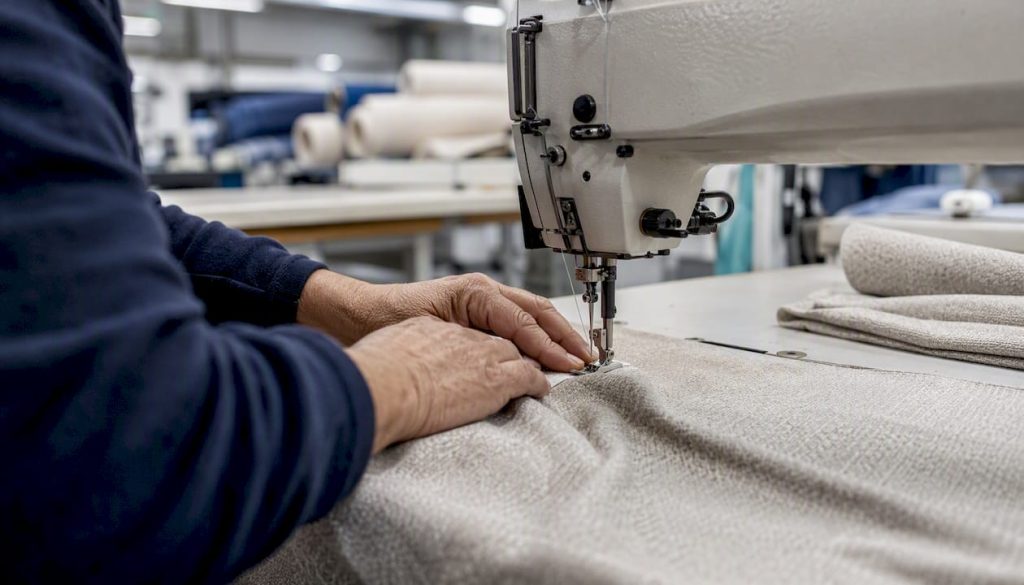
Yes, the advantages of textile manufacturing in house justify the investment once your volume, product complexity, or brand standards cross a specific threshold. In-house production shortens lead times, sharpens quality control, and gives you direct command over intellectual property in ways that outsourced contracts rarely match. For hotels, restaurants, and hospitality groups that live or die by consistency, that control is not a luxury. It is the operating standard guests notice even when they cannot name it.
Here is the short version before we get into the mechanics:
- Quality control you can walk over and inspect, not audit from a distance
- Faster lead times because sampling and production happen under one roof
- Stronger IP protection for proprietary weaves, finishes, and constructions
- Deeper customization for color matching, sizing, and quick reorders
- Reputational and sustainability control over your own supply chain
- Tighter inventory management tied directly to your actual demand cycles
The caveat: if your order volumes sit below roughly 1,500 to 2,000 units per style per season, or if your capital is tight and your product line changes constantly, in-house production can become a costly commitment rather than an advantage. Read on to see exactly where that line sits for your business.
Key Takeaways
In-house textile manufacturing pays off once volume, complexity, or IP protection needs outweigh the fixed cost burden, and a staged hybrid approach minimizes that risk during the transition.
| Point | Details |
|---|---|
| Volume threshold matters most | In-house production typically becomes cost-competitive above roughly 1,500 to 2,000 units per style per season. |
| Model total cost, not sticker price | Include rework, customs delays, and quality disputes in outsourcing comparisons, not just the quoted unit price. |
| Start with a pilot cell | Test in-house feasibility with two or three machines before committing to a full production line. |
| Protect IP with governance, not location | In-house production limits exposure but still requires signed confidentiality agreements with staff. |
| Gjergji H Tekstil offers a hybrid path | Its in-house fabric manufacturing and quality testing give hospitality clients vertical-integration benefits without factory ownership. |
Table of Contents
- Advantages of Textile Manufacturing In House: Operational Gains
- Strategic Advantages: Protecting IP and Building Reputation
- Costs and Investment: CAPEX, OPEX, and Break-Even Timing
- When Outsourcing or a Hybrid Model Wins Instead
- Case Study: Vertical Integration in Hospitality Textile Supply
- When I Recommend Insourcing and How to Phase It
- How Gjergji H Tekstil Supports Your In-House-Style Textile Strategy
- Frequently Asked Questions
- Sources
Advantages of Textile Manufacturing In House: Operational Gains
The operational case for insourcing comes down to control over four things: quality, speed, customization, and inventory. Each compounds the others, which is why hospitality suppliers that get one right tend to get all four right.
Quality control improves because inline inspection happens at the point of production, not after a shipping container clears customs. When a fabric lot shows uneven pile height on hotel towels or a dye batch runs slightly off from the approved swatch, an in-house team catches it during the run, not three weeks later when a hotel’s housekeeping director calls to complain. Traceability of fabric lots means you can pull the exact roll that caused a defect and correct the root cause instead of guessing across an entire shipment.
Lead times shrink for a straightforward reason: fewer handoffs. A typical outsourced order passes through pattern approval, offshore sampling, freight scheduling, and customs clearance before a single finished sheet set reaches a hotel’s linen room. In-house production collapses pattern making, cutting, and sewing into one continuous workflow, which is one of the largest sources of the sample-cycle speed advantage that vertically integrated operators report. A restaurant chain rolling out a new tablecloth pattern across a dozen locations can go from approved sample to delivered stock in a fraction of the time an offshore contract would require.
Customization is where in-house production earns its keep for hospitality clients specifically. Color matching to a hotel’s brand palette, custom hem finishes for banquet linens, or a quick re-dye run to fix a shade mismatch are all things a factory floor can turn around in days when it owns the equipment. Reorder cycles shrink too, since there is no minimum-order-quantity negotiation with an outside mill every time a restaurant needs another 200 napkins for a wedding season.

Inventory strategy shifts as well. Owning production lets you run closer to just-in-time for standard items while holding buffer stock only on the specialty fabrics that take longest to replace. Companies that outsource everything often do the opposite by necessity: they overbuy to survive long offshore lead times, tying up cash in warehouse space nobody wants to pay for.
Pro Tip: Track your reorder cycle time separately from your production cycle time. If reorders take nearly as long as first-run orders, your supply chain has no real advantage over an outsourced contract, in-house or not.
Strategic Advantages: Protecting IP and Building Reputation
Operational control creates strategic capital, and nowhere is that clearer than in intellectual property protection. Keeping pattern construction, proprietary finishes, and specialty weaves in-house limits how many outside parties ever see your designs before they hit the market. Every subcontractor you add is another point where a competitor could reverse-engineer a signature finish or a client-exclusive pattern.
Faster R&D feedback loops follow the same logic. When your design team can walk to the production floor and adjust a seam allowance or test a new blend the same afternoon, iteration happens in days instead of shipping cycles. Vertical integration practitioners report measurably faster sample turnaround and consolidated fabric purchasing as a direct result of housing design and manufacturing together, which lowers total landed cost per unit even before volume discounts kick in.
Reputational and sustainability gains round out the strategic case. Consolidated production means fewer freight legs, fewer separate waste streams to manage, and a supply chain you can actually describe accurately to a hotel client asking about sourcing. That transparency matters more each year as hospitality brands face their own guest-facing sustainability questions.
- Fewer subcontractors means fewer leak points for proprietary designs
- Same-day design-to-floor iteration speeds up seasonal refreshes
- Consolidated waste and freight reduce your environmental footprint per unit
- A traceable supply chain gives hospitality clients a real answer, not a shrug
Pro Tip: Put nondisclosure and non-compete clauses in writing with any staff who touch proprietary patterns, even in-house. IP protection is not automatic just because production happens under your own roof; it still requires deliberate governance.
Costs and Investment: CAPEX, OPEX, and Break-Even Timing
The financial trade-off is where most managers hesitate, and rightly so. In-house manufacturing converts what used to be a variable cost, per-unit contract pricing, into a fixed cost base: equipment, workspace, and commissioning (your CAPEX) plus ongoing staff, utilities, and maintenance (your OPEX). That shift is disadvantageous at low volumes because you are paying for capacity whether you use it or not. It becomes an economic lever only once your run volumes are high enough to spread that fixed cost thin.
The crossover point matters more than any single number. For many textile product categories, the volume threshold where in-house becomes cheaper than outsourcing lands somewhere between 1,500 and 2,000 units per style per season. Below that, outsourcing usually wins on pure unit economics, even accounting for freight and lead-time risk.
Here is the mini-calculation framework worth building into your planning, using a hotel linen supplier as the example:
| Variable | What to plug in |
|---|---|
| Fixed cost base | Equipment lease/purchase, facility rent, commissioning, annual depreciation |
| Variable cost per unit | Labor, raw fabric, dye, finishing, utilities per finished piece |
| Expected run length | Units produced per style, per production cycle |
| Reorder frequency | How often you reorder the same SKU across a season |
| Contract-manufacturer quote | Landed cost per unit including freight, customs, and quality-dispute reserve |
Run the fixed cost divided by expected annual volume, add your variable cost per unit, and compare that number against your best contract-manufacturer quote, landed. Managers routinely undercount the hidden costs on the outsourced side, rework, customs delays, and quality disputes, which narrows the gap more than the sticker price suggests.
Three risk categories deserve equal attention before you commit capital:
- Workforce skill needs. Skilled sewing machine operators, dye technicians, and quality inspectors are not interchangeable with general factory labor, and training takes months.
- Maintenance downtime. Industrial looms, dye vats, and finishing lines require scheduled maintenance windows that eat into production capacity you already paid for.
- Regulatory and environmental compliance. Dye houses and finishing operations often carry wastewater and chemical-handling obligations that outsourced contracts push onto someone else entirely.
When Outsourcing or a Hybrid Model Wins Instead
In-house manufacturing is not the right call for every textile business, and pretending otherwise does a disservice to anyone reading this to make a real capital decision. The main drawbacks are straightforward: high upfront cost, reduced flexibility when volumes are small or unpredictable, and the management overhead of running a factory floor on top of running a business.
Rules of thumb help more than theory here. If your order volumes sit well below that 1,500 to 2,000 unit crossover band per style, outsourcing typically remains cheaper once you model fixed costs honestly. If your product line changes every season with little standardization, a contract manufacturer’s flexibility beats the rigidity of owned equipment tuned to last year’s specs. And if reorder frequency is unpredictable, tying up capital in idle capacity is a poor trade.
- High upfront capital locks you into a cost structure before demand is proven
- Small or irregular volumes rarely spread fixed costs thin enough to compete with contract pricing
- Running a production floor adds a management layer beyond core business operations
The pragmatic middle path, and the one most practitioner guides land on, is a hybrid model that keeps high-IP or critical lines in-house while outsourcing commodity SKUs that do not need tight control. Start with a small development cell, two or three machines and a skeleton team, and use it to validate demand and refine specs before scaling any single category into a full production line. Third-party manufacturing remains the pragmatic early path for fast-moving or launch-driven product categories; in-house earns its cost once a category proves out and needs precision and IP protection more than raw speed to market.
Case Study: Vertical Integration in Hospitality Textile Supply
Gjergji H Tekstil built its position in the hospitality textile market by controlling the full chain: importing raw fabric from Italy, China, India, and Pakistan, running in-house design and production, and handling distribution directly to hotels, restaurants, and event venues across the region. That structure exists because hospitality clients cannot tolerate the lead-time risk or quality inconsistency that a purely outsourced model carries.
The core client problem is always some version of the same thing: a hotel needs bed linens that survive industrial washing cycles at scale without visible wear after a few dozen turns, delivered on a schedule that does not disrupt housekeeping operations. Solving that requires fabric sourcing decisions, in-house production oversight, and quality testing to happen as one continuous process rather than three separate vendor relationships each with their own failure points.
Gjergji H Tekstil’s client portfolio includes engagements with major international hotel brands, among them Meliá, Marriott, and Sheraton, properties that set demanding standards for both product durability and delivery consistency. Supplying brands of that caliber functions as third-party validation: hotel groups running standardized global quality programs do not select suppliers casually, and repeat business from them signals that the in-house model delivers on its promise.
- Full supply chain control from import through distribution, avoiding multi-vendor coordination failures
- Custom production and design advisory tailored to each hospitality client’s operational needs
- Volume-based import negotiation that lowers per-unit fabric cost across the client base
- Over 30 years of operational experience translating into fewer first-run quality surprises
The measurable outcomes hospitality clients care about most, on-time delivery rates and reduction in quality-related incidents, are exactly the metrics an in-house model is built to protect. Any hospitality operator evaluating a textile partner should ask directly for those figures rather than accepting a general quality claim at face value.
When I Recommend Insourcing and How to Phase It
The staged, hybrid approach is what actually works for most textile businesses I have watched evaluate this decision, not the all-or-nothing framing you often see in vendor pitches. Full in-house conversion on day one is rarely the right move even for businesses that will eventually benefit from it, because the fixed cost commitment punishes you before your systems and workforce are ready to use the capacity you just bought.
A pilot development cell is the right starting point: two or three machines, a small skilled team, and a mandate to prove out one or two product categories before anything else. Scale line by line as volumes justify it, adding capacity to hotel bed linens first if that is your highest-volume category, then expanding into restaurant tablecloths or event textiles once the first line is running at target yield.
Three metrics deserve a place on your dashboard from day one: yield (finished usable output versus raw material input), first-pass quality (percentage of units passing inspection without rework), and lead time (design approval to delivered stock). These three numbers tell you faster than any accounting report whether your in-house investment is paying off or quietly bleeding margin. Track them monthly, not annually, because problems compound fast when a production line is new.
How Gjergji H Tekstil Supports Your In-House-Style Textile Strategy
If you are weighing in-house manufacturing against outsourcing, Gjergji H Tekstil gives you a third path: the quality control and customization of vertical integration without the capital risk of building your own factory floor from scratch. Our fabric manufacturing and quality testing operations run in-house, which means the traceability, faster turnaround, and IP protection this article covers are already built into how we supply hotels, restaurants, and event venues.

This model fits hospitality businesses running 30 or more rooms, resorts, restaurant groups managing multiple dining rooms, and event companies that need custom textile setups on tight timelines. If your volumes do not yet justify your own production floor, working with a supplier who already owns theirs gets you most of the same advantages without the fixed cost commitment. Explore our wholesale hotel textile offerings to see current pricing and bulk terms, or request a feasibility conversation to talk through custom production, sample kits, and delivery timelines for your specific property or venue.
Frequently Asked Questions
What are the main advantages of textile manufacturing in house?
The core advantages of in-house textile manufacturing are tighter quality control, shorter lead times, stronger IP protection, and easier customization for reorders and specialty finishes. For hospitality suppliers, that translates into fewer defective shipments and faster turnaround on custom hotel or restaurant linens.
At what volume does in-house textile production become cost-effective?
Most product categories reach a favorable crossover somewhere between 1,500 and 2,000 units per style per season. Below that range, outsourcing usually remains cheaper once fixed costs are modeled honestly.
Is a hybrid model better than full in-house or full outsourcing?
For most textile businesses, yes. Keeping high-IP or high-volume core lines in-house while outsourcing commodity or fast-changing SKUs balances capital risk against operational control better than an all-or-nothing approach.
How does in-house manufacturing protect intellectual property?
Keeping pattern construction and proprietary finishes under one roof limits how many outside parties see your designs, but real IP protection still requires signed nondisclosure agreements and internal governance, not just physical proximity.
What should a feasibility checklist for in-house textile manufacturing include?
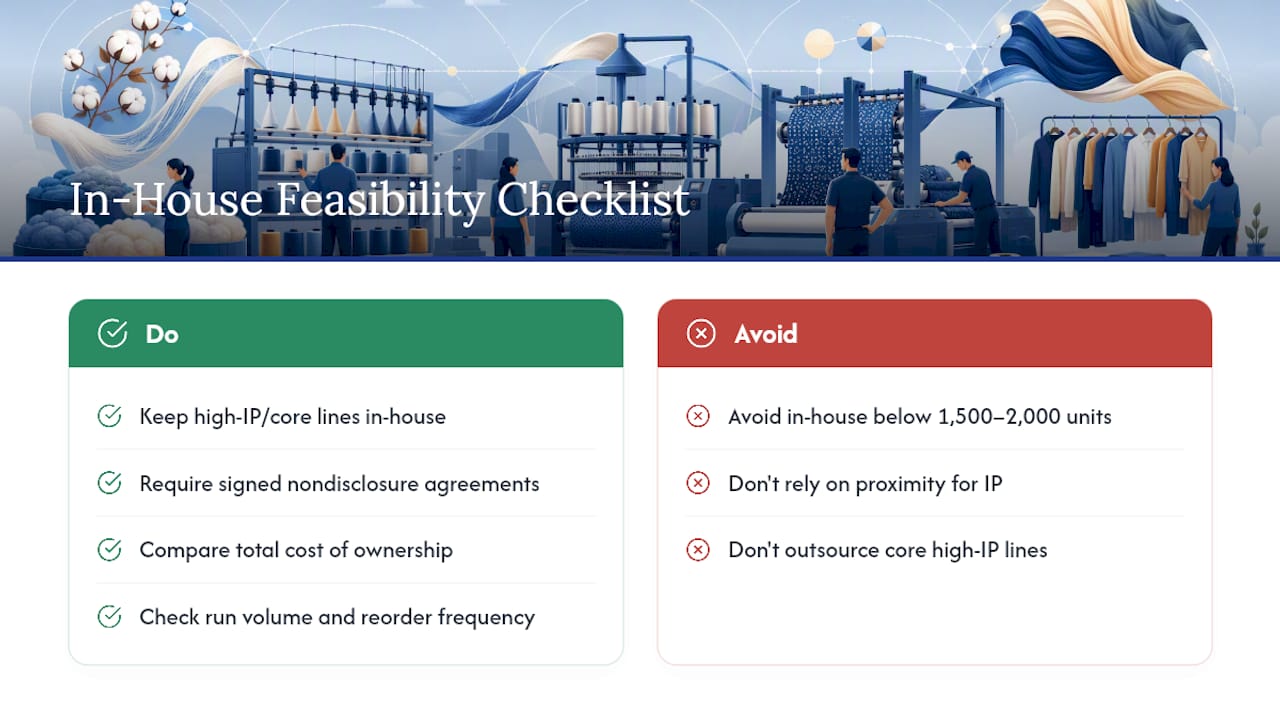
A solid checklist covers expected run volume per style, reorder frequency, available capital for CAPEX and OPEX, workforce skill availability, and a total cost of ownership comparison against your best contract-manufacturer quote.
Sources
- In-House Production vs. Outsourcing: Weighing the Pros and Cons | NetSuite
- Contract Manufacturing vs In-House Production: Which Is Right? UK 2026