

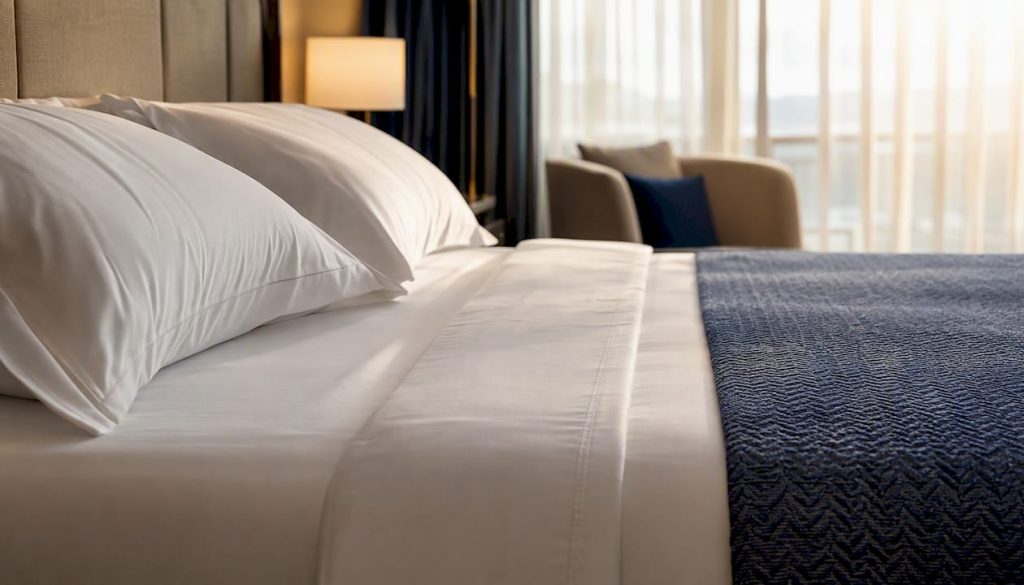
For hotel guest rooms, specify cotton-polyester percale sheets (60/40 or 65/35 blend), inherently FR blackout curtains, and dobby-woven upholstery rated for at least 75 industrial wash cycles. This combination holds color, resists pilling, and clears hospitality hygiene testing without forcing a tradeoff between guest comfort and laundry survival, helping you create an elevated atmosphere with curated ambient sound and textiles for the full guest experience as explained in AI Music for Hotels: Elevate Guest Experience Lobby to Roof.
Before you write a purchase order, confirm these specs are on the supplier’s data sheet:
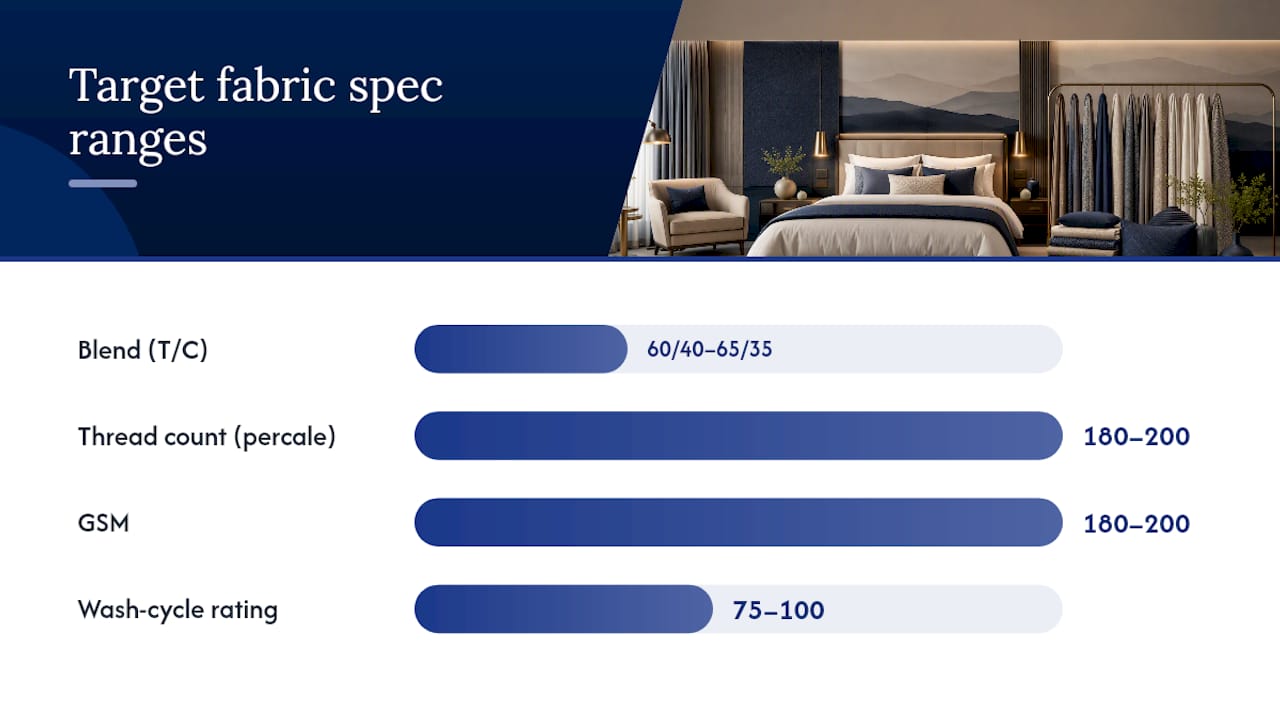
- Blend and weave: T/C 60/40 or 65/35 percale, 180–200 thread count, minimum 220 GSM for heavy-duty programs.
- Wash-cycle rating: A declared minimum number of industrial wash cycles to ensure durability, with colorfastness verified after laundering.
- Hygiene threshold: total bacteria counts ≤10 CFU/cm², per DB32/T 3797-2024, with negative pathogenic results.
Request manufacturer test reports covering wash-cycle survival, FR certification where curtains apply, and hygiene batch data before you commit to a sample order.
Key Takeaways
Hotel guest-room textiles succeed when procurement teams specify measurable wash-cycle, hygiene, and blend criteria before placing an order, not after a failure shows up in inventory.
| Point | Details |
|---|---|
| Blend and weave | Specify T/C 60/40 to 65/35 percale at 180–200 thread count for the best comfort-to-durability ratio. |
| Wash-cycle rating | Require a declared minimum of 75 to 100 industrial washes with colorfastness verified after that count. |
| Hygiene threshold | Reference DB32/T 3797-2024’s total bacteria count limit of ≤10 CFU/cm² on every batch test report. |
| Fire retardancy for curtains | Choose inherently FR fiber over post-treatment finishes for any curtain on a regular laundering schedule. |
| Supplier partner | Gjergjihtextil supports specification, sampling, and bulk fulfillment for hotel programs backed by 30+ years of hospitality supply experience. |
Table of Contents
- Materials, Weaves and Finishes for Industrial Laundering
- Building a Hotel-Style Layered Bedding System
- Curtains, Blackout Linings and Soft Furnishings That Survive Laundering
- Hygiene Standards and Industrial Wash-Cycle Requirements
- Choosing Colors, Patterns and Textures That Age Well
- Procurement Checklist, Sample Testing and a TCO Example
- A Supplier’s View on 30 Years of Hotel Textile Contracts
- How Gjergji H Tekstil Supports Your Procurement Process
- Frequently Asked Questions
- Sources
Materials, Weaves and Finishes for Industrial Laundering
Fiber blend decides whether a sheet set survives your laundry contract or gets pulled from inventory after 40 washes. Cotton-polyester blends dominate hospitality bedding for a reason: polyester content adds tensile strength and dimensional stability, while the cotton share keeps the hand soft enough for guests to notice the difference between your rooms and a budget motel. A 50/50 or 60/40 blend is standard for mid-tier programs; properties running severe laundry cycles often move to T/C 65/35 with GSM at 220 or above for tensile strength and bleach tolerance.
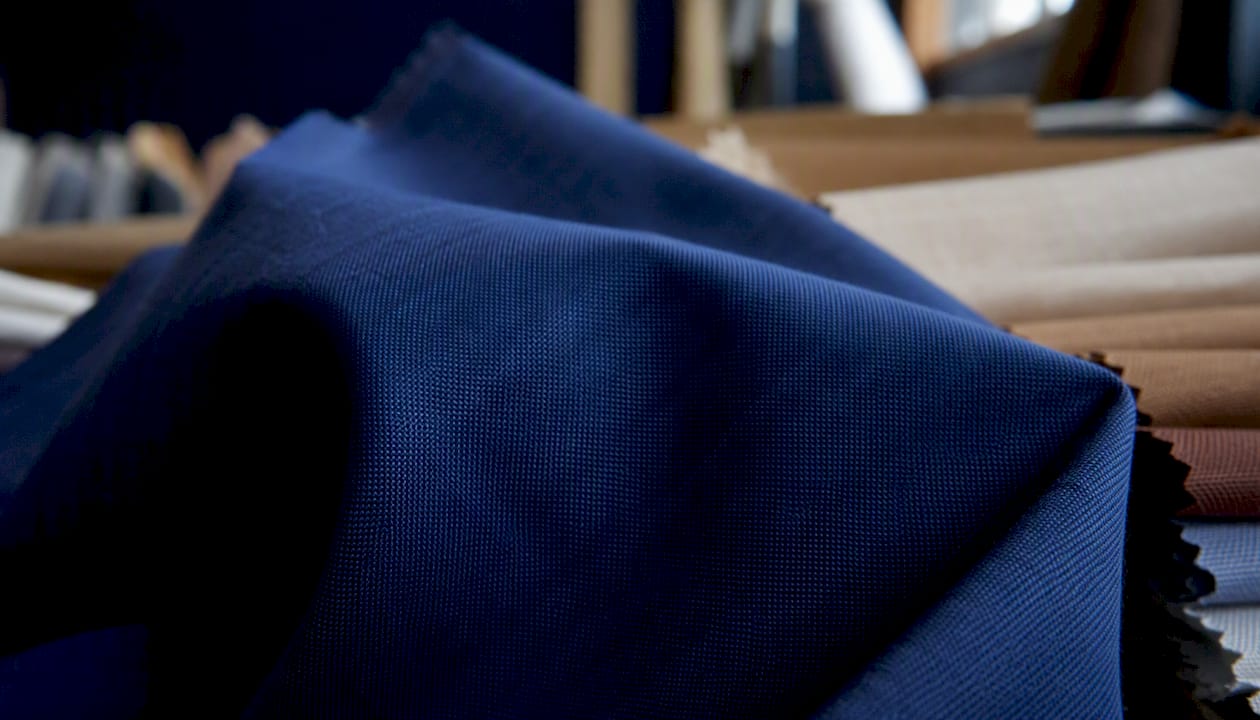
Weave matters as much as fiber content. Percale gives you a crisp, cool hand and holds up better to repeated bleaching than sateen, which looks luxurious out of the box but pills faster under commercial wash chemistry. Target 180–200 thread count in a percale construction for the best balance of comfort and wash life.
On every purchase order, require anti-pilling treatment, colorfast dyeing rated for high-temperature washing, and chlorine-peroxide tolerance. If a room type sees heavier soiling (spa properties, family suites), ask about hydrophobic or stain-blocking finishes as an add-on.
| Spec | Target Range | Why It Matters |
|---|---|---|
| Blend ratio | T/C 60/40 to 65/35 | Balances durability with comfort |
| Thread count | 180–200 (percale) | Wash survival without stiffness |
| GSM | 180–200 | Heavier for high-turnover programs |
| Wash-cycle rating | 75–100 cycles | Industry baseline for hospitality linens |
Pro Tip: Ask suppliers for a breaking-strength and tear-strength figure on the same data sheet as the wash-cycle rating. A high wash-cycle claim without a strength number is a red flag. Strength drops before color does.
Building a Hotel-Style Layered Bedding System
A guest bed that reads as luxurious after 200 laundry cycles isn’t an accident. It’s a spec sheet. The standard layered system includes a fitted sheet, top sheet, pillowcases, mattress protector, duvet cover with insert, and a decorative runner or throw as the visual accent. Each layer needs its own construction logic, not a single fabric choice stretched across every component.
Sizing tolerance deserves its own line item. A sheet that shrinks past that threshold stops fitting mid-contract, and you end up replacing an entire linen category early.
For duvets and inserts, fill selection determines whether the piece survives your laundry vendor or turns lumpy after a dozen cycles. Polyester fill with reinforced baffle stitching holds shape better than down-alternative loose fill in industrial machines. Tog values should match your market: lighter fills for warm-climate properties, higher tog for cooler regions or seasonal swaps.
Require these on every sample submission:
- Declared number of industrial washes before visible failure (aim for 75+).
- Colorfastness testing after hot-water and chlorine exposure.
- Pilling and abrasion ratings from a third-party lab, not just an internal claim.
For hotels sourcing across the region, ten guest-room textile upgrade ideas built for Balkan properties walks through sample bundles matched to different room tiers.
Curtains, Blackout Linings and Soft Furnishings That Survive Laundering
Fire retardancy is where a lot of procurement teams get caught off guard. There are two paths: inherently FR fiber, where the flame-retardant property is built into the polymer itself, or post-treatment FR, a chemical finish applied after weaving. Inherently FR fabric keeps its rating through 50 or more commercial laundering cycles, while post-treatment finishes often lose effectiveness after just 5 to 10 commercial washes. For any curtain you plan to launder regularly, specify inherently FR fiber and treat post-treatment FR as a budget compromise with a shorter service life.
Blackout linings need enough density to block light fully without adding excess weight to the heading and track. Sheers should carry reinforced hems since housekeeping handles them daily.
Specification checklist:
- Inherently FR fiber for curtains on any regular laundering schedule.
- Third-party test reports citing NFPA 701 or BS 5867, not just a supplier claim.
- Removable, zippered covers on cushions and throws so inner fill can be swapped without disposing of the whole piece.
Pro Tip: Treat decorative cushions as replaceable accents, not permanent fixtures. A zippered cover lets housekeeping rotate stained covers without pulling the whole cushion from inventory.
Hygiene Standards and Industrial Wash-Cycle Requirements
Guest-room textiles carry a measurable hygiene bar, and it isn’t a marketing phrase. DB32/T 3797-2024 sets the acceptance criteria at total bacteria counts of ≤10 CFU per square centimeter, with a negative result required for pathogenic bacteria. Ask any supplier for batch test reports that cite this exact standard, not a generic “sanitized” claim with no method attached.
10 CFU/cm² or fewer. That’s the total bacteria count threshold your linens need to clear on a RODAC plate test after laundering, per DB32/T 3797-2024. Anything higher signals a laundry process or fabric finish that isn’t holding up, which becomes a guest-complaint risk and a liability exposure long before it becomes a visible stain.
Testing methodology matters as much as the number itself. RODAC plate sampling presses a nutrient-agar surface directly against the textile, then counts colony growth after incubation. Require your supplier or laundry partner to report sample size per batch (a handful of plates per lot is standard) and to disclose pass/fail thresholds against the same criteria on every shipment, not just the initial sample run.
Industrial wash-cycle parameters should also appear on the spec sheet:
| Parameter | Recommended Range |
|---|---|
| Wash temperature | Hot cycle, per detergent chemistry used |
| Chlorine/peroxide use | Documented per fabric type and colorfastness rating |
| Minimum cycles before acceptance failure | 75–100 for hospital-grade linens |
| Hygiene test method | RODAC plate, per DB32/T 3797-2024 |
For heavy-laundry programs, require both a declared wash-life figure and a third-party test report verifying colorfastness and tensile strength after that declared count. A supplier who can’t produce both numbers on request is telling you something about how they test.
Choosing Colors, Patterns and Textures That Age Well
Palette choice is a maintenance decision disguised as a design decision. Mid-tone neutrals hide soiling and shadow far longer than bright white or dark charcoal, both of which show wear at opposite extremes: white reveals staining fast, and near-black fabrics reveal lint, dust, and fading unevenly.
Pattern scale matters just as much. Small, tight patterns and dobby or jacquard woven textures conceal minor wear and thread fraying better than large-scale prints, where a single pull or fade spot stands out against open background space.
For hand and durability, brushed percale and tightly woven dobby constructions outperform heavy sateen, which pills faster under repeated hot-water washing. Avoid delicate embellished finishes that can’t survive a commercial dryer cycle.
- Layer replaceable accents (throws, runners, cushions) instead of redesigning the full bedding system when a refresh is due.
- Match pattern scale to room turnover: higher-turnover budget and midscale properties benefit from tighter patterns that mask wear longer.
Gjergjihtextil’s guidance on textile trends shaping hospitality design covers current palette directions that still meet commercial wash requirements.
Pro Tip: If your brand identity calls for a bold accent color, put it on the throw or cushion cover, never the sheet set. Replacing a $15 cushion cover costs far less than replacing an entire linen category that’s faded out of brand spec.
Procurement Checklist, Sample Testing and a TCO Example
Run your evaluation in this order, and don’t skip steps to save a week on lead time:
- Confirm the supplier can produce written specs matching your target GSM, blend ratio, and wash-cycle rating.
- Request hygiene test reports citing DB32/T 3797-2024 and FR certification documents (NFPA 701 or BS 5867) where curtains are involved.
- Order a sample batch sized to your smallest room block, run it through your actual industrial laundry partner, and document any failure at each cycle interval.
- Confirm minimum order quantity, lead time, and warranty terms in writing before scaling to a full property order.
A simple total-cost-of-ownership comparison makes the case for spec discipline clearer than any brochure claim. Say Option A costs less per unit but is only rated for 40 industrial washes, while Option B costs more upfront but holds for 90 washes at the same laundry conditions. Over a three-year contract washing linens twice weekly, Option A needs replacing roughly twice as often. Once you divide total spend by occupied room-nights, the higher-rated fabric usually wins on cost per night, not just on guest experience.
| Factor | Lower-Rated Option | Higher-Rated Option |
|---|---|---|
| Unit price | Lower | Higher |
| Rated wash cycles | ~40 | ~90 |
| Replacement frequency (3-year contract) | More frequent | Less frequent |
Ask every supplier: Can you provide batch-level FR and hygiene test reports? What’s the guaranteed wash-life at your stated wash conditions? Will you supply a sample run before I commit to a bulk order? For a deeper look at fabric categories that hold up across multiple property types, see examples of long-lasting textiles for hospitality interiors.
Pro Tip: Never accept a wash-cycle claim without the wash conditions attached (temperature, detergent, chlorine use). “50 washes” means nothing if you don’t know what those washes looked like.
A Supplier’s View on 30 Years of Hotel Textile Contracts
Three decades of supplying hospitality textiles teaches you where procurement teams get burned: not on price, but on unverified claims. The most common pitfall is accepting a wash-cycle number with no test conditions attached, or skipping a sample run because a catalog photo looked convincing enough. Gjergji H Tekstil handles specification advisory, third-party lab coordination, sampling, and bulk fulfillment so hotel programs don’t have to chase test reports across multiple vendors. One habit worth borrowing from every large contract we’ve run: check color shade bands across production lots before a bulk shipment ships, not after it arrives at your property.
How Gjergji H Tekstil Supports Your Procurement Process
Gjergjihtextil is the alternative to sourcing linens through scattered importers and unverified overseas mills. Full supply-chain control from import through in-house manufacturing to distribution means one accountable partner for specification advisory, third-party test coordination, sampling, custom color runs, and bulk logistics, backed by more than 30 years supplying hospitality names including Meliá, Marriott, and Sheraton.
Every checklist item covered above, from wash-cycle ratings to hygiene batch reports, maps directly to how Gjergjihtextil runs its hotel supply program: sample testing and industrial-wash cycles as the acceptance criteria, not a marketing claim. Lead times and minimum order quantities scale with property size, and warranty terms are set per contract rather than a one-size template. If you’re ready to move from spec sheet to sample order, review Gjergjihtextil’s wholesale hotel textile program and request a batch sample against your exact wash-cycle and hygiene requirements.
Frequently Asked Questions
What thread count is best for hotel bed sheets?
A percale weave at 180 to 200 thread count in a cotton-polyester blend gives the best balance between guest comfort and industrial wash survival. Higher thread counts don’t automatically mean better durability once bleach and hot water enter the equation.
How many industrial wash cycles should hotel linens survive?
Aim for a minimum of 75 industrial wash cycles for standard guest-room bedding, with hospital-grade or high-turnover programs targeting closer to 100. Always request a test report that states the wash conditions, not just the cycle count.
What’s the difference between inherently FR and post-treatment FR curtains?
Inherently FR fiber has flame retardancy built into the fiber itself and holds that rating through 50 or more commercial washes. Post-treatment FR is a chemical coating that typically loses effectiveness after 5 to 10 washes, making it a weaker choice for curtains laundered on a regular schedule.
Why does the DB32/T 3797-2024 hygiene standard matter for procurement?
It sets a quantitative bacteria limit, total counts of 10 CFU per square centimeter or fewer, that a textile must clear after laundering. Citing this standard on your RFP gives you a testable acceptance criterion instead of relying on a supplier’s unverified cleanliness claim.
How do I calculate total cost of ownership for hotel bedding?
Divide the total spend on a linen category, including replacements, by the number of occupied room-nights served over the contract period. A higher-priced item rated for more wash cycles frequently costs less per room-night than a cheaper item that needs replacing twice as often.
Sources
Attach the DB32/T 3797-2024 test-method summary to your RFP and require RODAC plate batch reports from every finalist supplier.
- HCHOS standard (test-method summary) — TRSA